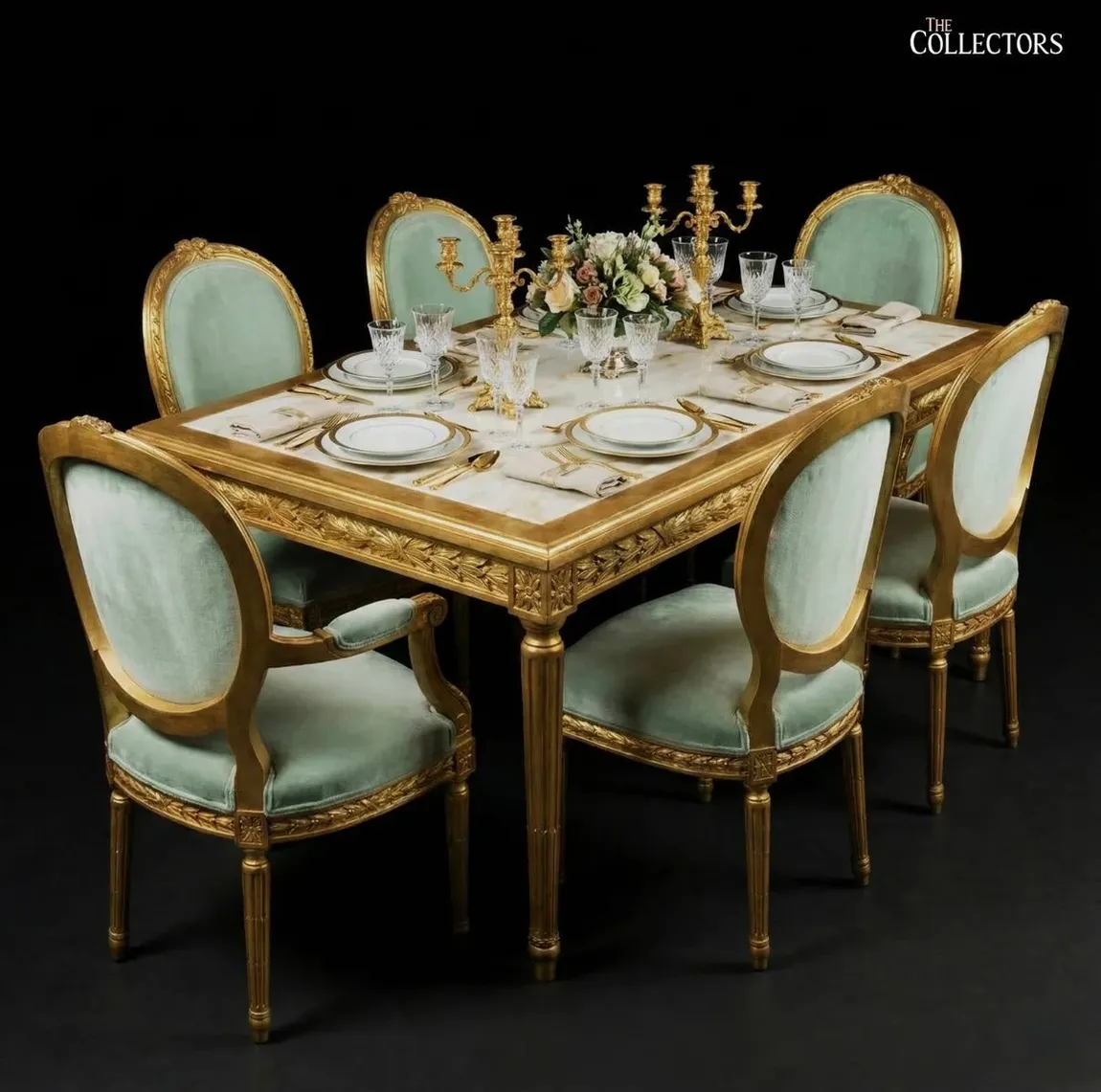
When everything turned out to be fake except the money
After the French Revolution, the Palace of Versailles was left bare. In the 1790s the furniture of Louis XVI and Marie Antoinette was sold off at auction, carted away, and in some cases burned for firewood. Since the 1950s the palace has been buying it back, chair by chair, chest of drawers by chest of drawers. And where there is an inventory that says "it was here" and an empty spot that says "it isn't", there will always be someone ready to fill that spot.
Two such people turned up.
The first was Bill Pallot, the world's leading expert on eighteenth-century French chairs. A former Sorbonne professor, he wrote the book "The Art of the Chair in Eighteenth-Century France". His father, an antiques dealer, went by the nickname Père Lachaise: a pun in which the French chaise ("chair") echoes the Père Lachaise cemetery.
Pallot knew the royal inventories by heart, which means he knew exactly which of Marie Antoinette's chairs had gone missing.
The second was Bruno Desnoues, a cabinetmaker from the Faubourg Saint-Antoine in Paris, where furniture makers have worked since the seventeenth century. He holds the official title of "best craftsman in France" and was a restorer for Versailles itself: he even made a copy of Louis XVI's bed.
Together they came up with a scheme: sell Versailles fake chairs. You remember, of course: Ilf and Petrov described this very business in detail as a side plotline of their famous novel.
They started back in 2008. For the base, Desnoues used genuine old eighteenth-century frames, so that wood analysis would confirm their age. Everything else was new: the carving, the gilding and the signatures of great masters such as Delanois, Jacob and Séné. Pallot, the chair expert, naturally issued the certificates of authenticity.
After that everything looked like a fairy tale. The famous Kraemer gallery, founded in 1875, bought a pair of "chairs from Marie Antoinette's pavilion" for 200,000 euros and resold them for two million to a Qatari prince from the Al Thani family. The French state even declared these chairs a national treasure: the Palace of Versailles itself wanted to buy them. But the price seemed steep, and they were sold to the prince after all.
The Hermès family, yes, that Hermès, bought an "armchair from the queen's study" at the Drouot auction house for 530,000. Sotheby's got involved.
And then came the apotheosis. Versailles itself bought half of the fakes, to the tune of more than a million and a half euros for just six chairs. (There were exactly 12 of them!)
The museum, where the leading experts on palace furniture work, was buying chairs from the man who lectured them on which chairs were genuine. And, incidentally, the very same Desnoues repaired them. The circle could have turned out to be a perpetual motion machine.
The two experts were caught not over the furniture but over the stupidity of their accomplices. In 2014 the French financial intelligence unit Tracfin noticed a Portuguese family outside Paris: a driver and a hairdresser, with salaries of about 2,500 euros a month, and more than a million in their accounts and real estate. The driver turned out to be simply Desnoues's nominee: he hid his cash and bought houses and apartments. The tax inspectors pulled on the thread and pulled out the whole chair.
The investigation nevertheless took nine years. Pallot and Desnoues confessed as early as their arrest in 2016. Pallot explained that it had all begun "for a laugh". In court he came out with a line worthy of a textbook: "I was the head, and Desnoues was the hands." The journalists' headline put it more precisely: "Everything was fake except the money."
In June 2025 the court handed down its verdict. Pallot received a four-year suspended sentence (he had already served four months before the trial), a fine of 200,000 euros and a five-year ban on working as an expert. Desnoues got three years suspended and a fine of 100,000.
Both were ordered to pay damages: 150,000 to Versailles, 420,000 to Sotheby's and 530,000 to the Hermès family.
The Kraemer gallery returned the two million to the Qatari prince. It was, by the way, acquitted: the court ruled that it had been deceived too. And civil liability was divided among Pallot, Desnoues and Versailles itself.
The immortal plot ended without any great tragedy: nobody was even stabbed to death.
But it was fun.