The Project 20380 corvette "Boikiy" is still burning, and the Russian expert community has already lined up with explanations. The thesis is uniform: "a ship like that without air defense cover is now a target."
The formulation sounds solid right up until someone checks the ship's equipment. On board there is a whole radar suite, a pair of 30-mm rapid-fire guns, twelve medium-range missiles and MANPADS on top. In other words, the corvette is itself a floating air defense system. Lamenting the absence of "air defense cover" for it is about as meaningful as mourning a shortage of water in the ocean. It did have cover, and its name was "Boikiy," and it is precisely this detail that dropped out of the experts' picture of the world.
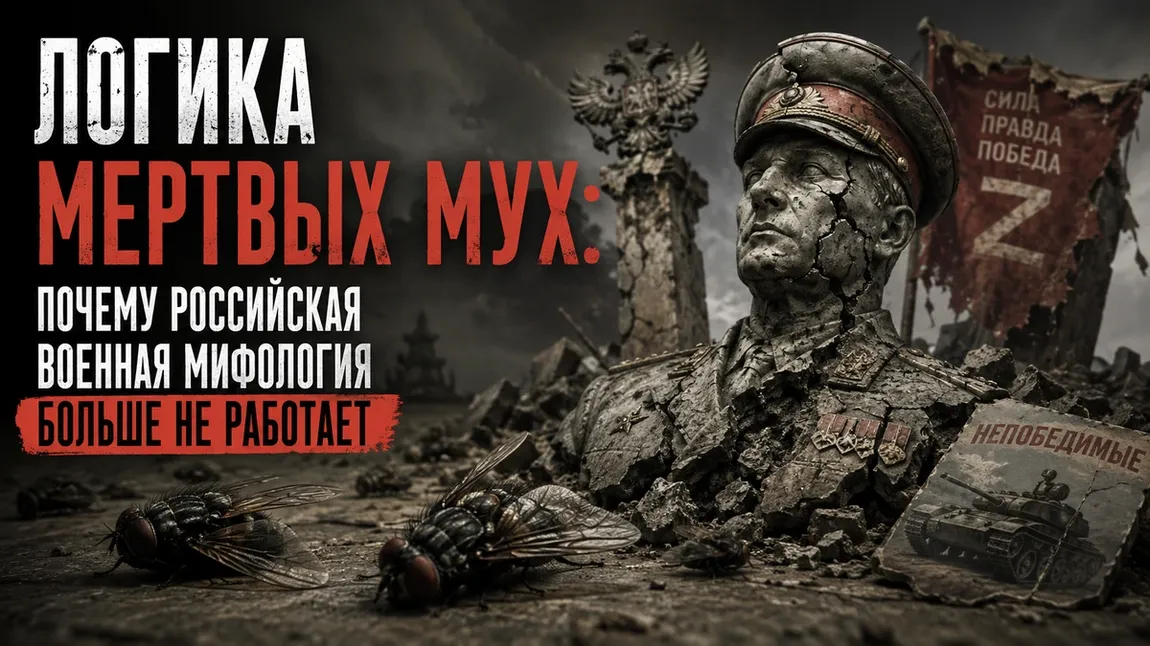
The pattern is not new. Russian military mythology has long dwelt in a reality where hardware exists independently of rhetoric, and the model exhibit of this collection is the "Oreshnik."
The other day Putin announced that "there has been no combat use of the Oreshnik yet." And here begins elementary-school physics. The test payload for checking accuracy is 36 dummies, each of which, by the most generous estimate, could hold a few dozen kilograms of explosive. In the original design, the multiple-warhead platform carried six nuclear warheads. Dummies arranged in bundles of six differ from real warheads in aerodynamics and in the way they are mounted so much that the informational value of such tests is comparable to experiments on dead flies. Placing 36 items heavier than a few dozen kilograms on a medium-range carrier is impossible in principle, and that is with the most charitable arithmetic. At the base lies a castrated "Topol" with a payload of about a ton to a ton and a half, which leaves some thirty grams per dummy. To improve their combat characteristics, all that remains is to smear them with a substance whose origin delicacy compels me to omit.
A separate irony is hidden in the geometry. In all recorded launches the bundles travel tightly next to each other. Yet separating nuclear warheads makes sense only when they scatter by at least several kilometers, not a hundred or two hundred meters. The urge to cram six nuclear charges into a circle with a radius of half a kilometer raises the only meaningful question: why was a multiple-warhead platform needed at all? Solely to make it more expensive?
But what made the speech about the "Oreshnik" truly revealing was not the physics but the footage. The recording was posted alongside other clips, and together they vividly demonstrated an inability to lie convincingly. On screen an elderly man in a kitchen explains to young people something he is not sure of himself: he stumbles, gets embarrassed, looks around expecting mockery. He knows perfectly well that the "Oreshnik" is a fiction, but he is organically incapable of lying with dignity. A more than respectable age, the self-esteem of an unrecognized genius, the inner makeup of an insecure teenager. For contrast: Trump is also infantile, but of a different kind; he lies virtuosically, or rather, cannot not lie. Hence the meeting in Anchorage turned out symbolic: one man, in total insecurity, retold tales about the Pechenegs with the same facial expression as about the "Oreshnik," while the other, on a realtor's reflexes, tried to push real estate on him, never making out who he was dealing with.
Against this background the nervousness of the Russian media space is natural. The other day the most sane of the insane, Marco Rubio, reported to Congress and in passing sketched out the White House's disposition. By his account, Washington has long since stopped being neutral and has chosen a side, the Russians "may never be able to achieve militarily the goals they demand at the negotiations," nobody is ready for concessions, work on new sanctions is under way, and Ukraine "has recently achieved successes on the battlefield and begun delivering increasingly painful long-range strikes." The last point is the key one. Defeat is always an orphan, while victory has fathers in abundance. A slow, mounting defeat was expected of Ukraine, and in the end Putin is talking about a "catastrophic shortage of personnel," and Crimea is sitting without fuel.
It is sitting without it so thoroughly that suddenly even the mobile air defense fire groups have no fuel. The Ukrainian Armed Forces, despite all their personnel shortages, have closed a vicious circle: drones destroy fuel deliveries to such a degree that air defense is left without fuel to intercept drones, which makes hunting fuel trucks an even easier and more entertaining pastime. The "catastrophe" has gone so far that in Crimea and in Donbas the shooting-up of truck parking lots has begun: air defense is suppressed, fuel trucks have been knocked out, and now random trucks can be attacked, thinning out the stock of logistics vehicles and turning the locations into places barely fit to live in. Some Russian war correspondents complain about strikes on reinforced-concrete shelters.
Against this backdrop, Deputy Prime Minister Novak was especially delightful, declaring that "there is no fuel shortage at Russian gas stations, gasoline is getting more expensive within the inflation rate." That is, Donbas and Crimea are definitely not Russia, firmly and clearly. Although, perhaps, Novak simply glanced into the future.
A potential offensive operation by the Ukrainian Armed Forces to cut off Crimea is looming. The Russians have a shortage of forces and are exhausted, air defense in the border territories and in Crimea itself is spread thin, and a systematic clearing of all logistics to the peninsula is under way. Ukraine is hard-pressed for offensive infantry, but it is already capable of isolating an area to a depth of hundreds of kilometers, after which any offensive becomes many times easier. The disposition increasingly resembles the summer of 2022.
Watching all this is the American animal kingdom, an infallible indicator of strength and weakness that reads the situation by instinct. The war goes on, and Ukraine lacks the resources to rout the Russians completely, but the moment is symptomatic: the scavengers have caught the scent of Russian blood.