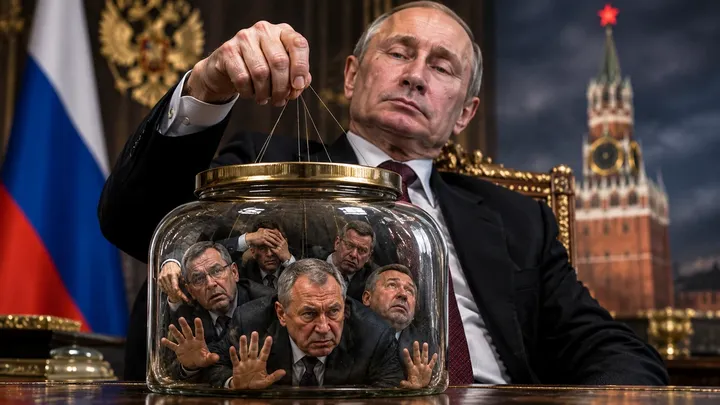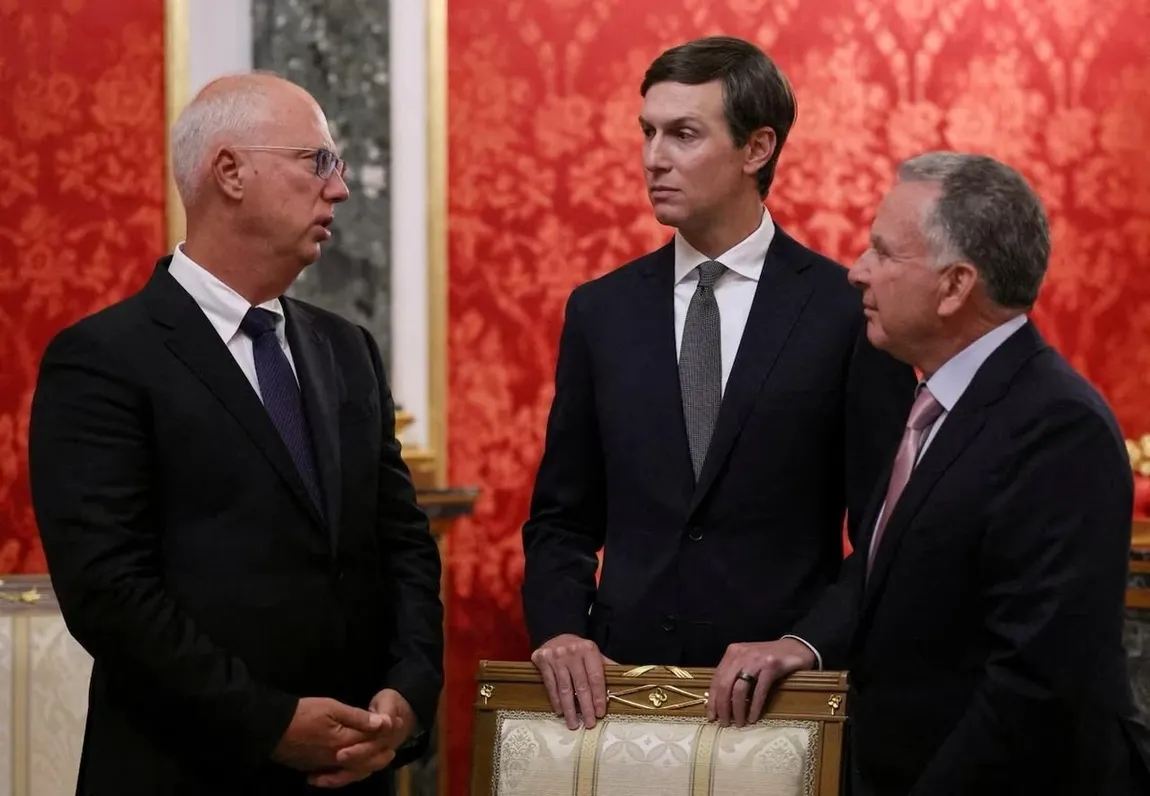
US special envoys Jared Kushner and Steve Witkoff propose resuming Russian gas transit through Ukraine and present it to Kyiv as a gift.
Their explanation is simple. Since 1 January 2025, when the contract with Gazprom expired, Ukraine has been losing about $1 billion a year in transit revenue, as The New York Times calculated. In other words, transit would bring the money back, and an American intermediary company would help get around European restrictions. Russia's revenue is promised to be frozen in an account in a third country so that it does not go to the war. American investors, as the WSJ frankly writes, would earn a good deal in the process.
But there is a question in this scheme that no one asks out loud: who needs this pipe more? In negotiations the stronger side is not the one selling the service but the one who can do without it. And the numbers show that empty Ukrainian pipes are a trifle compared with what is happening on the other side of the border.
Fields built for a single buyer
Imagine a field that was built for one buyer. Bovanenkovo on Yamal is the largest on the peninsula, with a design capacity of 115 billion cubic meters of gas a year. To feed Yamal gas into the unified system, Gazprom specially built a new corridor, Bovanenkovo - Ukhta. From there the gas went west, to Europe. For decades, Arctic wells, compressor stations and trunk lines were built for one market. In 2018-2019 Europe bought 170-180 billion cubic meters a year from Gazprom.
Now all that is left of this market is TurkStream. Its European branch physically cannot carry more than 16 billion cubic meters a year. In 2025, Russian pipeline gas exports to Europe fell by 44% to the level of the mid-1970s, Reuters calculated. In the first half of 2026, Russia sold Europe an average of 1.65 billion cubic meters a month. The market for which an entire Arctic industry was built has shrunk roughly tenfold.
What is to be done with gas that is produced for a volume that no longer exists? Gas is not oil: you cannot pour it into a tanker and wait for better times. There are two options: shut in the wells or burn the gas. Gazprom does both.
Shut-in wells and a flare at the Finnish border
First, the wells. In 2021 the Gazprom group produced more than 510 billion cubic meters, and in 2025, according to the company's own report, only 405.4 billion. That is, about a fifth of production has disappeared. In total, Russia produced 663 billion cubic meters in 2025, 3.2% less than a year earlier. But idling in the Arctic does not cost the same as an idle pipe. Analysts at the Oxford Institute for Energy Studies write that Gazprom's largest spare capacities are precisely at the Bovanenkovo and Urengoy fields. After a short shutdown in 2015-2016, the wells were successfully restarted. However, the analysts warn, a long pause may do damage, and no one knows what a multi-year mothballing would cost.
Now, the fire. In the summer of 2022, Finns noticed a huge flare over the border. The Portovaya compressor station at the start of Nord Stream was burning, by Rystad Energy's estimate, about 4.34 million cubic meters of gas a day, that is, roughly $10 million every day. Germany's then ambassador to the UK, Miguel Berger, explained this on the BBC without diplomatic embellishment: Russia has no one left to sell this gas to, so it burns it.
Since then there has only been more fire. According to the World Bank, Russia remains the world leader in gas flaring. It accounts for 18% of global flared volume, and in 2025 it burned 9% more than a year earlier. In cubic meters, that is about 30 billion a year, almost twice what TurkStream is able to deliver to Europe. Of course, most of this fire is associated gas from oil fields, not from Gazprom's wells. But the reason is the same: there is neither a pipe nor a buyer for this gas, so it is cheaper for Russia to burn it than to bring it to market.
The arithmetic of losses
Now the main thing: money. In 2023, Gazprom posted a net loss under international standards for the first time since 1999: 629 billion rubles, or about $6.8 billion. In 2024, the loss under Russian standards reached almost $12.9 billion. In 2025 the group again showed a profit, but revenue fell by 8.8%, and the profit appeared thanks to a strong ruble, which reduced the value of its foreign-currency debt, Reuters writes. That is, the profit came from a revaluation of debt, not from selling gas.
The most honest figure comes from Gazprom itself. The company estimated that because of lost exports it will fail to receive 15 trillion rubles in 2025-2034. At the current exchange rate that is about $190 billion, or roughly $19 billion a year. So, without transit Ukraine loses $1 billion a year, while Gazprom, by its own calculations, loses about $19 billion. The difference is almost twentyfold. That is the answer to the question of who has the problem.
And the worst for Moscow is still ahead. In 2025 Europe was still buying Russian gas: it made up about 13% of EU imports, more than €15 billion a year. But the regulation adopted in January 2026 bans imports of Russian liquefied gas from 1 January 2027, and of pipeline gas from 30 September 2027. Before letting gas through, EU countries will check where it was produced. So Russia will soon lose these €15 billion as well.
China, on which Moscow pinned all its hopes, behaves exactly as a buyer who knows the seller has no way out. The memorandum on Power of Siberia 2, which was supposed to turn Yamal gas from Europe toward China, was signed in September 2025. But even after Putin's visit to Beijing in May 2026, the terms and the construction start date were not agreed. In September the South China Morning Post reported that the talks had stalled over price. Finam analyst Sergey Kaufman estimates that the project would pay off at a price of $250-300 per thousand cubic meters, while Beijing wants it cheaper than what it pays for the first Power of Siberia. China understands that Russia has nowhere to go, and dictates the price.
Who will actually profit
Now let us look at who profits in the Kushner-Witkoff scheme. Moscow gains the most: it gets back at least part of the European market from which European law is squeezing it out. The "frozen" money in a third-country account is still its money, just a deferred payment. Its fate will be decided at peace talks, where unfreezing will become one more bargaining chip.
The American intermediary will also earn well, and the news says so directly. Some Ukrainian and European officials suppose that Washington may claim a share of the profits from Russian gas through the participation of American companies. Earlier, Reuters wrote about contacts between American and Russian representatives concerning the participation of American investors in the Nord Streams. This is no longer a single deal but a system: American capital wants to become the intermediary between Russian gas and the European consumer on all routes at once.
The timing is no accident. The US attack on Iran in February 2026 and the blockade of the Strait of Hormuz sharply raised gas prices. Europe is under price pressure, and right now Russian gas "via an American company" can be sold as a rescue.
Ukraine, meanwhile, will get the transit fee and all the risks. There will be a clash with the EU, where the regulation checks the origin of gas and an American signboard does not change that origin. There will be resistance from Germany, which, according to the NYT, was the most firmly opposed. And there will be a valve in someone else's hands, the very one with which Moscow blackmailed Kyiv in the gas wars of 2006 and 2009. The profit goes to the intermediary, while the risks are borne by the country through which the pipe runs.
Whose problem it is
So the American proposal turns everything upside down: Russia's problem is presented as an opportunity for Ukraine. In fact, the petitioner in this deal is Moscow. It is Moscow that produces gas for a European volume that no longer exists. It is Moscow's wells that stand idle and its flares that burn. By its own estimate, it loses about $19 billion a year, and from the autumn of 2027 it will lose even more. The empty Ukrainian pipe costs Ukraine $1 billion.
If transit is ever discussed, the price must take this twentyfold difference into account. That means not a transit fee but conditions: who controls the account with the Russian revenue, where this money goes, whether the deal is tied to the end of the war, and whether Brussels agrees to it. Without that, Ukraine would give up its strongest lever for $1 billion, and the margin on Russia's misfortune would be pocketed by others.
References:medium.comx.comcheslavsky.substack.com