This summer, Vladimir Putin personally sanctioned the arrest of Ilya Traber, a respected St. Petersburg businessman nicknamed the Antiquarian, an old friend and partner of the billionaire Arkady Rotenberg.
In the autumn, the same Putin personally ordered Traber released and the case closed. Only a few weeks separated the two decisions, and he took both with his own hand, without suspecting for a second that both the imprisonment and the release had been suggested to him by the same people pulling the same strings. He never used to do this. Putin could be slow, could stall, could keep the guilty dangling for years, but to reverse his own loud verdict like that, in front of everyone, and to admit that he himself had erred in ordering the arrest, is something new. And it is the most interesting thing to have happened at the top of Russian power lately. More interesting than any arrest. Because the arrest of an influential man is, after all, the everyday business of the system. But when an all-powerful ruler turns a hundred and eighty degrees twice in two months and both times is sure he is acting of his own free will, it means that he is still the one pressing the button, but someone else is now placing his hand on it. And the most fascinating part of this story is to find out who exactly.
Let's take it step by step, because the plot is so tangled that it is easy to lose the thread.
Let's start with why Traber's arrest became possible at all, and for that we have to understand what pit his patron Arkady Rotenberg had fallen into by then. He is, let me remind you, no ordinary rich man but one of the most system-forming figures of Putin's Russia: the president's childhood friend, his judo partner, a man through whose companies gigantic state contracts flowed for decades, from Gazprom construction projects to the Crimean Bridge. Such people are untouchable by definition, because a blow at them is a blow at Putin himself, who raised them up. But in the last year or year and a half everything has fallen apart for Rotenberg. Debts piled up, the flow of budget money he was used to feeding on dried up, and from above came a muffled but distinct displeasure. When a childhood friend stops being useful and starts causing problems, untouchability melts away, and right away there are people eager to gnaw at the weakened one.
Those eager people turned out to be the FSB's Economic Security Service, the Fourth Service, or SEB, the most lucrative and predatory unit of Russian state security, headed by the then all-powerful Sergei Alpatov. It was SEB that set about taking Rotenberg's empire apart piece by piece. First came the arrests of top managers, who went behind bars one after another. Among them was Konstantin Makhov, who managed the assets that Alexei Miller's gas monopoly had at one time "gifted" to the oligarch brothers; he was taken in a case of embezzlement during the construction of a runway at Moscow's Domodedovo airport. Then it was the turn of the innermost circle: Ilya Traber, the very Antiquarian, a figure from the St. Petersburg of the nineties, whom people in polite society try not to recall, went to the pre-trial detention center. Traber was charged with organizing the murder of the "master of Vyborg" Alexander Petrov, and charges for other bloody episodes were in preparation. And all this, of course, was not done on anyone's own initiative but with Putin's direct sanction. Nobody in Russia goes after people of this caliber without a nod from the very top.
And then came a hundred-and-eighty-degree turn. Literally overnight.
The hostage method: how Russia is governed through pre-trial detention
To understand what happened here at all, we first have to explain the laws this system lives by. Because the arrests of Makhov and Traber are not a fight against crime, nor even a fight against corruption. They are a management technology. And it works like this.
Take any major Russian official: a minister, a deputy prime minister, a governor. In all likelihood, someone from his innermost circle is sitting in pre-trial detention right now or is under investigation. Not a distant subordinate, not a casual acquaintance, but precisely a close one: a deputy, a family friend, a business partner, sometimes a relative. Meanwhile the official himself stays in his post, goes to meetings, reports, smiles for the camera. Mishustin, Kiriyenko, Manturov: the list can go on endlessly, and a governor without a jailed deputy or an arrested businessman friend is hard to find.
The point of the construction is that the official now works neither out of fear nor out of conscience but for the sake of a living person. If Putin is dissatisfied with the results, if it turns out that the successes are "inflated," someone from the inner circle immediately goes to a cell. After that, atone for your guilt, prove your loyalty, do the impossible, impress, fawn. Want to get your friend out? Show results. A classic example is Kuban governor Kondratyev: half of his entourage was jailed, his godfather to his child spent time in pre-trial detention, his own home was searched, and right after that came promises that all the beaches would reopen and the harvest would be unprecedented. Do it however you like, even with half the sea covered in oil. This instills in the top precisely the feeling on which the whole vertical rests: a constant fear that does not let go for a second.
The benchmark of this fear is Sergei Shoigu. Putin will never jail him, but punishes him almost daily. He did not win the war, and his whole entourage went to pre-trial detention. Imagine standing at the Victory Day parade, smiling, knowing that the man next to you has sent behind bars absolutely everyone you worked with for decades, whose families were friends with yours, with whom you celebrated holidays. If you stop smiling, your oldest, most devoted friend Ruslan Tsalikov, whom Shoigu literally begged to have moved to house arrest, will move back to a cell. Shoigu's family is not being touched yet: that is the very red line that Putin has not yet crossed. But everyone else gets goosebumps from such a spectacle, and that is exactly the effect that is needed.
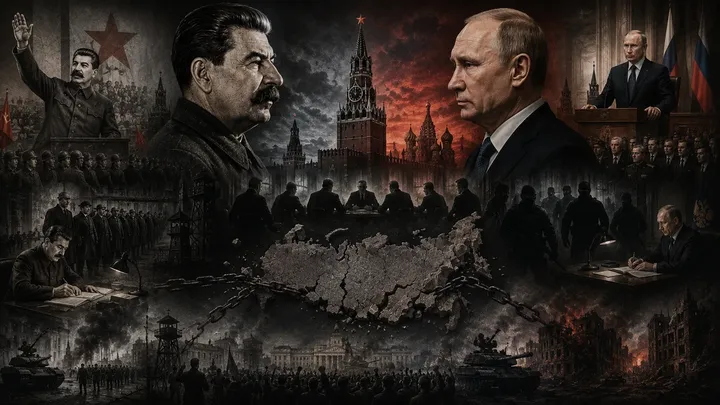
Someone will say: this is just the usual war among the siloviki, Putin simply doesn't want to make personnel decisions under pressure, and later he will send the offender into retirement. But "later" almost never comes. This is neither weakness nor chaos. It is a strategy, and everything happens strictly on his personal signal. There is, by the way, nothing new in it: Comrade Stalin worked in exactly the same way.
Keep this mechanism in mind. Because it is against its background that the whole story of Rotenberg, Traber and Alpatov's fall takes place.
The turn: Putin overrules Putin
So, in the summer the system worked as usual. Rotenberg's empire was methodically dismantled, his people were jailed, Traber sat in pre-trial detention. And then the position of the first man turned a hundred and eighty degrees, and not gradually but all at once.
The starting signal was the Eastern Economic Forum. There Arkady Rotenberg came out into the light demonstratively for the first time in many years. Previously, at the EEF he at most "showed up" at the judo tournaments that he himself organized; he did not take part in plenary sessions and did not appear before cameras, since he did not consider it necessary. But this time he suddenly sat in the front rows, next to Gazprom head Alexei Miller, during Putin's speech. That is, next to the head of the very gas monopoly that was one of the biggest sources of money for the Rotenbergs' companies and "shared" a number of assets with them. The oligarch's PR people immediately began spreading exclusive photos with captions through the channels: look, he is no longer in disgrace.
And almost right after the forum, the releases followed. The first signal was Konstantin Makhov, the very Rotenberg top manager who sat in pre-trial detention in the Domodedovo case. The Moscow City Court changed his measure of restraint to house arrest. In itself, softening the measure for one prisoner is a trifle that at another time nobody would even remember. But by the rules of this system, where a jailed close person is a form of punishment for his patron, release works exactly the opposite way: if the hostage is let go, it means that his patron, in this case Rotenberg, has been given to understand that he is on the way to forgiveness. Next, Ilya Traber walked free, and the case of Petrov's murder was dropped entirely, the charges lifted, and it was done by Putin's personal decision, the same Putin who had personally approved the arrest earlier. It is symbolic that the Antiquarian's forgiveness fell exactly on the eve of the feast of the Dormition of the Most Holy Theotokos, a day of forgiveness and reconciliation.
After Traber, his whole fighting infrastructure came tumbling out. His "right hand," the repeatedly convicted crime boss Vladimir Danilenko, walked free, and the criminal prosecution was dropped. And yet only a few days ago a unique document surfaced: how this same Danilenko paid the crime boss Abakar Darbishev the second part of a fee of a million dollars for eliminating Petrov, with the sum formalized as a loan agreement, interest-free, with a repayment date as far off as 2046, in order to legalize it and invest it in the business of Yuri Iliadi, Traber's buddy, who at one time helped the Antiquarian obtain a Greek passport. The decision to remove Petrov ripened for Traber at the height of the pandemic, and the faithful Danilenko then rushed to Moscow to Darbishev in a minibus. The enforcer Alisultan Nadirbegov was also released, the very man who organized the surveillance of Petrov, brought the hitman to St. Petersburg and generally ran the whole operation. Nadirbegov's biography is telling: he used to be in charge of muscle operations for the thief-in-law Vyacheslav Ivankov, nicknamed Yaponchik, and when a sniper shot Ivankov, he moved to Darbishev's gang. Petrov, by the way, was also killed by a sniper. A signature style.
All these people, the organizers and perpetrators of a contract killing, ended up free with a single motion. Because the question being decided was not about them but of a completely different level.
Who really pulled the string
And now the most important thing. What made Putin turn around?
The turn happened after a thorough conversation between the first man and one of the members of the so-called clan of bodyguards, supposedly Alexei Dyumin. What they talked about only the two of them know. But from the way events developed, the picture is not hard to reconstruct.
Putin was told that a conspiracy was being prepared against him. And that Traber's arrest and the attack on Rotenberg were part of that conspiracy. The logic here was subtle and therefore convincing. The point is that Traber, Rotenberg and this whole St. Petersburg circle of the nineties in general come from the same milieu as Putin himself, and their roots are shared, all the way down to old unsolved murders such as the shooting of Pavel Kapysh, director general of the Baltic Financial and Industrial Group, in 1999. Dig seriously into any of these cases and the investigation will inevitably stretch toward the very top of today, because in that Petersburg everyone was connected with everyone else. Which means that every move in the Antiquarian's case or the Rotenberg team's case ricochets off the reputation of the president himself: as soon as investigators take up an episode, Putin's name immediately surfaces nearby. Wherever you poke, the first man's ears stick out. And the most experienced Alpatov, they said, let himself be misled and, without wishing it, misled the president. What exactly the informant used to back up his words is unknown. But the reaction was instant. Traber and Rotenberg's key people walked free, and Alpatov was removed in a single day. The all-powerful head of SEB, one of the leaders of the rating of the siloviki, was sent on a leave from which he will not return to the FSB. His protégés are also under threat: the head of the FSB's Directorate T, Nikolai Babakov, appointed only recently, the very directorate that handled the embezzlement case over the Domodedovo runway construction, in which Makhov was arrested. The head of the St. Petersburg FSB directorate, Sergei Demyanishnikov. And a whole number of other top managers appointed under Alpatov. A full list of dismissals is promised by October, when a big shake-up is expected in the FSB generally.
Here lies the main news. This is not the first time the clan of bodyguards has pulled this trick on Putin. In the spring a trial balloon was launched: representatives of the clan reported to the president about an assassination attempt being prepared against him (remember all those mythical gunmen and machine gunners on the Kremlin walls and on the Mausoleum?) and brilliantly "prevented" a nonexistent threat. That was when the clan understood what its real strength was. The Traber story became the second attempt, a more serious one: not just to impress, but to rescue one of their own and at the same time clear inconvenient siloviki off the board.
So the mechanism is this. There is a group of people who control what the top man sees and hears. This group has learned to steer decisions by steering his picture of the world. It doesn't talk him out of anything or intrigue openly; it slips him the reality it needs: there is a plot against you, you have been lied to, your loyal Alpatov has set you up. Putin believes it and turns around. Once over a made-up assassination attempt. A second time over a made-up conspiracy. And he reverses his own decrees: first the July decree dismissing Sergei Bochkarev from the Prosecutor General's Office, the leading specialist in seizing assets for the state, and now the arrest of Traber. No such changeability was ever observed in him before. Now it is. And it is extremely interesting which center of influence is working these miracles.
The guards' clan: a new era
The answer to the question "which center" is the denouement of the whole story.
For many years, the reshuffles in the security bloc, the ministries and the state corporations were driven by familiar names: members of the Ozero dacha cooperative, shareholders of Bank Rossiya. The St. Petersburg circle, the old guard, people with assets and with a history. Well, that era is ending. It is being replaced by the clan of guards, and the change has been coming for a long time, stubbornly, step by step.
The core of the clan is made up of people with the same line in their biography. State Council Secretary Alexei Dyumin is a former Putin bodyguard. Presidential aide Dmitry Mironov is a former Putin bodyguard. Deputy head of Rosimushchestvo Dmitry Stepanenko is a former Putin bodyguard. The head of the Federal Protective Service is Dmitry Konchev. These are people with no Ozero behind them, no Bank Rossiya, no oil fortunes of the nineties. But they have what no one else has: physical proximity to the body. For years they stood at the door, drove, guarded, were there in the minutes when no one else was. And now it turns out that proximity to the body converts into proximity to the ear. And whoever owns the ear owns the decisions.
The clan has already firmly entered all of Arkady Rotenberg's assets, and its people have strong influence over Sber head Herman Gref. Right now the clan is squeezing assets out of Anatoly Yablonsky, the keeper of the capital of FSB deputy director Yevgeny Lovyrev. This group has always had political ambitions; it simply used to lack the courage to put them forward.
Now it has the courage. And the operation to rescue Rotenberg was not about rescuing Rotenberg at all. Or rather, not only about him. Yes, the clan's interests largely coincide with the oligarch's financial interests, and yes, Traber was helped to get out. But in reality it was a demonstration. The clan was showing Putin and the rest of the top tier what it is capable of. We can convince the top man of anything. We can jail and we can release. We can take down the all-powerful head of the SEB in a single day. Watch and remember.
Rotenberg himself has no illusions. Yes, the attack was repelled. But he will not get his former positions back. He has gone from master to pawn in someone else's big game and fallen into complete dependence on the clan. The guards have long had their eye on a number of his assets, including those he owns jointly with Traber, in particular the PNT oil terminal in St. Petersburg. He will clearly have to part with them. That is the whole price of the rescue: you are pulled out of the pit so that you can be fleeced not on the run but calmly, in a proprietorial way. Here, rescue is a form of takeover.
What the war has to do with it
And now for the main question. Why is all this happening right now? Why does the top man jail and release over a single episode, cancel his own decrees, while a predatory clan that did not exist before forms around him?
Because the food has run out.
For twenty-five years this system lived on a growing pie. Oil, gas, budget contracts, the leftovers of privatization, access to export flows: all of that was enough for everyone admitted to the table. One could divide, one could negotiate, one could keep a rival in limbo for years without killing him. The pie was growing, so there was room. And the mechanics of the hostage worked gently: a close associate was jailed, the official mended his ways, got him out, everyone was happy, everyone had a job.
The war stopped the pie from growing. The budget is empty, there is no funding, exports are under sanctions, and spending on the front eats everything it can reach. According to people on the inside, Putin is dissatisfied with everything and everyone, because there is nothing left to please him with. The successes are "inflated," the war has not been won, the money is gone. And the arrests, which used to come as needed, now come literally every day, interspersed with nationalizations. A system that cannot grow begins to eat itself. It has nothing left to divide, so they divide each other.
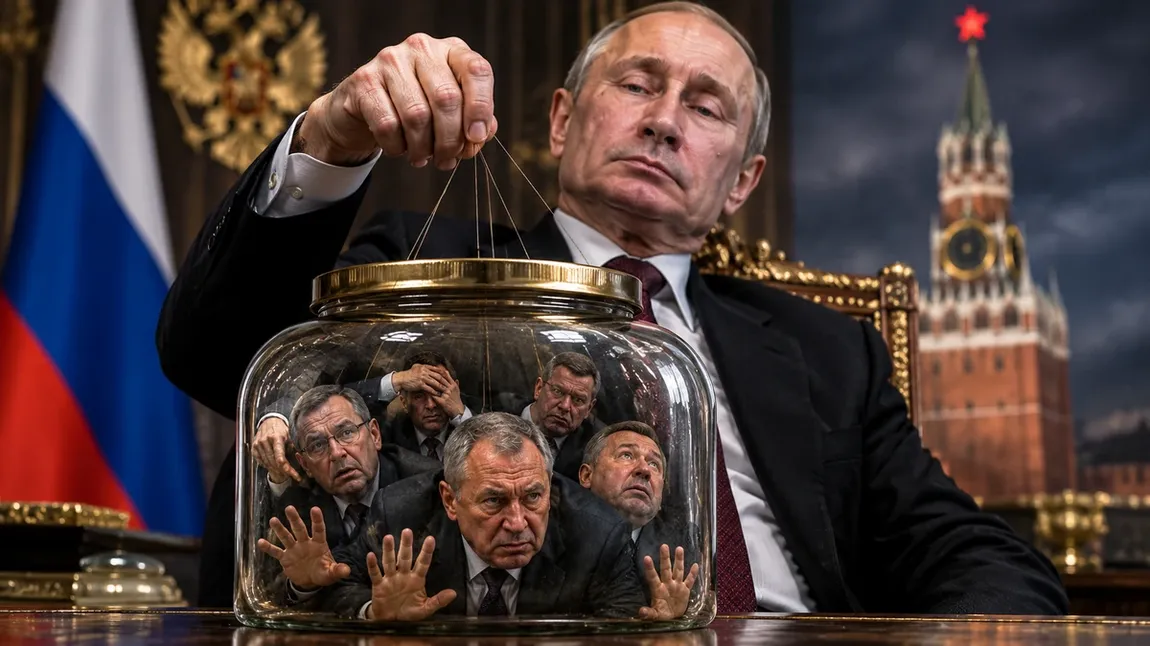
This is the jar of spiders. While food was being poured into the jar, the spiders sat in their corners, eyed one another, occasionally fought over territory, but on the whole got along. Once the food ran out, each spider became the only available lunch for its neighbor. The siloviki devour the oligarchs: the SEB takes Rotenberg apart. The clans devour the siloviki: the guards take down the SEB. And even the "rescued" are not saved but merely put off till later, like Rotenberg with his PNT terminal. In a jar where the food has run out there are no allies, only those who haven't been eaten yet, and the queue.
And the war in this construction is not just a backdrop. It is the hand that closed the jar with a lid and stopped throwing food in. It is what zeroed out the old model in which there was enough for everyone and pushed up a new tier: those who have no assets but have access to the body. In the well-fed years the guards would have remained guards. Hunger made them a clan. Because when there is nothing left to divide, the decisive asset is not a factory or an oil field but control over what the leader sees and hears. Whoever feeds him his picture of the world is the master of the jar.
And here the whole story comes full circle. Vladimir Putin, who spent a quarter of a century building a system of total personal control, a system in which no one dares act without his nod, has himself become its hostage. He still presses the buttons. He jails and releases, appoints and dismisses, his signature still decides everything. But what exactly he signs is no longer determined by him but by those who dose the reality that reaches him. He jailed Traber because the situation was shown to him in one way. He released Traber because it was shown to him in another. In both cases the hand was his. The head was no longer. And this is perhaps the most accurate picture of what the war has turned the Russian government into: a leader who is still all-powerful but no longer knows whose will his own hand is carrying out.
References:x.commedium.comcheslavsky.substack.com