In Kyiv's Teremky district there is what can be called, in short, a war for the forest. Since July 30, local residents have been protesting the felling of the forest park strip, hugging trees, and it has even come to clashes with the police. Officially, specialists have determined that 662 trees in the work zone are to be removed, of which only 56 can be replanted, along with 70 bushes, of which 16 will be replanted. Among the doomed are oaks more than a hundred years old.
The official version sounds flawless. The client for the works is the municipal enterprise Kyivteploenergo, which is acting within its own investment program and the capital's Energy Resilience Plan. The project envisages building an underground link between the Teremky district boiler house and heating main No. 4 of CHP-5, to create a backup heat supply scheme for the Teremky-1, 2 and 3 residential areas in case of accidents or enemy shelling of energy infrastructure. The KCSA stresses that Kyivteploenergo has all the permits, and the police confirm that the preparatory work is lawful. The district administration calls the route through the forest strip optimal, since laying pipes under the roadway of Teremkivska Street would cause a lengthy traffic collapse.
The argument would look convincing were it not for one circumstance that activists discovered. According to the tender specification, the route was supposed to run precisely along Teremkivska Street, as the master plan requires. The first design tender was announced back in 2020, but the contract was not signed then because the technical requirements changed. The agreement was finally concluded in 2023, and the document clearly stated that the utilities would be built under Teremkivska Street. And then, according to activists of the "Holka" movement, once the government's carte blanche had been received, the project was quietly redrawn onto the forest strip.
Human rights defender Oleksandra Matviichuk formulated the questions the authorities have not yet answered: why a project developed back in 2023 began to be implemented only in 2026, what the authorities were doing all those years, and why the problem is being solved in the height of summer. And, above all, why the original plan was abandoned precisely in favor of the park.
There is also a purely technical detail that makes the promises to restore everything worthless. State building codes prohibit planting trees in the heating network zone. That means that in place of the felled hundred-year-old oaks there will never be a new forest.
Now to why the pipe went exactly there. Civic activists suggest looking at the diagram, and it explains more than any press release.
From the Teremky district boiler house a red line leads through the forest park, whereas under the project the green line was supposed to run under Teremkivska Street, turning onto the Ring Road. And had the pipe followed the designed route, the plots that are only beginning to be built up within the boundaries of the Respublika residential complex in Teremky-3 would have been left unconnected. Moreover, the pipe leads to the almost completed but not yet heat-connected Senat residential complex of the GEOS group. And further on, activists claim, it will go to new buildings of other developers.
The logic here is simple and as old as Kyiv construction. For the utility workers, abstract Kyivans and their needs are of no interest; the forest is cut down because there is an order. Developers decided to save money and are felling the forest with the hands of a municipal enterprise.
It is important here to record the position of the other side. KAN Development, whose project the Respublika residential complex is, published an official statement at the request of "StopKor" stressing that it has nothing whatsoever to do with either the felling of trees or the construction of the heating main. The developer states that it is neither the client, nor the designer, nor the contractor of the works, did not choose or approve the route, and is carrying out no work on this site.
At the same time, according to open-source data cited by the media, the project involves companies linked to businessmen Dmytro Firtash, Serhiy Levochkin, Stepan Chernovetskyi and developer Ihor Nikonov. According to civic figures, the landowners and clients of the construction of the Respublika residential complex in Teremky-3 are LLC "Megapolishilstroi", which is linked to Firtash and Levochkin, and LLC "Teremky-Bud", behind which, according to the same data, stands Stepan Chernovetskyi. The contractor is said to be LLC "Kanbud", linked to Ihor Nikonov.
And now the most interesting part: who exactly will get the money for this pipe.
The contractor for the construction of the heating main is LLC "ISK Atmosfera Menedzhment". The contract runs until March 31, 2027, and its very text is classified. The sum is about 540 million hryvnias.
The portrait of the company drawn up by civic figure Oleksandr Rak deserves to be quoted in textbooks. Authorized capital: 30 thousand hryvnias. Three employees. Earnings over the past year: one and a half million hryvnias. The largest tender in the company's history was two million hryvnias in 2019, and its highest annual income was eight million in 2024. A month before the tender the company changed its beneficiaries and manager, and recently it was re-registered from Kyiv to Kharkiv.
The current sole beneficiary is listed as Oleksandr Chykal. The combined income of all his businesses for 2025 was 141 million hryvnias, that is, almost four times less than the cost of the procurement itself.
Rak's conclusion is unambiguous: this is a shell company that could not even approximately perform the volume of work envisaged by the contract, which means all the funds will go to subcontractors.
The question of exactly whom has its own answer too, and it is built on registry links. According to civic figures, the company is in fact controlled by the scandalous developer Viktor Besaha of the "SERVIT" group. The chain is as follows: the official owner of "Atmosfera Menedzhment", Oleksandr Chykal, heads the charity foundation "Sikurs", whose founder is Volodymyr Besaha, Viktor's brother. The same Chykal owns LLC "Teploprimbud", which is headed by Oleh Yelfimov, and Yelfimov is at the same time director of LLC "VKTs SERVIT", owned by Viktor and Volodymyr Besaha. The circle closes.
The figure of Besaha himself is nothing new in Kyiv construction. He is called a partner of Oleksandr Spasybko, Klitschko's former deputy for land issues, who is now behind bars. He is credited with the destruction of a monument on Koniskoho Street, the scandal around the "Turgenev" residential complex, and the construction, for 15 million hryvnias, of wooden steps from Peizazhna Alley to Vozdvyzhenka. Through intermediaries, according to the same data, he controls LLC "Demeivka-Invest", which owns the firm "Valdi-Holding", that is, the market in Troieshchyna, and a co-owner there is JSC "Gelior" of the same Spasybko.
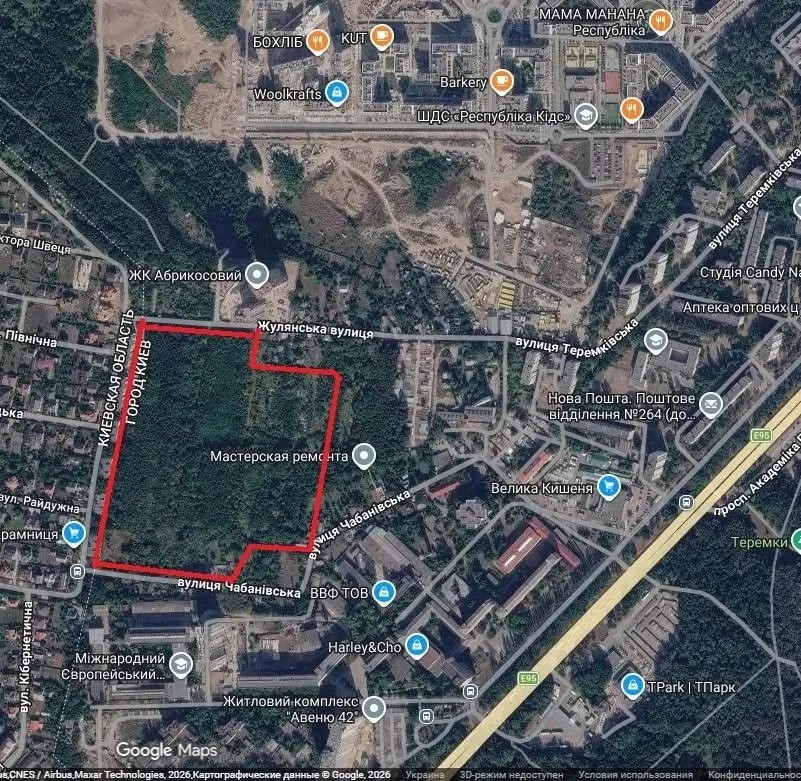
But the heating main is only the first episode. Right next to the Teremky district boiler house lies another forest park of nine hectares between Zhulianska and Chabanivska streets. It was allocated without an auction to the municipal enterprise "Spetszhylfond" for housing construction.
Formally everything looks flawless and even noble: residential buildings with social infrastructure, including under the "Affordable Housing" program, to provide housing for ATO participants. A tender with an expected cost of 2.94 billion hryvnias was announced back in 2019, and the construction period was stretched to 2029. According to the technical specification, fifteen buildings, mostly 26 stories high, almost three and a half thousand apartments, are to be erected on 8.85 hectares. The documentation states directly that green plantings are located on the site, most of which are to be removed.
The context of this generosity is also worth remembering. In the four years before the tender was announced, the capital's authorities provided housing to exactly 393 families of ATO veterans. The promise to build three and a half thousand apartments in ten years sounds especially convincing against the background of this figure.
"Spetszhylfond" handed the functions of housing client to the firm "Construction Enterprise Bud-Monolit". Its director and owner is listed as Andriy Chykhun, who also heads and co-owns LLC "Miskbudalians", known for the scandalous development in the forest park on Shapovala Street. The founder of "Bud-Monolit" is listed as Ihor Softenko, who also heads LLC "Skaibud Group", a recipient of billion-hryvnia city contracts.
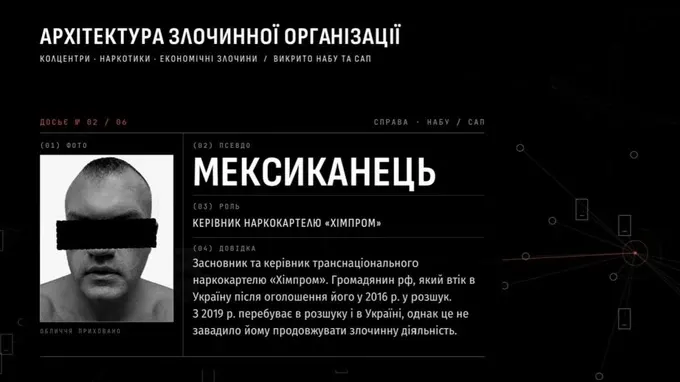
Both of these companies, like "Spetszhylfond" itself, are persistently linked in the public space with Denys Komarnytskyi, who is called the underworld overseer of Kyiv and who figures in the "Clean City" case about the so-called toilet schemes. Komarnytskyi managed to leave the country, and NABU, to put it mildly, did not hinder his departure.
The detail about the permits deserves separate attention. The permit for this construction was issued by the State Architectural and Construction Inspectorate in 2022, when it was headed by Semen Kryvonos. The very same Kryvonos who is now director of NABU. That is, the body investigating the toilet scheme on ten sotkas once issued a permit for the development of nine hectares of forest park.
To understand the systemic rather than accidental nature of these stories, it is worth recalling the Bihus.Info investigation. Journalists obtained documents from a computer in Komarnytskyi's office, among them memoranda and so-called "by the code" agreements between respected people. There was also a table listing thirty-eight companies that are probably controlled by Komarnytskyi and registered to front persons designated in the table as "ours". For years these companies received contracts from "Spetszhylfond", "Zhylinvestbud-UKS" and the "Directorate of Track and Transport Structures", effectively monopolizing that right. In total, over four years they received almost 13 billion hryvnias in contracts from Kyiv's municipal enterprises.
The same documents also featured price lists for services. Approval of a detailed territory plan was priced at 40 thousand dollars, amendments to the urban planning cadastre at 50 thousand, postponing a court hearing at 10 thousand, a ruling of the Higher Commercial Court at 60 thousand. And in one of the "by the code" agreements concerning 230 hectares near the Pyrohovo museum, 15 million dollars was offered for securing the necessary Kyiv City Council decisions.
Vitali Klitschko himself, in a comment to Bihus.Info, said that he has known Komarnytskyi and Stolar for many years but does not meet with them, never engaged in any lobbying, and knows nothing about the tender successes of individual companies.
That this scheme is not unique to Teremky is shown by another story, described by Tetiana Nikolaenko on "Censor". In Solomianskyi Park a landslide occurred before the eyes of passersby: an asphalt path collapsed, and the slope slid down toward the foundation pit of a new building. The clients of that construction are LLC "Smart-Development", one of whose founders is the son of Kyiv's former mayor Oleksandr Omelchenko, and the already familiar "Miskbudalians".
The mechanics of legalization there were just as sophisticated. The urban planning conditions were issued in 2019, and they honestly stated that under the detailed territory plan these are zones of public development and green plantings, that is, there is no residential development there. But in the line on maximum permissible population density, instead of zero, they wrote that it is not calculated for public development. This formula, according to activist Heorhii Mohylnyi, was used deliberately, so that an official would not later go to prison and the developer could build whatever he pleased. As a result, a hotel complex appeared on the construction board, but with apartments, and the SACI permit was issued in the last days of its existence, when it stamped 450 permits in a month.
Now put all these stories side by side, and you will see not a coincidence of circumstances but a technology.
First a green zone is found that, for legal reasons, has no proper protected status or even a cadastral number. Then a socially significant reason appears: energy resilience, housing for veterans, reconstruction. Next the permitting bodies issue documents with wording that does not personally expose anyone. The contractor becomes a company with three employees and authorized capital of thirty thousand hryvnias, which passes the money further down the chain. And when residents come out to hug the trees, they are told that everything is legal, the permits exist, and an alternative route would cause a traffic collapse.
And every time, this construction contains what is in no press release, namely a private interest. In any scam, that is the first place to look.
So the question that is really at stake in Teremky does not sound like an environmental one. It sounds like this: why did the backup heat supply scheme, drawn up back in 2023 under Teremkovska Street, become possible only in the version that also connects the plots of specific developers to the heating network? And why are century-old oaks paying for the answer to that question?