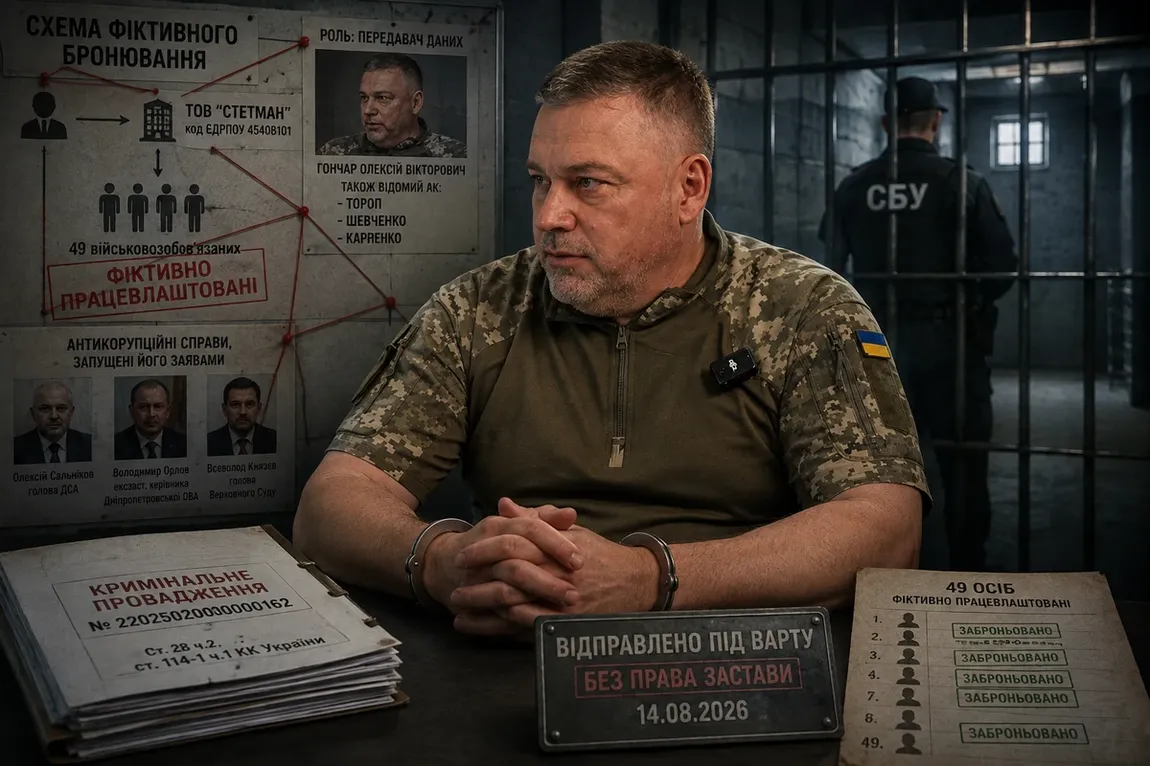
On 14 August 2026, the Vinnytsia City Court sent to jail, with no right to bail, the man whose complaints once launched the country's most high-profile anti-corruption cases.
In the ruling in case No. 127/28586/26, the suspect is depersonalised down to a dry "PERSON_4", but the court left enough in the text to identify him without any hints: a native of the city of Orenburg, Orenburg Oblast, Russian Federation, a citizen of Ukraine, charged in two proceedings under Part 4 of Article 190 of the Criminal Code. The investigation cites one of them under a number dated 06.10.2021, on suspicion of fraud. The ruling of the Obukhiv District Court of Kyiv Oblast of 12 August 2026 concerns the same proceeding No. 12021111230001203 of 06.10.2021 and the same charge under Part 4 of Article 190. Only there the surname is not hidden: Honchar Oleksiy Viktorovych.
The very same Honchar, a.k.a. Torop, a.k.a. Shevchenko, a.k.a. Karpenko. The man whose complaints formed the basis of the cases against the head of the State Judicial Administration Oleksiy Salnikov and against the former deputy head of the Dnipropetrovsk Oblast Military Administration Volodymyr Orlov, whose attempts at contact figured in the story of the Supreme Court chairman Vsevolod Kniazev. In February 2026 the High Anti-Corruption Court acquitted Orlov, having established that it was the complainant, not the official, who had pushed the conversation toward an unlawful benefit. Now the professional whistleblower has himself ended up a suspect, and not for ordinary fraud but under an article from the section on crimes against the foundations of Ukraine's national security.
Forty-nine souls on the books of LLC "STETMAN"
Criminal proceeding No. 22025020000000162 was entered into the Unified Register of Pre-trial Investigations as early as 12 September 2025. It is run by the investigative department of the SBU Directorate in Vinnytsia Oblast; the motion for custody was filed by a senior investigator for particularly important cases, a lieutenant colonel of justice, with the prosecutor's approval. The charge falls under Part 2 of Article 28 and Part 1 of Article 114-1 of the Criminal Code, that is, obstruction of the lawful activity of the Armed Forces of Ukraine during a special period, committed by a group of persons by prior conspiracy.
The facts set out in the ruling sound as humdrum as trading in the right not to fight has become. According to the investigation, Honchar had connections and influence, established "under circumstances unknown to the investigation", over an unidentified person involved in the activity of LLC "STETMAN" (USREOU code 45408101). Knowing that this person was engaged in fictitious employment of persons liable for military service, that is, without any real performance of work duties, he entered into a criminal conspiracy with them. His role in the scheme was that of a conduit: he ensured the delivery of personal data and documents of those liable for military service, received from another figure in the case, to that same unidentified person, so that they would register the men on the company's staff. After that, a stamped piece of paper turned into grounds for a reservation from mobilisation that was lawful, as it seemed to the buyer. For a cash reward, naturally.
The investigation states the motive outright: significant demand for illegal reservations makes it possible to earn money from them. Market, demand, supply. Just like the textbook, except that the commodity is the nation's defence capability.
The investigation counts the result of the scheme item by item. As a consequence of the consecutive actions of at least five depersonalised figures and one unidentified person, each acting within the role assigned to them, 49 persons liable for military service were fictitiously employed at LLC "STETMAN" between 13 January 2025 and 16 April 2026. Information about them went into the Unified State Register of Conscripts, Persons Liable for Military Service and Reservists. In other words, the state with its own hand entered into its own database 49 people whom it had effectively lost from its mobilisation pool. A year and a half of the conveyor running. One participant in the scheme was served a notice of suspicion as early as 23 April 2026, and by a ruling of 24 April the term of the pre-trial investigation was extended to four months, until 23 August 2026.
Honchar himself was detained on 12 August 2026 under Article 615 of the Criminal Procedure Code, that is, under the special regime of pre-trial investigation in conditions of martial law. He was notified of the suspicion the same day. The investigation backed the validity of the suspicion with a record of examination lasting from 8 June to 17 July 2026, the detention record, and information from the Main Directorate of the Pension Fund in Vinnytsia Oblast. The last is especially telling: fictitious employment shows up best of all in pension data, because a hiring paper is bound to leave a trace in reporting.
Four risks and not a single bail
The investigating judge counted four risks in the case from those provided for by Article 177 of the Criminal Procedure Code: hiding from the investigation and the court, unlawfully influencing witnesses, obstructing the proceedings in some other way, and continuing criminal activity. Each is substantiated separately and, it must be admitted, without the bureaucratic autopilot usual for such motions.
The court derived the risk of hiding from the severity of the possible punishment: the article he is charged under carries five to eight years of imprisonment, and the suspect is aware of this. Here the judge cited the ECtHR judgment in "Iliykov v. Bulgaria", where the seriousness of the suspicion and the severity of the penalty are recognised as a substantial element in assessing such a risk, as well as "Letellier v. France" with its thesis on public disquiet capable of justifying pre-trial detention. The risk of influencing witnesses is substantiated in a plain and convincing way: the witnesses' personal details and addresses are in the case file, and the court receives testimony orally and directly.
The most interesting wording concerns the risk of continuing the crime. The court writes that the suspect acted according to a well-honed scheme and using established contacts, and that his activity ended not on its own but only as a result of exposure by law enforcement. A well-honed scheme and established contacts. Does that remind you of anything? A man who for years acted professionally as a complainant in other people's cases is now blamed by the court precisely for his skill at establishing contacts.
In a separate paragraph the investigation recalled that Honchar is currently a defendant in two other proceedings for grave mercenary crimes: in the case of 6 April 2021 under Part 4 of Article 190 and Part 2 of Article 15 with Part 4 of Article 190, that is, for fraud and attempted fraud, and in the case of 6 October 2021 under Part 4 of Article 190. This, in the wording of the motion, characterises his propensity to commit criminal offences.
The court set no bail at all. The law allows it: Part 6 of Article 176 of the Criminal Procedure Code prescribes applying precisely custody during martial law to suspects under Articles 109-114-2 where risks exist, and Article 183 gives the investigating judge the right not to set the amount of bail in such proceedings. The judge used this right, noting that bail of any amount would not ensure proper procedural conduct. Of any amount. For a man whom the investigation describes as the organiser of a cash flow, this is perhaps the most precise characterisation.
A combat participant against mobilisation
At the court hearing the suspect objected to the motion. He explained that he is a serviceman of the Armed Forces of Ukraine and a combat participant, has four minor children as dependants, and has an illness and wounds received in defending the Motherland. The defence lawyer added that the suspicion contains no detail of his client's participation in the crime, and asked for house arrest during a certain period of the day, or at the very least minimal bail.
Put that together. A serviceman of the Armed Forces, a combat participant, wounded in the war, is suspected of having traded the opportunity to avoid ending up in that war. Forty-nine times. The court, incidentally, took these circumstances into account: the reasoning part lists that the suspect is a serviceman, has a permanent place of residence, is divorced, supports four minor children and has no prior convictions.
No prior convictions. Formally impeccable, because there really is no Ukrainian conviction. The Ukrainian certificate of no criminal record knows nothing about the six years of imprisonment for fraud in Russia in 2002-2006, about the wanted notice under Part 4 of Article 159 of the Russian Criminal Code since 2012, about the three changes of surname between Karpenko, Honchar and Shevchenko, or about the changes of first name from Oleksiy to Mykhailo and back. And it never did. It was with precisely this certificate that the man went for years to the anti-corruption bodies as a model complainant.
A compulsory escort to an address where he no longer is
And now the best part. On 12 August 2026, the very day the SBU was detaining Honchar in the reservation case, the Obukhiv District Court of Kyiv Oblast was considering an entirely different matter. The defendant Honchar Oleksiy Viktorovych failed to appear again at a court hearing in case No. 372/1191/23 on a charge of fraud under Part 4 of Article 190. The prosecutor filed a motion for a compulsory escort, the victims did not object, and the judge ruled to apply compulsory escort.
The judicial machine worked unhurriedly and flawlessly by the protocol: bring the defendant to the court hearing on 25 August 2026 at 12 o'clock, with execution entrusted to the Obukhiv District Police Department. Both addresses are carefully written out in the ruling: registered in Cherkasy on Chyhyrynska Street, actually living in the cottage town "Zoloti Vorota" in the village of Pidhirtsi in the Obukhiv area. The ruling is not subject to appeal.
The term of detention under the Vinnytsia ruling runs for eleven days from the moment of detention, until 9:05 on 23 August 2026, and it will almost certainly be extended. The compulsory escort is set for 25 August. That is, Obukhiv police officers will drive out for the defendant to a cottage town near Kyiv, while he will be sitting in the Vinnytsia pre-trial detention centre. Two branches of one law enforcement system are hunting one man without knowing about each other.
The Vinnytsia ruling can be appealed within five days; filing an appeal suspends its entry into legal force but does not suspend its execution. So the next investigative actions with the man whose complaints once opened the doors to cases against judges and officials will take place where one now has to go to get a new whistleblower complaint. The institution of whistleblowers was created as a fuse. In Honchar's hands it turned out to be a business model with two circuits: first, clear the space with complaints, then trade on that space in the right not to fight.
One question remains, and it is not for the investigating judge. How many complaints signed by this hand still lie in the files of active cases?
References:facebook.com