Are you sure you know history well, and can confidently say that Lomonosov was a scientist, Tsiolkovsky was not a fascist and the Cherepanovs were not plagiarists?
Are you sure you know history well, and can confidently say that Lomonosov was a scientist, Tsiolkovsky was not a fascist and the Cherepanovs were not plagiarists?
No?
Then I advise you to read this interview. It will help you get rid of the centuries-old noodles hung on your ears.
We are Russians.
But what does that mean?.. They say the basis of national self-awareness is national history.
They say history is the leaven of the national spirit.
Then such self-awareness is not worth a penny! And neither is such a spirit: they are a soap bubble, because they rest on myths.
On a beautiful fairy tale about the noble Alexander Nevsky, who defeated the dog-knights.
On the invention about the twenty-eight Panfilov men who died heroically but did not let the enemy through to Moscow.
On tall tales about an empire that swelled to an incredible size thanks to waging exclusively defensive and just wars.
And any attempt to encroach on a myth provokes in the people, offended by the encroachment, the angry howl of a wounded beast thirsting for the blood of the offender.
Although, one would think, the times have long been vegetarian. It is the twenty-first century, after all.
But it was precisely in the twenty-first century that the researcher Gely Salakhutdinov was fired with a bang from the Institute for the History of Natural Science and Technology of the USSR Academy of Sciences (now the Russian Academy of Sciences) for trying to clean out the Augean stables of historical science of the patriotic crap that had piled up in them.
Talking to Salakhutdinov is a pure pleasure!..
Why were you, a man with such a purely scientific name as Helium, kicked out of the history of science with a bang?
For doing what nobody can like: debunking myths and destroying inflated authorities. First they gave me reprimands, then they simply fired me. People like that have always been inconvenient.
Right now everyone is devouring Suvorov's books, but in our institute, back in the seventies, long before Suvorov!
One fellow tried to publish figures showing that before the war the USSR alone had produced more of just the newest KV and T-34 tanks, whose armor no German field gun could penetrate, than all the tanks in the rest of the world put together.
They hounded the fellow!
Him then, and me now.
Twenty years have passed since Gorbachev's perestroika, Stalin and Lenin were crushed and exposed long ago, and historical science was cleansed of communist dogmas.
However, not everything was cleansed: the history of domestic science and technology is still built on the Stalinist model of 1946, which was born in the era of the struggle against cosmopolitanism, kowtowing and servility before the West.
In this historical nature reserve, to this day sit people who write works about Lomonosov, the founder of Russian science, Popov, the inventor of radio, and Tsiolkovsky, the founder of cosmonautics.
All of it is solid myth, which is still being palmed off on children at school.
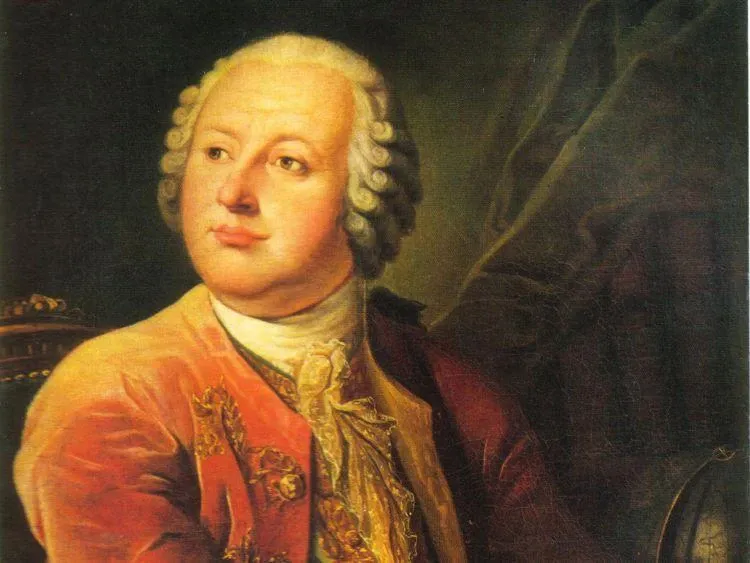
And how did Lomonosov displease you?
By the fact that he did nothing in science. At all!
Textbooks say that Lomonosov discovered the law of conservation of mass.
What is the basis for that?
It's simply that Lomonosov once wrote a phrase in a letter to a friend:
If something is added in one place, it is taken away in another!
From it the Stalinist falcons concluded that Lomonosov discovered the law of conservation of mass. But a chance phrase in a letter is not the formulation of a law!
The law of conservation of mass was first clearly formulated and confirmed by experiments by Lavoisier.
And not in a private letter, but in a scientific work!
They also write that Lomonosov developed the molecular-kinetic theory of gases.
He did not! And he could not have, because he knew mathematics very poorly. For exactly that reason, all his works in physics and chemistry were simply helpless fantasies.
Lomonosov is credited with creating foundational works on mining.
In reality these works are nothing other than LECTURE NOTES HE TOOK WHILE STUDYING IN GERMANY!
In Germany, by the way, Mikhailo for the most part did not study but drank and chased women. That is why he was weak in mathematics too.
Lomonosov is not a scientist!
He is an administrator, a man who knew how to do only two things well: drink and extract money for crazy projects.
For example, he organized a pseudo-scientific overseas expedition: he came up with the following idea, to reach India by going around America through the Arctic Ocean.
For some reason Lomonosov got it into his head that the Arctic Ocean is free of ice at latitudes north of 80 degrees.
An obvious stupidity, but Lomonosov's influence at court was so great that he easily got money from Catherine for two expeditions.
Both, naturally, ended in failure: beyond Spitsbergen the ships ran into heavy multi-year ice.
Who turned out to be to blame?
Certainly not Lomonosov, but the expedition commander Chichagov, who was subjected to a most severe dressing-down in the Admiralty Board.
But Lomonosov supposedly invented mosaic. The kind that goes on walls.
Count Tretyakov brought mosaic to Lomonosov from Italy. Lomonosov immediately caught fire with the idea of mastering mosaic production in Russia. The empress allotted him a huge plot of land, money and a pile of serfs for it. But Lomonosov managed, even with a state order for mosaic, to botch this business too!
How did he make his way up to being a founder of Russian science?
PR. When Lomonosov returned to Russia, he told himself: I am a man of the lower estate, I need patrons. And he began writing laudatory odes in honor of high-ranking persons.
With this simple trick he earned the favor of many of the powers that be, in particular Count Shuvalov, who was himself still a kid then. Lomonosov threw dust in his patrons' eyes with quasi-scientific stories. And in his old age Mikhailo got completely out of hand: he would get dead drunk and go to the Academy of Sciences to wreak havoc, chasing people around and beating them.
People complained about him, but it always ended in the hooligan's favor, only because he had friends in high places.
No wonder you were fired. You brought down such a colossus.
My sacrifice was not in vain. Now many people already understand everything about Lomonosov.
Not long ago, for example, Academician Zakharov publicly stated that:
Lomonosov is an inflated figure, and his entire contribution to science is the translation of two textbooks from German.
But for such statements to become possible, I had in my time to live through reprimands and public condemnation by the scientific community. And it all happened so strangely.
I go to our physicists at the institute and ask: what did Lomonosov do in physics?
They say: nothing, he seems to have done chemistry. I go to the chemists and ask the same question.
They give the same answer: he did nothing in chemistry, go to the physicists.
I had already been there. I go to the geologists and ask: does Lomonosov have any works in geology?
They answer: none, go to the chemists or the physicists, they know.
After that I give a report in which I declare: LOMONOSOV IS A BIG ZERO IN SCIENCE!
And a resolution of condemnation is passed against me. Passed by the same people who had just confirmed that in their field Lomonosov did nothing!
I keep this wonderful document:
We condemn the activity of G.M. Salakhutdinov. The Scientific Council does not consider justified his statements that Tsiolkovsky was not a scientist, Polzunov not an inventor, and Lomonosov made no serious scientific discoveries.
The word "condemn" is missing the word "angrily". In what benighted year was such a resolution passed against you?
It was September 28, 2000! I'm telling you, the Stalinist directives in the history of natural science are alive to this day!
So what about Polzunov?.. He is the inventor of the steam engine, isn't he?
The steam engine had already existed for half a century before Polzunov took an interest in it.
Having studied foreign drawings, the Altai worker Polzunov decided: are we really such clumsy oafs, can't we really build the same machine the English made?!.
Smart people told him: it is impossible to do this in Russia, because the necessary technologies are not here, but Polzunov had six grades of education and understood little about technology.
All our "geniuses," I must say, were half-educated dropouts. Lomonosov studied abominably, Tsiolkovsky had four grades of education, and he spent two years of those sitting in the same grade.
But Polzunov's undertaking appealed to the top. The empress, who was informed about it, created all the conditions for the self-taught talent. And Polzunov built a poor copy of the English machine.
It was not for nothing that he was told the needed technologies did not exist in Russia. A steam engine is not a cart, it requires the fitting of parts to each other! And Polzunov was proud that a finger could not squeeze in between the piston and the cylinder wall.
Imagine those gaps! Of course such a machine did not hold steam! Polzunov tried to plug these holes with something.
But what can you plug them with, if the piston has to travel along the cylinder?
Naturally, his machine stood idle more than it worked.
Polzunov did not understand the simplest things: for instance, he pumped water into the boiler straight from a pond, and the machine, naturally, immediately clogged with dirt and silt. In the end the wrongly designed boiler sprang a leak and the machine broke down for good. It was a genuine adventure.
After all, the steam engine took centuries to appear in the West, it grew along with metalworking technologies.
A steam engine has 102 non-trivial parts that must be fitted together correctly. A steam engine has its own rather complicated logistics of operation. And then suddenly some illiterate Polzunov appears and announces that he will build it all right now on his knee.
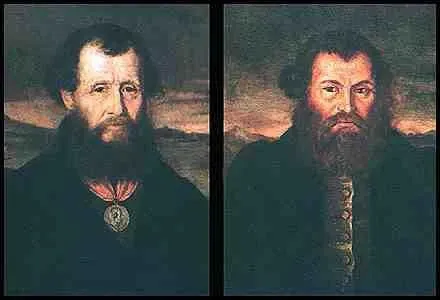
Who else is left for us? The Cherepanov brothers, who invented the locomotive.
The Cherepanov brothers were on a training stint in England, saw a locomotive there and decided to start building such machines in the Urals.
That's the whole of the "invention."
And the famous Academician Petrov, about whom all the textbooks say that he discovered the electric arc, did not discover any arc.
Not long before, galvanic cells had been invented, and Petrov ordered the English craftsman Major to make a great many such cells for experiments.
It was this Englishman who, having made a pile of cells for Petrov, assembled a battery from them and discovered the phenomenon of the electric spark. Petrov had nothing to do with it.
He simply ordered galvanic cells from Major and was therefore their legal owner.
Of them, not of the discovery!
SWIPING OTHER PEOPLE'S CREDIT IS IN OUR PEOPLE'S BLOOD!
Why, for instance, is the plan for the electrification of Russia called Lenin's GOELRO plan? That plan was developed back under the czar by three Russian energy companies.
So, let me guess: Popov did not invent radio?
Marconi didn't either! Radio appeared as the result of a long evolution. The first to introduce the term "wireless telegraphy" was Edison. That happened in the 1870s.
On the basis of electromagnetic induction he transmitted signals from a station to a passing train and from the shore to a steamship. The range of transmission was 200 meters. Then Hertz discovered electromagnetic waves.
He had a receiver in the form of a half-ring and a radiating coil. Hertz was a pure theorist who did not bother with the practical application of his discovery. That was taken up by Tesla, who declared that with the help of Hertz's discovery it would be possible to transmit signals across the entire globe and even into space, after which he drew the schematic diagram of radio.
Next, the Englishman Branly, instead of Hertz's unsuccessful half-ring, devises a different receiver: a small glass tube with metal powder, through which an electrical signal passes. Then another Englishman, Lodge, builds a radio on Tesla's scheme with Branly's receiver.
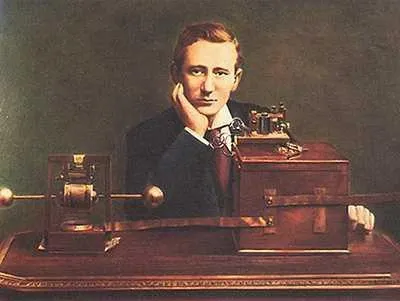
Having read about these experiments, Popov and Marconi began to repeat them. The only difference: they raised the antenna higher and increased the output power of the transmitting device. That is, they came up with nothing fundamentally new.
But Marconi had the sense to patent it all and started making money from it. Popov did not have the sense to patent somebody else's invention. But after Stalin ordered Radio Day to be introduced, Popov was appointed the inventor of radio, and a film was made about it.
Right after the war a book by Danilevsky appeared, claiming that:
All the inventions in the world were made by Russians!
The serf peasant Artamonov invented the bicycle. Kryakutny flew in a balloon before the Montgolfier brothers. Mozhaisky rose into the air in his airplane before the Wright brothers.
For this raving Danilevsky received a Stalin Prize!
And the book became a reference book for historians of science and technology.
It later turned out that the manuscript about Kryakutny was forged, that there are no documents about Mozhaisky's flight, and that his airplane could not have taken off even in theory, because its engine had a third of the power needed for flight. The story with the cyclist Artamonov is similar.
So Tsiolkovsky is not the father of cosmonautics, I suppose?
Not even the mother.
Rockets have been known since the 13th century. In 1800 the English colonel William Congreve was the first to deal with them on a serious level. The first theoretical works date to about the same time: at Cambridge University the equation of motion of a point of variable mass was solved, essentially the equation of motion of a rocket.
It turned out to be so simple that Cambridge students solved it at their exams throughout the entire 19th century.
In Russia, of course, they did not know about this, so it is hardly surprising that Ivan Meshchersky solved this equation anew and included it in his dissertation, which he successfully defended.
Another six years passed. Tsiolkovsky takes this equation and publishes it in his little book Exploration of Cosmic Space by Means of Reaction Devices.
And in 1933, when the Soviets needed to celebrate the jubilee of a great Soviet scientist (we have scientists too! and no worse than yours!), Tsiolkovsky was appointed the author of this equation. And the equation was given his name. Indeed, why give authorship to a bourgeois specialist like Meshchersky? Let alone to some English imperialists?
Meanwhile Tsiolkovsky's own technical works are full of childish mistakes, and as for his philosophical writings...
He is our Russian cosmist, after all.
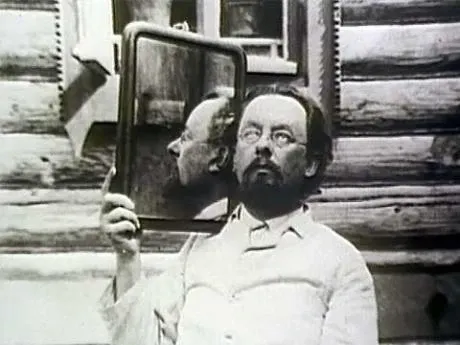
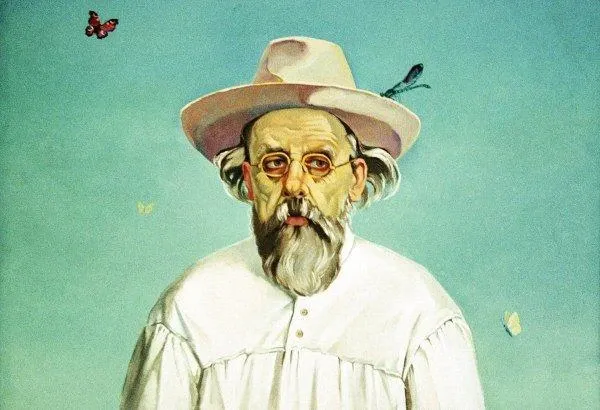
But it would be more accurate to call Tsiolkovsky the progenitor of Russian fascism!
In his philosophical works Tsiolkovsky builds such pictures of a totalitarian society that it becomes simply frightening.
Imbeciles, the insane, as well as Negroes, Indians and other lower races, Tsiolkovsky proposed to destroy, and to breed supermen artificially from the best sires.
To that end the great humanist Konstantin Eduardovich considered it necessary to gather the most perfect human specimens in special houses.
Tsiolkovsky's eugenic ideas were later attempted to be carried out by the German fascists.
Well, all right, suppose they have bred a superman. But people age, that is, they spoil!
Here is how Tsiolkovsky proposes to solve this problem in his work Joy Without Reckoning:
Suppose a human being or another mortal animal lives only until the decline toward old age and the burden of life begins. In a human this period begins at 30, 40 or 50 years, depending on temperament or conditions. When the burden of life begins in a human, let us kill him by a painless method.
Doctors assure us that such a method exists. Indeed, if one builds a machine that in a thousandth of a second or even faster (this is theoretically possible) reduces a person to the tiniest bits, how can the person feel this destruction? It should not be accompanied by torment, since because of its brevity it cannot register on the nerves. It is more advantageous than striving for excessive longevity to make a person's end more painless. This is also more feasible.
And what if someone does not want to die, or turns out not to be as perfect as our little old man would like? Please, here is Tsiolkovsky's recipe:
Egoistic strivings can be destroyed by extinguishing the lineages with undesirable traits, through restricting the right to produce offspring.
Back then all of Europe was pregnant with totalitarian, communo-fascist ideas... I am interested in something else: why has Russia always lagged behind in science?
A administrative-command system promotes the development of neither the economy nor science.
Our scientists are used to solving all their scientific problems with the help of the authorities.
We remember how the empress supported Lomonosov's delirious scientific theories, how genetics and cybernetics were persecuted and Lysenkoism extolled under Stalin.
Do you know how our science looks to observers from abroad?
Professor Legler writes:
In Soviet science, local ideologies very often arose, intended either to seize power or to preserve the power of certain persons and groups in the scientific community!
Thus, for example, for decades Soviet geology and world geology existed on opposite theoretical positions.
The Western scientific community adhered to the fundamental scientific theory known as plate tectonics.
Soviet geologists, roughly equal in number to the Western ones, rejected this theory completely.
Now plate tectonics is recognized in Russia too. In the history of Soviet science, the confrontation between the Soviet and world scientific schools was systematically repeated.
Psychology, the humanities and the economic sciences were always in a state of confrontation.
Even physicists and mathematicians were in serious confrontation.
Besides broad scientific fields, such as biology as a whole, embracing thousands of scientists and dozens of scientific institutions, there were countless confrontations in narrower areas as well.
And in all cases without exception, Soviet science in the course of time admitted that it had been wrong.
The leaders of the confrontation on the Soviet side usually held leading posts in the scientific community. Therefore participation in the confrontation was mandatory for all members of the scientific community.
Violators were subjected to punishment, up to expulsion from the community. The confrontation was overcome by the principle of circumvention: the scientific opposition turned for help to forces external to the scientific community, to foreign public opinion, to the press or to state power.
Under the guise of science, a grandiose system of its imitation existed in the Soviet Union.
Soviet science can at best follow world science, repeating its achievements with some delay.
At worst it turns into a local ideology opposed to world science and unable to perform the traditional functions of science. Or do you think that, lagging behind in the quality of cars and vacuum cleaners, the USSR could, for some mysterious reasons, keep neck and neck with the developed world in science?
There are no such mysterious reasons.
If an administrative system is inefficient in the economy, why would it be efficient in science?
The Academy of Sciences and science in Russia are still built on Stalinist patterns!
Our total backwardness is plainly visible in the number of Nobel Prizes.
The headcount of scientists in the USSR was the same as in the USA, but we have only 10 Nobel Prizes against 160 in the USA!
In tiny Austria there are 10 Nobel laureates, in Switzerland 12, in Holland 14, in Sweden 20, in France, Germany and Great Britain about 60 each!
Maybe we were deliberately slighted, denied prizes? The Cold War...
There is such a point of view.
There is also the opposite one: many believe that some worthy Western scientists were denied the Nobel Prize so that it could be given to at least someone in the USSR.
They flirted with a nuclear power, civilizing it in this way.
Both points of view are politics; let us stick to the facts, and they are these: we have a shamefully small number of Nobel laureates!
If everything is so bad, how did we get into space first?
Purely by chance. Where did the USSR get its liquid-fuel rocket?
A captured V-2.
We started perfecting it because we needed something to shoot at America: airplanes could not reach.
And the USA at first did not deal with rockets at all: their strategic bombers from military bases scattered along our borders could reach any part of our territory.
The USA first began to develop ballistic missiles in 1954, when the hydrogen bomb appeared, which was smaller and lighter than the atomic one.
So they gave us a head start of 8 years.
And even so, we launched our satellite first only because the American government decided that there was no point in hurling a dummy lump into orbit.
As early as 1946 they came to the conclusion that a satellite could be launched within five years of setting such a task; they even calculated the reliability of the launches: it turned out that with the technology level of the time, out of 11 launches 9 would end in failure, and two rockets would put two satellites into orbit.
The project would have cost America 55 million dollars. All this seemed to them too expensive and pointless an undertaking.
More than that!
In 1954 Wernher von Braun declared: if you give me the go-ahead, I will launch a rocket into space.
He was refused.
In 1956 Braun again asked for permission to launch a satellite in 90 days.
He was refused again!
And only after the USSR launched its iron lump into orbit, and then the dog Laika, was Braun finally given money!
And exactly 90 days later he launched the first American satellite. And had they allowed it right away, he would have launched it three years before the Soviet one.
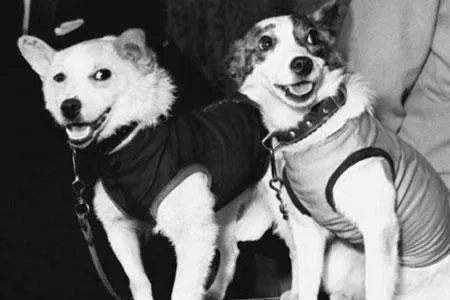
And we were also the first to shoot a little man into space.
Yes, the first man, the first woman.
In the beginning it was easier for us because of that very eight-year head start.
The Americans really did lag behind in the race at first, but then they easily won the space competition against us.
They build a good spacecraft, Gemini, while with our Soyuz it is one accident after another.
They fly to the Moon, and we again have one accident after another!
But the main thing is that this competition of two powers was absolutely meaningless!
It was not for nothing that Niels Bohr said that manned cosmonautics is "an undoubted triumph of intellect, but a sad error of common sense".
It is not needed!
There is no task in space that automatic machines could not perform.
The defining tendency, the law of development of the technosphere, is the displacement of manual labor by machine labor, of the human by automation.
Why risk it and launch a human into space, if one can launch machines that need no air to breathe, no food, no training simulators and the rest?
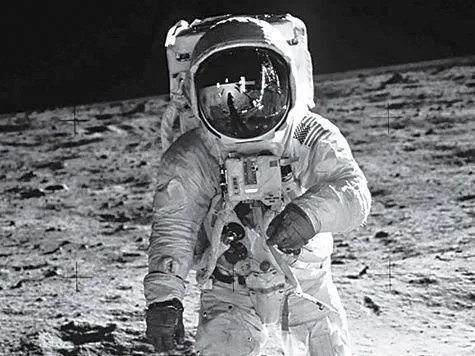
But what about the age-old dream of conquering Mars? So many books written, so many films made! The Martian Chronicles, Schwarzenegger's head explodes...
Want to fly to Mars?
A flight to Mars will cost roughly 100 billion dollars.
What does that mean for Russia, for example?
Simply take our entire stabilization fund and send it to Mars.
And stick a little flag in the ground there
Why should somebody's silly dream be fulfilled at the expense of all taxpayers?
Academician Mishin, Korolev's right-hand man, screamed at the top of his voice that Buran must not be built, because winged spacecraft have no future.
Nobody listened to him.
Meanwhile, Buran really is useless. No, from an engineering point of view it was a masterpiece, of course.
But from the point of view of economics
First, the wings of the descent vehicle create extra drag at launch.
Second, there is simply nothing to use this whole behemoth for.
Just imagine, our shuttle can bring 20 tonnes of payload down from orbit.
A great figure!
But where are we supposed to get those tonnes?
What exactly are you planning to haul down from orbit?
Moreover, in economic terms Buran is even worse than the American Shuttle .
The American Shuttle is put into orbit with the help of two cheap solid-fuel boosters, while to put our Buran into orbit, you have to burn through a liquid-fuel rocket as expensive as Energia , which could fly to the Moon.
Why all this gigantism?
It is high time to finally shake off the burden of past mistakes and myths that keep us from moving forward.
We need to get rid of the last islands of the totalitarian past and introduce the principles of organizing the economy and science that exist in the West.
In America, say, science is done by universities. Applied science gets grants and economic independence.
And fundamental science gets state support, which will only become more powerful if it is not spread thin across numerous and useless research institutes, where local scientific clans hold the line, clans that long ago stopped having anything to do with science.
References:oleg-leusenko.livejournal.com