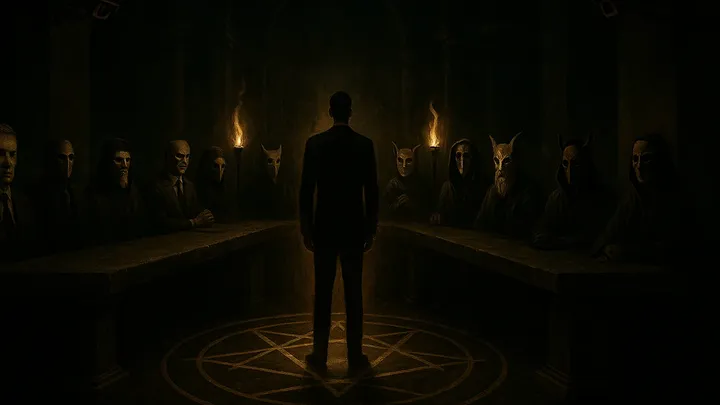
For Moscow, its own people have always been a colony. Back then, the people were retrained to cross themselves differently so that Moscow could become the master. Today they are being retrained to celebrate and to ban by the Chinese calendar so that Moscow can become the servant.
February. Moscow. A woman travels to the city center for Maslenitsa. For pancakes, for the festivities, for the effigy that is supposed to be burned. She arrives at Manezhnaya Square, a couple of steps from the Kremlin, and cannot understand where she has ended up.
Red lanterns. Dragons. Instead of pancakes, they sell Peking duck. Later she writes online that she wanted to go to Maslenitsa and came to the center of Moscow looking for the festivities, but there was nothing but China. Not a single hint of Maslenitsa. Only Asian decor.
No, she hadn't got the address wrong. This was the festival "Chinese New Year in Moscow." From February 16 to March 1. More than 100 performers from Beijing and the Chinese provinces. Opera, acrobats, martial arts. More than 60 venues across the city. And it was organized not by some private enthusiast. It was organized by the Moscow government, with the support of the Russian Foreign Ministry and the Chinese embassy.
In fairness, the dates coincided this year. Chinese New Year fell exactly on Maslenitsa week. But the mayor's office had a choice of what to put up by the Kremlin wall, and it made one. The dragons went up on Manezhnaya. Maslenitsa was sent for export. To Beijing. From February 19 to 22, a festival called "Moscow Maslenitsa" was held there. The pancakes went off to China, the dragons came to Moscow. Moscow and Beijing exchanged holidays the way delegations exchange gifts.
Remember this exchange. Because in October the two capitals took the next step. This time together.
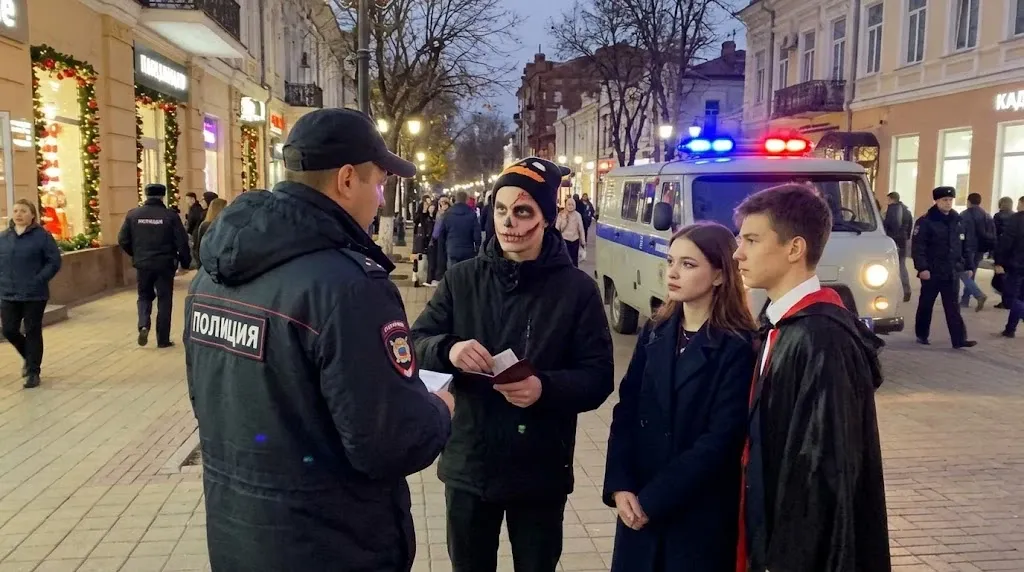
The end of October. Krasnodar. Halloween evening. The police patrol the places where teenagers gather. Officially, it is prevention. Talks about fraudsters. Talks about traffic rules. But for some reason special attention goes to schoolchildren in face paint and in costumes of the undead.
These are not rumors. You can see it in the video the police themselves published. The children's documents are checked. The children are led onto a bus. Reports are drawn up against the children. A kid painted a corpse's face on himself and became a threat to road safety.
In Moscow, the security forces weren't bored either. They raided the club "Bizarre," where a Halloween party for swingers was under way. Apparently they were fighting fraud there too. And crowds of teenagers in costumes gathered in the center that evening, and the police walked among them checking documents. They gathered, by the way, in Kitai-gorod. You couldn't make it up.
Now let's see what was happening in Beijing at the same time. It turns out to be exactly the same thing.
In China, Halloween is not officially banned. It is simply, as they say there, not welcomed. Back in late October in Shanghai, companies began canceling holiday events. People from the entertainment industry said so. And newsrooms received instructions not to write about Halloween celebrations at all. This is not the first year. Last year, Shanghai police blocked off streets where people in costumes used to gather. And in Guangzhou, special zones were set up at metro entrances where people had their makeup forcibly washed off.
Someone, of course, tried anyway. In Shenzhen there were quite a few people in costumes on the metro in the evening. In Shanghai, isolated attempts to celebrate also took place. Just as in Krasnodar, just as in Moscow. Young people in both countries want a holiday. And the state in both countries decides that celebrating is not allowed.
Now add up February and October. In February, Moscow and Beijing agreed on what to celebrate together. In October, they decided at the same time what to ban together. That is synchronization. A common calendar. A common list of their own holidays and a common list of foreign ones.
One can say, of course: so what? Fashion. Friendship of peoples. Europe was fascinated by the Chinese style for centuries. In the 17th and 18th centuries it even had a name, in French chinoiserie, that is, "Chinese-ness." Cabinets, screens, and plates painted "in the Chinese style" stood in every respectable palace. The same went for Arab, Indian, and Persian motifs. Pushkin wrote "Imitations of the Quran." Goethe wrote the "West-Eastern Divan."
But all of that was a game. A merry carnival. Where a count in a turban danced with a countess in a Venetian mask to the strains of a Polish mazurka. Exotica was added to one's own. Nobody abolished one's own in the process. And nobody banned the foreign either.
Here there is no whiff of a game. Here everything is deadly serious. Halloween is forbidden. Valentine's Day is forbidden. That, you see, is kowtowing to the West. A word, by the way, from Stalin's campaign of the late 1940s, when the whole country was hunting for "rootless cosmopolitans."
But the Chinese New Year across the whole capital is allowed. And not because Muscovites asked for it. There is no demand from below. Chinese tourists don't need paper dragons in Moscow either. They will see enough dragons at home. They come to Moscow precisely for Russian color. For pancakes, matryoshkas, and ushanka hats.
So all this is not for the Chinese. It is for Russians. For the domestic consumer. To fix the "pivot to the East" not only in oil contracts but also in heads. To slowly, holiday by holiday, tear people away from Europe.
So this is not a carnival. It is a recalibration of consciousness. And the most interesting thing is that Moscow has done this before. More than 370 years ago.
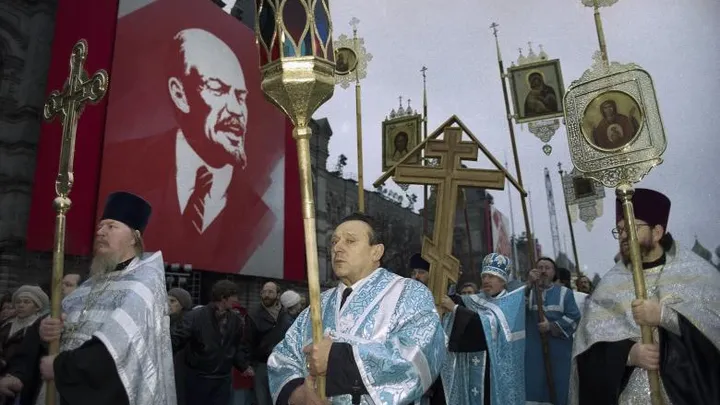
In 1652, Nikon became patriarch in Moscow. And within a year he began remaking the faith. Not theology, but what a person does with his hands every day. From now on one had to cross oneself not with two fingers but with three. Full prostrations were to be replaced by bows from the waist. The Savior's name was to be written not "Isus" but "Iisus." The liturgical books were to be corrected.
Why? The official version sounded beautiful: a return to Greek models. But look at whom they were really modeling themselves on. As early as 1649, learned monks were summoned to Moscow from Kyiv. Epifaniy Slavynetsky. Arseniy Satanovsky. And it was Slavynetsky who became one of the chief correctors of the Moscow books. Kyiv scholarship was rewriting the Muscovite faith.
Because in Kyiv they crossed themselves with three fingers. In Kyiv they served as the Greeks served. And Moscow with its two fingers looked like a backwater province in the Orthodox world.
Now look at the dates. January 1654. Pereyaslav. Bohdan Khmelnytsky is at war with Poland and is looking for an ally. A military alliance is concluded with Moscow. An alliance precisely, an agreement between two parties. It was only later that Moscow rewrote it into "reunification" and "eternal subjecthood." And nobody has ever seen the originals of the Pereyaslav agreements; only copies have come down to us.
And in that same year of 1654, Nikon convened a church council that approved the correction of the books. Moscow had only just gained an ally, and was already preparing to absorb it. It needed to swallow Kyiv. And to swallow it, it had to become similar to it. So that a Kyiv parishioner, stepping into a Muscovite church, would not feel a stranger. So that the Kyiv Metropolis would have no grounds to say: your faith is wrong, and we will not submit to you.
How did it end? In 1685, Moscow itself, without any Constantinople, ordained its own Kyiv metropolitan, Prince Gedeon Chetvertynsky. And it decided to obtain Constantinople's consent retroactively. And it obtained it in the two ways by which Moscow always settles matters.
The first way is a bribe. To the patriarch of Constantinople, Dionysius, they personally brought 200 gold chervonets and 120 sables. Not a gift, not a sign of respect, but payment for a signature.
The second way is a threat. The patriarch lived under the rule of the Turkish sultan. And the Muscovite envoys gave Istanbul to understand: if the patriarch did not sign, Moscow would join the alliance against the Turks. The Ottoman Empire at that time was already fighting Austria, Poland, and Venice. It did not need another war. And the grand vizier ordered the patriarch to sign.
In 1686, Dionysius signed. The Kyiv Metropolis was handed over to Moscow. And what did Moscow do once it had got what it wanted? In that same year of 1686 it joined that very alliance against the Turks. And a year later it marched on Crimea, the sultan's vassal. They took the bribe and carried out the threat all the same. The sultan paid for peace and got a war.
And who paid for the reform itself? Their own. Russian people who did not want to cross themselves the new way. The Schism began. The Solovetsky Monastery withstood a siege by the czar's troops for 8 years. Archpriest Avvakum was burned in a log cabin in Pustozersk. Thousands of Old Believers burned themselves whole communities at a time, rather than accept the "Nikonian" faith.
Moscow broke the faith of its own people. Not for the sake of that people. For the sake of loot.
Now lay the two stories side by side.
Then Moscow changed its own rite so that another's church would lie down under it. It adapted to the future colony in order to eat that colony. Today Moscow changes its calendar so that its own people lie down under a foreign master. Then Moscow prepared Kyiv to accept a Muscovite master. Today Moscow prepares Russians to accept a Chinese master.
The direction is reversed. The mechanism is the same. From above they decide how you cross yourself and what you celebrate. And whoever disagrees goes into the log cabin. Or, by today's gentler standards, into a police bus.
And don't call this a civilizational choice. Over its history Moscow has changed more than one master. The Horde, Venice, Holland, England, America. Each time it adapted to a new suzerain. And each time it explained to its people that this was their age-old tradition. Today the dragon on Manezhnaya has been appointed the age-old tradition. And along with the dragon, the Chinese list of prohibitions.
One question remains: who benefits? Under Nikon, Moscow benefited. Kyiv, the metropolis, the lands, the people. The people got the Schism and the bonfires. Today Moscow benefits again. Only not the country, but the top. The oil and gas that Europe no longer takes now go to China. The pipes have been turned to the east. And so that heads turn after the pipes, dragons are hung on Manezhnaya, and in Krasnodar schoolchildren in face paint are put on a bus. Just as in Guangzhou makeup is washed off at the metro entrance.
For Moscow, its own people have always been a colony just like Kyiv. Back then, the people were retrained to cross themselves differently so that Moscow could become the master. Today they are being retrained to celebrate and to ban by the Chinese calendar so that Moscow can become the servant. And in both cases the bill is presented to those at the bottom.