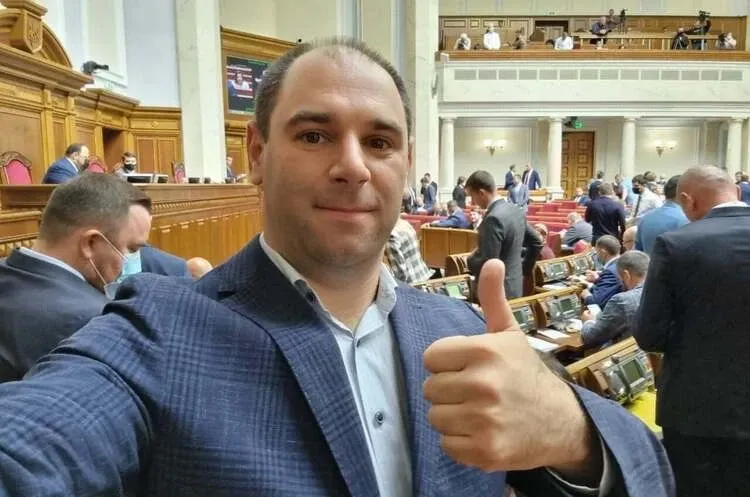
There is a simple way to find out who will end up paying for any economic idea. Ask not what the money will be spent on, but whose pocket it will come out of. That is exactly the question to put to People's Deputy Dmytro Kysylevskyi, the coordinator of the "Made in Ukraine" policy in the Verkhovna Rada.
He has proposed introducing in Ukraine a levy on non-critical imports, that is, on mobile phones, clothing and premium goods. The money from this levy, as he envisages it, is to fill an insurance fund that would compensate business for war risks. It sounds caring. But look closer, and it turns out that the losses businesses suffer from Russian strikes are to be shifted onto the person who came to the shop for a new phone or jacket.
Let us start with where the problem came from in the first place. The government came forward with an initiative to create an insurance fund that would make it possible to scale up insurance of business and industry against war risks. The need for it is real. According to estimates by the Ministry of Economy, cited by Economic Pravda, business losses from attacks this year alone may reach $10 billion. Kysylevskyi himself admits that the existing instruments are not enough. At present, he says, only two war-risk insurance programs are in effect. The first works for frontline regions, Kyiv and the Kyiv region, and covers losses of up to 30 million hryvnias. The second compensates the cost of insurance up to 5 million hryvnias. The scale of destruction far exceeds what these programs can handle, so coverage needs to be expanded.
What the new fund should look like was explained by Minister of Economy Oleksii Kravchenko. The fund should cover the first $10 million of losses from a Russian attack on a single enterprise, the insurance premium would be 2% of asset value, private insurers would be brought in, and the program could launch in early 2027. The minister puts the starting capital at $2-3 billion. And he immediately adds: without a tax increase or a mandatory contribution, the premium would have to exceed 20% of asset value. Kysylevskyi, for his part, describes the desired proportion like this: roughly one hryvnia from the state and 2-3 hryvnias from partners, so that the fund is truly large and solves the problem.
Note the figure of $10 million per enterprise. This is not insurance for a kiosk or a coffee shop by the metro. Kravchenko himself said bluntly that the current programs serve small and medium-sized business but do not meet the needs of large business. In other words, this is primarily about protecting the assets of big companies.
Next comes the question for the sake of which it is all being started: where to get the money. The government proposed raising VAT by one percentage point, from 20% to 21%. This idea did not win unambiguous support. According to Kysylevskyi, part of business supports the VAT increase, while another part opposes it. Here the deputy also allowed himself a procedural remark: in his view, such things should first be discussed with parliament, which will take on political responsibility for the decision, and only then brought into public discussion. A fair remark. It is only a pity that the author of the alternative himself brought it into the public arena without naming either a rate or a list of goods.
And now the alternative itself. "A good option for filling this fund would be an import levy on non-critical imports," says Kysylevskyi. He explains the logic this way. Ukraine currently imports a great many goods, weapons and fuel, and that is critical import. But there is also import of mobile phones, premium items, clothing, and other things. At the same time the country has a catastrophic trade imbalance, meaning imports far exceed exports. So if a levy on non-critical imports is launched, an alternative source for filling the fund will appear.
On the imbalance the deputy is right. According to data from the State Customs Service, in 2025 Ukraine imported goods worth $84.8 billion and exported $40.3 billion. The gap was about $44.5 billion. But let us look at what this import consists of. The largest item, machinery, equipment and transport, accounted for $34.1 billion. Chemical products accounted for $12.5 billion, fuel and energy $10.5 billion. That is, the bulk of imports is precisely what the country cannot fight or work without. Phones, clothing and "premium items" are merely a tail against this background. By taxing that tail you will not fix the trade imbalance. But you can collect money, and the only question is from whom.
And it will be collected from the buyer. This is the key thing to understand about any import levy on goods that are barely produced in the country. There are no Ukrainian smartphones on the shelves capable of replacing imported ones. So the levy will not protect the domestic producer and will not bring anyone back to Ukrainian goods. It will simply make the same imported phone more expensive. The one who pays will not be the importer, still less the foreign manufacturer, but the person at the checkout. In essence, this is the same consumption tax as a VAT increase, only with a narrower base and the pretty name "levy on non-critical imports." There is one more predictable trouble as well. The more expensive the legal import of phones and clothing becomes, the more profitable the gray import, on which no levy is paid at all.
Now let us put the whole picture together. Enterprises need protection from missiles and drones, and that need is real. But instead of looking for a mechanism in which the risk would be shared among business, insurers, partners and the state, a simple route is offered. The losses from the war settle in an insurance fund, and the fund is filled with the money of people buying phones and jackets. Profit meanwhile stays with the owners, while losses turn into a common burden on the consumer. This is the economy of losses in its purest form: losses are nationalized, while profit remains private. The war serves in it as a perfect expense item, because almost any new burden on citizens can be pushed through under its banner.
Ukraine, incidentally, already has experience with such a levy. In 2015 the country introduced an additional import levy: 10% on ready-made food products, drinks, tobacco and agricultural products and 5% on all other goods. It was introduced for exactly one calendar year, under the law on measures to stabilize the balance of payments, with reference to Article XII of the GATT 1994, which permits temporary restrictions for balance-of-payments reasons. On January 1, 2016 the law ceased to be in force. That is, even then, in a crisis, the levy was framed as a temporary measure for the sake of the currency balance, not as a permanent source for filling some fund.
The rates and the list of goods for the new levy have not yet been determined. According to Kysylevskyi, it is first necessary to find out how much funding international partners are ready to provide and what sum the state must supply. "Then it will be possible to calculate the need for money, and what percentage this import levy should be, and accordingly which goods could be subject to this levy," the people's deputy explains. And he adds that the government has realized that the idea of raising VAT by one percent has no unambiguous support, so it is looking for alternatives, and this is precisely one of them.
A curious sequence emerges. How much money is needed is unknown. How much partners will give is unknown. What the rate will be is unknown. Which goods will fall under the levy is also unknown. Only one thing is known: the consumer is the one proposed to pay. And if the VAT increase found no support because it would hit everyone, then a levy on phones and clothing will hit the same people, just through a different cash register.