In World War II, one in five Ukrainians died
At a time when Russian media are actively trying to portray Ukrainians as zealous supporters and collaborators of fascism and Nazism, this article presents data that shows the exact opposite.
- For Ukrainians the war began in March 1938, when, as a result of the Munich collusion, Hungarian troops, friendly to Germany, seized by force of arms the newly proclaimed Carpatho-Ukraine, which had previously been part of Czecho-Slovakia. In the fighting, Carpatho-Ukraine lost 430 killed and more than 400 wounded fighters. The total losses of the Sich fighters, according to various sources, ranged from 2,000 to 6,500 people. This is explained by the fact that most of them died not in clashes with regular Hungarian units, but in sweeps and executions of prisoners. The Hungarian population began hunting down groups of Sich fighters and killing them on the spot without trial or investigation. Sich fighters who were handed over to the Poles were also shot on the spot.
- In the September campaign of 1939, as many as 112,000 Ukrainians took on the Wehrmacht as part of the Polish Army; 7,834 soldiers of Ukrainian nationality were killed in battles with the Wehrmacht under Polish flags, and 16,000 were wounded in the September campaign.
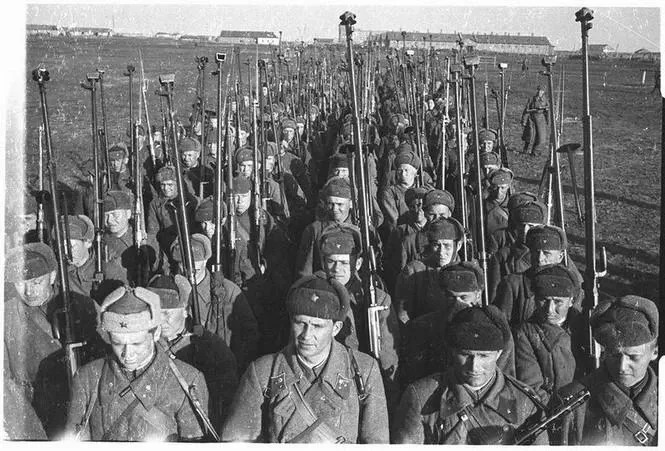
- In Ukraine, the Red Army widely practised the so-called early conscription of boys aged 16-17, who were thrown into battle at once, without training and often poorly armed, and as a result died in great numbers.
- Overall, one in five Ukrainians died in World War II. Of the servicemen conscripted in the summer of 1941, only 3% of the total survived.
- Ukraine's total demographic losses, counting the killed, victims of concentration camps, deported and evacuated, amount to no fewer than 14 million people. Of the 41.7 million people who lived in the Ukrainian SSR before the war, only 27.4 million remained by 1945.
- During the evacuation, about a thousand of Ukraine's best industrial enterprises were taken from Ukraine to the East and were not returned to their home cities after the war. These enterprises, for whose creation the Ukrainian people paid with their own blood (in the literal sense of the word) throughout the 1930s, became the basis for building the military-industrial complex in the eastern part of the USSR in the postwar years.
- In 1941, the Soviet authorities left scorched earth behind them as they retreated. During the evacuation, they blew up the Dnipro Hydroelectric Station in Zaporizhzhia. Neither the civilian population nor even the military units stationed nearby knew about it, and a considerable part of those units was swept away by the wall of water from the Dnipro dam. In Dnipro, a bread factory was blown up together with its workers. In Odesa, as the Red Army retreated, the seaside districts were flooded together with their residents, and wounded Red Army soldiers were thrown into the sea together with the ambulances. From Kharkiv, hundreds of members of the intelligentsia were taken away to be burned in a locked house. In Uman, people were walled up alive in a cellar. There are many such examples. And all of this was done not by Nazis, but by communists during their retreat.
- A correspondent of the Saturday Evening Post, who visited Ukraine in 1945, wrote with horror: What some try to portray as Russian glory was, above all, a Ukrainian war. No European country suffered more from the deep wounds inflicted on its cities, its industry, its agriculture, its manpower.
- World War II completely changed the ethnic face of Ukrainian society. Such formerly influential national minorities disappeared from Ukraine as the Germans (who left for the east of the USSR in 1941, 1944 and 1945), and the Crimean Tatars, who for centuries had been an important factor in the history of the Black Sea region and in 1944 were deported from Crimea to Central Asia. Of almost 3 million Ukrainian Jews, 800,000 survived the war (140,000 of them later left for Poland), and of 2.5 million Poles, fewer than 400,000 remained by 1950. By contrast, the number of Russians grew from 4 million before the war to 7 million in the first postwar decade.
- Ukrainians fought against Germany in other armies and military units as well; in particular, many of them served in the American and Canadian armies (40,000 of them in the latter). They also fought in the French Resistance. Thousands of Ukrainians served in the Polish army of General Władysław Anders and took part in military operations on the British side in Egypt, Libya and Italy. Western Ukrainians also made up 2% of the Polish Tadeusz Kościuszko Division and 70% of the Czechoslovak brigade of General Ludvík Svoboda.
References:ipress.ua
Share