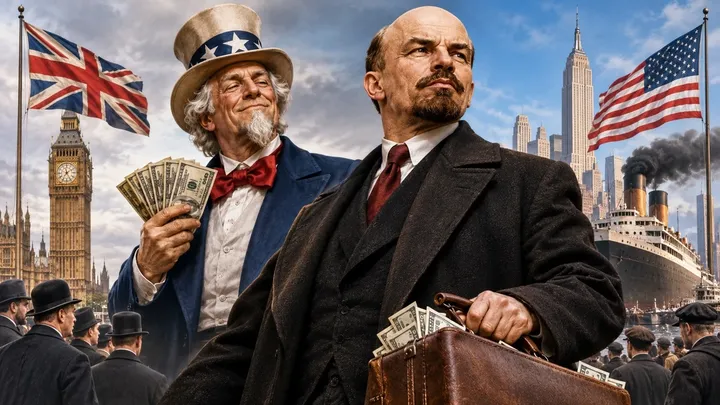
In the 19th century Russia worked for London. Its loans came from London and Paris banks, British firms owned its oil and mines, and British diplomacy decided where it would fight and where it would stop.
In 1914 Russia entered the war as Britain's ally in the Entente. Only a few years passed, and everything changed. The Soviet government sought recognition in Washington, its first international bank worked with New York bankers, and the gold it paid with abroad went through American banks. How did a country that London had raised for a whole century slip out of British control so quickly?
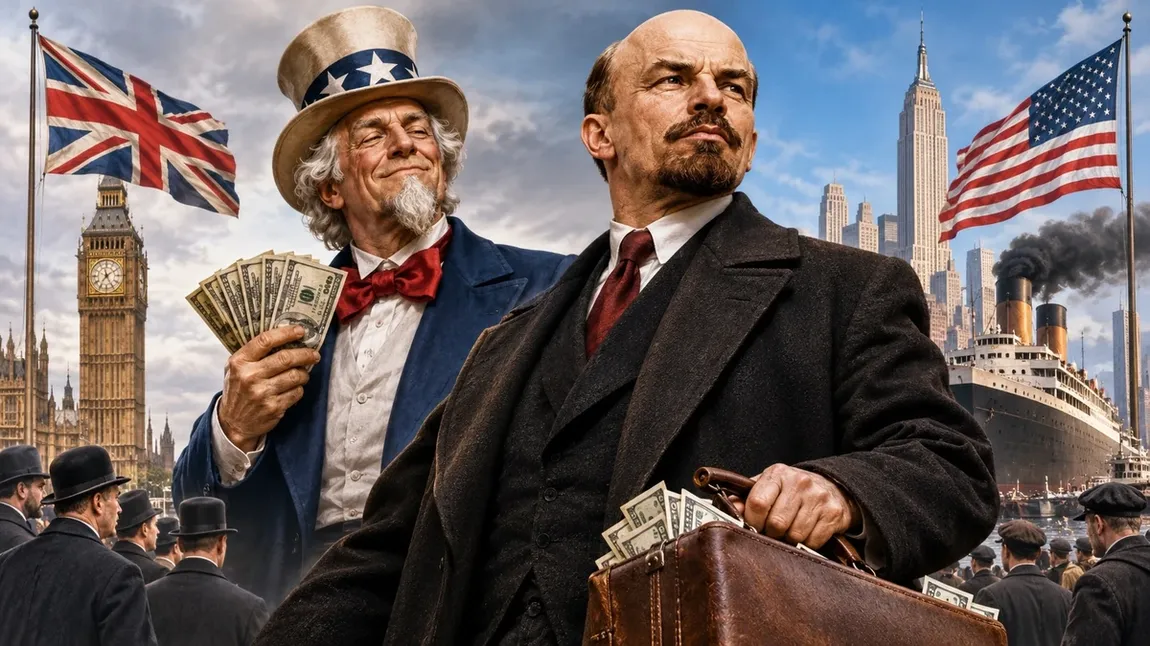
The answer determines how we understand the change of hegemons in the 20th century. I argue that the hegemon of the world is the one whose viceroy Russia serves. Moscow was never an independent center. It always served whoever ruled the world at the time, and each time it changed its master, the world changed its master too. In 1917 London still wore the hegemon's crown, but the biggest money was already in New York. From 1915 the House of Morgan lent to Britain and France, and London itself became a debtor to American bankers. The next step was for New York to take London's chief viceroy, Russia, away from it.
Who is subordinate to whom can be seen even in currency rates. Under the gold standard the pound sterling was worth 4.86 dollars. From January 13, 1916 to March 20, 1919 the pound never fell below 4.76, because the New York firm of Morgan paid for that. As an agent of the British Treasury, it bought up in New York every pound offered at that rate. This means that the February Revolution, the October coup, the Peace of Brest and the first year of the civil war in Russia all fell in a period when the British currency was being propped up by American money. In March 1919 Morgan stopped buying pounds, and the pound slid down. By 1920 it fetched only 3.18 dollars.
The official history explains the Bolshevik coup of 1917 by German money. According to this version, Germany stood behind Lenin, and nobody else. The German General Staff carried Lenin across its territory, the German government paid the Bolsheviks through the Stockholm bank of Olof Aschberg, and the German foreign minister Kühlmann himself wrote that only a constant stream of German money allowed the Bolsheviks to publish Pravda and expand their narrow party. All of this is true. But Germany was breaking up the Russian army for one purpose, to take Russia out of the war, and, by General Hoffmann's own admission, did not understand whom exactly it was transporting. Berlin did the dirty work and lost the war a year and a half later. Another player took advantage of the result.
In 1974 the American historian Antony Sutton found documents about this player in the archive of the US State Department. Sutton proves that Wall Street financiers were partners of the Bolsheviks, not their enemies, and that without money, diplomatic cover and political support from New York the Bolsheviks could well have been swept away. He explained this by the American bankers' pursuit of a monopoly on the Russian market. In the same documents I see something else. They show how American capital takes Britain's chief viceroy away from it.
Wall Street had experience of revolutions in foreign countries even before 1917. Sutton shows that weapons for the Mexican revolutionary Pancho Villa were paid for through New York's Guaranty Trust, a bank controlled by Morgan. Relying on Senate committee materials, Sutton concludes that Carranza's government, which adopted the world's first Soviet-type constitution, would hardly have survived without American arms. In other words, these people learned to finance revolutions long before Petrograd.
American capital came to Russia in 1916, still under the czar. Rockefeller's National City Bank and Morgan's Guaranty Trust lent money to belligerent Russia, although the State Department had warned them directly that this violated international law. Until then Russia had borrowed mostly in London and Paris, and the Americans entered this market without asking permission from either the British or their own government. Interestingly, the intermediary in these loans was the same Aschberg. In 1916 he arranged American credits for the czar, and in 1917 German money for the revolutionaries flowed through his bank.
Sutton also points out that part of the German money likewise came from New York. During the war Germany borrowed in New York banks for espionage and secret operations in North and South America. Through Guaranty Trust German agents obtained credits, including for buying newspapers that were supposed to write in Germany's favor. Yet the same bank financed the Allies, that is, Britain and France. New York money worked for both sides of the war.
From this point of view Sutton also explains the story of the so-called "Sisson documents." In 1918 Edgar Sisson, a representative of the American Committee on Public Information, bought in Petrograd a bundle of papers that supposedly proved that Lenin and Trotsky were German agents. The American government published them as genuine. It later turned out that almost all the documents were forged and that their German text was full of crude errors. In Sutton's view, the forgery served as a smokescreen. It convinced the public that only Germany stood behind the Bolsheviks, and distracted attention from what the Americans were doing in Russia.
The key figure in Sutton's version is Trotsky. In January 1917 he arrived in New York. By his own account, he lived there on fees from a poor émigré magazine. Yet Trotsky rented a good apartment, rode in a car with a chauffeur, and when he set off for Russia he had 10 thousand dollars on him. In April the British took him off the ship at Halifax in Canada, because they believed he was going to overthrow the government of an allied country. Pressure on behalf of Trotsky began insistently in Ottawa, and a month later the Admiralty in London ordered him released. The Canadian intelligence officer Lieutenant Colonel MacLean later wrote that his release was sought by the British embassy in Washington. The embassy acted at the request of the US State Department, and the latter, in turn, acted in the interests of someone else. In a note, the Russian publisher of Sutton's book draws a direct conclusion: Trotsky's money is more logically sought among those financiers who arranged his passage and sailed with him on the same ship.
Later Trotsky played a double game, and the State Department documents show it almost day by day. On March 20, 1918 a report reached the State Department from Moscow about Trotsky's interview with a Russian newspaper. In it Trotsky declared that Soviet Russia would not enter into any alliance with capitalist America, because that would be treason. Three days earlier, on March 17, Ambassador Francis had reported to Washington that Trotsky was asking the Americans for 5 officers to inspect his new army, as well as people and equipment for the railways. The American General Judson went to see Trotsky at Smolny without coordinating it with the ambassador. The landing of Entente troops at Murmansk in the spring of 1918 was approved by Trotsky himself. Sutton also recalls the Stalin trials of 1938, at which Trotskyists were accused of being paid agents of international capital. These accusations are usually considered an invention of Stalin's prosecutors, yet Sutton writes that they coincide with the documents he found.
Meanwhile the mission of the American Red Cross, which Sutton calls a Wall Street mission, was operating in Petrograd. During the war the Red Cross effectively passed into the hands of New York bankers, and John Foster Dulles later wrote that businessmen regarded it as their instrument. The 1917 mission had 24 people with officer ranks. Only 5 of them were doctors, while more than half of the mission consisted of lawyers and financiers from New York's business district. All the expenses were paid by William Boyce Thompson, a director of the Federal Reserve Bank of New York. His assistant later admitted that the Red Cross was only a cover for the mission. The doctors went home after a month, because they did not want to take part in its political work.
In Sutton's view, the mission was supposed to influence either Kerensky or the Bolsheviks, depending on who gained the upper hand, and thus open America's way to the Russian market and Russian resources. At first Thompson supported Kerensky. When the Bolsheviks overthrew Kerensky, Thompson switched to them within a few weeks. In December 1917 a telegram arrived at the Hotel Europe in Petrograd in which Morgan reported that he had transferred a million dollars to Thompson's account at National City Bank. Thompson's biographer writes that this money went to political purposes. When the Bolsheviks nationalized the banks, the Petrograd branch of National City Bank turned out to be the only bank in Russia untouched by the nationalization decree. Thompson himself, after returning to America, published in Russian a laudatory booklet, "The Truth about Russia and the Bolsheviks."
On his way home Thompson stopped in London with Morgan's partner Thomas Lamont and met Prime Minister Lloyd George. In December 1917 the British War Cabinet was firmly anti-Bolshevik. After the conversation with the Americans it decided to work with the Bolsheviks and sent an unofficial representative to Russia. This means Britain changed its policy toward Russia on the prompting of an American banker. Meanwhile in Washington the State Department instructed Ambassador Francis to gradually establish unofficial relations with the Bolsheviks, and Secretary of State Lansing told the French ambassador that America would not quarrel with any force that held power in Russia.
Thompson's deputy Raymond Robins, who remained at the head of the mission, explained the aim frankly. If the US recognized the Bolsheviks, he wrote, America would gain control over Russia's surplus resources and place its own controllers at all border points. This phrase contains the essence of the takeover. The resources go to the new master, his people stand on the borders, and the government inside the country may call itself Soviet, czarist or anything else.
Britain tried to keep its positions. In the spring and summer of 1918 Entente troops landed at Murmansk and Arkhangelsk, but, as the Russian publisher of the book notes, they landed against the Germans, not against the Bolsheviks. When Germany capitulated, the British left. Part of the czarist equipment from the local warehouses they carried away, part they gave to the Reds or sank in the sea. They left nothing to the White armies.
London made its last attempt with money. In the autumn of 1922 the Bolsheviks created their first international bank, Roskombank. A foreign consortium, mostly British, put money into it, and the British government, according to the State Department, also invested large sums. Yet the bank's foreign department, that is, all its external operations, was headed by Max May, a vice president of Guaranty Trust, and the bank's representative in the US became Guaranty Trust itself. The Swedish professor Gustav Cassel, an adviser to the bank, said that it would be reckless to abandon Russia with its resources to the whims of fate. This means that Britain put the money into Roskombank, and the Americans disposed of it.
Five years after the revolution the balance of forces had changed for good. Germany, which paid for the coup, lost the war and dropped out of the game. Britain, Russia's mistress in the 19th century, remained an investor who manages nothing. Its troops left the north, its policy toward Russia was dictated by the Americans, and its money in the Soviet bank passed under the control of a New York banker. America got what Robins had written about: the Russian market, Russian resources and access to a government that publicly cursed capitalism and secretly asked American officers for help. Formally the hegemon's crown passed to Washington only after the Second World War. New York took its Russian part from London a quarter of a century earlier, and London had handed control of its currency's rate to New York as early as 1916.
References:x.comcheslavsky.substack.commedium.com