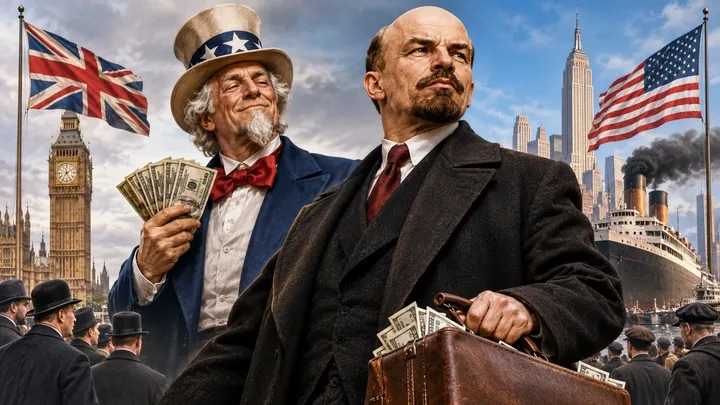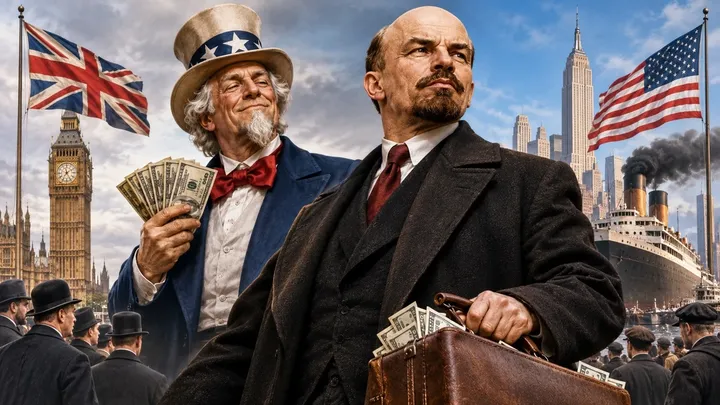
The Allies supplied the USSR with one and a half times more motor vehicles than the entire Soviet Union produced during the war years.
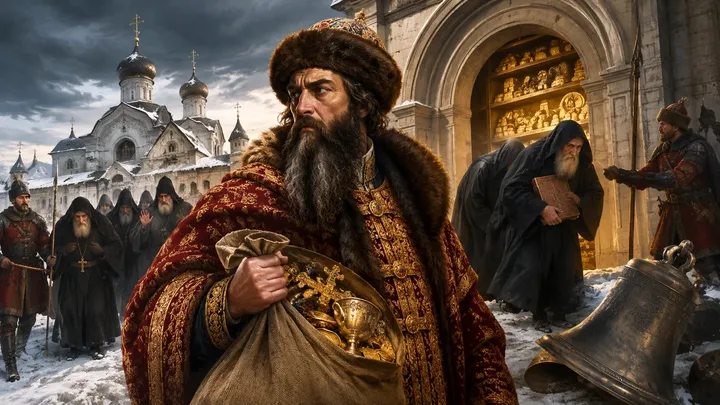
The story of how the Bolsheviks sold off paintings from the Hermitage collection is widely known. Canvases by Titian, Rubens, Rembrandt, Raphael, Velázquez, Botticelli, Van Eyck and Lucas Cranach the Younger went for next to nothing. They sold collectible weapons, Scythian gold and Sasanian silver.
All the money went into building tanks.
In total, masterpieces worth 20 million gold rubles were sold. But that was only the small fry. The main money was taken from a completely different place.
Do you know when the Allies opened the Second Front?
Do you know that while Great Britain and France were shedding blood together fighting Hitler, the USSR sat it out, waiting for a convenient moment to seize all of Europe?
Of course not!
These simple and clear truths will not appear in the new Russian history textbooks. What is more, voicing them could land you a criminal sentence for distorting history and belittling the role of the great Russian people in its solitary struggle against fascism!
But however that may be, in reality it was the Allies who saved the Soviet Union from defeat.
And the British and French opened the second front (in fact, the first) on September 3, 1939, by declaring war on Germany.
At that time the USSR was Germany's ally, supplying it with oil, cotton, grain, gasoline and other strategic goods needed to wage war. Together with Germany it carved up Poland and signed agreements on dividing Europe, coquettishly called the Molotov-Ribbentrop Pact – in reality, of course, it is the Stalin-Hitler Pact.
Even despite the swift defeat of France, the British were not afraid of war with Hitler and fought it practically alone.
"We shall go on to the end, we shall fight in France, we shall fight on the seas and oceans, we shall fight with growing confidence and growing strength in the air, we shall defend our island, whatever the cost may be, we shall fight on the beaches, we shall fight on the landing grounds, we shall fight in the fields and in the streets, we shall fight in the hills; we shall never surrender." In the Battle of Britain alone (July 9 – October 30, 1940) the British destroyed more than 1,700 German aircraft. And in the Battle of the Atlantic, which drew off colossal resources of the Reich, the Allies sank more than 700 German submarines. The submarine fleet was Germany's elite – nothing was spared for it. And every submarine means dozens of tanks and aircraft that were never built.
The Allies opened yet another front on July 26, 1941, by freezing all Japanese assets in the United States and imposing an embargo on oil deliveries to Japan. In this way they provoked into war a Japan deprived of 95% of all the oil supplied to the country. By doing so they saved the Soviet Union from a Japanese attack on our Far East. That made it possible to transfer Siberian divisions to Moscow at the hardest moment for the country.
The Allies did not let the Germans reach Middle Eastern oil, vital for the Reich's army. During the Battle of Kursk the Allies landed in Sicily and began the Italian campaign, which kept Hitler from moving reserves to Russia. And already in 1943 the Allies forced Italy out of the war.
Allied aviation methodically destroyed German industry and infrastructure, forcing Germany to keep a huge air fleet in Europe, while fear of an Allied landing tied down serious ground forces.
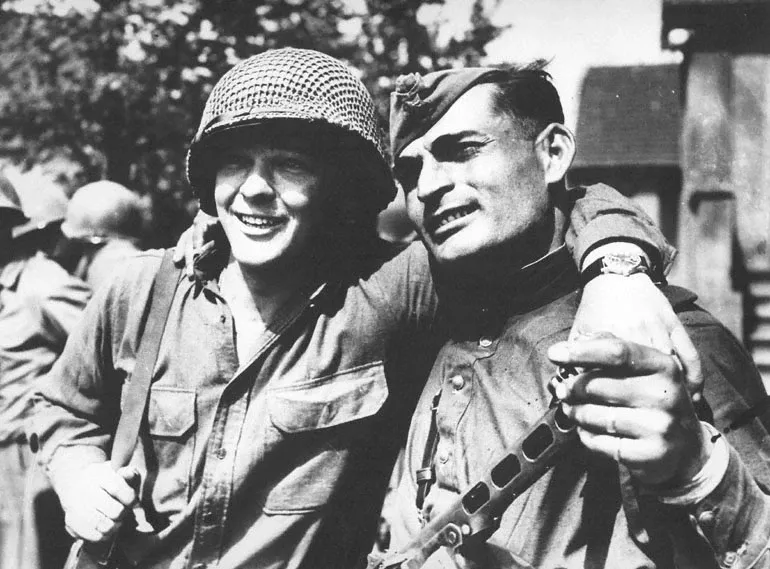
From November 1941 the Soviet Union was also connected to American Lend-Lease aid. Harriman, instructing the US delegation, kept repeating: "Give, give and give, without counting on repayment, with no thought of getting anything in return."
American equipment was delivered under Lend-Lease fully outfitted – with gear and even small arms for the crew.
The USSR received aid worth 11 billion of those dollars, which at today's rate equals no less than 120 billion dollars!
18 thousand aircraft and more than 11 thousand tanks. 44 thousand jeeps. Zhukov on the Allies' help: "We received 350 thousand motor vehicles, and what vehicles they were!.. We had no explosives, no gunpowder. Nothing to load rifle cartridges with. The Americans truly bailed us out with gunpowder and explosives. And how much sheet steel they kept sending us. Could we have quickly set up tank production if it were not for American help with steel?"
We hauled our artillery on American trucks. The main chassis for the legendary "Katyushas" became the American Studebakers.
The Allies plugged practically all the holes in Soviet industry with their deliveries. A small technical digression. The base of a tank turret is a huge bearing with an equally huge gear ring around it. The caliber of the gun that can be placed in the turret depends directly on the diameter of this bearing. Well, in the whole of the Soviet Union there were only TWO MACHINE TOOLS capable of making a turret ring for a gun of eighty-five millimeters or larger. The T-34 got its larger turret with the eighty-five-millimeter gun only after receiving a third machine tool. We also received a great deal of rolled armor plate from the Allies for tank production.
In general, by January 1942 exactly half of our industry was left. The production of gunpowder and explosives suffered very badly. Of three aluminum plants only one remained – the smallest, in the Urals. Aluminum production requires an enormous amount of electricity. That is why the plants stood on the Dnieper and the Volkhov, next to power stations. And then the Germans came there. During the war our country produced 263 thousand tons of aluminum, and received 328 thousand tons from the Allies. That is, at least half of our aircraft were made of American and Canadian aluminum.
More than 500 warships and boats were delivered to the Soviet Navy under Lend-Lease. Among them were 28 frigates, 89 minesweepers, 78 large submarine chasers, 60 patrol boats, 166 torpedo boats, as well as 43 landing craft.
The Allies supplied us with one and a half times more motor vehicles than the entire Soviet Union produced during the war years. We did not produce our own locomotives in the war years – the Americans supplied us with 1,900 steam locomotives and 66 diesel-electric locomotives. The Americans supplied us with 10 times more railway cars than we produced in wartime. A third of all explosives came from Allied aid. The deliveries doubled our production of cobalt and tripled our production of tin. American canned stewed meat saved hundreds of thousands of Soviet people from starving to death.
The USSR received four and a half MILLION tons of food!
And we received all of this practically for free. The US did not demand compensation for military equipment destroyed in combat.
The Lend-Lease Act provided for payment only for civilian deliveries: railway transport, power stations, steamships, trucks and other equipment that was in the recipient countries as of September 2, 1945.
The Americans reduced the amount of the debt several times, but Russia has not paid it off even today.
References:militera.lib.ru