In Russia, people tend to talk about the Great Patriotic War rather than the Second World War.
In Russia, people tend to talk about the Great Patriotic War rather than the Second World War.
Ever wondered why?
After all, the Great Patriotic War is an integral part of the Second World War, which began a full 2 years before 22 June 1941.
Let's look at how it began:
19 August 1939
After wavering between two possible alliances, with the French and British or with Germany, the USSR chose to cooperate with Germany and signed an economic agreement on the supply of German military technology to the USSR in exchange for raw materials.
23 August 1939
Just 4 days later, the USSR and Germany concluded a political agreement in Moscow on non-aggression and the partition of Europe, the so-called Molotov-Ribbentrop Pact.
Under the treaty, the USSR received:
- Finland
- Lithuania
- Latvia
- Estonia
- Half of Poland
- part of Romania, namely Bessarabia
Moscow, fittingly, was the place where the pact was signed.
This historic event is the starting point of the Second World War.
1 September 1939
Germany attacks Poland from the West.
17 September 1939
The USSR attacks Poland from the East, but just look at the sauce it serves its impulse with:
At 3 a.m. on 17 September, Molotov handed the Polish ambassador a Note from the Soviet government
The Polish-German war has revealed the internal bankruptcy of the Polish state.
Within 10 days of military operations, Poland lost all of its industrial regions and cultural centres. Warsaw, as the capital of Poland, no longer exists. The Polish government has collapsed and shows no signs of life.. This means that the Polish state and its government have in effect ceased to exist. Consequently, the treaties concluded between the USSR and Poland have ceased to be in force...
Nor can the Soviet government remain indifferent to the fact that the kindred Ukrainians and Belarusians living on Polish territory, abandoned to their fate, are left defenceless. In view of this situation, the Soviet government has instructed the High Command of the Red Army to order the troops to cross the border and take under their protection the lives and property of the population of Western Ukraine and Western Belarus.
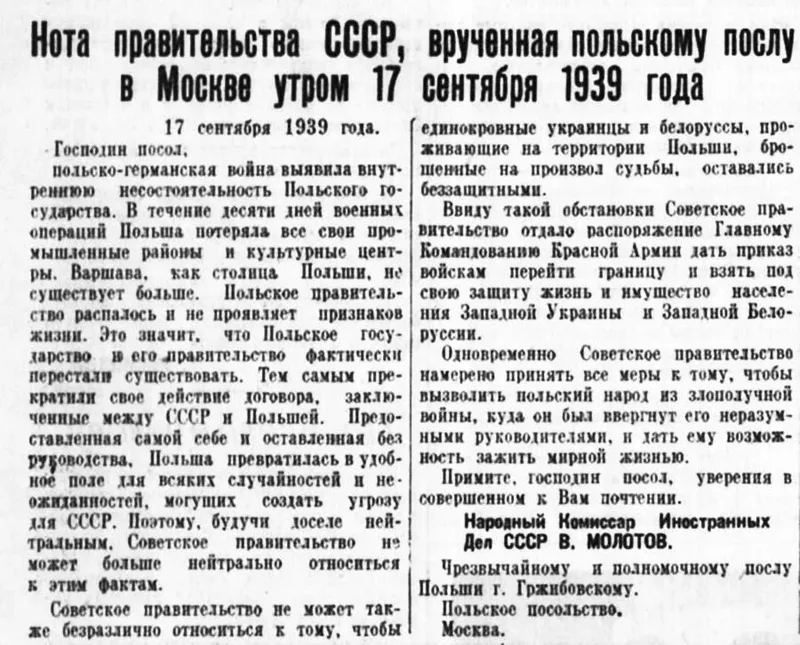
I would straight away introduce a new term: charitable occupation.
6 October 1939
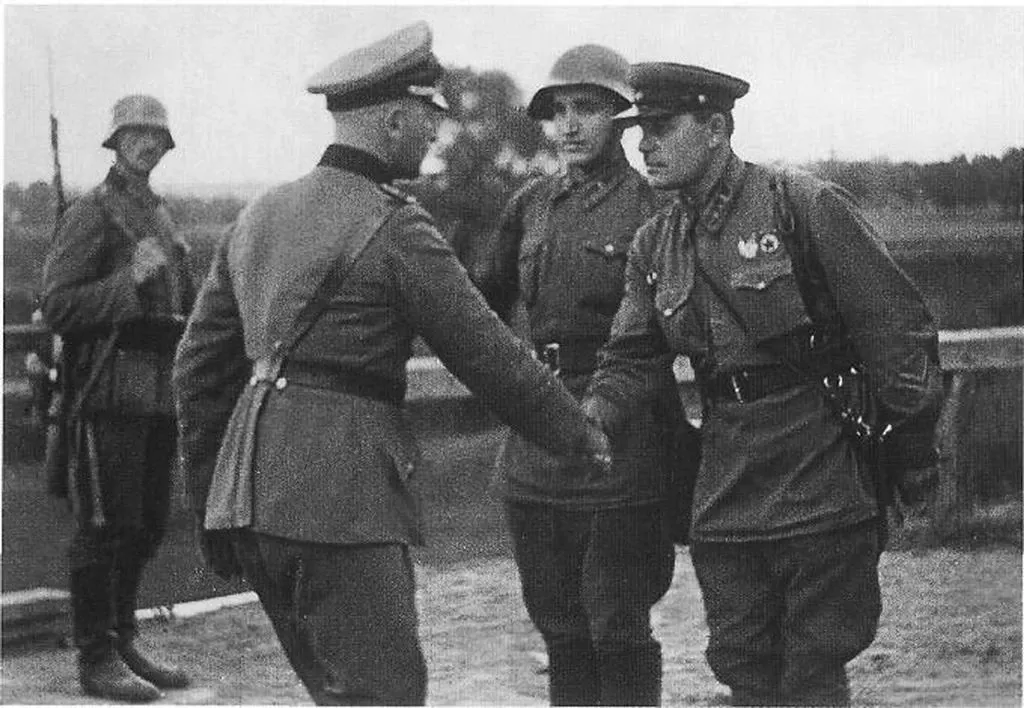
Poland is completely occupied and divided between Nazi Germany and the USSR. On the Soviet-occupied side, thousands of Polish prisoners of war are shot and tens of thousands are sent to concentration camps.
6 October 1939
Hitler tries to conclude a peace agreement with Great Britain and France, but stresses that the fate of Poland will be decided solely by Germany and the USSR.
Hitler was refused, and he finally decided to attack France.
30 November 1939
In accordance with the Nazi-Soviet treaty, the USSR attacked Finland.
But fierce Finnish resistance and a cold winter ended in defeat for the USSR on 13 March 1940.
The USSR suffered five times the losses of the Finns.
11 February 1940
A supplementary economic agreement between the USSR and Germany on expanding trade is signed.
The USSR increased its deliveries of raw materials to Germany, which were absolutely critical for the advance of German troops in Europe.
A sort of Soviet-Nazi Lend-Lease.
April 1940
Germany swiftly occupied Denmark and Norway.
10 May 1940
Germany attacked France and a number of neighbouring countries (Belgium, the Netherlands and Luxembourg).
On the same day, Great Britain occupied Greenland, Iceland and the Faroe Islands, which belonged to Denmark, to prevent Germany from gaining control over them.
10 June 1940
Italy also attacks France, declaring war on Great Britain and France.
June 1940
In accordance with the Nazi-Soviet Pact, the USSR occupied Lithuania, Latvia and Estonia. Later it also occupied part of Romania, Bessarabia.
Subsequently, mass repressions began in the Baltic states, along with deportations of the local population to concentration camps.
Which in the end would make the populations of these countries welcome the appearance of the Wehrmacht on their territory in the war against the Soviet Union.
22 June 1940
France capitulated and was divided between Germany and Italy.
A neutral government was formed in France, but politically the country was under the control of the Axis powers.
3 July 1940
The British attacked the French navy, formally an ally.
19 July 1940
Hitler once again offered to conclude a peace treaty and end the war between Germany and the Allies.
Hitler was refused.
Whereupon Germany launched an air campaign against Great Britain to suppress its air force.
Notable is Directive No. 17 of this campaign, which forbade the Luftwaffe to bomb residential areas and focused exclusively on British air force targets and military-industrial facilities.
Mass bombing was permitted only on the direct order of the Führer.
But the campaign was not effective, and Great Britain responded by bombing Berlin.
After which Hitler began more massive bombing, this time of British cities.
The war with Britain also moved to the naval theatre of operations.
December 1940
Roosevelt, who had promised during the election not to involve the US in wars, spoke out in condemnation of Hitler's policy and launched the Lend-Lease programme of supplying weapons, equipment, technology, fuel and food to the allies, chiefly Great Britain.
August 1940
A crisis in relations between the allies.
The USSR and Germany, I mean.
The USSR stopped its deliveries of raw materials, violating its obligations under the Nazi-Soviet economic pact.
The reason was Stalin's fear that Hitler might quickly dispose of his opponents in Western Europe, with no further agreements on redividing spheres of influence between the USSR and Germany.
This fear was reinforced by disputes over the borders in the divided countries.
At the end of August the disputes between the USSR and Germany were settled, and the USSR also became convinced that, now that the US had entered the war in the form of Lend-Lease, the war would not be easy or short for Germany.
And that would give time to reach new agreements.
October - November 1940
The USSR was formally not a member of the Axis, although de facto it was.
Stalin wanted to resolve this uncertainty by signing the relevant agreements.
As a result of this, and because Hitler himself looked favourably on including the USSR as the 4th Axis power, negotiations on the matter were held in the autumn of 1940.
Hitler had considered including the USSR in the Axis earlier too, even before signing the agreements with Italy and Japan.
But at that moment no agreement with the USSR had been signed, although the Axis pact did contain a clause guaranteeing the security of the USSR.
But that was not enough, and in the autumn of 1940 negotiations were held on including the USSR as the 4th member of the Axis.
Molotov conveyed to Stalin Hitler's wish to include the USSR, which flattered the Soviet leader.
But, unfortunately, the negotiations failed to succeed because of the USSR's excessive demands for access to the Bosphorus and for spheres of interest in Bulgaria and Turkey.
The USSR's current and potential territorial demands were too excessive and potentially dangerous for Hitler.
He feared that this would give the USSR more room for manoeuvre in the event of a war with Germany.
As a result, both Germany and the USSR began preparing for war, having failed to conclude a pact admitting the USSR to the Axis countries on Soviet terms.
Three facts stand out from all this:
- All the territorial conquests the USSR made during the war on the side of Nazi Germany remained with the USSR. That is part of Poland, part of Romania, Estonia, Lithuania and Latvia.
- The Soviet territorial claims on Turkey, which were one of the reasons for Hitler's refusal to admit the USSR to the Axis, later became one of the reasons for the start of the Cold War with the US and Europe.
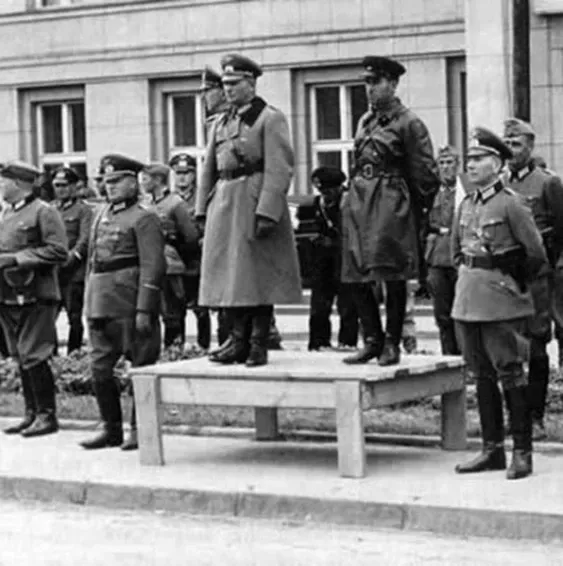
- And the USSR's participation on the side of Nazi Germany was no smaller than the participation of the US on the side of the Allies. Just as the US helped the Allies through Lend-Lease, the USSR gave Hitler substantial help with raw materials during the war. In August 1940 the disruption of supplies from the USSR was even critical for Germany. Just as the US did on the side of the Allies, the USSR also took part in combat operations on the side of the Nazis: the Wehrmacht and the Red Army held joint parades, and the USSR fought on other European fronts within the framework of the Soviet-Nazi agreements.
The only difference: unlike the US, the USSR got occupied territories as a bonus.
References:facebook.com