There is no baseness greater than the authorities waging war on little children with the full might of the punitive apparatus.
There is no baseness greater than the authorities waging war on little children with the full might of the punitive apparatus. Relying on the directives of the Politburo of the Central Committee, and of Lenin and Stalin personally, the Bolsheviks created a special system of disgraced childhood . This system had at its disposal children's concentration camps and colonies, mobile reception and distribution points, and special orphanages and nurseries.
The children were supposed to forget who they were, where they came from, and who and where their parents were.
It was a special, children's GULAG...
From the memoirs of the Kalmyk poet David Kugultinov:
I crossed the threshold: children. An enormous number of children under 6. In tiny padded jackets, in tiny padded trousers. And numbers on their backs and chests. Like prisoners. These are the numbers of their mothers. They were used to seeing only women around them, but they had heard that there are fathers, men. And so they ran up to me, crying out: Papa, papochka . This is the most terrible thing, when children have numbers. And on the barracks: Thank you, Comrade Stalin, for our happy childhood ...
If we turn to the very first names and surnames in the children's execution register, we have to begin with the czar's family, with the execution of Czar Nicholas II and his family in the Ipatiev House in Yekaterinburg. This execution was organised by Lenin's government. Later it would organise millions more executions .
In 1919 in Petrograd, relatives of officers of the 86th Infantry Regiment, which had gone over to the Whites, were shot, children among them. In May 1920 the newspapers reported the execution in Yelisavetgrad of four girls aged 3 to 7 and the elderly mother of one of the officers.
In 1920 Arkhangelsk was called the city of the dead , where Chekists shot children aged 12 to 16.
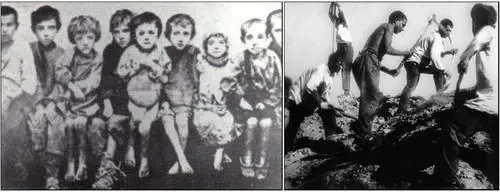
Nobody needed photographs of little slaves. Only by chance could a man with a camera (even one in an NKVD uniform) end up where the Soviet authorities were grinding down tens of thousands of children of their own people. Still, a few such pictures have survived in the archives.
There is no forgiveness for what is recorded in Yezhov's operational order No. 00486 of 15 August 1937, On the operation to repress the wives and children of traitors to the Motherland .
I will quote some provisions of this monstrous document (keeping its style):
Preparation of the operation
It begins with a thorough check of every family targeted for repression. Additional compromising materials are collected. Then, on that basis, the following are drawn up:
- a general file on the family ;
- a separate brief file on socially dangerous children over 15 years of age who are capable of anti-Soviet actions;
- lists by name of children under 15, separately for preschool and school age.
The files are reviewed by the people's commissars of internal affairs of the republics and the heads of the NKVD directorates of the territories and regions.
The latter:
- give sanction for the arrest and search of the wives of traitors to the motherland;
- determine measures regarding the children of the arrested women.
Carrying out arrests and searches
Wives who were in a legal or de facto marriage with the convicted man at the moment of his arrest are subject to arrest. Also subject to arrest are wives who, although divorced from the convicted man at the time of his arrest, were involved in his counter-revolutionary activity, harboured him, or knew of the counter-revolutionary activity but did not report it to the authorities. After the arrest and search, the arrested wives of the convicted are escorted to prison. At the same time, in the manner indicated below, the children are taken away.
Procedure for processing cases
An investigative file is opened on each arrested woman and on each socially dangerous child over 15 years of age. These are sent for review to the Special Council of the NKVD of the USSR.
Review of cases and measures of punishment
The Special Council reviews the cases of the wives of traitors to the motherland and of those of their children over 15 years of age who are socially dangerous and capable of committing anti-Soviet actions. Socially dangerous children of the convicted, depending on their age, degree of danger and possibility of correction, are subject to confinement in camps or corrective labour colonies of the NKVD, or to removal to special-regime orphanages of the People's Commissariats of Education of the republics.
Procedure for carrying out sentences
Convicted socially dangerous children are sent to camps, corrective labour colonies of the NKVD or special-regime homes of the People's Commissariats of Education of the republics by personal assignments of the GULAG of the NKVD for the first and second groups, and of the Administrative and Economic Directorate of the NKVD of the USSR for the third group.
Placement of the children of the convicted
All orphaned children left after the conviction are to be placed as follows:
- children aged from 1–1.5 years to 3 full years in orphanages and nurseries of the People's Commissariats of Health of the republics, in the places of residence of the convicted;
- children aged from 3 full years to 15 years in orphanages of the People's Commissariats of Education of other republics, territories and regions (according to the established deployment) and outside Moscow, Leningrad, Kyiv, Tbilisi, Minsk, and coastal and border cities.
For children over 15 years of age, the question is to be decided individually.
Infants are sent together with their convicted mothers to the camps, from where, upon reaching the age of 1–1.5 years, they are transferred to orphanages and nurseries of the People's Commissariats of Health of the republics. If relatives (who are not being repressed) wish to take the orphans into their full care, this is not to be obstructed.
Preparation for receiving and distributing the children
In each city where the operation is carried out, reception and distribution points are to be specially equipped, to which the children will be delivered immediately after the arrest of their mothers, and from which the children will then be sent on to orphanages.
Time and again I reread this order, and each time I am thrown into confusion: is this not a forgery? Alas, that is how it was.
As of 4 August 1938, 17,355 children had been taken from repressed parents, and another 5,000 children were slated for removal.
On 21 March 1939 Beria reported to Molotov that in the ...corrective labour camps 4,500 children of nursery age were with their imprisoned mothers; he proposed taking them away from their mothers and adhering to this practice in future. The children began to be given new names and surnames .
One of the pretexts for yet another tightening of criminal legislation concerning children was a letter from Voroshilov of 19 March 1935, addressed to Stalin, Molotov and Kalinin. A nine-year-old boy had attacked the son of Moscow's deputy prosecutor, Koblents, with a knife. Voroshilov wondered: why not shoot such scoundrels?
Responding to this request to shoot such scoundrels , on 7 April 1935 the Central Executive Committee and the Council of People's Commissars of the USSR issued the decree On measures to combat crime among minors . It stated: minors, starting from the age of 12, are to be brought before a criminal court with the application of all measures of criminal punishment . In connection with this, the question arose locally of whether the supreme penalty could be applied to children. A clarification from the Politburo of 20 April 1935 confirmed that the measures of criminal punishment also include the supreme penalty (execution by shooting).
In May 1941 the NKVD issued an order to create a network of agents and informers in labour colonies for adolescents. The residents were to be members of the VKP(b)...
A glaring example of the falsification of charges against minors is the case of 16-year-old Yuri Kamenev, shot by the sentence of the Military Collegium of 30 January 1938. Without any evidence of his guilt, the Military Collegium stated in its sentence:
Kamenev, who was under the ideological influence of his father, the enemy of the people L. B. Kamenev, absorbed the terrorist views of an anti-Soviet, Trotskyist organisation; embittered by the repression applied to his father as an enemy of the people, Yuri Kamenev in 1937 in the city of Gorky expressed among students terrorist intentions with regard to the leaders of the VKP(b) and of Soviet power .
In the years of the Patriotic War the Hitlerites drove children in one direction, to Germany, and the Stalinists in another, to Central Asia, Kazakhstan, the East. To distant lands went the children of Germans, Chechens, Kalmyks, Ingush, Karachays, Balkars, Crimean Tatars, Bulgarians, Greeks, Armenians, Meskhetian Turks, Kurds, and after the war, of Ukrainians, Estonians, Latvians and Lithuanians.
As of April 1945, 34,700 Karachay children under 16 had ended up in Kazakhstan, Kyrgyzstan and Uzbekistan. 46,000 children from Georgia were brought to Uzbekistan. In the first years of life in the new places, mortality among the resettled reached 27 percent a year, and these were mostly children...
Alexander YAKOVLEV
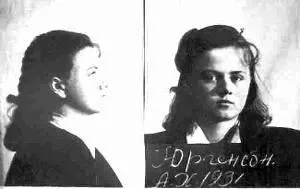
An enemy of the Soviet system: 15-year-old schoolgirl Ayli Jürgenson from Tallinn.
Sentenced to be shot for desecrating a monument to the Soviet liberators , she served eight long years in the camps.
Hundreds of thousands of children of the peoples of the Caucasus met a hungry death together with their deported parents. They perished by whole auls and districts. The genocide of the peoples of the Caucasus is a whole historical layer.
On 12 May 1938 they came for me. Get yourself ready and get the child ready. You are under arrest . I replied that I wanted to hand my son over to my parents. In response I heard: We have no time to bother with handing over the boy . Then I told them that I would not go, that I would scream and fight for as long as I had the strength. When they finally learned that my parents lived very close by, they allowed Sasha to run and bring them...
Two days after my arrest an NKVD employee came to my parents and said that the boy had been handed over to them unlawfully and that he had to take him away. He stressed: The child was raised in a family of enemies of the people, and we are obliged to re-educate him .
The orphanage for the children of enemies of the people was on Pervaya Rechka, which was the name of a place twenty kilometres from Vladivostok. It was a converted pioneer camp, now surrounded by a very high fence with barbed wire, with a checkpoint, an armed guard and bars on the windows. The slogans Thank you, beloved Stalin, for our happy childhood remained.
One day a commission arrived. The lice-ridden, dirty children, covered in scabs, were ordered to be bathed. During one of these baths in Amur Bay, Sasha ran away...
References:facebook.com