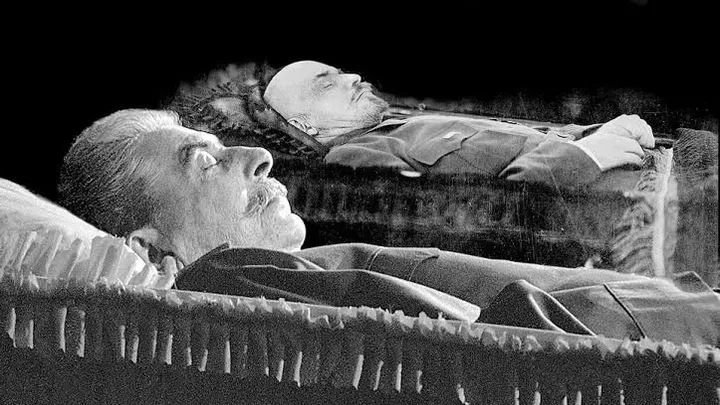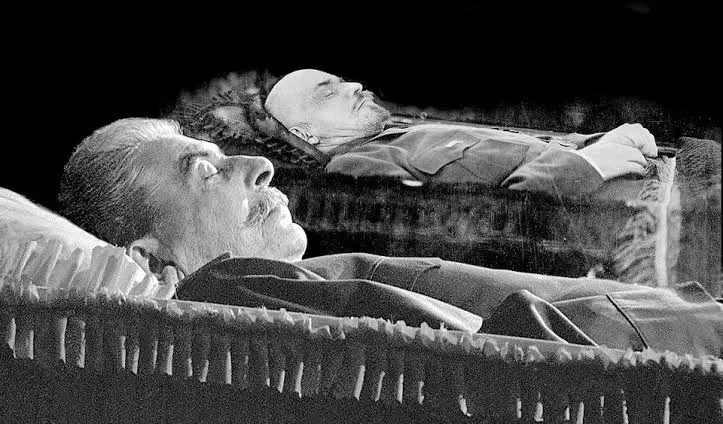
It sounds like a farce, but the state that called itself the world's first atheist one placed two embalmed bodies in the very center of its capital, bodies that were in essence objects of worship, or, simply put, of a cult.
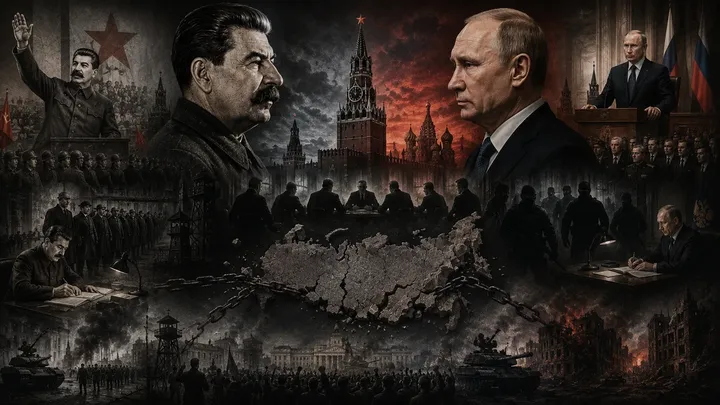
What is far sadder and funnier is that more than 60 years after one of those bodies was carried away at night behind plywood screens, Moscow is again stamping his profile on metro walls and writing his name on airport signs.
It is important to understand that the problem here is not Stalin as a person. The question is how Moscow's power itself is built. It needs a symbol of a cult, an object of worship, though not for the sake of faith. It needs a sacred symbol as inventory: something that can be put on display, shoved into a storeroom, and then taken out again when needed. The procedure that took place on the night of 31 October to 1 November 1961 was telling: one such figure was taken down from the altar and moved to another shelf, further back.
The Soviet Paradise with Mummies
To understand why Joseph Stalin was expelled from the mausoleum, we need to recall how this central temple of communism was built. In January 1924, when Lenin died, the funeral commission was headed by Felix Dzerzhinsky. It is interesting that the man who ran the Cheka also ran the creation of the new state's main shrine. From the very first day, everything sacred in Moscow was in the hands of the secret police.
The body of the leader of the revolution was to be preserved. Among those who insisted on it was Leonid Krasin, who seriously believed that Lenin could be brought back to life, since Soviet science would surely learn to raise the dead. Just think about it! The Bolsheviks, who had blown up thousands of churches, built a temple of their own and set their own Lazarus on a pedestal. Lenin, who in his lifetime mocked the "God-builder" comrades, became their chief relic after his death.
There is an important detail here that is usually overlooked. Throughout its history the Church took real wealth from people, promising in return a heavenly paradise after death. The Bolsheviks changed nothing in this scheme in essence. They simply moved paradise from heaven to earth and promised to build it in the near future. They took bread, land, life, and in exchange handed out a ticket to a "bright future." The mausoleum became the sacred altar of this deal: there lay the very prophet who had promised to build an earthly paradise in the near future. But however comfortable he felt on his pedestal, in March 1953 a second one was laid beside the immortal leader of communism. Two words appeared above the entrance: LENIN and STALIN. The Soviet pantheon now held two saints awaiting imminent resurrection.
The Congress That Promised Paradise
Now imagine October 1961. The 22nd Congress of the CPSU is in session at the Kremlin Palace of Congresses. It adopts a new party program, and it says in black and white: the foundations of communism will be built by 1980. Nikita Khrushchev utters a phrase that would later be quoted with a bitter smirk: the present generation of Soviet people will live in paradise, that is, under communism.
For the first time, earthly paradise received a concrete delivery date, like an apartment building. And it was this very congress, having promised paradise in 19 years, that unexpectedly decided to evict one of the gods from its main shrine.
Moreover, on 30 October, the very day the delegates voted to carry Stalin out, the most powerful bomb in human history, about 50 megatons, was detonated over Novaya Zemlya. Paradise was promised for 1980, while hell was already being tested now, on an Arctic archipelago.
The question of Stalin was not on the congress agenda. It "arose" at the last moment, and arose according to all the rules of Soviet stagecraft. The first secretary of the Leningrad regional committee, Ivan Spiridonov, took the rostrum and, on behalf of the Leningrad delegation, conveyed a proposal from the working people: from the Kirov Plant, the Nevsky Machine-Building Plant and others. The working people, it turned out, were asking for Stalin to be removed from the Mausoleum. Next to speak was Pyotr Demichev for Moscow, then party members from Georgia and Ukraine. They needed the voices of both capitals and the outlying republics so that the performance would look like an expression of the people's will.
Note this device. "At the request of the working people" in 1961, "at the request of residents" today. Moscow's power never does anything by itself. It only ever responds to an "appeal from citizens" that it wrote itself.
And then Dora Lazurkina took the rostrum, an old Bolshevik with almost 60 years of party membership, nearly 20 of which she had spent in camps and exile. And at the congress of an atheist party she uttered a phrase worthy of the leaders of a communist cult. The old Bolshevik told of the result of a spiritualist séance: "Yesterday I consulted with Ilyich." Lenin, according to her, appeared to her as if alive and said that it was unpleasant for him to lie beside a man who had brought the party so much misfortune.
The hall applauded. The leader of the communist sect had made his will known through an initiate, and the adepts unanimously carried it out. The resolution recorded that the further presence of Stalin's sarcophagus in the Mausoleum was deemed inappropriate: because of violations of Lenin's precepts, abuse of power and mass repressions against honest Soviet people. Note: not crimes against people in general, but against "honest Soviet" ones. Those who were not honest and Soviet enough, apparently, needed to be repressed.
A Special Operation Under Plywood
What follows is what Moscow today would call a special operation. On the evening of 31 October Red Square was cordoned off. The official reason was impeccable: a rehearsal of the parade for 7 November. Barriers were put up, passage was blocked, and the Mausoleum was covered with plywood screens so that no one could see anything.
The reburial commission was headed by Nikolai Shvernik. This is a figure who explains a great deal by himself. From 1946 to 1953 he was the formal head of state, chairman of the Presidium of the Supreme Soviet, that is, the one who signed decrees while Stalin was alive. And in 1961 he headed the Party Control Committee, the party's inquisition. The man who had put his signature under the leader's will was now carrying out his body.
The commission also included Alexander Shelepin, the chairman of the KGB. The circle closed. In 1924 the Chekist Dzerzhinsky laid the first god in the sanctuary. In 1961 the country's chief Chekist attended the eviction of the second. The shrine remained in the hands of the same people; only the signboard on their agency had changed.
Khrushchev, according to memoirs, dropped a phrase full of calm cynicism: the commandant of the Mausoleum knows where to dig the grave. The Kremlin Commandant's Office assigned 6 soldiers, who were given shovels and an order to dig. Another 8 officers were to carry out the coffin.
The body was transferred from the glass sarcophagus into a plain wooden coffin covered with black and red cloth. And then came a scene worth a whole dissertation on the Soviet system. The commandant of the Mausoleum, Mashkov, removed the Hero of Socialist Labor Gold Star from Stalin's uniform. Then he cut off the gold buttons and sewed on brass ones.
The gold was taken off the leader and put into a safe. The leader was sent to the afterlife with cheap brass.
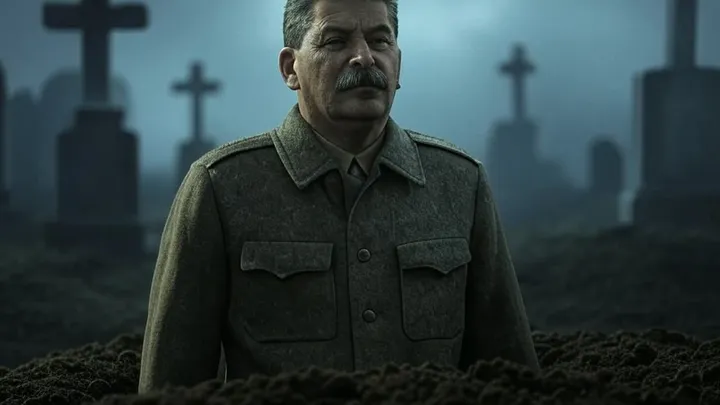
The confiscated regalia were handed over to the Kremlin's Guard Room, where the awards of all those buried by the wall were kept, sealed and put away. The coffin was lowered on ropes into a grave behind the Mausoleum, and a slab of white marble was laid on top. Relatives were not invited. There were no speeches. There were no honors. The whole procedure of removal from the eternal symbols took about an hour. The commission members returned to the Kremlin and signed the act.
The inscription STALIN on the façade was covered that same night with a white band bearing one word: LENIN. Later a permanent inscription was carved in the marble.
An irony of the calendar: in the West that night children dressed up as the dead and went from house to house. And in Moscow a dead bloodsucker and ghoul was demoted that same night and thrown into a pit. Evidently without forgetting to drive an aspen stake into his chest.
A Morning Without Panic
On the morning of 1 November the barriers were removed and the guards withdrawn. People walked across the square and saw one surname on the Mausoleum instead of two. Visitors passed Lenin's sarcophagus in silence, as if nothing had happened.
There was no unrest. No one came out to defend the leader of communism, before whom just 8 years earlier crowds had wept, crushing each other to death at his funeral. The guard at the new grave was removed already on the second day. No one intended to approach the mound, and it could not even be seen from the square.
Why? Because it was not faith but fear. A believer defends a shrine. A subject defends only himself. While Stalin was in power, he was loved the way one loves a master on whom one's life depends. When the master became a corpse, and the new master ordered him removed, the subjects simply accepted the new order. No questions, no protests, no tears.
In this sense Stalin was indeed a czar in the original meaning of the word. And the body of the czar was treated according to the old Muscovite tradition. Power in Moscow never changes in the light of day. So the most terrible Stalin was carried out of his posthumous palace at night, hiding behind plywood.
Why Khrushchev Needed It
It would be naive to see repentance in this action. Khrushchev did not repent. In 1937-1938 he headed the Moscow party organization and himself asked to raise the "limits" for executions. From 1938 he led the Communist Party of Ukraine, where the terror did not stop. His hands were red up to the elbows with the same blood as those of the man he was carrying out.
The removal of the body served entirely different purposes. First, it was a cleansing of his own biography: if all the crimes belong to one dead man, the living perpetrators become victims of the "cult of personality." Second, it was a weapon in the internal struggle. At the same congress they again denounced the "anti-party group" of Molotov, Malenkov and Kaganovich, whom Khrushchev had pushed aside in 1957. Stalin's body became an argument in an apparatus brawl.
But no one touched the system. The KGB remained. The party that issued the orders remained. The mechanism that allowed one man to dispose of the lives of millions remained untouched. Only the mannequin was removed from the shop window.
And here is the proof. Seven months later, in early June 1962, workers of the Novocherkassk Electric Locomotive Plant went out to protest against higher prices for meat and butter and lowered pay rates. The very working people on whose behalf the congress had asked to remove Stalin. And they were shot. According to official figures, acknowledged only in the 1990s, 26 people died. Stalin was carried out of the Mausoleum, but Stalinist methods were carried out of the Kremlin by no one.
Whose God Was It
Now the main point. The cult of Stalin rested on the image of the great builder of communism. Industrialization, Magnitka, tractors, automobiles, a country that "made an atomic bomb out of a wooden plow." But who actually built this industry?
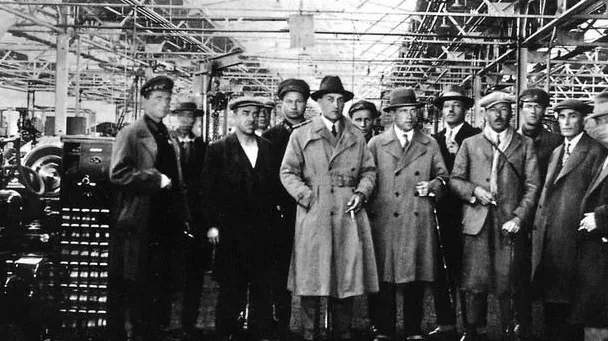
The firm of the American architect Albert Kahn of Detroit designed more than 500 industrial facilities for the USSR in the early 1930s. The Stalingrad Tractor Plant was manufactured in the US, dismantled, shipped across the ocean and assembled on the Volga. The Magnitogorsk steelworks was designed by the Cleveland company of Arthur McKee on the model of the steel plant in Gary, Indiana. The Gorky Automobile Plant grew out of a contract with Ford.
And what was paid with? Grain, which was swept out of Ukrainian villages. While people in Ukraine were dying of hunger, bread went for export, and in return machine tools, turbines and engineers came to the USSR. That is the real economy of the Stalinist "miracle": Ukrainian bread turned into American factories, and American factories turned into the cult of the Muscovite leader.
Stalin was not a creator. He was the manager of a project designed by the hegemon of his time, the United States. Moscow once again played its eternal role as middleman, as it played it under Venice, under the Dutch, under England: technology in, raw materials out, and between them a layer that calls itself a great power. The leader in the glass sarcophagus was a comprador who had been proclaimed a demiurge.
And here you can see why removing the body changed nothing. The leader was written off as scrap, but the scheme stayed. In 1959 Khrushchev went to America and came back with a dream of corn. In 1963 the USSR bought grain abroad for the first time, in Canada and the US. A country that under Stalin had exported bread at the price of the Holodomor was now importing it. And in 1970, under Brezhnev, Moscow signed a "gas for pipes" deal with West Germany. Stalin lay by the wall while the pipe kept growing. Raw materials went to the West, technology came from the West. Peter once hauled the same raw-material "pipes" to the West, only wooden and hemp ones.
A god can be carried out. The comprador pipe cannot, because the whole building stands on it.
The Return of the Banished
The banishment from the Soviet pantheon turned out to be temporary. In 1970 a bust by Nikolai Tomsky appeared on Stalin's grave. Brezhnev quietly gave Stalin back his place in the pantheon, though not in the sarcophagus. And then came what we see today.
In May 2025, at the Taganskaya station of the Moscow metro, a copy of the bas-relief "The People's Gratitude to the Leader and Commander" was unveiled, with Stalin's figure at its center. The original was removed in 1966. The same month, Volgograd's airport officially became "Stalingrad" airport. That very Volgograd which was renamed on November 10, 1961, ten days after the night of the plywood screens. Monuments to Stalin are appearing in Vologda, in Ulan-Ude, in Mozhaysk, in Chuvash villages. And, of course, "on the initiative of residents." The technology of 1961 works in reverse without a single change.
Why does Moscow need this? Because Russia is waging a war again, this time against Ukraine. And a war needs a god of victory and a model of mobilization. It needs a master who never asked what lives cost. It needs a "grandfather" who "could repeat it." When there is no real wealth to offer people, the authorities again hand out the imaginary: greatness, duty, ancestors. And in Moscow's warehouse of imaginary values there is nothing bigger than Stalin.
In 1961 Moscow did not bury Stalin. It moved him a few dozen meters: from glass into the ground, from one sanctuary to another. It changed the inscription, not the system. Repentance is done by day, with open archives, with a trial and a verdict, as it was in Germany. In Moscow there was no trial and no verdict, there was night, plywood and a commission's report. That is why the god was not overthrown. He was only demoted. And someone demoted can always be reinstated.
But the most telling thing about this return is not even Stalin himself. The return of Stalin to the pantheon of the great Russians does not show that, during the years of liberalization, nobody grew up among the Russians. Quite the opposite, people did grow up. People grew up whom one could have looked up to, both morally and ideologically. Only they did not grow toward a comprador colony. They stood for something else, something the very logic of the Kremlin finds repugnant. You cannot look up to such a person and still remain an obedient subject, so Moscow finds him useful neither alive nor in bronze.
And where the Kremlin looked for its heroes, among the comprador riffraff, nobody grew at all. That milieu knows how to pump raw materials to the West, launder money and buy villas, but it does not know how to produce an example. The middleman has nothing to present except someone else's pipe, and you do not pray to someone else's pipe.
So Moscow dug up the old bogeyman. The one the USSR itself threw onto the rubbish heap, at night, behind plywood, was dug up, brushed off and set to be waved over the country. And this second-hand item turned out to be dearer to the Kremlin than all the young growth that came up during the years of liberalization.
The price of this choice has already been counted. According to the American Center for Strategic and International Studies, by summer 2026 the Russian army's losses in Ukraine had reached about 1.4 million killed, seriously wounded and missing. Of these, no fewer than 450,000 are dead.
In other words, Moscow has simply turned back, to the Gulag. Only now the millions are being ground up not on construction sites but in a war.
If this piece struck a nerve, you may also be interested in my books: "Russkiy Mif" ("Русскій Міфъ"), available in Ukrainian and English, and "The Economics of Losses", Ukrainian and English
References:x.commedium.comcheslavsky.substack.com