The USSR was a gloomy, perpetually backward, shabby country with peeling façades and a population that was infantile, drably dressed and embittered by constant shortages.
What are the Sovok-wankers proud of?
In truth, they have very little to be proud of.
The USSR was a gloomy, perpetually backward, shabby country with peeling façades and a population that was infantile, drably dressed and embittered by constant shortages.
But even the Sovok-wankers have their three reasons for pride.
These three worn-out cards are what they throw back at every accusation:
- Little Yuri Gagarin
- But we beat Hitler!
- Industrialisation
As for little Yuri Gagarin, the Sovok-wankers' official saint, I wrote everything about him in my book Behind the Facade of the Empire , and about "but we beat Hitler" in my book Strike First .
Now I want to say a few words about industrialisation.
Which is the biggest fetish and the biggest deception of Soviet historiography.
Took over a country with a wooden plough and left it with an atomic bomb .
Not with a rich population, mind you, but with a bomb.
And a bare-arsed population sitting on top of it.
The myth goes something like this:
The Bolsheviks were so miraculous and blessed that, having taken over a ruined country, they managed, with the help of the red miracle, to carry out industrialisation in it: to build a heap of plants and factories, entire, you understand, branches of industry!
To begin with, the Bolsheviks did not take over a country in ruins; they first plunged it into ruin.
Czarist Russia had plenty of plants; it produced locomotives, cannons, automobiles, battleships, and was getting ready to launch its first electric train...
Where did all of that go?
The Bolshevik junta, which came to power as a result of a putsch, plunged the country into a civil war. The result of which was total ruin.
Having begun with a crime, the Bolsheviks never afterwards left that bloody path.
But perhaps, having destroyed the country to its foundations, they nevertheless rebuilt it afterwards, carrying out that very industrialisation?
Of course not.
Well, what industrialisation can executioners carry out, when it requires specialists? Think about it yourselves.
Industrialisation was not carried out by the Bolsheviks
They simply bought it, with czarist gold and in exchange for grain taken from the peasants.
And since only slaves can be made to toil for free, they turned the peasants into slaves, returning to a serf system that we know as the collective-farm system.
So.
First, back in the 1920s, it was the Germans who began building the first plants in Russia.
The Bolsheviks, being criminals, later cheated them out of their money, as they would later cheat their other Western partners too; I wrote about this in Strike First .
Then came the turn of the Americans.
As the magazine Expert rightly notes:
...the Soviet government received from Albert Kahn, Inc. an entire programme of industrial construction in the Soviet Union, known in Soviet history as industrialisation in the USSR .
In February 1930 an agreement was signed between Amtorg and Albert Kahn, Inc., under which Kahn's firm became the chief consultant of the Soviet government on industrial construction and received a package of orders for building industrial enterprises worth 2 billion dollars (about 250 billion dollars in today's money) .
Let us continue the quotation; it is quite curious:
Since a full list of the construction projects of the first five-year plans has never been published in our country, the exact number of Soviet enterprises designed by Kahn is still unknown; most often people speak of 521 or 571 sites. This list undoubtedly includes the tractor plants in Stalingrad, Chelyabinsk and Kharkiv; the automobile plants in Moscow and Nizhny Novgorod; the forging shops in Chelyabinsk, Dnepropetrovsk, Kharkiv, Kolomna, Magnitogorsk, Nizhny Tagil and Stalingrad; the machine-tool plants in Kaluga, Novosibirsk and Verkhnyaya Salda; the foundries in Chelyabinsk, Dnepropetrovsk, Kharkiv, Kolomna, Magnitogorsk, Sormovo and Stalingrad; the machine-building plants and shops in Chelyabinsk, Podolsk, Stalingrad and Sverdlovsk; a thermal power station in Yakutsk; the rolling mills in Novokuznetsk, Magnitogorsk, Nizhny Tagil and Sormovo; the 1st State Bearing Plant in Moscow, and much more .
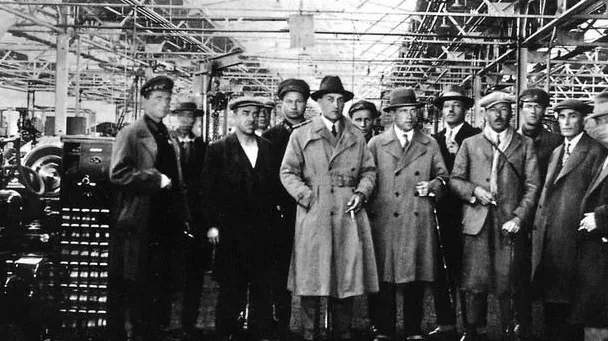
Take, for example, the Urals Heavy Machinery Plant (UZTM). From 1928 to 1941, 311 foreign specialists worked there.
The Urals machine-building plant: The iron-foundry shop was equipped with machinery from the German firm Krigar, while the charge was loaded by cranes from the English company Sheppard. The steel-foundry shop was fitted with electric furnaces from AEG, as well as sandblasting chambers and saws from Mars-Werke. Uralmash's forging and pressing shop, the largest in Europe, was equipped with two steam-hydraulic presses from the German firms Hydraulik, Schlemann and Wagner. The pride of the plant, machine shop No. 1, had 337 machine tools, of which 300 were bought from the bourgeois .
And DneproGES, the main pride of the Sovok and the symbol of Stalinist industrialisation?
Its design and construction were handled by the American engineering and construction firm Cooper. The construction site was prepared by the German firm Siemens, which also supplied the electric generators. The turbines of DneproGES (except for one, already our own copy) were made by the American company Newport News...
The legendary Magnitka is the brainchild of the firm Arthur McKee!
The Baku oilfields were developed by the company Barnsdall.
The famous Donbas and Kuzbas: Stuart, James Cooke, Roberts Schaefer, Allen Garcia.
Why, then, do Soviet textbooks give the glory of industrialisation to the great Soviet people, whose entire merit consisted in breaking their backs on the construction sites of the national economy, as rightless serfs on collective farms and as slaves of the GULAG?
Because the red executioners simply shot the Soviet-side managers of those construction projects, covering their tracks.
Killing is the only thing the reds were good at:
What is most staggering in the history of Stalinist industrialisation is that practically all the key figures of this project turned out to be enemies of the people. Shot were Bannikov, the first builder and director of Uralmash, Fidler, the first chief engineer, his successor Muzafarov, Popov, the builder of the power station, and many other builders of the plant.
The legendary metallurgist Avraamy Pavlovich Zavenyagin said: Magnitka was raised, in essence, by three heroes: Gugel, Maryasin and Valerius. All three were shot in the late thirties.
Zavenyagin himself was saved only thanks to his personal friendship with Molotov..
Chingiz Ildrym, the favourite of Magnitostroy, was shot in Sukhanovka prison in 1941. Shot too were V. Smolyaninov, the first director of Magnitostroy, and Ya. Shmidt, the manager of Magnitostroy in 1930, and V. Kalmykov, the celebrated foreman of the first builders and a holder of the Order of Lenin. The first chief engineer, V. Gasselblat, died of exhaustion in a concentration camp in the town of Chibyu near Ukhta.
As a result of the repressions of the thirties, practically everyone who was directly or indirectly involved in purchasing imported equipment for these construction projects was destroyed. It is therefore hard to shake the conviction that one of the main goals of the pre-war wave of repressions was to conceal the truth about how and by whom industrialisation in the USSR was carried out. So that in history textbooks it would remain forever an unparalleled feat of the liberated proletariat, led by the Bolshevik party and the brilliant Stalin .