Karl Marx, Voltaire and many other minds of the civilized world were not the only ones who knew that Muscovy-Russia is not Rus
It was not only Karl Marx and other Western thinkers who understood that Muscovy-Russia is not Rus. Despite all the falsifications, people inside the Russian Empire itself understood it too.
The Kalmyk Erenzhen Khara-Davan, after long research, concluded that the Horde created Russia as a state. He was sure that up to Peter I Muscovy had nothing in common with Europe and was part of Asia. After Peter's reforms little changed: Russia never became Europe.
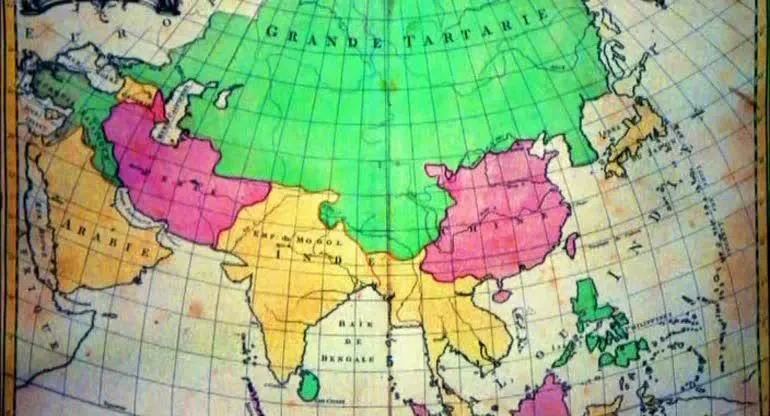
I will set out his thesis briefly. The Horde created Muscovy for its own convenience, as a center for administering the conquered lands. Moscow kept the Horde's training and outlived its master. In 1552 Ivan IV took Kazan, and among the commanders of his army was the Kasimov czar Shah Ali, a Chingizid in Muscovite service. In time Moscow reached almost the former borders of the Horde. Only the main faith of this new Horde became Orthodoxy.
The Horde theory of Russia's origin is not the dominant one. Other explanations have far more supporters, and they can be divided into several groups.
The school of geographical determinism
Russia is a flat country with no direct access to the Atlantic, with hot summers and long, cold winters. According to this theory, it was climate and space that determined its special path of development.
This theory was shared by Pavel Milyukov, in part by Eduard Kulpin, by the early Lev Gumilev, and by the American historian Richard Pipes. Its most detailed version was given by Academician Leonid Milov in the book "The Great Russian Ploughman": a short summer and poor soil, according to Milov, determined the entire history of the country.
Interpreters of the Mongol yoke
This group is divided into two warring camps.
The first camp, the Eurasianists, praises the Mongol conquerors. In their view, the Mongols, having subjugated the Slavs and mixed with them, created an alloy of the Slavic and the Turanian, and on it the greatness of Russia grew.
The second camp, which includes Karamzin, Pushkin, Chaadaev and Kostomarov, sees the Mongol invasion as the cause of all Russia's troubles. In their view, it was the Horde that led Russia away from the normal European path.
The school of the barbarian periphery
According to this theory, Russia's backwardness and its special path are explained by its remoteness from the centers of civilization. Russia took shape on the periphery of the ancient world, and culture reached it last.
This theory was shared by Samuel Huntington, in part by Richard Pipes, by Sergei Nefedov, and by the cliometrician Boris Mironov.
Russia is the Horde
This theory was created by the Eurasianist Erenzhen Khara-Davan. He believed that Russia was created precisely by the Horde, and saw progress in that. Without the Horde, in his opinion, the principalities around Moscow could not have become a separate state: the West would have swallowed them, and they would have entered the Polish-Lithuanian state, which was far freer for its time. For Khara-Davan that would have been an evil.
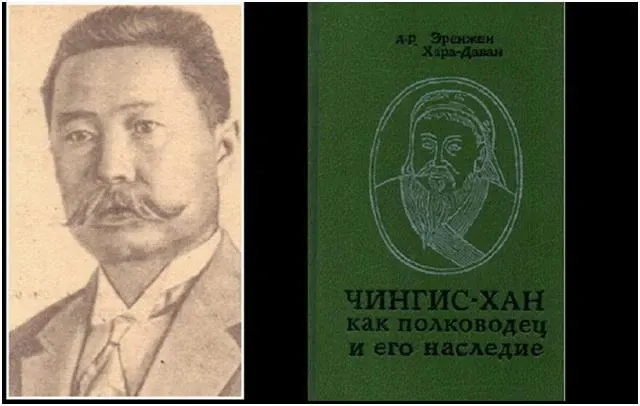
Who was Erenzhen Khara-Davan?
Erenzhen Khara-Davan was born in 1883 in the Maly Derbet ulus of Astrakhan Governorate. He became the first Kalmyk physician, was a Kalmyk educator and national democrat, and sought autonomy for his people.
In 1917-1920 he managed to work with the Provisional Government, with the Soviet authorities, and with the Whites. After the defeat of the Whites he emigrated. In Prague he took part in the Kalmyk commission of cultural workers, and in 1929 he moved to Belgrade. There he published the book "Genghis Khan as a Military Commander and His Legacy". Khara-Davan died in Belgrade during the German occupation, at the end of 1941 or in 1942.
Among the Eurasianists of the White emigration he held the most extreme Asian position.
The theory of how Muscovy emerged
Khara-Davan described what the Horde gave Moscow. Let us see what the facts confirm.
The Horde did not bring slavery to Rus; it existed earlier. In the Ruska Pravda the kholop is the most rightless person: for killing someone else's kholop the fine was 5 hryvnias, and for a free man 40, eight times more. Estates existed too: princes, boyars, retainers, smerds, kholops.
The Horde brought something else. It turned the princes into its viceroys.
In 1243 Yaroslav Vsevolodovich, Prince of Vladimir, came to Batu's headquarters on the Volga and recognized the authority of the Mongol Empire. Batu made him senior prince "in the Ruska tongue," that is, elder over all the other princes. This is the first yarlyk, the first document of appointment. From then on a prince sits on the throne not by right of lineage and not by the will of the veche, but by the will of the Horde's czar.
These rulers were called czars in the Turkic tradition. The title "czar" came to the Slavs from the Bulgars, and before Ivan IV only Bulgarian and Mongol rulers bore it. The chronicles call Batu and his successors czars, while the Muscovite prince remains a grand prince in them.
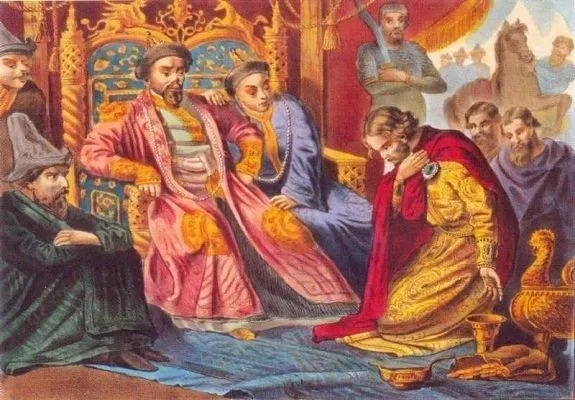
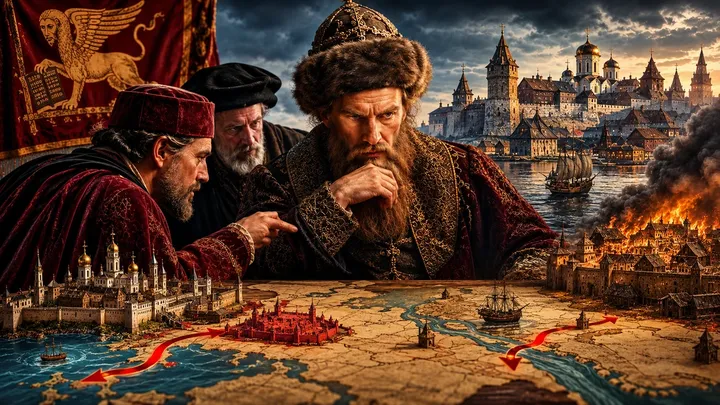
The Horde could not abide a multitude of petty principalities that squabbled among themselves and interfered with the collection of tribute. So it encouraged the strong power of a single grand prince, whom it charged with subordinating the rest and absorbing his neighbors. In 1328 that prince became Ivan Kalita of Moscow. He received the yarlyk from Czar Uzbek for suppressing the uprising in Tver together with the Horde's army.
That is how Moscow got its job. The task was set for it in Sarai, it received payment for its service there too, and it applied force against its neighbors itself. The Horde was in essence a military camp, with Sarai serving as the commander-in-chief's headquarters, and Moscow adopted this arrangement one to one. For Moscow the "gathering of the lands" was not unification but the collection of tribute from new territories.
In 1257 the Horde conducted a census in order to levy tribute on every household. Moscow took the money from the Horde as well: the word "denga" is Turkic, like "kazna" (treasury) and "tamozhnya" (customs). The first Moscow coins were minted under Dmitry Donskoy on the model of the Horde's, with inscriptions in Turkic. The kopeck appeared later, in 1535, under Yelena Glinskaya: the ruble was then a unit of account and equaled 100 kopecks or 200 dengas.
Serfdom Moscow built itself, to the Horde's blueprint. The Law Code of 1497 allowed peasants to leave their master only during one week of the year, around St George's Day. The Council Code of 1649 tied them to the land forever.
For Moscow everyone was a kholop. Even a noble boyar in a petition to the czar signed with a diminutive name and called himself "your kholop." The Church added its own formula to this: every baptized person is a slave of God, and the only representative of God on earth is the autocrat czar. The result was an ideal scheme for a slaveholding order.
The Horde valued Slavs as merchandise. Through Genoese Kaffa and Venetian Tana, Black Sea ports under the Horde's rule, people were shipped to the markets of Egypt and Italy. The word for "slave" in Western languages comes from the word "Slav": the Greek "sklavos" around the 11th century came to mean any slave at all, and the medieval Latin "sclavus" gave English "slave" and Italian "schiavo." This happened before the Horde, through the slave trade of the Venetians, but the Horde continued the business.
Orthodoxy came to Rus not with the Horde but in 988, from Constantinople. What the Horde did was different: it took the Church under its hand. In 1267 Czar Mengu-Timur exempted the Church from tribute, and from then on the yarlyks of the Horde's czars protected its property. In return the Church preached obedience and prayed for the czar. It even made a saint of a man of the Horde: a nephew of Czar Berke was baptized in Rostov with the name Peter.
The Horde's system destroyed the distinctiveness of the conquered peoples so that they would be easier to rule. From this grew the alloy that is called Russians today.
The phenomenon of the Horde
The Horde is a phenomenon for which it is hard to find an analogue in history.
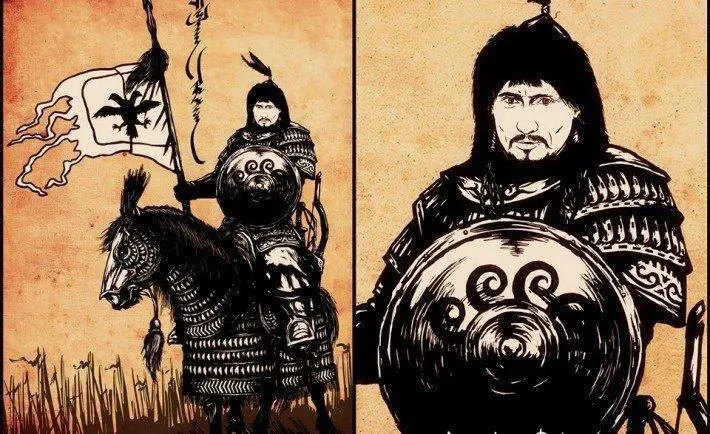
In essence the Horde is not a country, not a land and not a people. It is a military alliance created by one man, Genghis Khan. He devised a system of subjugation in which the defeated have two ways out: to die, or to become part of the Horde and go on with it against the next victims.
The Horde has no homeland, no permanent borders and no titular nation. Peoples, tribes and states were formed as a council of the community, a veche, a rada. The Horde was formed as an army. In it there is only the czar, who commands, and the Horde carries out his command. Whoever refuses, dies. Whoever begs for his life receives it, but gives up his will in exchange.
Moscow adopted this too. There was no knighthood in Muscovy. Even as its Saint George it chose not a knight with a red cross but a martyr. A knight serves honor, while a viceroy needs servants and soldiers ready to die "for the czar."
Well? Do you still have any doubts that Russia is the Horde?