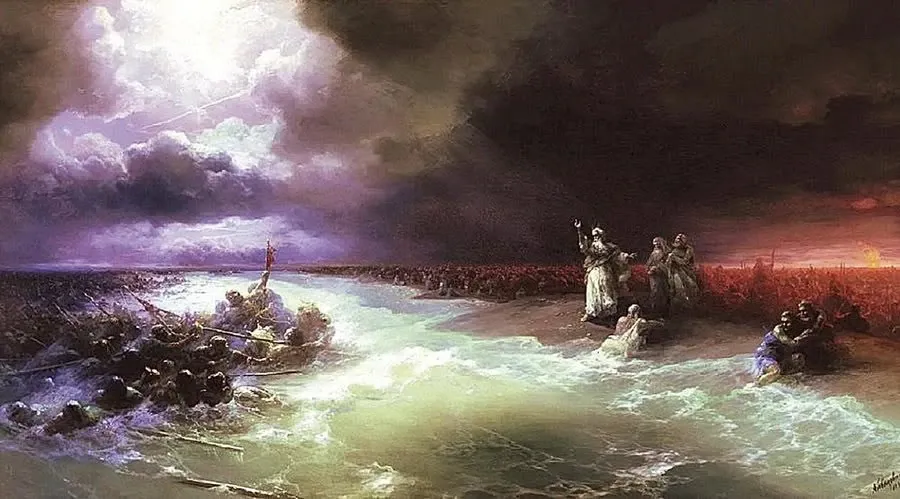
Historians and archaeologists have very serious doubts that the Exodus of the Jews from Egypt ever happened. I understand that proving the absence of something is impossible in principle, but the scholars' arguments are nevertheless quite weighty.
First, look at the map. In the supposed era of the Exodus (the 15th–13th centuries BC), Canaan was an Egyptian province. Egyptian garrisons stood in Gaza, Beth Shean and Jaffa. To flee from Egypt to Canaan meant to flee from Egypt to Egypt: "And two handsome guards drove me from Siberia to Siberia." The forty years of wandering would have had to take place on Egyptian land, between Egyptian fortresses, along a road patrolled by Egyptians. The biblical account of the conquest of Canaan does not mention the Egyptians at all: the author of the Exodus simply did not know they had been there. Because he wrote many hundreds of years later, when the Egyptian empire was no longer there.
The same is shown by the many anachronisms in the text, which give away the time of writing. Camels appear in the patriarchal stories hundreds of years before they were actually domesticated in the region. Edom, which refused to let Israel pass, took shape as a kingdom only by the 8th–7th centuries. The route of the Exodus, with its "way of the Philistines," presupposes Philistines, who arrived by sea only around 1175. The names, the topography, the line of fortresses all correspond best to Egypt of the 7th century, the Saite period. Hundreds of years had passed. By the time of Joshua, Jericho had already lain in ruins for three centuries (so much for the tales about the walls of Jericho), and Ai had been dead for a thousand years.
Second, the Egyptian silence. New Kingdom Egypt is one of the best-documented civilizations of antiquity: economic papyri, diplomatic correspondence (the Amarna archive) and border logs that recorded the passage of groups of a few dozen nomads have all survived. Nowhere is there a word about an enslaved people of hundreds of thousands, about the ten plagues of Egypt, about the flight of slaves or the destruction of an army along with the pharaoh. The flight of a labor force on that scale would have wrecked the country's economy, and it would certainly have shown up in the documents.
Third, the Sinai Peninsula has been intensively surveyed (especially in the years when it belonged to Israel). An encampment of 600 thousand men, which with women and children comes to more than two million people, comparable to the entire population of Egypt at the time, left nothing in forty years: no potsherd, no fire pit, no grave. Archaeology can find the camps of groups of twenty or thirty Bronze Age nomads. Particularly telling are the excavations at Kadesh-Barnea, where according to the text the people of Israel spent 38 years: the digs yielded a fortress of the 10th–7th centuries, but from the relevant period, nothing.
And fourth, archaeology convincingly shows where the Israelites actually came from. Around 1200 BC, many small farming settlements gradually appear in the Canaanite highlands, and this is early Israel. The material culture of these villages, including the pottery, the "four-room house" architecture and the farming, is a direct continuation of the local Canaanite one, without a single Egyptian element. Among specialists there is no disagreement: the Israelites were not newcomers from outside but an offshoot of the Canaanites themselves, who set themselves apart in the hills after the collapse of the Bronze Age.
To sum up. Some small group of people may have come from Egypt; people were forever hanging around back and forth. But the story of the enslavement of a huge people and of the Exodus of hundreds of thousands of people from Egypt is a myth. And the Ten Commandments, which begin with the words "I am the Lord your God, who brought you out of the land of Egypt, out of the house of slavery…", begin with a lie. Simply because every religion needs miracles to give it authority.