Ukrainians and Russians are two completely different peoples with two separate identities, and by no means "Russian nationalities".
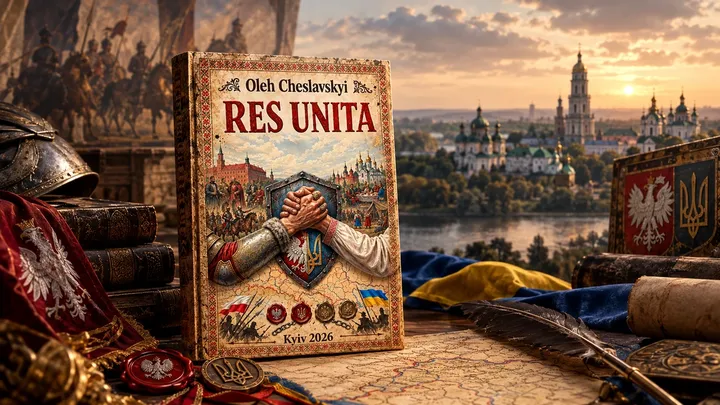
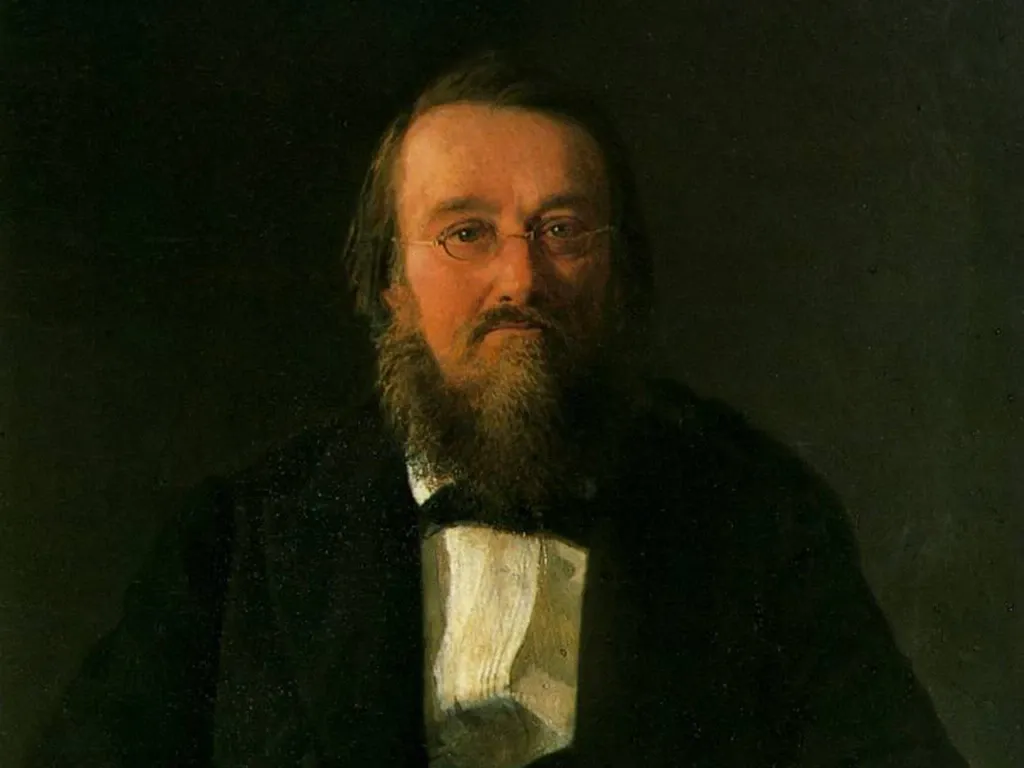
In 1861, Professor Nikolai Kostomarov published his book Two Russian Nationalities, a sort of attempt to describe the similarity between Ukrainians and Muscovites.
But however hard the author tried, all his attempts to link peoples who are opposite both in spirit and in origin failed to produce the desired result.
Instead of confirming the myth of the similarity and brotherhood of the Russian and Ukrainian peoples, which was popular then and is popular now, he dispelled it for good!
With his book, Kostomarov destroyed the stubborn stereotype, built up over hundreds of years by Russian ideologists, of a common Slavic blood origin for Muscovites and Ukrainians, the myth of the similarity between the Horde-descended Muscovite-Russians and the Ukrainian-Rus people!
The work caused a sensation, but because of its objectivity it was never popularised, and even today only a handful of people know of it.
However, why waste words? Read for yourself the passages I have selected from Nikolai Kostomarov's work Two Russian Nationalities:
Customs
In the character of the Ukrainian people, personal will prevails, while in the Russian, the general prevails.
For a Ukrainian, the bond between people is fundamentally based on mutual consent and may be dissolved by their mutual will.
Russians strive to fix the necessity and indissolubility of a bond once established, and to ascribe the very cause of its establishment to God's will and, consequently, to remove it from human criticism.
The collective means one thing to a Ukrainian and another to a Russian. For the former, it is a voluntary organisation of people.
In Ukraine, every member of the hromada is an independent individual, a self-standing owner!
His obligation in the hromada lies only in the sphere of mutual security and the benefit of each.
For a Russian, the collective is the expression of a common will that swallows up the personal individuality of each.
Faith in God
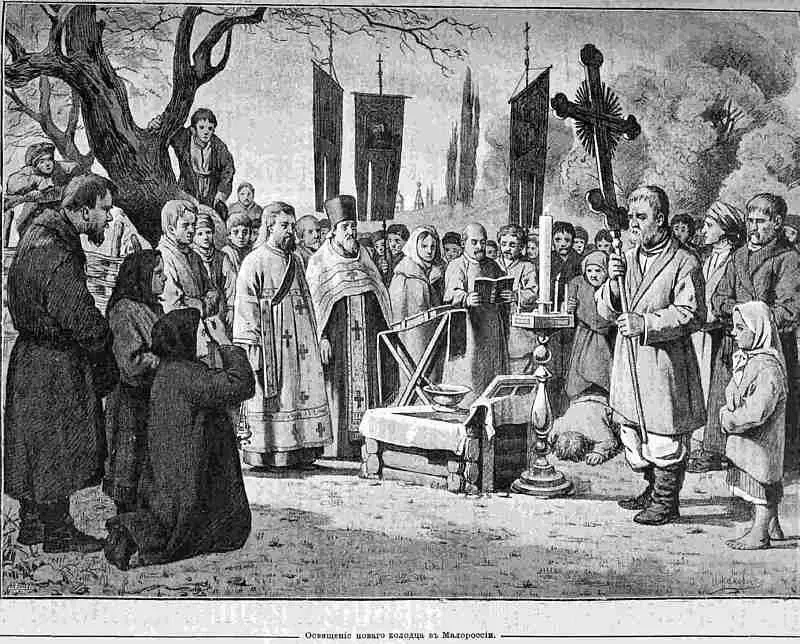
In Ukraine, the church has great moral authority and strength, but it does not carry its strength so far as to sanctify the success of all undertakings on faith alone, without proof.
With the church in Russia, the complete opposite happened.
In Russia, through the deeds of its dignitaries, the church became an organ of the last judgment.
Church authority in Russia stands incomparably higher above the masses and has far more opportunities to act arbitrarily.
Russians have a great urge to quarrel over the letter, to attach dogmatic importance to what is often no more than a grammatical question.
Observing the Russian people in all layers of society, we will often meet people of truly Christian morality, whose religiosity is turned toward the practical realisation of Christian good, but in them there is little inner piety, little pietism.
We meet hypocrites, strict observers of outward rules and rites, but without inner piety, for the most part coldly indifferent to the cause of religion, performing its outward side out of habit.
In the highest educated class of Russians there are few believers, and not as a result of any mental labour and struggle, but out of fashion, because unbelief seems to them a sign of enlightenment.
Truly believing natures are the exception.
In the Ukrainian people, the sense of God's omnipresence is strong: a tenderness of the soul, an inner turning to God, secret reflection upon oneself, a heartfelt attraction to the spiritual, unknown, mysterious but comforting world.
Ukrainians perform rites and respect formulas, but do not subject them to criticism.
A Ukrainian will not hold forth about the liturgy, about rites and feasts, but will tell of his pious impression of the service, of the solemnity of the rite, of the lofty significance of the feast, and so on.
In Ukraine, among the educated classes, it is not as easy to break faith as among Russians. Unbelief will settle in the soul of a Ukrainian only after a long, deep struggle.
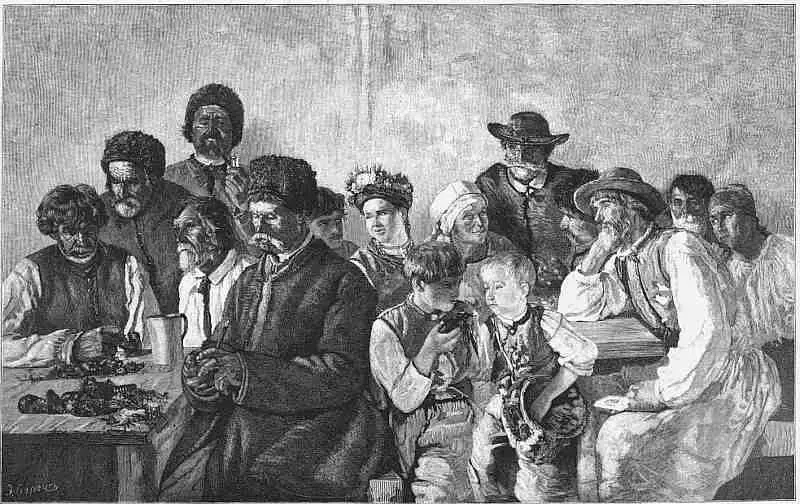
Attitude to other religions
Russians show intolerance toward other religions, contempt for foreign nationalities, and a haughty opinion of themselves.
All foreigners who visited Muscovy in the 15th–18th centuries unanimously assert that Muscovites despise other faiths and nationalities. The czars, who in this respect stood ahead of the masses, washed their hands after touching the ambassadors of foreign Christian confessions.
Germans permitted to live in Moscow were subjected to contempt, and the clergy stood against any contact with them.
A patriarch who had carelessly blessed them demanded that they differ more noticeably from the Orthodox in outward appearance, so as not to receive a blessing by accident in future.
The Latin, Lutheran, Armenian and every other faith that differed even slightly from the Orthodox was considered accursed by Russians.
Russians consider themselves the only chosen people in faith, and are not even fully well disposed toward the co-religionist peoples, the Greeks and Ukrainians.
As soon as something was at all unlike their rule, it deserved contempt and was considered heresy.
Muscovites look down on everything foreign.
Evidently, such a view of everything was inevitably helped along by the Russians' subjugation by the Tartars.
In Ukraine, everything is different.
From time immemorial, Kyiv, and later Volodymyr-Volynskyi, were gathering places and residences of foreigners of various faiths and peoples.
Ukrainians have been accustomed since time out of mind to hearing foreign speech among them, and do not shy away from people of a different appearance and different customs.
In the imagination of a Ukrainian, a Catholic does not appear as an enemy.
Persons of princely lineage entered into marriages with members of influential houses of the Catholic confession. The same, probably, was done among the people.
In Ukrainian towns, Greeks, Armenians, Jews, Germans, Poles and Hungarians found free refuge and got on well with the locals.
The Poles, who came into the Kyiv land as allies of Prince Iziaslav, were captivated by the merriment of life in a foreign land.
This spirit of tolerance, this absence of national haughtiness, later passed into the character of the Cossacks and has remained among the people to this day.
Anyone could come into Cossack society! No one asked who he was, what faith, what nation!
When the Poles grumbled that the Cossacks took in all sorts of vagabonds and, among them, heretics fleeing the persecution of the spiritual court, the Cossacks answered that it had always been so with them, that anyone may freely come and go.
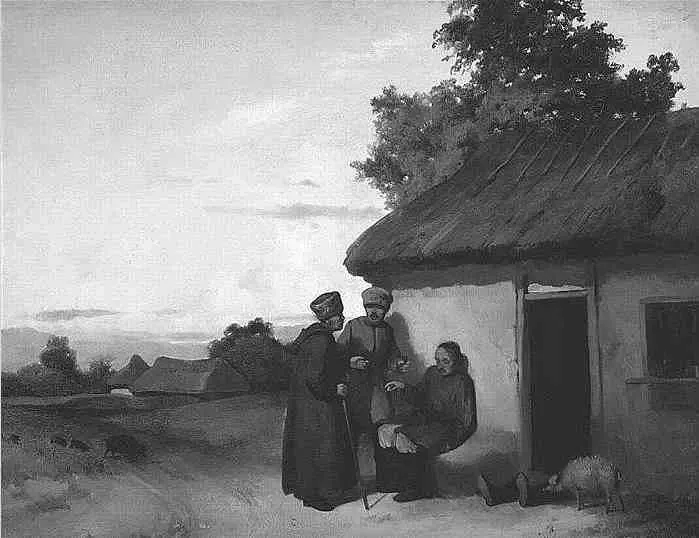
The essence of the conflicts
The wars of Ukrainians with Catholics in the time of the Cossack uprisings arose not from hatred of Catholicism, but from vexation at religious violence, coercion and humiliation.
The campaigns against the Turks and Tartars were prompted, on the one hand, not by blind fanaticism against infidels, but by revenge for their raids and for the capture of Ukrainians.
On the other hand, they were driven by the spirit of daring and the passion for plunder that necessarily develops in every warlike society.
Meanwhile, in Russia, Jews did not dare even to show themselves.
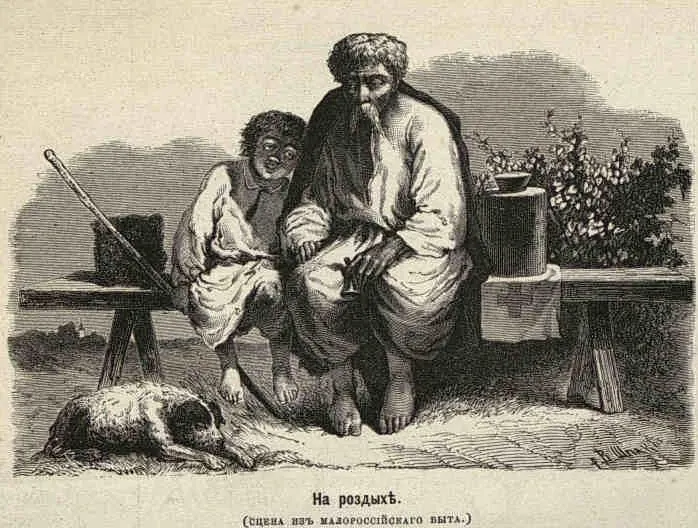
The role of imagination in the spiritual world
With their poverty of imagination, Russians have extremely few superstitions, though extremely many prejudices, and they cling to them stubbornly.
Ukrainians, by contrast, appear to be a highly superstitious people, especially in the west. In almost every village there are artful tales of the dead appearing from the other world in the most varied forms.
These range from touching tales of a dead mother appearing and embracing her little ones to the terrifying image of vampires crucified at midnight on grave crosses and crying out in wild voices.
In the Ukrainian land, so rich in historical life, legends of long-past times abound.
A vivid popular invention shows through in these legends.
Sorcery with its fanciful devices, the world of spirits in the most varied forms and terrors that make the hair stand on end and provoke laughter to the point of hiccups: all this is clothed in well-shaped tales, in graceful pictures.
Ukrainians themselves sometimes scarcely believe in the reality of what they tell, but they will not part with the tale as long as the sense of beauty has not died in them, or until the old finds a renewal of its poetic content in new forms.
With Russians it is quite different.
They believe in devils, house spirits and witches because they received this belief from their ancestors; they believe because they do not doubt their reality; they believe because belief is needed to explain incomprehensible phenomena, not out of a striving to rise above the flat lot of everyday life.
Russians have few fantastic tales. Their devils and house spirits are very material.
The sphere of the afterlife and the spiritual world interests the Russian little.
Russians have almost no stories of the soul appearing after death.
And if one is found, it is borrowed from books and is, rather, in an ecclesiastical treatment, not a popular one as with Ukrainians.
Owing to the spirit of intolerance, the Russian is far more stubborn in his prejudices.
I was a witness to a very characteristic case in which a certain gentleman was accused of godlessness and blasphemy for having spoken with disdain of the belief in the existence of devils.
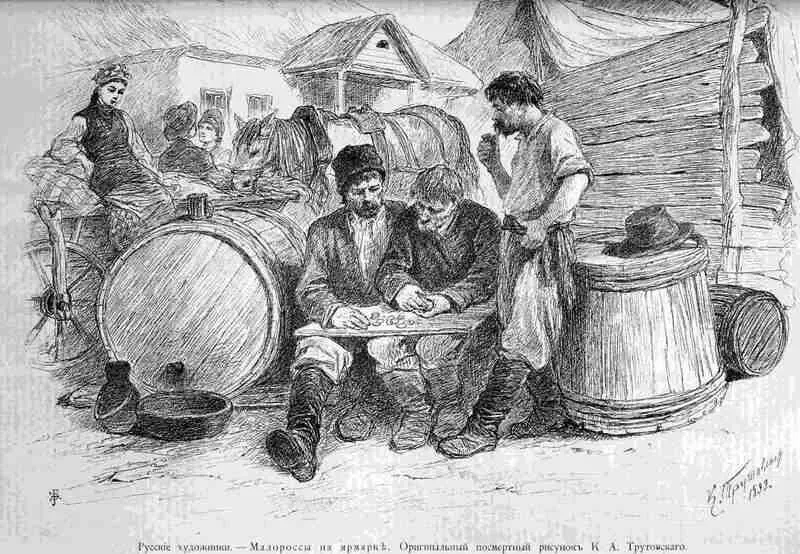
Family or community
Russians strongly express a striving toward a close collective organisation of people, in which personal interests are destroyed under the authority of the common ones.
The inviolable legitimacy of the common will, expressed in the sense of a hard fate, coincides in the Russian people with the unity of family life, the indivisibility of families, and communal property.
For a Ukrainian, there is nothing harder and more repugnant than such an order.
Ukrainian families divide and break apart as soon as the need for an independent life arises.
Parental guardianship over grown children seems to a Ukrainian an unbearable despotism.
The claims of elder brothers on younger ones, like the relations of uncles with nephews, arouse furious enmity between them.
Blood ties and kinship do little to incline Ukrainians to concord and mutual love; on the contrary, very often people who are affable, gentle, peaceable and easy to get along with are in implacable enmity with their blood relatives.
Quarrels between relatives are a most ordinary occurrence in all estates.
In Ukraine, to preserve love and concord between close relatives, they must part and have as little in common as possible.
The kinship of Ukrainians' ties leads rather to their weakening than to their strengthening.
Among Russians, on the contrary, the blood tie often makes a person friendlier, fairer and more indulgent toward another, even when he is generally not distinguished by these qualities in relation to strangers.
Out of submission to duty, a Russian is ready to force himself to love his kin by blood, even if they are not to his liking, to be indulgent toward them because they are related to him; he is ready to make a personal sacrifice for them, aware that they are not worth it, but they are his own blood.
Some Russians who acquired estates in Ukraine sometimes undertook to introduce Russian collectivism and indivisibility into Ukrainian families. The fruit of this was repulsive scenes: not only were own brothers ready at any moment to start a fight, but sons dragged their fathers out over the thresholds of their houses by the hair.
A Ukrainian is a respectful son when his parents leave him complete freedom and themselves, in their old age, submit to his will.
He is a good brother when he lives with his brother as a neighbour, as a comrade, having nothing in common, nothing undivided.
In Ukrainian families the rule is observed: to each his own.
Not only do the adult members of the family not put on one another's clothing, but even among children each has his own.
Among Russians, in peasant life, two sisters often do not know which of them owns this sheepskin coat or that one, and the children have no notion at all of separate ownership.
Woman as mother
In Russian culture woman rarely rises to her human ideal. Her beauty is rarely lifted above matter, a lover's feeling rarely finds anything in her worth valuing beyond the bodily form, and the valor and dignity of the female soul are rarely displayed.
The Ukrainian woman in folk folklore, by contrast, is so spiritually beautiful that even in her fall she poetically expresses her pure nature and is ashamed of her humiliation.
In playful, humorous songs the opposite character of the Ukrainian and Russian peoples is sharply expressed.
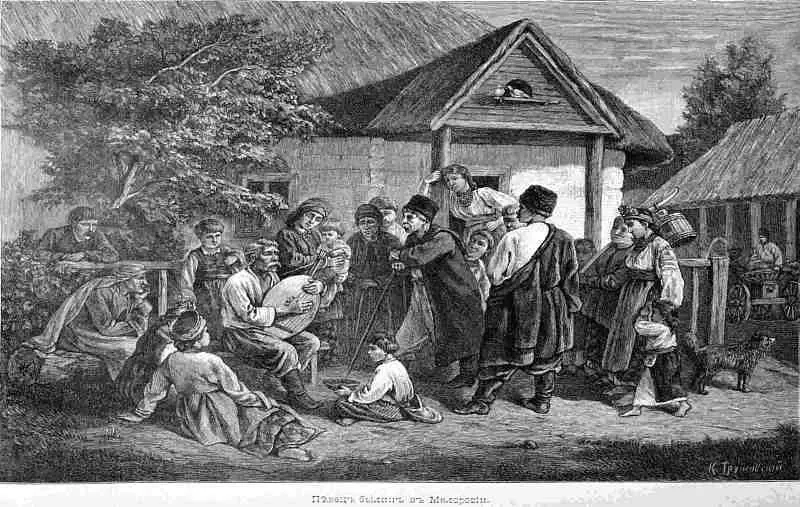
In Ukrainian songs about woman and mother the charm of the word is developed, and the expressions reach true artistry.
Russian songs of this kind, on the contrary, show no more than the wish of a person tired from prosaic labor to forget himself for a minute somehow, without racking his brains, without touching the heart or the imagination.
Such a song exists not for its own sake but for some kind of decoration, for the sake of material pleasure more than anything.
The individual
Among Russians the serf joined his fate to the life of his master: the lord's will came to replace his own will.
In Ukraine life flowed differently. The notion of the collective was almost absent.
The ancient right of personal freedom was not swallowed up by the preponderance of social power, and no notion of common land ownership took shape.
Every farmer was the independent owner of his own land.
Thus the right of property raised up the rich and influential, forming an upper class, while the mass of the poor people was cast into subjugation.
But in Ukraine the magnate-owner did not represent the expression of a lord's will, and through it the czar's will; he was an owner by right.
This right expressed strength, the triumph of circumstances and the antiquity of origin.
Naturally, in Ukraine the serf, the dependent person, wished to become free at the first opportunity.
In Russia the serf could not wish this, for he found his master dependent on another, higher will, just as he himself depended on the master.
The role of the ruler
For Russians, if God raises one man up and rewards him while punishing another, then the czar, who carries out the divine will on earth, must act the same way.
This is vividly expressed in the Russian proverb: God's will, the Czar's judgment.
Hence the uncomplaining submissiveness of the people, who bear even what exceeds the limits of human patience.
To resist the czar, even an unrighteous one, means to resist God, and it is both sinful and dangerous, because God will send still worse misfortunes.
In Russia the czar-sovereign is the full owner of the entire state.
The word "sovereign" (gosudar) meant an owner with the absolute right to dispose as he sees fit of everything in his state, as of his own things.
Russians know that whatever was given by the czar could always be taken back by him and given to another, as constantly happened.
Relations between rich and poor
Among Ukrainians there were rarely cases when a dependent person was sincerely devoted to his master, bound to him by a disinterested, almost filial love.
Among Russians there are examples of touching attachment of this kind.
The serf, the servant, the slave is often wholly devoted to his lord, with soul and heart, even when the lord does not value it.
He guards the lord's property as his own and rejoices when his ambitious lord receives an honor.
One could see the lord's servants who were entrusted with some business.
The trusted men were natural rogues themselves and cheated everyone for the benefit of their lord, but toward him they were honest and straightforward as Aristides.
Ukrainians, on the contrary, bear out the proverb: no matter how much you feed a wolf, he still looks to the forest. If a servant does not deceive his master, it is because he deceives no one.
But once he has been tempted to deceive, he will deceive his own master first.
In vain did wealthy Russians who came to Ukraine try to attach their Ukrainian subjects to themselves by kind treatment and justice.
The lord's work was always done without willingness, and there was neither sincerity nor attachment.
Therefore Russians surrounded themselves with their countrymen, and with Ukrainians they remained in distant relations.
It is unjust to reproach Ukrainians with laziness. By nature they are more industrious than the Russian and always find an occupation for themselves.
State structure
In the political sphere Ukrainians are capable of creating voluntary associations among themselves, bound together only as far as pressing necessity impelled them. Their durability rests on the right of personal freedom.
Russians strive to form a strong communal organization that rests on age-old principles and is permeated for all people by a single spirit.
The activity of the Ukrainian community leads to freedom, to democracy, but it is hard for it to create a state. Russians do everything toward autocracy and a strong state.
Russians have something immense and constructive: a spirit of orderliness, a consciousness of unity, the dominion of practical reason, able to withstand difficult circumstances, to catch the time when one should act, and to make use of it...
Ukrainians have not shown this. Their free element led either to the dissolution of social ties or to a whirlpool of impulses.
Magical Kyiv
Everything shows that there was an idea of creating another Kyiv in the northeast of Muscovy, of moving the old Kyiv to a new place, the city of Vladimir.
In the 12th and 13th centuries in Vladimir there appeared the Church of the Holy Mother of God with the Golden Roof and the Golden Gate, and the names of Kyiv localities appeared as well: the Pechersk town, the river Lybid, and others.
In the Cathedral of the Mother of God they placed the miracle-working icon stolen by Prince Andrei Bogolyubsky from Vyshhorod.
Soon the stolen holy object was credited with great miraculous power.
In the chronicle of the Suzdal land every victory, every success, almost every even slightly remarkable event that happened in the region is called a miracle of this Mother of God.
Kyiv, in the understanding of Russians, was not fit to be the capital of a centralized state.
Although Kyiv did not lay claim to this, it could not even keep supremacy over the nearest lands.
Ukrainians have no luck at coercing and leveling, no far-reaching plans, no cold calculation, no firmness on the way to a definite goal.
The poetry of the soul
In their striving to create an idea, Russians always show an inclination toward materialism and yield to Ukrainians in the spiritual side of life, in poetry, which in the latter has developed incomparably more broadly, more vividly and more fully.
Listen to the voice of the songs, look closely at the images created by the imagination of the one people and the other.
Russian songs are not devoid of poetry; on the contrary, what is highly poetic in them is precisely the force of will, the sphere of action, precisely what is so necessary for accomplishing a task.
The best Russian songs are those that depict moments of triumph or misfortune. That is why bandit songs please everyone so much: the bandit is a hero who goes out to fight both circumstances and the social order. Destruction is his element, but destruction inevitably presupposes re-creation.
Russians turn to poetry and song only when they step out of the sphere of everyday life, over which they labor without rapture.
The poetry of Russians often strives into the realm of the boundless, going beyond the limits of natural possibility, and just as often sinks to simple amusement and diversion.
Russian songs have yearning and meditation, but they have almost none of that dreaminess which so poetically captivates us in Ukrainian songs, carries the soul off into the realm of imagination and warms the heart with an unearthly fire.
Among Ukrainians the feeling of love and the soul in folk poetry reaches the highest spirituality, purity, loftiness of impulse and grace of images.
Even the material side of love in humorous songs is depicted with a grace that conceals triviality and spiritualizes and ennobles sensuality.
Among Russians, however, love and the soul in folk poetry rarely rise above the material component.
Still, one cannot deny the Russian people a poetic gift, but they lack those devices of poetry that Ukrainians have.
The songs of Russians represent an original poetry which seems to say that the people who created these songs will one day shine with a new, unexpected brilliance.
Love of nature
The Russian does not love nature much.
In a peasant's kitchen garden you will very rarely meet flowers, which are found in almost every yard of a Ukrainian peasant.
The Russian harbors a kind of enmity toward plants.
Many examples are known of Russians chopping down trees beside hideously built houses, thinking that the trees spoil the beauty of the view.
In villages and towns it is extremely hard for the authorities to make residents water and tend the planted trees and protect them from destruction.
Russians have many orchards, but they are almost all fruit-bearing and are established for commercial purposes.
Russians rarely plant forest trees in them, as useless for everyday life.
One rarely meets a Russian who would be aware of and feel the charm of surrounding nature, who would give himself up to contemplating the vault of heaven, would unconsciously drink in with his eyes the mirror of a lake lit by the sun or the moon, or the blue distance of forests, or would stop to listen to the chorus of spring birds.
Even in the upper class of society the same coldness toward the beauty of nature remains, covered, sometimes very unsuccessfully and comically, by imitation of Western European culture, where, as some know from experience and others by hearsay, good form requires showing love and sympathy for nature.
Sometimes Russians turn their borrowed love of nature to rare objects that fall outside the general sphere of the phenomena around them, and delight their eyes with artificially grown camellias, rhododendrons and magnolias, without in the least suspecting what the true feeling of contemplating the beauty of nature is.
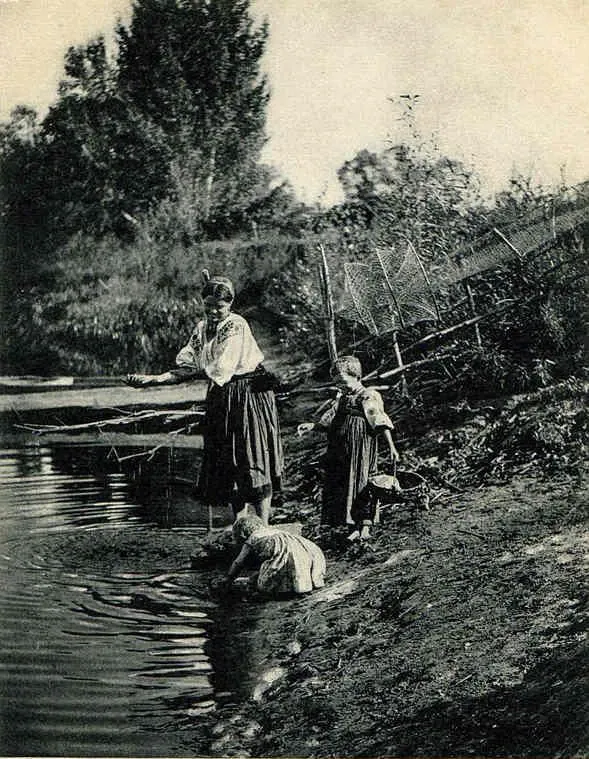
Nature is represented in Ukrainian culture with extraordinary strength.
Ukrainian poetry and song are inseparable from nature; they animate it and make it a partaker in the joy and grief of the human soul.
Grasses, trees, birds, animals, heavenly bodies, morning and evening, heat and snow: everything breathes, thinks and feels together with man, everything answers him with an enchanting voice of sympathy, hope and judgment.
Faith in the beautiful
The Ukrainian people is a deeply religious people, in the widest sense of the word.
Where there is poetry of human nature, there is religion; the one is unthinkable without the other.
With poetry, faith in the beautiful is inevitable, and the beautiful is not subject to analysis, for it is spiritual.
One can analyse only the material in which the beautiful appears. One can take a musical instrument apart and examine its parts in the most minute detail. One can study the laws of sound and the ways it travels through the air to our hearing. But the wholeness of the impression produced by a combination of sounds cannot be caught and subjected to study.
Books
Russians read serious books, or those that relate to the reader's occupation, and even then only the part of a book that can be put to immediate use.
Light, entertaining literature is rarely met with, and Russians read it without contemplating its construction, without any awareness of its idea.
Poets are read either for the sake of diversion, to show the extraordinariness of one's position, or to show one's education and good manners.
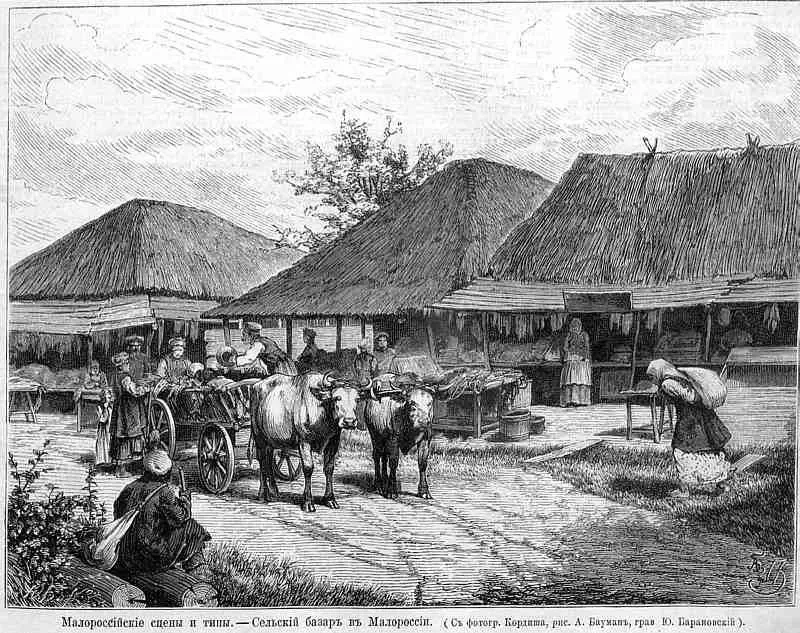
Despite the closeness of Ukrainians and Russians and their historical bond, it is remarkable that in the world of literature the one often like what the other cannot possibly like.
For example, I have seen many Russians go into raptures over the verses of Nekrasov, and, I confess, I have not seen Ukrainians on whom they worked through their poetic side.
A little history
In the 15th century, on the mainland of present-day Russia, four separate worlds could be distinguished: Novgorod, Muscovy, Lithuania and Rus'.
In the 16th and 17th centuries Novgorod was erased and destroyed by Moscow, and only Muscovy, Lithuania and Rus' remained.
Later the name "Russian" became for Moscow the very thing that for ages had remained almost exclusively the possession of Ukrainians.
Moscow stole from the Ukrainian people its name.
The Mongol-Tatar origin of Muscovy lent a definite character to its political order.
Before the Muscovite Tatars established themselves in Rus', there were no foundations of monarchism there; the influence of the ancient liberties of the veche and its assemblies prevailed.
The Mongols could not offer Rus' a new system of relations and liberties. For them victory was marked in two ways: universal ruin and the collecting of tribute.
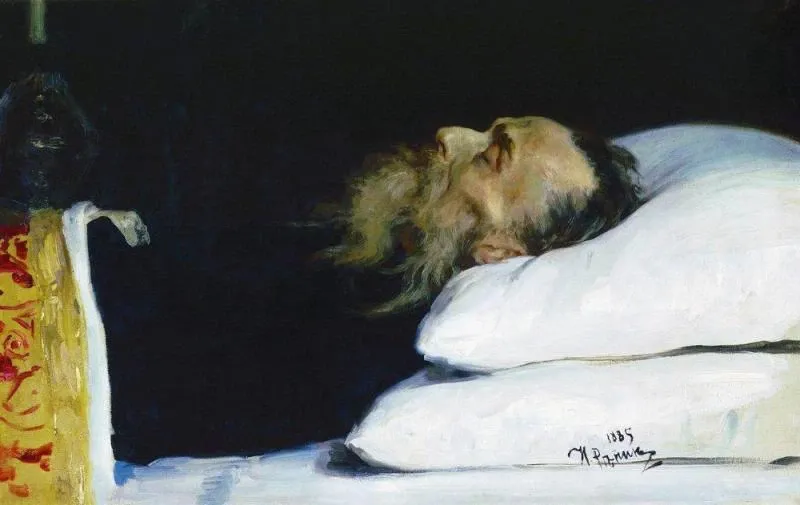
Note that after the publication of the book Two Russian Nationalities, Kostomarov was practically not published; the name of this historian and writer could be found only in reference books and encyclopaedias.
And his books, including the fundamental Russian History in the Biographies of Its Principal Figures, were printed neither in the Russian Empire nor in the Soviet Empire.
The reason was "Ukrainian nationalism", a label stuck onto Kostomarov by Muscovite imperial censorship, a label so remarkable that Soviet propagandists gladly took it up, and they, too, did everything to hinder the popularisation of his works.
References:litopys.org.uaehorussia.com