There was no "retreat" in 1941. The terror of the world, the Red Army, fled from the German one without a fight, abandoning weapons, ammunition and provisions.
By July 9, 1941, the front already ran along the line Pskov — Velikiye Luki — Vitebsk — Smolensk — Rogachev — Gomel. In seventeen days the Hitlerites had taken the Baltic states, Belarus and Western Ukraine, and had approached Kyiv. Soviet historiography (propaganda) explained the incredible retreat of the Red Army by the suddenness of the attack and the enemy's superiority in manpower and equipment: "the whole industry of Europe worked for Nazi Germany," "fascist tank armadas," and so on.
All of this was a lie.
In fact, even in 1941 we produced twice as many tanks as Germany, and in 1942 already six times as many. (Not counting the thousands of tanks and aircraft supplied by the Allies.) Over the whole war the USSR lost 100,000 tanks. It ended the war with 35,000 tanks.
So, the balance of forces at the start of the war (all figures are from the All-Russian Research Institute for Documentation and Archival Affairs):
- German tanks — 4,000. The Red Army — 14,000
- German aircraft — 5,000. The Red Army — 10,000
- German guns and mortars — 42,000. The Red Army — 59,000
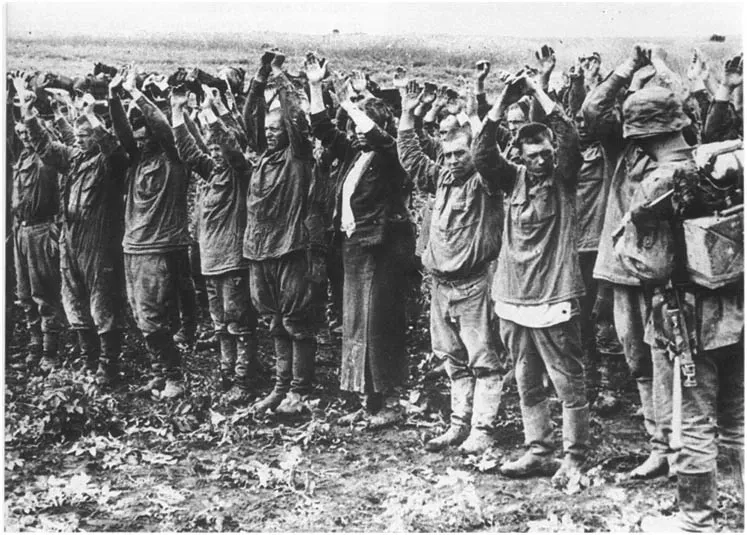
Nevertheless, on December 11, 1941, Hitler declared in the Reichstag that between June 22 and December 1 on the Eastern Front German troops had taken 3,806,860 Soviet soldiers and officers prisoner.
What on earth was going on, if the prisoners alone numbered almost four million in half a year?
In no book did I find a convincing explanation. In every meeting with veterans I would steer the conversation that way, unobtrusively — and got no answer.
Of course I asked my father too, but he never experienced the retreat; he began the war in October 1941 near Moscow, at the turning point. It was a deadly defense, but he stood facing the enemy and fought, and that is quite another knowledge, another experience.
"There are hardly any of us left…"
And then life turned out so that for 40 years, until his last days, I was friends with Vasily Yefimovich Subbotin — a participant in and chronicler of the storming of Berlin and the Reichstag, the author of the world-famous book "How Wars End." Every year in early May he tried not to turn on the television — the excessive jubilation and the frenzy whipped up by the press tormented him; he called these celebrations dancing on bones. Vasily Yefimovich regarded many of the war stories appearing in print with wariness.
"You understand," he would say, "very few people know war as a direct clash with the enemy. Some left the front line, others replaced them, then they left too — it was a conveyor belt of death four years long. Few survived and lived to tell. The front edge, the trench — that is a platoon, a company. At battalion headquarters you can already look around. Battalion commanders go to regiment headquarters the way foremen go from the field camps to the village: you can rest, see people. Division headquarters is like the central estate of a state farm, a big village. Army headquarters is like a district center, and front headquarters — a city! And everywhere, in the most various units, from regimental to front level, millions of people served. They did very, very important work — they supplied the front edge, and without them there could have been no war. But they did not come into direct contact with the enemy and do not know the trench. Yet with the years, probably, something happens to memory, and what belongs to others is passed off as one's own. And so they begin to tell, as their own, what they heard from the men of the trenches, muddling and distorting a great deal. Because if you don't know war, you can't lie about it skillfully; you will certainly slip up on some small detail."
Soviet critics and literary scholars, when discussing how our soldiers' heroism was reflected in war prose, liked to quote two lines from Vasily Yefimovich's book: "I am one of the few who remain alive — one of those born in 1921. When the war began we were twenty years old. There are hardly any of us left… What a generation that was… Like bayonets!"
But immediately after those lines come some utterly enigmatic phrases that were never quoted: "If only we had been told. If only that strength had been taken in hand. We would have lain down where we were shown, and defended the country… No one would have run. The German would never have gone so far."
"Millions of soldiers retreated without a fight"
What does it mean: "If only we had been told"? Words that seem out of tune with the whole tone. Their very incongruity caught the attention.
Vasily Subbotin's soldier's and literary fate is unique also in that he not only ended the war in Berlin but met it on the morning of June 22, 1941, on the western border, at his post as turret gunner of a medium tank. He lived through the tragedy of the retreat. Some of it he wrote about in his books, some he passed over in silence. There was, after all, not only the pressure of editorial offices, political organs and censorship — there was also self-censorship, self-restraint. He endured so many attacks for the book "How Wars End"! He would say with bitterness: "Pioneers and generals tell us how we fought…"
And the "pioneers and generals," the editorial offices, the censorship and the political organs are not there by themselves — they are the expression of an all-suppressing official historiography. Any word of an eyewitness that did not match the canon was rejected and persecuted. There is also the manipulation of consciousness, suggestibility and suggestion, which even participants in the events fall under. Thus, 15 years after the war, in 1960, at a reunion of veterans of the 150th Idritsa Division, some heroes of the storming of the Reichstag said to one another: "Remember, there was also Senior Sergeant Ivanov with us, he was killed…" But "Senior Sergeant Ivanov" is a fictional character from the feature film "The Fall of Berlin" (1949), introduced there as a comrade of Yegorov and Kantaria. (In 2000 Nezavisimaya Gazeta wrote about "Sergeant Ivanov" as a real person, in an article titled "The Hero of the Storming Remains Unknown.")
There were quite a few such stories. Not to mention the (let us put it mildly) disputes that lasted for decades and are still going on — disputes over who was first to plant flags over the Reichstag. Not for nothing did older, experienced writers warn Subbotin at the start of his path: "Don't be a suicide, change all the names and surnames, make it, as it were, 'fiction.'"
And so even in the years of freedom Subbotin did not print or publish the diaries of his wartime and postwar years. He feared that his heart would not withstand new accusations of "incorrectly showing the nationwide feat."
"Our regiment began to be bombed in the very first minutes, since we were stationed at the border," Vasily Yefimovich recounted. "We urgently left the barracks and took up positions in a neighboring forest. We dug trenches and camouflaged the tanks and trucks with branches. But no one yet believed that war had begun. The political officers kept repeating one word: 'Provocation.'
As we guessed, there was no communication with the command and no orders. Because we stood in that forest for three days almost without firing a shot. German aircraft flew over us, at night the horizon blazed. It was clear that the Germans were going around us on all sides. On the third day a group of German motorcyclists turned into our forest along a country road — the first Hitlerites we had seen. They had lost their way. We pulled them off their bikes, disarmed them, everyone ran to look. To this day I remember how they behaved. They carried themselves like masters, as if expecting that we would now throw down our weapons and surrender to them as a whole regiment. Then the commanders drove us soldiers away, the Special Department men came and led the Germans off to interrogation.
Having stood in the forest for three days, we moved out in a column onto the road to Tarnopol (since 1944 the city of Ternopil. — S.B.), hoping there would be a assembly point there. As soon as we came out of the forest, the bombing began. We arrived — and Tarnopol was already burning, occupied by the Germans. We went around it. But after Tarnopol, after the bombings, the regiment as a fighting unit no longer existed — only separate groups of people trudging in retreat. We got into the general stream of retreating troops, just as bewildered as we were, understanding nothing. We walked under bombing, the dead were left in ditches, by the roadsides. The sun beat down mercilessly. We walked without rest, without a crumb of bread in our mouths, with our feet rubbed bloody.
Among ourselves we said: let's just reach the old border — and there we'll stop, there we'll give battle. We knew that Shepetovka was on the old border. And the old border was fortified. But we could not come out exactly at Shepetovka, we only saw a blazing glow in the distance. So we crossed the old border without noticing anything. We came out at Volochisk, and from there on to Proskurov (since 1954 the city of Khmelnytskyi. — S.B.).
Almost four million prisoners in half a year of war!
But there could have been more prisoners. There was a day when we walked alongside the Germans. In the same direction — east. They walked along a road parallel to ours. Sometimes we could see them. The infantry moved in columns. Many soldiers rode in trucks, with motorcyclists in front and behind. Tanks separately.
So they went by. They paid no attention to us. That is, they understood, they had made sure that we would not fight, would not shoot at them.
With the years, remembering, I began to think: why did we retreat without a fight? After all, there were commanders among us, but in the days of the retreat I hardly saw or heard them, I did not hear an officer's commanding voice.
Now we know that before the war the command staff of our army was subjected to terrible repressions. From lieutenants to marshals. So the atmosphere among the commanders was such that people were demoralized. They feared not the Germans but their own superiors. They were afraid to give any order independently, without an order from above. No one dared to take responsibility and organize defense at any line. They simply retreated."
I will break off Vasily Yefimovich's account here. There are many versions about Stalin's actions, or rather inaction, in the first days of the war. That he fell into complete prostration.
There are documents about his attempts to reach an agreement with Hitler — an explanatory note by Pavel Sudoplatov, deputy head of the NKVD Intelligence Directorate, dated August 1953: "Around June 25–27, 1941, I was summoned to the office of the former People's Commissar of Internal Affairs, Beria. Beria told me that there was a decision of the Soviet government under which it was necessary to find out by unofficial means on what conditions Germany would agree to stop the war against the USSR and halt the advance of the German-fascist troops… Would it satisfy the Germans to hand over to Germany such Soviet lands as the Baltic states, Ukraine, Bessarabia, Bukovina and the Karelian Isthmus. If not, what territories Germany additionally lays claim to" (Russian State Archive of Socio-Political History. F. 17. Op. 171. D. 465. L. 204–208; published in the collection: 1941. Moscow, 1998. Vol. 2. pp. 487–490).
Let us return to Vasily Yefimovich Subbotin's account:
"There was no communication with the troops; it was cut off at once. Here is the newspaper Izvestia, a letter from Mark Modestov, also a tankman, judging by everything from the command staff. He too met the war on the western border, was surrounded, taken prisoner, put in concentration camps. Modestov writes: 'In those first terrible days I saw commanders shooting themselves in the temple… In an encirclement closed by five rings, we were bombed continuously, but we did not see a single plane of ours that would drop us word: what we should do, how to act.'
That is, they too waited for an order. No order, if there was one, reached anyone. And on their own, without an order, commanders were afraid to do anything at all. And millions of soldiers retreated without a fight.
And I am sure: if every commander had ordered his men to take up defense, we would have given battle and not let the German go so far. The Brest Fortress held out a whole month! How many Germans were killed there, what forces it tied down! Because a commander was found who ordered: 'Fire on the enemy!' And if such commanders had been found everywhere, every battalion could have become a Brest Fortress. And what happened would not have happened, the front would not have rolled back to the Dnieper in some two or three weeks.
What else is there to add? In ten days of retreat we crossed three regions — Lviv, Ternopil and Khmelnytskyi. In Proskurov we tankmen were gathered together, a new unit was formed, and we were transferred by train to the vicinity of Kyiv. And already in those days, perhaps on the way or near Kyiv, I came across a newspaper with Stalin's address: 'Brothers and sisters…'"
Stalin addressed the people on July 3, 1941. By that moment the Germans had taken Minsk.
This is the background against which one must consider the account of Vasily Subbotin, a turret gunner of a medium tank who met the war on June 22, 1941, on the western border and ended it in Berlin with the rank of senior lieutenant. This is what lies behind his words: "If we had been told… We would have lain down where we were shown, and defended the country… Nobody would have run. The German would never have gone so far."
And it seems to me that Vasily Yefimovich's account explains a great deal. Officers paralyzed by fear of repression. Commanders who were afraid of responsibility. They were even afraid to defend the Motherland! Such was the atmosphere in the army.
The war took…
How casualties were recorded during the war is eloquently shown by comparing the General Staff's Report of May 1, 1942, with the order of the Deputy People's Commissar of Defense of April 12, 1942.
According to the Report, irrecoverable losses from June 22, 1941, to March 1, 1942, amounted to 3,217,000 people.
The real state of affairs is described in the order of the Deputy People's Commissar of Defense of April 12, 1942:
"The recording of personnel, especially the recording of losses, is being conducted in the field army in a completely unsatisfactory manner… At present no more than one third of the actual number of those killed is on the personal register" (emphasis mine. — S.B.).
That is, the number of dead in that period was THREE times greater than what was reported to the higher staffs.
Let us continue quoting the order: "The data of the personal register on those missing in action and those taken prisoner are even farther from the truth" (emphasis mine. — S.B.).
This is how the overall statistics took shape.
In March 1946, Stalin announced: "As a result of the German invasion, the Soviet Union irrecoverably lost in battles with the Germans, and also through the German occupation and the deportation of Soviet people to German penal labor, about seven million people."
Khrushchev in 1961: "The war took two dozen million lives of Soviet people."
Brezhnev in 1965: "More than 20 million people."
Gorbachev in 1990: "The war took almost 27 million lives of Soviet people."
That is, the casualty figures grew almost fourfold. Such was the statistics.
In January 2009, the president of the Russian Federation Dmitry Medvedev was indignant: "65 years after the war, the data on our losses have still not been made public. We must arrive at the historical truth!" And he instructed the minister of defense to take personal control of preparing the data on the dead.
The Commander-in-Chief's order was not carried out. On the eve of the 65th anniversary of Victory, a deputy minister of defense announced the same figures: in 1941–1945, 26.6 million Soviet people died. Civilian losses amounted to 18 million. Combat losses — 8.66 million.
However, according to these data, combat losses are reduced by more than half.
As early as 1995, the Central Automated Data Bank of the All-Russian Research Institute of Records Management and Archival Science counted 19.5 million personal cards on servicemen of the USSR Armed Forces who were killed, went missing, or died in captivity and of wounds (Collection of materials of the scientific conference "Human Losses of the USSR in the Great Patriotic War." Institute of Russian History of the Russian Academy of Sciences, 1995).
Let us add to them the official data on civilian losses — 18 million. The result is 38 million.
When I made these calculations public, I heard a great many accusations: invention, falsification, defamation… As if the figures had been taken out of thin air. Yet a few years later the highest authority had its say. And reality turned out to be more terrible than my calculations.
On February 14, 2017, at hearings in the State Duma, a report titled "The Documentary Basis of the People's Project 'Establishing the Fates of Missing Defenders of the Fatherland'" was delivered by Nikolai Zemtsov, State Duma deputy and co-chair of the "Immortal Regiment of Russia" movement:
"According to declassified data of the USSR State Planning Committee, the losses of the Soviet Union in the Second World War amount to 41 million 979 thousand, not 27 million, as was previously thought. That is almost one third of the present population of the Russian Federation.
Irrecoverable losses as a result of the factors of war — more than 19 million servicemen and about 23 million of the civilian population… almost 42 million people."
Hitler's Germany, fighting on several fronts (the Eastern, Africa, the Mediterranean, the Western Front), lost up to 7.3 million soldiers and civilians.
And the USSR — 42 million soldiers and civilians. Among them, according to the Ministry of Defense's data for 2013, almost 2 million are "missing in action."