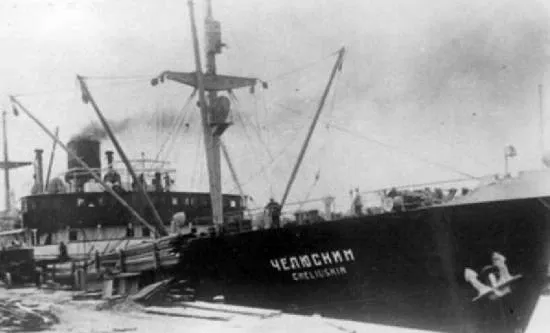
Eduard Belimov, a candidate of philological sciences, met a man in Israel who told him the true story of the historic Chelyuskin expedition.
Eduard Belimov is a candidate of philological sciences. He worked for more than twenty years at NETI in the foreign languages department, and then moved to his wife's historical homeland, Israel. There he met a man who told him the true story of the historic Chelyuskin expedition.
In the first days of December 1983, a notice appeared in the institutes of the Leningrad branch of the Academy of Sciences: A meeting with the Chelyuskinites will take place on December 5 in the assembly hall on Vasilyevsky Island. Starts at 2 p.m. Admission free.
So, the Chelyuskinites again. Are they really still alive? Maybe I should go after all? The hall was almost empty. Though people kept arriving. About 20 minutes late, the guests of honor appeared on the stage. There were five of them: four men and one woman. The event turned out not to be accidental. It was on this very day, December 5, exactly 50 years earlier, that the icebreaker Chelyuskin left Murmansk to meet its doom.
I remember reading a book about the Chelyuskinites once. I was about 15 then. But I did not understand everything in it. Many years have passed since, and the questions remain. For example, why did Chelyuskin set sail in the depths of the polar night, when the ocean is locked in ice? And further: the whole undertaking was called an expedition, yet where it was sailing and why, the book somehow does not say a word. But that is not all. If the expedition was high-latitude, that is, polar, then why were women and even children among its members? One of the passengers even managed to give birth to a child right on the way! It happened in the Kara Sea, and so the girl was named Karina. May thunder strike me if I am mixing something up!
In 1957, as a second-year student, I attended a meeting with the pilot Vodopyanov. The famous pilot came out on stage in a general's uniform, his chest covered in decorations, his head already gray. He did not want to talk about the rescue of the Chelyuskinites, since everyone knew about it anyway. He spoke about the war and other events. Only at the very end did someone in the hall ask how many Chelyuskinites he had personally carried out to the mainland. Thirty-two, Vodopyanov answered. So, more than the other pilots? No, the number of flights was about the same for all of us.
Another puzzle! As everyone knows, there were about 100 people on Chelyuskin. Three planes and three pilots would have been enough to rescue them. Yet Moscow sent seven planes and seven pilots to Chukotka. Whom, then, were they rescuing?
And the Chelyuskinites on the stage told the same story as 50 years before: they knew, they believed, they never doubted that help would come, they are proud of their Motherland, and so on and so forth.
The woman spoke last. She turned out to be precisely that passenger of Chelyuskin who gave birth on the way to the girl named Karina. She did not speak for long. She is proud of her great Motherland, she is grateful to the Soviet people and the Communist Party for caring for her and her child. Karina grew up, graduated from an institute, and lives and works in Leningrad. The woman fell silent, and then a man stood up in the hall, short and stocky, with a round head, as mathematicians often have, and asked:
- You said nothing about your husband. Who was he?
- And why does that interest you?
- You needn't answer, I know anyway. But tell me, does the word Pizhma mean anything to you?
The Chelyuskinites clearly did not like this question.
- Even if it does, - the woman said, - what has it to do with you?
- Imagine, it has. My father was on Pizhma, as you have already guessed, in the capacity of a prisoner. And your surname is Kandyba. Your husband was the head of the convoy on that same ship. Where is he now?
- My husband was repressed in '34 and perished, just like your father.
- Now there you are mistaken: my father is still alive.
This surprised the Chelyuskinites.
- Are you joking?
- Imagine, not in the least.
The woman did not want to continue the unpleasant conversation and demonstratively sat back down in her seat. Then some other people spoke, and in conclusion there appeared on the stage... Karina! That was something nobody expected. She was applauded for a long time. What she said is hard to recall. Of course, that in her passport, in the box for place of birth, it says: Kara Sea. Icebreaker Chelyuskin. And also that she loves her mother very much and is very proud of her. With that the meeting ended, and people exchanged impressions outside.
The round-headed man approached me himself, coat open, on his head a hat of indeterminate color. As far as I understand, he simply wanted to pour out his heart to someone. We introduced ourselves. His name was Yakov Samoilovich. And so, very slowly, we walked toward the Vasileostrovskaya metro station. A wet wind blew from the Neva, slush squelched underfoot. Yakov Samoilovich, probably for the first time, was telling what he had kept silent about for years, and the veil of mystery around Chelyuskin began to lift.
On the steps of the metro station we were to part. We talked for another five minutes or so, and then Karina appeared. She was wearing a pretty coat with a narrow fake-fur collar and a knitted woolen cap on her head; that was how almost all Leningrad women dressed in those days.
Yakov Samoilovich waved his hand and, without even saying goodbye, ran to meet her. They stopped, started talking about something, and literally the next moment vanished through the metro doors.
And two or three days later Yelizaveta Borisovna, Karina's mother, was already receiving a noisy and unceremonious guest at her home. She recognized him at once, as soon as he took off his hat. As a true patriot, Yelizaveta Borisovna regarded Jews, to put it mildly, without particular sympathy. But what could she do? What can a mother do at all with a 50-year-old daughter who has decided to replay her youth? In time everything settled down. Yelizaveta Borisovna did not like to talk about it, but Yakov Samoilovich was insistent, and he had the right to be.
SO, let us return to the distant past, to December 5, 1933. At about 9 or 10 in the morning Yelizaveta Borisovna was brought to the quay and helped aboard Chelyuskin. Almost at once the departure began. Steamships hooted, flares burst in the black sky, music played somewhere, and everything was solemn and a little sad.
The captain's bridge on Chelyuskin was as spacious as a schoolyard. Looking ahead, you could see nothing but the gloom of the polar night. But looking back, there was something to see. Behind Chelyuskin sailed Pizhma, ablaze with lights like a fairy-tale city. On the navigating bridge of Chelyuskin two men walked almost constantly: Captain Voronin and the head of the expedition, Academician Otto Yulyevich Schmidt. On the bridge of Pizhma, too, two figures could almost always be made out, one shorter, the other taller: Captain Chechkin and the head of the convoy Kandyba, the lawful husband of Yelizaveta Borisovna.
Days passed. The farther east, the stronger the frosts and the less open water. Skirting the ice massifs, Chelyuskin and Pizhma sometimes veered far north, at times by hundreds of kilometers, and sometimes descended far south, almost to the continent itself. Stubbornly, kilometer after kilometer, they advanced east. And only once did the twin ships moor alongside each other. That happened on January 4, 1934, Karina's birthday. The head of the convoy Kandyba, a fearsome representative of the Cheka, within five minutes of becoming a brigade commander, wished to see his newborn daughter in person.
Yelizaveta Borisovna occupied a luxury cabin, the same as the captain's and the expedition head's.
- What a cabin it was! - Yelizaveta Borisovna dreamily closes her eyes. - I see it as if it were now: two rooms, a large one with two portholes, the sitting room, and a smaller one with one porthole, the bedroom. And there was also a bathroom and a hallway. Polished wood everywhere, mirrors, nickel, carpets. Little Karina lived in this cabin for forty days and felt wonderful. I simply cannot imagine that all of it is flooded with water and lies on the seabed. And they certainly know how to build!
- And who are they, Yelizaveta Borisovna? Where were Chelyuskin and Pizhma built?
- They didn't tell us that. And we didn't ask, we weren't raised that way. Everything ours, everything Soviet. Only once, in the wheelhouse, did I happen to notice a small brass plate, and on it was written in English something like this: Chelyuskin launched June 3, 1933. Displacement 7,500 tons, built to the order of the Soviet Union at the shipyard in Copenhagen, Kingdom of Denmark.
So, on the evening of January 4 the head of the convoy Kandyba crossed from Pizhma to Chelyuskin. In cabin No. 6, at the bedside of the woman in labor, a short meeting of the command staff took place. There was only one question: what should the new passenger be called?
Yelizaveta Borisovna patiently heard everyone out and said: Tanya, Olya or Masha are good names, but not for my daughter. No one has yet been born in the middle of the Arctic Ocean during the polar night. We are in the Kara Sea, and I have thought up an unusual name: Karina.
The men were delighted, and Captain Voronin right then wrote out a birth certificate on a ship's form, indicating the exact coordinates, north latitude and east longitude, signed it and affixed the ship's seal.
Karina was born in the farthest corner of the Kara Sea. There were some 70 km left to Cape Chelyuskin, and beyond it, as is well known, another sea begins, the East Siberian Sea. But even that is not the end of the road. Where, then, and why were Chelyuskin and Pizhma sailing?
In 1929 a geological party discovered in Chukotka the largest deposit in the world of tin and other most valuable metals, the companions of tin ore. One geologist was once descending a hillside and sat down to rest. He took off his rucksack, lit a cigarette, then glanced absently down and saw, next to the heels of his boots, elongated pebbles of a smoky gray color. He had seen such rock somewhere before! He thought for a moment and remembered: in his student years, in the university geological museum. But it couldn't be! Cassiterite! Tinstone! And where?! In godforsaken Chukotka! To check the assumption no laboratory is needed: it is enough to put a piece of the mineral on a flat stone and build a small fire around it. If it really is cassiterite, in a few minutes the bit of rock will turn into a puddle of liquid tin. And so it happened. The deposit was studied for two years. And at the beginning of '33 the Council of People's Commissars made a hasty decision: to build in Chukotka by the end of that same year a mine, a concentration plant and a socialist settlement. The country must have its own tin, and other rare metals as well!
To carry the cargo it was decided to use two large ocean steamers, ordered earlier in Denmark. In July of '33 both ships arrived in Murmansk and were moored for loading. Chelyuskin was simply loaded, while on Pizhma a reconstruction was under way: carpenters turned the ship's holds into a floating prison for two thousand prisoners. Running ahead, I will say: the Deputatsky tin mine and the settlement of the same name were built only in '37. In 1990 the workers' settlement of Deputatsky had 6,000 residents, and in the summer of 1996 it ceased to exist, that is, it was abandoned by its people. Mining tin ore at the edge of the world, and beyond the Arctic Circle at that, turned out to cost several times more than buying ready-made tin in Malaysia.
Preparation for the expedition went on in incredible haste, they worked day and night and still managed it only in four months. That is why Chelyuskin and Pizhma put to sea only on December 5.
The holds of Pizhma were neither cold nor gloomy, as the well-known Kolyma song has it. The steam heating worked without interruption, and the electric light burned around the clock. On three-tier bunks, in incredible crowding, criminals and politicals coexisted. With the criminals everything is clear: they are the same everywhere and always. But who were they, the political prisoners of '33? First of all, peasant men from among the so-called kulaks, then former NEPmen, saboteur engineers, double-dealing scholars and, of course, clergy of every stripe, mostly Orthodox priests. They even had their own leader, Metropolitan Seraphim, from somewhere in the Moscow region. Even the VOKHR, that is, the armed guard, treated him with respect.
A group of Jewish specialists kept apart from the other political prisoners: radio engineers and, of course, foreign agents. Among them was the father of Yakov Samoilovich, who also earned the honor of traveling in the holds of the Pizhma. And for what services? Half a century later his talkative son told the following story about it.
— You know Jews: always and everywhere they stick their noses in where nobody asked them to. Picture a Jewish boy from a Belarusian shtetl, a cobbler's son (my grandfather was a cobbler), and what do you think he took a fancy to? You'll never guess: radio engineering! And this in the twenties, when nobody could yet understand why you needed this radio of yours if you had the telephone and the telegraph! And you think he was the only one? Heaven forbid! There were many of them. And I always said: you shouldn't mix anything on Jewish brains alone, you'll get an explosive mixture for sure, and it won't end well. And so it turned out. By the early 1930s there was a great stir and clamor all over the world. Judge for yourselves: not somewhere else, but in backward Russia, the most powerful radio station in the world, the Moscow one, goes on the air, and beside it the biggest radio transmitting tower in the world! And that's not all. For the first time in the world an independent radio industry is created, along with educational and scientific centers for radiophysics. "Well, that's good," you'll say. It is good, but it depends where. While the average man was proud and glad, on the Lubyanka they were already wondering: why are these fellows trying so hard? For no reason? But let's not talk nonsense: nothing is ever for no reason. They started digging and found that they were all Jews, even those you wouldn't suspect. They went on reasoning: why do Jews need radio? Again, for no reason? Don't make people laugh, Jews are not the sort of people to do anything for no reason. They started looking and very quickly found it. It turned out that each of them had a homemade radio station at home and a whole list of foreign correspondents. Nowadays they're called radio amateurs, but in those distant times they reasoned differently: residents of foreign intelligence services. On the Lubyanka they rubbed their hands: a spy center discovered and neutralized! And on what a scale! They didn't shoot them, because Chukotka came along just in time. It was decided like this. Let them work a couple of years mining nonferrous metals, and then they'll kick the bucket on their own.
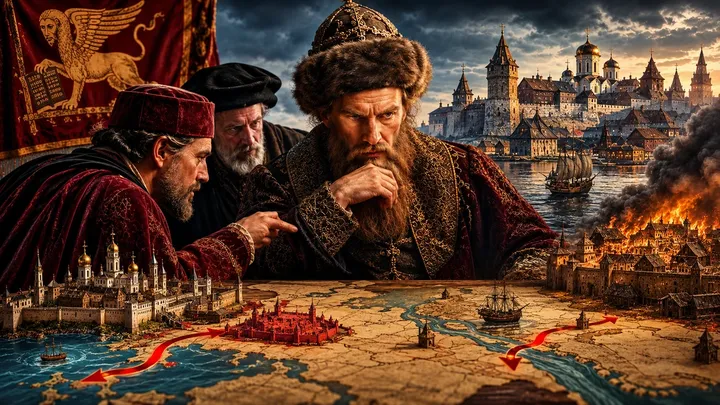
NOW it is time to tell about the most important thing. But first, some historical background. In 1992 a special commission appointed by President Yeltsin discovered in the archive of the Politburo of the Central Committee of the CPSU for 1933 two curious documents: two notes from the government of Denmark to the government of the Soviet Union. The first note concerns the steamship Chelyuskin, and the second concerns two steamships at once: the Chelyuskin and the Pizhma. So, we read: The Royal Government of Denmark expresses serious concern in connection with the decision of the Soviet authorities to send the ships Chelyuskin and Pizhma on an independent voyage from Murmansk to the Far East through the seas of the Arctic Ocean. The Chelyuskin and the Pizhma are not icebreakers, as is claimed in the Soviet press. Both ships belong to the class of the most ordinary cargo-passenger steamships and are therefore completely unsuited to navigation in northern latitudes. Should even one of the named ships be lost, the prestige of the Danish shipbuilding industry will suffer undeservedly.
That is all. What was the Politburo's reaction? The Danish notes are not mentioned at all in the minutes of its meetings. It was one of two things: either the agenda was very full and there simply wasn't time for such trivial questions, or the notes were read out after all but left unanswered. It is not hard to imagine the scene: the Teacher and Leader of the Peoples takes the pipe out of his mouth and, letting out smoke, says with a Georgian accent: The capitalist gentlemen, as always, are looking after their profits. We paid them in full, and now these ships are ours. We will dispose of them as we see fit. Nobody has the right to interfere in our internal affairs. The master of the Kremlin was right as always, and the members of the Politburo bowed their heads in agreement. And ahead of them lay retribution for this frivolity.
The morning of February 13, 1934 came. The polar night was already behind. At the appointed time the sun rolled out from behind the horizon and hung right above the hummocks of the frozen sea. On the Chelyuskin the lights were put out, people poured out onto the deck, and mothers brought out their bundled-up children. After the polar night there is no more stirring sight than a sunrise. Meanwhile the Chelyuskin was slowly gliding along a narrow passage between two ice fields. Neither dead ahead nor astern of the steamship was any open water to be seen. The ice fields moved stubbornly toward each other, and no force could stop that movement. The Chelyuskin was in a deadly trap. Only a day would pass, and the whole world would learn of the tragedy in the Chukchi Sea. Why the Chukchi Sea? Because the Party's assignment was almost completed. There were only some 300 kilometers left to the Chukotka settlement of Pevek, with its large and secure bay, but it was precisely these kilometers that remained uncovered. Fifty years later the Chelyuskin survivors would recall as if it were yesterday how the ship's radio came to life and in Captain Voronin's hoarse voice said: Everyone onto the ice! We're sinking! At that moment the thin steel plating of the ship was bursting under the pressure of the ice floes as if it were made of paper.
Almost on that very day the American president Roosevelt offered the Soviet Union free assistance in rescuing the Chelyuskin people. The case was unique: in a few months a presidential election was to be held in the USA. And here was such an opportunity to show the American people what a humane and all-powerful president they had. The Soviet Union is a poor and backward country. Neither in Chukotka nor in Kamchatka do the Russians have a single airplane. And even if they did, what good would they be? Are those even airplanes? Little plywood dragonflies, one pilot and two passengers, sitting in open cockpits. On top of that they fly at a tortoise's pace, a little over 100 km an hour. America is another matter! Polar aviation! That exists only in the United States. Amphibian planes! The latest model of the American designer Sikorsky, who is, by the way, Igor Ivanovich and, of course, a native of Russia. The Americans in Alaska already have a whole squadron of such planes. Looking like a gull soaring in the sky, the amphibian is put on skis in winter, and in summer on wheels or floats for landing on water. The fuselage is tightly enclosed and equipped with a heating system run off the engine. The plane is flown by two pilots, and the passenger cabin has six leather seats. The amphibian flies at more than 200 km an hour. From Alaska to the place where the Chelyuskin perished it is 500 km. There and back, 1,000. For Sikorsky's plane such a distance is no obstacle. The Chelyuskin's crew need only prepare a landing strip, and the Soviet government give its consent. And within a single day all the women and children would be delivered to Alaska, to warm houses with every comfort. And within two more days all the other victims of the shipwreck would be rescued too. Quite unexpectedly for everyone, the Soviet government categorically refused to accept the help. That was something President Roosevelt could not understand at all.
And it was all as easy as pie. Along the Northern Sea Route there sailed not one steamship, as the Americans thought, but two at once. On one of them, named the Pizhma, were prisoners and armed guards, and on the other, named the Chelyuskin, the guards' wives and children. Disaster struck one of the ships, and as a result women and children, including the very smallest, found themselves on an ice floe in 50-degree frost. How could one possibly refuse American help?! What cruelty! However, let us not rush to conclusions. We must not forget the Pizhma. The Chelyuskin's faithful companion had lately begun to fall behind and in the end got stuck among the ice floes and hummocks. By February 13 the distance between the two ships already exceeded 30 km. And where was land? Not so very far, only 170 km. Herds of reindeer roamed there, and the Chukchi lived there in their smoky yurts. How long would the Pizhma's ice captivity last? Everyone aboard the steamship, from prisoner to captain, racked their brains over this question and invariably reached one conclusion: open water would not appear in these parts before mid-July, and that meant the vessel would not budge. There was enough coal and food. The problem lay elsewhere: what to do with two thousand prisoners? There were many of them, and the guards were laughably few. And there was nowhere to expect help from. And the prisoners had already planned something: you could see it in their behavior, in the special glint in their eyes, and you can't fool the guards!
As soon as it became clear that the Pizhma was stuck among the ice firmly and for a long time, the convoy commander Kandyba ordered the aerosleds to be unloaded onto the ice and tests of the new machinery to begin. And here it turned out that none of the guards knew how to operate the unusual machine. Then they turned to the prisoners: are there any pilots among you, boys? There were pilots, of course. There were about five of them. According to their files, they had all been plotting to fly abroad, and not empty-handed but with the blueprints of Dneprostroi or Magnitostroi. But there was nothing to be done, so the pilots were smartened up: washed, given haircuts, dressed in brand-new overalls, and from there everything went like clockwork. The engines obediently started, the propellers spun. On the very first day the design flaws made themselves known. The novelty was, no question, just what was needed: on hard crust and on loose snow alike the aerosleds ran at the speed of a car, but for some reason they responded badly to turns and uneven terrain. Even on a small bump they could tip onto their side or, light as a cork, fly off to one side and land runners up. In time the pilots learned to drive the aerosleds without any particular incidents. And just in time!
On the evening of February 14 aerosleds rolled up to the starboard side of the Pizhma, first one and then a second. The doors flung open, and children of all ages poured out like peas. Kandyba came down the creaking gangway onto the ice, walked up to the first sled and looked inside. It was dark and hot there. In clouds of steam appeared Elizaveta Borisovna in a squirrel-fur coat with a red bundle in her arms. So the order had been carried out: all the children had been delivered to the Pizhma. A week later not a single woman was left in the Chelyuskin people's camp. Moscow ordered the men of the Chelyuskin to stay on the ice floe and wait for help from the mainland. Little Karina and her mother again settled into a deluxe cabin, exactly like the one on the Chelyuskin. Only on April 5 did the pilot Kamanin ferry them to Chukotka. On the evening of that day only men were left aboard the steamship. In Kandyba's pocket there already lay a secret order, a coded radiogram. Nobody knew what was written in it, but almost everyone guessed.
What happened next, nobody knows for certain. There have long been no living witnesses.
ALL THAT REMAINS is to report a few details from the lives of Karina and her parents. About a week after the Chelyuskin people's triumphal entry into Moscow, Kandyba was summoned to the Lubyanka. He returned home with the rank of brigade commander and the Order of the Red Banner on his chest. And no explanations to anyone, not even to his wife. Still, once, when he was very tipsy, Kandyba told Elizaveta Borisovna about his visit to the Big House on the Lubyanka.
He was led down a long corridor into an office the size of a basketball court. Men in uniform rose to meet him and shook his hand. And at once the master of the Lubyanka came in: General Commissar of Internal Affairs Genrikh Yagoda, in blue trousers with stripes and a white tunic with gold buttons. Everyone sat down, and a businesslike conversation began. They asked, and he answered in a military manner, briefly and precisely. They asked, for example, about the pilots, what he thought of them, whether they were capable of holding their tongues. One had to answer quickly and tell only the truth. All these Kamanins, Vodopyanovs and Lyapidevskys, said Kandyba, are simply naive boys, and you can expect anything from them.
A short pause followed. Then Yagoda himself spoke: For the time being we've shut their mouths. We came up with the title Hero of the Soviet Union especially for them, and now they're in seventh heaven.
Everyone present laughed, but they demanded clarification.
— And was there really anything heroic there?
"Absolutely nothing," Kandyba answered without a moment's thought. "We flew brand-new planes, and only in good weather, an hour there and an hour back. We landed on well-prepared strips, and each pilot made about 20 sorties without a single incident. Ordinary work, nothing heroic."
"Strange reports have appeared in the American press. Supposedly some of the prisoners from the Pizhma made it to Alaska. What do you think about that?"
A chill of fear ran down Kandyba's spine. He knew well what prisoners were capable of. But for any of those wretched skeletons to walk 500 kilometers across a frozen ocean?!
"That cannot be!" he answered without the slightest hesitation.
"Was the Pizhma blown up properly? Were there any oversights?"
"Everything was done as it should be: three charges went off simultaneously, and the pilots Molokov and Doronin saw with their own eyes how the Pizhma sank."
Kandyba's confidence made a good impression. That was where it ended.
At the beginning of August the Chelyuskinites were sent to the Black Sea to rest and recover. Kandyba's family settled into the general's suite of an NKVD sanatorium in Yalta. Little Karina at once became the idol of the whole sanatorium, and then of the whole town. Just think: she was born on an icebreaker in the middle of the Arctic Ocean, then spent two months in a tent on an ice floe. And she survived! Correspondents and photographers arrived from every direction. Karina was photographed for children's books, magazines, textbooks. And she really was a perfect little angel: curly-haired, blue-eyed, with a charming smile!
On September 4 Karina turned eight months old. From early morning the birthday girl received congratulations and presents. With nothing else to do, the sanatorium went wild. In the evening tables were laid on the huge balcony of the suite where the Kandyba family lived. The guests came, all of them weighty people, NKVD bosses from all over Mother Russia. They made merry until deep into the night. The carefree life seemed to have no end. And yet the end was drawing near. Another week passed, and a telegram arrived addressed to Kandyba: report immediately to Moscow, and again to the Lubyanka.
This time he had to wait a long time. At last his turn came. A young man led him through the corridors and passages of the ground floor. In a small room a man in military uniform sat at a desk, most likely an interrogator. Suddenly the door swung open and Karl Peters walked in, the permanent deputy chairman of the Cheka from Dzerzhinsky through Yezhov inclusive, a legendary figure, a merciless guardian of the revolution. Five more years would pass, and Peters himself, together with Yagoda and Yezhov, would be led along these same corridors to be shot. But who could know that in 1934?! At the sight of such high-ranking authority Kandyba jumped up and drew himself to his full, enormous height. Peters signaled him to sit and himself lowered himself onto a chair beside the interrogator. In his hands he held a foreign magazine with a glossy color cover. Peters opened it to the right page, laid it in front of Kandyba, and only then began to speak, in a quiet, colorless voice with a slight Latvian accent.
"Look carefully at this photograph. Do you recognize anyone here?"
At first Kandyba saw the silhouettes of American skyscrapers against the winding line of a sea bay. Only then did he notice, below, a large group of bearded men dressed somehow strangely. He looked closer and understood: they were Orthodox priests in full church vestments. He ran his eyes over the faces and opened his mouth in astonishment: before him were his old acquaintances, the involuntary passengers of the Pizhma, and in the foreground, Metropolitan Serafim in person!
"Aha, I see you have recognized them. This photograph was taken in New York a month ago. I very much want to know how these gentlemen got into the United States. And not only they, but also a large group of Jewish radio engineers. One can only guess what interviews they are giving American journalists, what horrors about our country they are telling!"
This was not an interrogation. Peters talked, and Kandyba, pale and pitiful beyond recognition, listened and said nothing.
"You received an order to blow up the Pizhma. But how did you carry it out? Of the three charges, for some reason only one went off, and that one of small power. Instead of a few minutes, the Pizhma took eight hours to sink. In that time the prisoners managed to carry hundreds of tons of cargo onto the ice, and then, having got into their hands stores of food and warm clothing, they set off for the mainland as a whole camp. As far as we know, many hundreds reached the shore and scattered across Chukotka. It will take years to round them up. But not all of them left. A large group of political prisoners stayed to wait for American help. And they got it. Before leaving the Pizhma, citizen Kandyba managed to run into the radio room and disable the transmitter. To do this he fired several shots from his Nagant revolver at the radio tubes, but for some reason forgot about the spare set. Among the zeks there were any number of radio specialists. Within a few minutes they replaced the smashed tubes with intact ones, and the transmitter worked again. One of them immediately tapped out an SOS into the ether to his friends across the ocean. When the prisoners' revolt began on the Pizhma, you, citizen Kandyba, fled to the Chelyuskinites' camp on a motor sledge, taking with you only a few men from the guard. What became of the rest of the guards one can only guess."
Kandyba's fate had been decided in advance somewhere at the very top. In such a case a trial and investigation become unnecessary formalities. Many years later Karina tried to have her father rehabilitated, but could do nothing. Kandyba's file was not found in the KGB archives.
Our story has come to an end. But it is a little too early to put a full stop. Let us return once more to 1934! A large group of political prisoners ends up not in Chukotka but in the United States of America, where there is no censorship, where anyone can say and write whatever he pleases. In the autumn of 1934 a decree On Tightening Measures Against Persons Attempting Illegal Border Crossing unexpectedly appears in the Soviet press. This crime is now punishable by death. And what about those who escaped all the same? In that case responsibility is shifted to close relatives: for connivance and carelessness, 10 years of strict camp regime. At first even in the Soviet Union many were surprised: was it not too severe? But then they figured it out: everything is correct! How can one run away from such a wonderful country, where man breathes so freely?! What a scoundrel one must be! And the relatives? They will, of course, swear that they knew nothing. But who would believe them?
It is hard to say whether anyone was actually prosecuted under this decree. But in America some people immediately bit their tongues. Our fugitives remembered their parents, wives and children, changed their surnames, and never told anyone their biographies again.
ONE MORE event took place in 1980. A Leningrad apartment on Vasilyevsky Island. In front of the television, in an armchair, sits a 50-year-old man with a round bald head and temples already turning gray. This is our old acquaintance Yakov Samoylovich. The telephone rings. Yakov Samoylovich is watching footballers on the TV screen, mechanically picks up the receiver, and hears a high, undoubtedly elderly voice.
"I need Yakov Samoylovich."
"I'm listening."
"I must make sure that you are the very man I am looking for. Were you born on August 1, 1930?"
"Absolutely right."
"Is your mother's name Sofya Izrailevna?"
"My mother died during the Leningrad blockade, but she was indeed called Sofya Izrailevna."
"In that case you are exactly the one I am looking for. I am your father. I am calling you from the United States."
"You are evidently quite a joker! My father died in unclear circumstances back in 1934, in the capacity of an enemy of the people."
"And nevertheless I am not joking. I did not die at all. By God's grace I stayed alive and got to America. Dear son! I will write you everything in a letter. If you only knew how hard it was for me to find you!"
So Yakov Samoylovich acquired a father. However, they never managed to meet. Leningrad scientists were not allowed abroad in those years. And his father, a peer of the century, could not come because of poor health. He lived another five years and died in the same year as Elizaveta Borisovna.
In 1992 Yakov Samoylovich left for his historical homeland, and Karina was left alone. She still lives in her small apartment on the Okhta side. On the wall above her bed hangs an enlarged framed photograph. Under the photograph is the caption: Yalta. August 1934. In the picture her father is in military uniform, with the golden star of a brigade commander on his collar tab, and her mother, like a bride, in a white dress. Both are young and beautiful. In the background are cypresses and the Black Sea. In another, smaller photograph, standing on the nightstand by the bed, is a man already familiar to us, in a straw hat and shorts, against the background of a different sea, the Mediterranean. Sometimes letters come from the shores of that sea, sometimes the telephone rings. And that, perhaps, is all.