In this 70th anniversary year of the victory in the Great Patriotic War, many programmes and films about those events are being released, but everywhere the truth about the war is deliberately concealed.
In this 70th anniversary year of the victory in the Great Patriotic War, many programmes and films about those events are being released, but everywhere the truth about the war is deliberately concealed.
Why were the Germans able to reach Moscow itself?
Who is to blame?
After all, the entire war in 1942, 1943 and 1944 was only the CORRECTION, at a monstrous price, of someone's mistakes made in the summer of 1941.
The culprit of the tragedy
The culprit of the 1941 tragedy has long been known: the Chief of the General Staff, G.K. Zhukov.
No commander in the world has suffered such disgraceful defeats as Zhukov did in the summer of 1941.
The whole splendidly prepared Red Army was routed in the first months of the war because of Zhukov.
In 1941 the Red Army lost 6.3 million soldiers and officers.
Of these, 1 million were shot by the NKVD or sent to the GULAG for refusing to fight. 1.3 million were killed in combat.
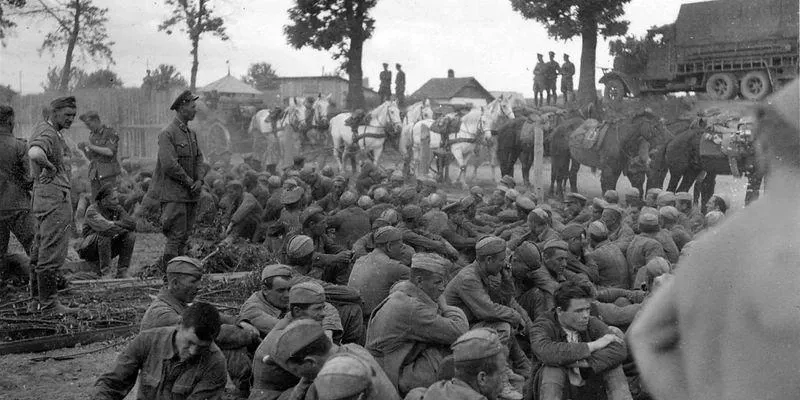
And 4 million surrendered to the Germans (they surrendered to an army of 3.5 (!) million), mostly voluntarily, not wishing to fight for the Soviet regime.
The entire pre-war regular army was destroyed!
Personally to blame for this is G.K. Zhukov, who was responsible for preparing the country for war.
In 1941 the Red Army lost 6,290,000 small arms, most of which went to the Germans as trophies in the first days of the war, since they had been stockpiled at the border.
That is enough weapons to arm the whole of Germany.
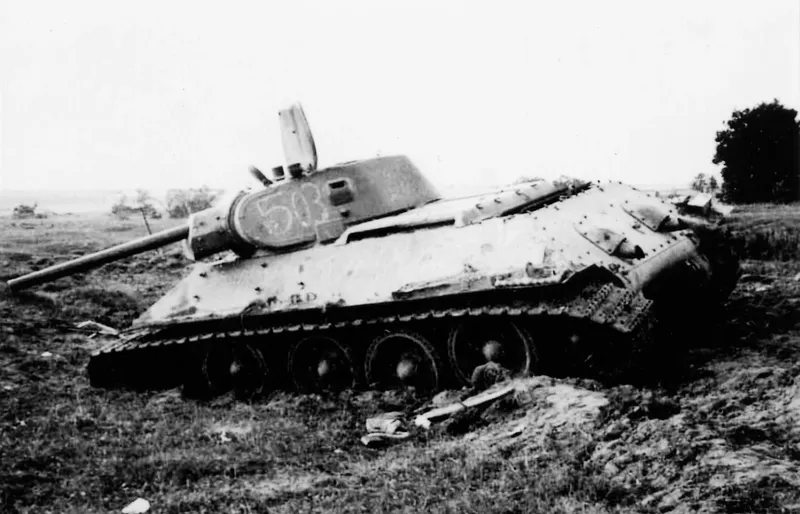
In 1941 the Red Army lost 20,500 tanks out of 27 thousand before the war.
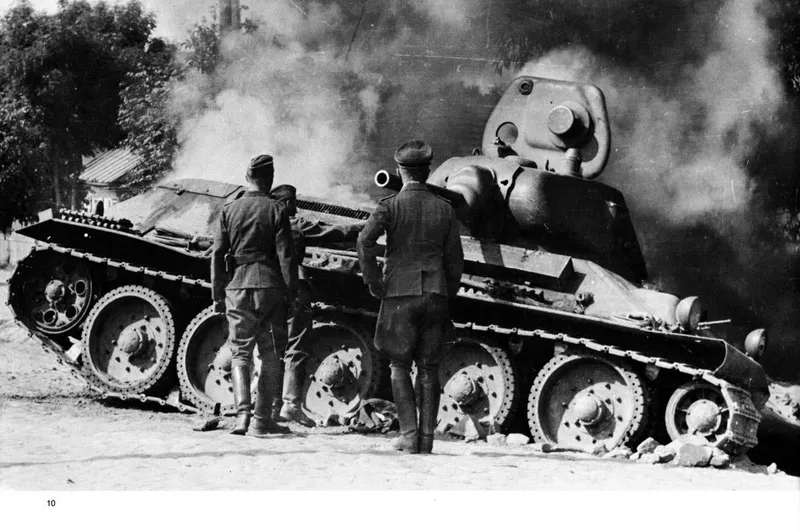
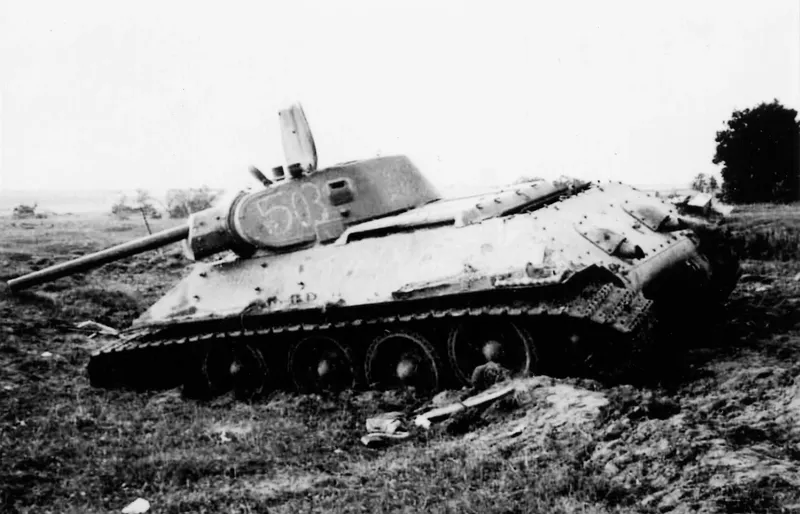
Of these, in the very first days of the war Zhukov presented Hitler with 6.5 thousand Soviet tanks, including the T-34, KV-1 and KV-2, which then advanced on Smolensk and Moscow with crosses on their sides.
Literary Gazette, 22 March 1989, V. Anfilov's article The Hardest Years:
We lost at once, up to the middle of July 1941, about a million soldiers and officers, of whom 724 thousand were taken prisoner. The enemy got as trophies 6.5 thousand tanks, 7 thousand guns and mortars, and huge stocks of fuel and ammunition.
Hitler began the war with only 3,582 tanks, but in the very first days of the war he seized another 6.5 thousand tanks!
Moreover, the Soviet tanks were considerably better than the German ones; about half of the German tanks were two-man T-II light tanks with bulletproof armour, armed only with machine guns.
Thus Hitler advanced on Minsk, Smolensk and Moscow with tank armies in which German tanks made up only a third, and two thirds were Soviet tanks, presented to Hitler by Zhukov.
In 1941 the USSR lost 101,100 guns and mortars, of which 7 thousand were captured by the Germans already on the morning of 22 June at the border.
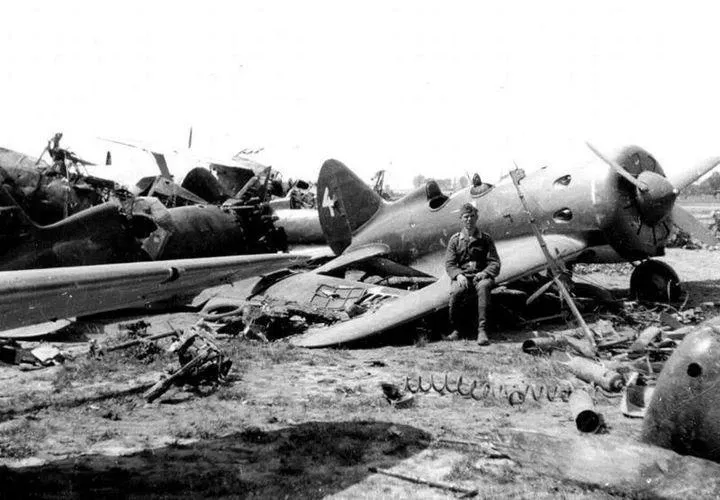
It also lost 10,300 aircraft, more than twice the total number of German aircraft, almost all of which were burned on the ground without ever taking off.
Moreover, most of them were destroyed at the airfields by German tanks.
In our film epics about the war, thoroughly mendacious, the people are told that the troops were supposedly placed criminally close to the border by the commander of the Belorussian Military District, Pavlov.
That is a lie, since the troops were placed criminally close to the border in all the western military districts of the USSR, and the order to station them there was given by the Chief of the General Staff, Zhukov.
Why?
Because, as Lieutenant General N.G. Pavlenko wrote in the Military History Journal, 1988, No. 11, p. 21:
Our leadership did not even think about the strategic defence that was forced on us by the enemy in the summer of 1941.
As early as the spring of 1941 Zhukov ordered the airfields moved as close to the border as possible: fighter aviation 20-30 km from the border, bomber aviation 50-70.
And Zhukov placed many airfields in strategic directions just 8 km from the border.
Colonel General L.M. Sandalov wrote:
The assault regiment was relocated to a field airfield 8 km from the border on 20 June 1941 by order of the Chief of the General Staff of the Workers' and Peasants' Red Army, General of the Army G.K. Zhukov.
Zhukov's pre-war orders are altogether very interesting!
On Zhukov's orders, 10 railway brigades totalling 70 thousand men were concentrated at the border to relay the German-gauge track to the wide Soviet standard.
On 22 June the men of these brigades fought off the Germans with sledgehammers and shovels.
But here is the question: if Zhukov was not planning an attack on Germany and did not expect an attack by Hitler, why did he gather 70 thousand military railwaymen at the border?
Zhukov's crimes
All of Zhukov's pre-war orders were criminal, and for them Zhukov should have been tried and shot instead of Pavlov, as the chief culprit of the terrible rout of the army.
Because it was his orders that predetermined the dreadful Catastrophe of 1941 and all the horror of the Great Patriotic War, which without Zhukov's orders would have run quite differently, outside our territory.
If the Germans had managed to plant their own agent in the General Staff of the USSR, even a thousand such agents would not have done the USSR more harm than Zhukov did to his country.
The single gift of 6,500 Soviet tanks to the aggressor is already odious.
All of Germany, working at full strain, was able to produce only 3.5 thousand tanks by the start of the war, and weak ones at that, more than half of them armed only with machine guns.
And Zhukov presented Germany with twice as many in the very first days of the war.
Those tanks were created by the hard labour of our people, who went hungry and gave the army their last kopeck, their last piece of bread.
In the USSR people were sent to camps for stealing two ears of grain from a collective-farm field, and 12-year-old children were even shot.
And here the strategist Zhukov presented the Nazis with 6.5 thousand tanks!
Is it really for this that Zhukov is regarded today as the Savior of the Fatherland?
Zhukov is the author of the tragedy of the peoples of the USSR.
First of all, it is because of Zhukov that the western territories of the USSR were occupied, where in Belarus alone more than 99% of the Jews were destroyed.
This is the result of the strategy of this strategist, the Chief of the General Staff of the USSR.
The blockade of Leningrad and the death by starvation of hundreds of thousands of Leningraders is Zhukov's work, since he let the Germans through to Leningrad.
Leningraders should thank him for their starvation deaths.
And he gave the enemy not only our tanks.
He gave thousands of guns and aircraft, huge stocks of aviation fuel and oil, huge stocks of provisions, huge stocks of shells and bombs, which at the end of May and in June, on Zhukov's orders, were dumped straight onto the ground at the border stations.
Among them were more than a million pairs of calfskin boots, which were dumped there in enormous heaps; Zhukov wanted to re-shoe our soldiers in them before the liberation campaign to the West, so that the liberators would not be disgraced in tarpaulin boots.
The famous German assault on the Brest Fortress took place against the backdrop of these pyramids of calfskin boots, many metres high, piled along the entire railway line.
Our soldiers hid behind these mountains of boots, firing back at the Germans.
Why did Zhukov give all this to the Germans?
And yet it was exactly all this that the enemy needed so badly for his march on Moscow.
In his Reminiscences and Reflections Zhukov displays a remarkable sclerosis, since in his memoirs there are neither reminiscences nor, still less, any reflections.
About his work as Chief of the General Staff and about his criminal orders in the period from January to 22 June 1941 he says NOT A WORD.
Fine reminiscences, aren't they?
And instead of his own recollections he put into the book Bagramyan's account of the pre-war months; Bagramyan was then just a colonel and, naturally, knew nothing about what the General Staff headed by Zhukov was doing on the eve of the war.
And the General Staff headed by Zhukov, as has now become known from the opened archives, was preparing an attack on Germany.
This has now been admitted by the General Staff of the Russian Federation itself, but its 1992 admission so little fitted the stream of mythical, inflated notions about the war that it went unnoticed.
The great lie
However, many modern press publications repeat the same thing like a parrot: for example, the newspaper Trud, in S. Turchenko's article Military Secret: The History of the Great Patriotic War Is Still Full of Blank Spots, 9-15 December 2004, writes that there are supposedly no documents confirming that: Stalin was preparing a preventive strike on Germany and thereby forced Hitler to launch the march to the East.
Still, how great is the desire not to see the truth right in front of one's eyes!
Moreover, the truth is not only, and not so much, that Stalin really did force Hitler into a preventive aggression.
It is that, because of the preparations for an attack on Germany, the Soviet troops found themselves in a foolish, hopeless position, which led both to monstrous casualties and defeats for the USSR and to the heaviest of all possible scenarios for the development of this Catastrophe.
And our people in the war years heroically overcame not the aggressor at all, but the consequences of the stupidity of Zhukov and Stalin; it fought in effect not the Germans but the mistakes of its own uncontrolled AUTHORITIES.
And the main source of the Catastrophe of 1941, like the main reason for such a hard and bloody course of the Great Patriotic War, lies in our main disease: the slavish submissiveness of the people and the impunity of those at the top.
So the point is not at all that Stalin's preparations for war forced Hitler to attack first. That is a mere trifle, although it is precisely onto this plane of the question, into abstraction, that they always try to lead us away from discussing the MAIN thing.
And the main thing is that the damage done to us by the Germans is many times smaller than the damage done to our country in 1941 by our own native authorities.
Compare for yourselves: in 1941, 1.3 million soldiers died, while 4 million surrendered to the Germans. In the battles of June and July 1941 the Germans burned fewer than 2 thousand of our tanks, while our own native authorities presented them with 6.5 thousand, TRIPLING Germany's tank forces.
And so on across all indicators, including almost all of our aviation in the west of the USSR, which the wise authorities did not even let take off.
That is the measure of responsibility.
Who is answerable for this?
How did it happen?
And THERE IS NO ANSWER!
Although the answerable party is our people themselves, who allowed their beloved leaders impunity.
That is the main lesson of the Great Patriotic War: do not make yourself an idol, a leader.
Having deprived their people of popular rule and imagining themselves cleverer than all of us, those at the top in the USSR committed absurd and monstrous mistakes, for which the whole people had to pay in blood.
As part of the 60th anniversary of the victory in the war, on 17 January 2005 the Moscow TV channel TVC began showing the 9-episode film Tragedy of the Century, made in 1993 jointly by Russia, Syria and France.
This film epic is a compilation of old Soviet war films.
On 17 January 2005 the first episode was shown, shot back in the 1960s on black-and-white film.
There the still-young Ulyanov and Filippenko play Generals Zhukov and Pavlov.
A substantial part of the episode is taken up by a scene of staff exercises that supposedly took place in Moscow on 29 December 1940.
The film shows the General Staff supposedly working through a scenario of a German attack on the USSR.
Pavlov played for the Reds and defended Belarus against the Blues, commanded by Zhukov.
Zhukov supposedly encircled and defeated Pavlov's troops, just as the Germans then did in the summer of 1941.
Why did you lose? Stalin asks Pavlov sternly.
Pavlov behaves like a simpleton and replies to Stalin disdainfully, with a smirk:
Well, it's like playing cards, the game of fool: today I won, tomorrow I lose.
Stalin remained silent, displeased, while the smart, serious Zhukov, like a tumbler doll, jumped to his feet and reported that the fortified areas under construction must urgently be removed from the border.
Stalin supported Zhukov's proposal and appointed Zhukov Chief of the General Staff.
Did all this really happen?
No, this is a lie from beginning to end.
The film's authors create the impression that the Catastrophe of 1941 was the fault of one fool, Pavlov, who had already lost his troops in similar exercises.
Pavlov treats his work as head of the Belarusian Military District like a card game of durak, the "fool" game.
Zhukov the hero, by contrast, takes his service seriously. He defeated Pavlov in the staff exercises, and he was the first and only one to report to Stalin on the threatening position of our troops concentrated right by the border, though at the time they had not yet been concentrated there at all.
For which Stalin promoted him from commander of the Ukrainian Military District to Chief of the General Staff.
A fairy tale for children
Let us imagine for a minute that everything happened as shown in the film.
But then the viewer comes to the conclusion that the card-playing fools and the culprits of the Catastrophe of 1941 were not Pavlov at all, but Zhukov and Stalin.
Indeed: if it turned out that Pavlov was a slacker, then Stalin and Zhukov should have removed him from his post.
They did not do this.
If in the exercises Zhukov anticipated exactly the Germans' actions of June 1941, then why, as Chief of the General Staff, did he not lift a finger to prevent such a scenario in reality?
Why does Zhukov in the film call for pulling troops back from the border and removing fortified regions from the border, while in reality, as Chief of the General Staff, he does the opposite?
He orders the fortified regions disbanded, even has the barbed wire removed along the entire western border of the USSR on 20 June, and from May 1941 gathers unimaginable military forces 20-40-60 km from the border: more than half of the USSR's aviation, more than half of its fuel and shells, more than half of the food reserves of the USSR's army?
Pavlov, let us suppose, was a fool, a card player, and did not understand.
But Zhukov understood everything perfectly well.
It turns out, then, that Zhukov was a deliberate saboteur, a traitor?
Note: the film was shot in the 1960s, but compiled into an epic in 1993.
That is what is astonishing!
Because in that same year, 1993, the full text of the conference staged in the film was published in Moscow in a 470-page book, On the Eve of the War: Materials of the Conference of the Senior Command Staff of the Red Army .
One would think that if the film's authors create scenes claiming historical accuracy based on this conference, they would at least open its declassified transcript, and not make things up.
But they made up everything.
And they created the film epic not on the basis of facts, but in defiance of facts.
Everything was completely different, and, of course, without the absurd phrases of General Pavlov, whom the film undeservedly humiliated and insulted, turning him into a scapegoat .
In that staff game Zhukov did not attack Pavlov's Belarusian troops at all, but defended against them on the territory of Poland and East Prussia.
Here Zhukov did not beat Pavlov at all, but lost.
Zhukov did not anticipate any future actions of Germany , since he did not encircle any Red troops, but was himself encircled by the Reds and defeated outside the borders of the USSR.
Zhukov did not ask Stalin at all to move the fortified regions farther from the borders, but on the contrary complained that the troops needed to be brought closer to the borders.
Finally, there was not one staff game, but two separate ones: for the forces of the Belarusian and Ukrainian districts advancing on Germany.
Neither game considered defence against Germany; both played out aggression against Germany, a surprise attack.
Here are the facts. On 23 December 1940 a conference of the Red Army's high command opened in Moscow, attended by 276 marshals, generals and admirals of the USSR.
It lasted 9 days and ended on the evening of 31 December.
After it, following the conference's results, staff games were held over the course of two weeks, in which an offensive against Germany and its allies was played out.
In the first game the generals of the Belarusian and Baltic military districts fought against the generals of the Ukrainian Military District, who fought for Germany, and in the second it was the other way round.
In the first, Pavlov drove Zhukov 120 kilometres into Prussia, and in the second Zhukov drove the commanders of the Belarusian and Baltic districts into Romania and Hungary, where the game ended at Budapest.
Thus Zhukov took Budapest as early as 1941.
The game itself was determined by the circumstance that the Polesie marshes divide the strategic map in two.
Where should one attack: south of the marshes or north?
Stalin and the Politburo, on the results of the games, decided that in 1941 the attack on Germany should be launched from Ukraine.
The timing of the war was July 1941.
I stress: the text of this conference and the content of the staff games were classified until 1992, but in 1992 the General Staff of the Russian Federation declassified them and officially published them as a separate book in 1993.
Why, then, do the authors of the epic go on lying?
Why do they continue to show us this lie on TV in 2005?
Why is this lie still in school textbooks?
This is a genuine conspiracy of Lies.
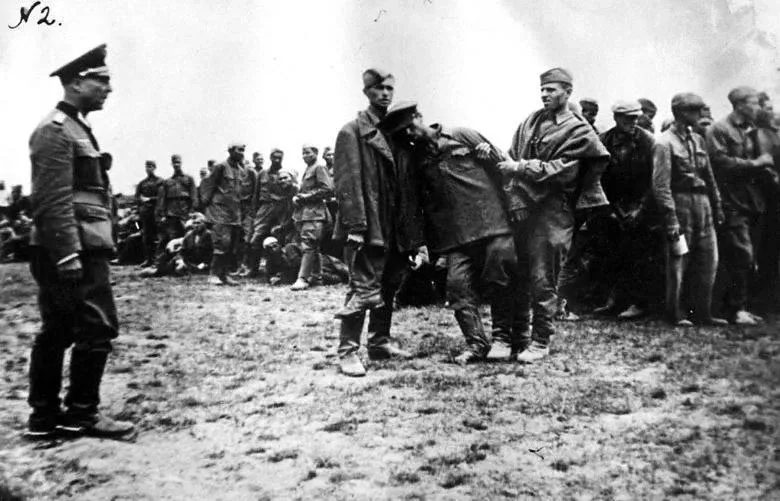
A conference to prepare an attack on Germany
This film epic, like the other pearls of the war's heroizers, is based on a single source: Zhukov's pseudo-memoirs.
While the USSR existed, the materials of the conference were stamped Top Secret .
Had the USSR not collapsed, we would know about this conference even now only what Zhukov told us, a strange narrator of things stamped Top Secret .
But in 1992 the General Staff of the Russian Federation declassified the transcripts of the conference, and it turned out that Zhukov had lied.
Saving his own skin from personal responsibility for his criminal decisions before the war veterans and the whole Soviet people.
It turned out that six months before the German aggression a conference took place at which Stalin, the Politburo and the entire senior leadership of the Red Army sat for 9 days, and they were preparing not for a sacred defensive war , as Zhukov lied, but for an attack on Germany.
The text of the conference was published in 1993 in a 470-page book: defence was not discussed at this conference even remotely.
A characteristic episode of the conference: Lieutenant General F.N. Remizov, commander of the troops of the Oryol Military District, begins his speech with an address to the People's Commissar of Defence, Marshal of the Soviet Union S.K. Timoshenko:
Comrade People's Commissar of Defence, modern defence we understand above all as.. We are not talking about defence !
The first and central report was Zhukov's report on methods of surprise attack on the enemy.
The topic of the report speaks for itself.
The topic of the second report was The Air Force in an Offensive Operation and in the Struggle for Air Supremacy ; the speaker was the head of the Red Army Air Force Main Directorate, Lieutenant General of Aviation P.V. Rychagov.
The gist of his speech:
The best way to destroy aviation on the ground is a simultaneous strike on a large number of airfields where the enemy's aviation may be based .
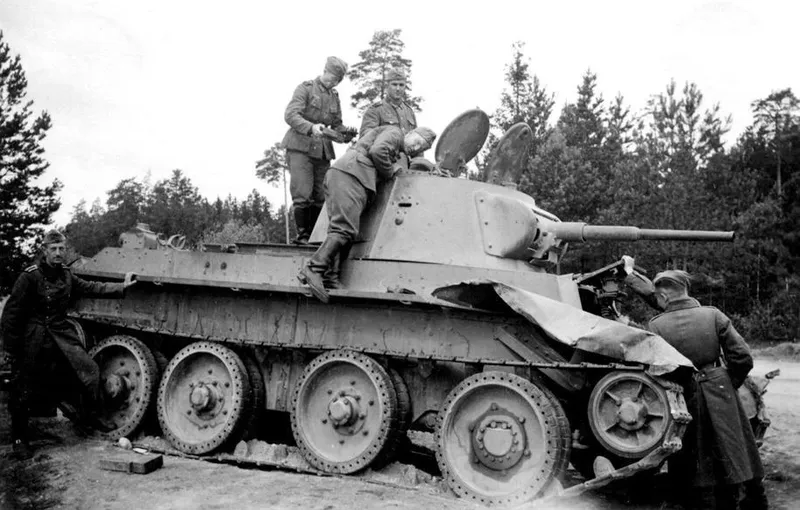
Next, the report:
The Use of Mechanized Formations in a Modern Offensive Operation and the Commitment of a Mechanized Corps into a Breakthrough .
The speaker was the commander of the troops of the Western Special Military District, Colonel General of Tank Forces D.G. Pavlov, who would be shot for the Catastrophe of 1941 in the summer of 1941.
In his report he writes: Poland ceased to exist after 17 days. The operation in Belgium and Holland ended after 15 days. The operation in France, until its capitulation, ended after 17 days. Three very characteristic figures, which cannot but make me take them as some possible number in the calculations for our offensive operation .
Then come other similar reports on occupation. And Pavlov's report is interesting precisely because on 4 July 1941, on Stalin's orders, he was arrested, and on 22 July he was shot for the Catastrophe of 1941.
Although he was not the one to blame, but the Chief of the General Staff, Zhukov.
In his report at this conference Zhukov stated:
In an area of just 30 by 30 km, 200,000 men, 1,500-2,000 guns, a mass of tanks, an enormous quantity of motor transport and other means will be concentrated .
What he wrote in the report, he did in 1941.
So why was Pavlov shot?
It was Zhukov who should have been shot.
Zhukov:
Air supremacy is the basis of the operation's success. This supremacy is achieved by a bold and sudden powerful strike by all the air forces against the enemy's aviation in its basing areas. For this: Aviation is positioned at airfields at a distance of: fighters 30-50 km, bombers 75-100 km from the front line .
But in that case our aviation may come under a surprise strike.
Here is Zhukov's recipe:
The particular concern of the commander and of the army's air force commander will be not to let their aviation be destroyed at the airfields. The best means for this is a surprise strike by our aviation on the enemy's airfields. Surprise is the main condition of success .
The trouble is that with the degree of troop concentration on the border announced by Zhukov, the rout of the Red Army was inevitable already in the second half of May, when armadas of divisions began to arrive at the border in enormous confusion.
And it reached the degree of potential Catastrophe precisely in the second half of June, when the troops had already replaced the border guards but were in a state of chaos from the move.
But if the Germans had attacked the USSR in early May, they would not have been able to capture even Baranovichi, because they would have met a normal, organized defence.
However, the USSR was not oriented toward any defence, for a number of reasons:
- First, the idea of blitzkrieg ruled in the USSR, which Zhukov had successfully carried out against the Japanese, while the experience of the First World War, when after the declaration of war the powers brought their main forces into action only a couple of weeks later, was considered obsolete and irrelevant for the military strategy of the USSR. Moreover, all the reports contain references to Germany's experience of waging war against Poland and France.
- Second, the communists did not start the Second World War in order to be on the defensive: Lenin bequeathed to these mad chauvinists the task of enlarging the USSR with new republics, which they actively worked on, building the Soviet empire.
- Third, it is utterly absurd to build a defence against an enemy who has almost 10 times fewer tanks, 7 times fewer aircraft, an army half the size, and whose resources for waging war are generally illusory. What is the point of building a defence against such a weakling as Hitler's Germany then was? This is by no means hat-tossing bravado, as the court historians of the USSR later called it on the orders of the top brass. Had the USSR managed to attack Germany first, events might well have unfolded exactly as they were worked out during the General Staff games. That is, within two or three months the Red Army would have seized Romania, Hungary and half of Germany. And Berlin would have fallen by the beginning of winter.
However, the USSR's blitzkrieg against Finland ended in a shameful defeat, so even in this case it could hardly have succeeded
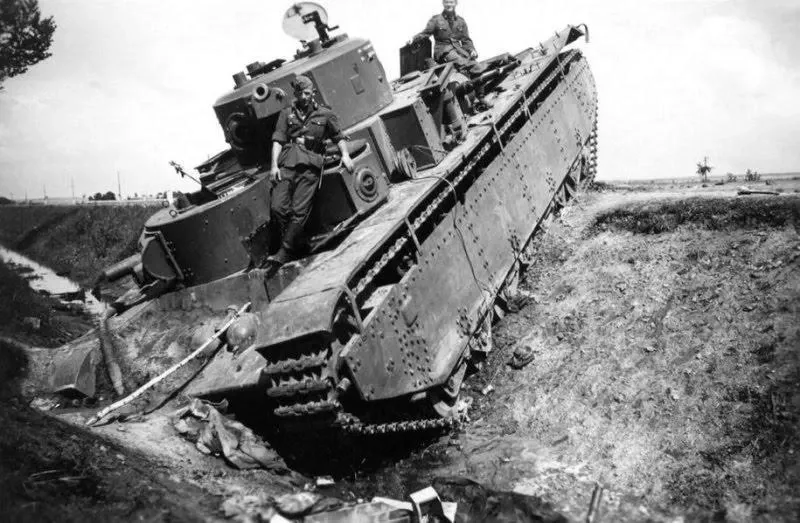
Dangerous staff games
If some clever fellow somewhere still tells you that the USSR was not preparing an attack on Germany, you can tell him to his face that he is a liar.
Because the USSR's preparation of an attack on Germany in early July 1941 is A FACT.
Confirmed by the court of last resort in this dispute, the General Staff of the Russian Federation.
The materials of the strategic games on the occupation by Soviet troops of the territory of Germany, Romania, Hungary and others, as well as a detailed plan for the occupation of Finland in 1941, were declassified by the General Staff of the Russian Federation in 1992.
Among other things, this was the subject of a large article in the Military History Journal, 1992, No. 2, and of an entire two-page spread in the newspaper Izvestia of 22 June 1993 titled "In January 1941 the Red Army Was Advancing on Königsberg!"
In these staff war games Zhukov, Pavlov and the rest were not working out how to defend the country against German aggression at all. They were rehearsing the finer points of seizing Königsberg, Warsaw, Bucharest, Prague, Kraków, Budapest and so on.
Zhukov's stories that in the game he anticipated the German plans are an outright lie, since combat operations on the territory of the USSR were not considered in the games at all.
Of course, when publishing the materials of the staff games, the commentators of the Military History Journal immediately tried to clarify that the USSR supposedly intended to use these aggressive war plans only in the event of a German attack.
But, firstly, if these plans were used in the event of a German attack, they could lead only to one thing, and did lead to it: the Catastrophe of 1941.
So this is mere verbal acrobatics, demagoguery.
And secondly, whom can such naivety deceive?
As historians in opposition to the official line have rightly noted, it always turned out that the enemy attacked precisely at the moment when everything was ready on our side for seizing his country.
In November 1939 we concentrated five armies on the border with Finland and made ready, and then the silly Finns, as if on order, supposedly fired a single shot from a cannon.
And at once our newspapers exploded with that very noble fury:
- We will repel Finland's attack!
- Give a rebuff to the overreaching raiders!
- We will answer the aggressors' blow with a triple blow!
- We will destroy the vile gang!
Meanwhile, here are Khrushchev's memoirs:
I came to the Kremlin, to Stalin's apartment. A conversation began, and in the course of it I felt that it was a continuation of an earlier conversation. In effect, it was already the implementation of the decision to present an ultimatum to Finland. They had already agreed with Kuusinen that he would head the government of the Karelo-Finnish SSR that was being created.
Suddenly a call came that a shot had been fired. The Finns replied with artillery fire. In fact, war had begun. I say this because there is another interpretation: the Finns fired first, and so we were forced to respond.
Did we have the legal and moral right to such actions? Of course, we did not have the legal right.
It is perfectly clear that in this case, with regard to Germany, the USSR would have repeated the Finnish experience of unleashing a war.
Which, incidentally, differs in no way from the method by which Germany attacked Poland, also supposedly Defending Itself from Aggression.
So the naive comments of the Military History Journal are worth nothing and can deceive no one.
For the sake of decency, in both staff games, the Belarusian and the Ukrainian, a condition was introduced in two sentences: in the summer of 1941 an enemy had attacked us and penetrated 100-200 km into the territory of the USSR, but had been driven back, by whom and how is unknown, to the line of the State border again.
And from this state the Belarusian game begins, in early July 1941.
The second, Ukrainian, game of 8-11 January 1941, which Zhukov forgot about, began already on enemy territory in July 1941, 90-180 km west of the State border of the USSR, on the line of the Vistula and Dunajec rivers. The content of the game was the Red Army's retaliatory actions in Germany, Czechoslovakia, Hungary and Romania.
The forces of Germany and Hungary were commanded by Colonel General of Tank Troops D.G. Pavlov, the forces of Romania by Lieutenant General F.I. Kuznetsov, previously commander of the North Caucasus Military District, who was removed from that post and summoned to Moscow for the game, and after it was appointed commander of the Baltic Special Military District.
In this game Budapest was seized by Zhukov.
An essential detail: in these games the balance of forces did not correspond to reality, and the forces of the Germans and their allies were overstated by a factor of 2.5-3 compared with the real ones in the summer of 1941.
So in a real blitzkrieg the USSR's successes would have been far more significant than in these games, which were conducted, as it were, with a reserve of enemy strength just in case.
In the Belarusian game Zhukov did not drive back the late Pavlov at all, as he lied in his sclerotic memoirs.
It was Pavlov who routed Zhukov.
Here is what the newspaper Izvestia wrote on 22 June 1993:
A number of books and articles claim the following: in this game G.K. Zhukov supposedly planned and carried out everything just as the Germans did half a year later, and on the eighth day the North-Eastern Front of the Westerners had supposedly already reached Baranovichi. But it was far from being so: the North-Western Front of the Easterners (D. Pavlov), carrying out the task of reaching the lower course of the Vistula by 3 September 1941, went on the offensive on 1 August, and in the first days its troops forced the Neman, seizing the Suwałki salient (encircling a large grouping of the Westerners in it), and on the left flank broke through the front headed by G. Zhukov. A cavalry-mechanized army was introduced into the breakthrough, and by 13 August it reached an area 110-120 kilometres west of the State border of the USSR.
Zhukov lost to Pavlov!
Though he lied to us that it was the opposite.
And this lie is repeated to us today from TV screens in all sorts of epics for naive simpletons, for our veterans so dearly loved by those at the top, whom it is not shameful to deceive.
As the classic wrote, I am glad to be deceived myself, they say, so that is what they themselves want.
And a well-known Russian writer recently said cynically on the Kultura TV channel:
To tell veterans the truth about the war that was hidden from them in the USSR is like depriving a foolish child of a beloved toy: nothing will come of it but hurt.
I think this is not so, because a veteran still has children and grandchildren, who must not repeat the fate of a veteran who miraculously survived the war and be cannon fodder for a new generation of politicians.
I think a veteran will not argue that behind his back, behind the back of the whole people, a handful of adventurers in the Kremlin secretly prepared aggression, but made a fool of themselves.
At the price of all the tragedy of the war, our Catastrophe of 1941.
Because no person would approve when the authorities, in strict secrecy from him, prepare a war, counting on sending this person somewhere to kill somebody for the sake of goals whose they are, no one knows.
Based on the results of this game, the directors of the games came to the conclusion that:
The deployment of the main forces of the Red Army in the West, with the main forces grouped against East Prussia and in the Warsaw direction, gives rise to serious concern that the struggle on this front may lead to protracted fighting.
So the southern, Ukrainian direction was chosen, where in the course of the game it was possible to advance far into Romania and Hungary and to seize Romanian oil.
And since Zhukov was commander of the Ukrainian Military District, it was he, not Pavlov, who was put in the post of Chief of the General Staff to prepare the USSR's attack on Germany and its satellites: in order to prepare the Ukrainian Military District for aggression to the maximum.
Neither at the conference nor in the games did their participants even try to consider the situation that might develop in the first operations in the event of an enemy attack. Therefore the claim that the games were held to work out some questions connected with the actions of troops in the initial period of the war is without foundation. These questions were not listed among the training goals of the games and were therefore not considered.
1941: A Farce of History or a Relapse of the Plague?
It is held that when history repeats itself, it repeats itself as farce.
That is not so.
Sometimes history repeats itself again in a far more dreadful relapse, if the disease has not been cured but is progressing.
In the First World War, which our people then called the Great Patriotic War, though that sacred name was stolen by the Bolsheviks for their new Bolshevik war, which was anything but patriotic, czarist Russia did not give up its territory to the enemy but fought on the enemy's territory.
But as soon as the creators of the USSR came to power, this Junta, headed by Lenin, immediately gave the enemy huge territories.
Twenty years later this same Junta, now headed by Stalin, gives the same enemy the SAME territories again.
And in the autumn of 1941 Stalin, through the Bulgarian ambassador to the USSR, Stotenov, asks Hitler for a separate peace, similar to Lenin's Brest peace, when the fraternal Russians gave the Germans the Belarusians and Ukrainians as a gift for their own salvation.
This is a mystical déjà vu.
Everything repeats itself exactly again, with the difference that now it is not simply Germans but Nazis who have come to destroy us.
And within a couple of years, under this separate peace of Stalin's, they would have destroyed all the Belarusians and Ukrainians.
Which Stalin, of course, understood perfectly well when he offered Hitler this separate peace.
To the great good fortune of the Belarusians and Ukrainians, Stotenov later replied that Hitler had refused Stalin's offer.
But consider the very fact: Stalin, saving his own skin, was ready to give us to the Germans again.
As a gift from the Russian people to the German people in the person of the Belarusian people, who are slaughtered like a lamb to conclude peace.
And it is a fact: although Hitler refused, Stalin did offer, he offered us as the price of his own life!
And who needs such a ROTTEN USSR at all, where the RSFSR and Georgia bargain with the enemy for their own lives at the price of the deaths of the other republics?
This is not a farce, it is a deadly relapse of the same disease, which began with the dispersal of the Constituent Assembly by Soviet terrorists.
With the bloody theft from the people of their popular sovereignty.
The most important norm of democracy is the very attitude to war: since a war is fought not only by those at the top and their kids, who often do not fight at all, but by the whole people, the question of war and peace must be decided by the whole people, and not behind the scenes by a handful of conspirators in power.
That is why today, everywhere in civilized countries, except the CIS, that respect the rights of the Citizen, the rule has been introduced that the executive power has no right to declare war, to prepare for war, or to conclude peace.
This is the prerogative of parliament; without its permission, the permission of the people, there will be no war or peace.
It is clear that the Kremlin would never have given such powers to the Supreme Soviet of the USSR.
There, for example, the question of starting the USSR's 10-year war in Afghanistan was decided by an extremely narrow circle of persons. Just as Gorbachev alone, without the opinion of our people, suddenly decided to end this war.
As with regard to Germany in 1940-41: whether to prepare for defense or to prepare aggression.
When such questions are decided by a narrow group of persons, and between glasses of Georgian cognac at that, it leads only to what it led us to in the USSR.
The Paradoxes of 1941
The analysis of the Catastrophe of 1941 leads to paradoxical conclusions: if, under the conditions of the despotism of the Junta that we had then, we had possessed a significantly smaller army and armament, the scale of our defeats would have been orders of magnitude lower.
The point is that for defending a country against an aggressor there are certain ratios of forces, which are known in military strategic science.
An attacker against positions prepared for defense always suffers losses several times greater than the number of the defenders.
An excellent example is the Soviet-Finnish war, where the USSR put up against Finland 11,266 guns and mortars, 2,998 tanks, 3,253 combat aircraft and an army of about a million soldiers and officers.
On the Finnish side only a few dozen tanks and aircraft fought.
We lost about 75 thousand killed and 17 thousand missing in action.
More than 200,000 were wounded or frostbitten.
The Finns' losses came to 23,000 killed and missing and 44,000 wounded.
It all comes down to how well prepared the Finns were for defense, to the Mannerheim Line they had built.
Now let us compare the forces of Germany advancing on us with our own.
For an effective defense against an aggressor, according to the textbooks of military strategy, we would have needed to field a little over a thousand tanks against 3,500 German ones.
In 1941 we had 27,000.
Likewise several times as many aircraft and artillery pieces, and an army twice the size of the German one together with its allies.
With such forces, it is absurd to prepare for defense.
Because forces like these are created as a deliberate surplus.
If such forces were put on the defensive, then of course no enemy would break through such a defense or take a single millimeter of our land.
But the problem is precisely that, once they possess such forces, the top echelons, uncontrolled by the people, begin to regard them as an instrument of foreign policy, and not of defense at all.
The country turns into a potential aggressor, and what the people created for their own defense becomes a weapon of aggression in the hands of politicians.
Which, by the way, is what we observe today in the example of the USA, because the mountains of weapons that have been built up must fire, and if a gun hangs on the wall in the first act of a play, it will inevitably go off later anyway.
And, as it always turns out, the surplus of weapons created by the people for defense turns into enormous problems for the people themselves, into their own blood.
Because this surplus has to be put somewhere, and politicians use it no longer to defend the country but for saber-rattling and aggression.
A surplus of weapons is as bad as a shortage of them.
Poland had only about 200 tanks in all, France about one and a half thousand. We had 27,000, mostly the newest tanks, produced in 1937-1941.
And it made no difference, because the tanks were not the point.
The point lies in entirely different processes, which are what determine victories and defeats.
And it is called the Health of Civil Society.
Where, if the health is poor, nothing will help.
The USSR attacked Finland, fielding against it almost as many tanks as Germany fielded when it attacked the USSR on June 22, 1941: three thousand.
The Finns destroyed most of them.
Moreover, the Soviet tanks were an order of magnitude more fearsome than the German ones. The KV-1 alone was worth a great deal: it fired 150-mm howitzer shells, and no one anywhere in the world then had such a tank.
And against this armada of tanks, almost equal to the entire tank power of Germany in the summer of 1941, the Finns, with their three dozen antediluvian tanks, not only held out but in fact routed the aggressor.
There is no reason to suppose that our people could not have repelled the German aggression in exactly the same way, right at the border, if our authorities had been concerned with defending the Motherland.
Which, alas, no one was thinking about at the time.
References:secret-r.net