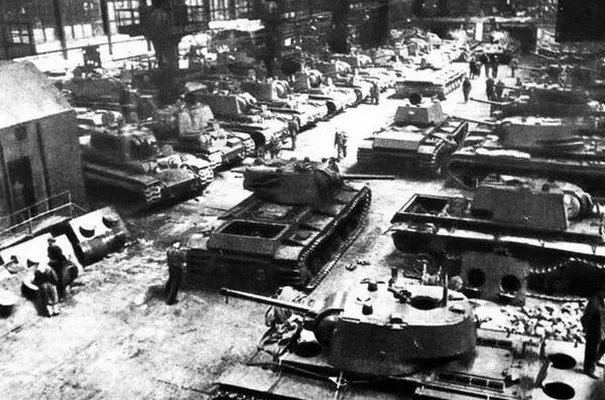
There was in fact no blockade of the city of Leningrad itself.
This resonant term was most likely invented to shift onto the Germans the blame for the mass casualties among the city's population. But the city of Leningrad itself was never encircled in that War!
In the summer of 1941, according to the publicly available information, a certain fairly large area of several thousand square kilometres, where the city of Leningrad stood and still stands, was cut off by German troops from the rest of the country. This happened at the end of August 1941:
“After fierce fighting, the enemy's 39th Motorised Corps seized the large railway junction of Mga on 30 August. The last railway connecting Leningrad with the country had been cut…”
Why were there so few shells?
A. Kungurov's article begins by analysing the written claim that 148,478 shells fell on the city during the blockade. Historians describe these events as follows:
“Leningraders lived in constant nervous tension, the shelling came one bout after another. From 4 September to 30 November 1941 the city was shelled 272 times, for a total of 430 hours. At times the population stayed in bomb shelters for almost a whole day. On 15 September 1941 the shelling lasted 18 h 32 min, on 17 September, 18 h 33 min. In all, about 150 thousand shells were fired at Leningrad during the blockade…”
Kungurov, through simple arithmetic, shows that this figure was plucked out of thin air and may differ from reality by several orders of magnitude! A single artillery battalion of 18 large-calibre guns could fire 232,000 rounds during the 430 hours of shelling mentioned!
But the blockade, according to the established data, lasted far longer than three weeks, and the enemy had several hundred times more guns. So the number of shells that fell, which the newspapers of the time wrote about and which everyone who has written to us about the blockade then copied, should have been several orders of magnitude greater if the blockade had been what we have all been taught to believe.
On the other hand, many photographs of Leningrad under blockade show that the destruction in the central part of the city was minimal! That is possible only if the enemy was not allowed to attack the city with artillery and aircraft.
However, judging by the maps, the enemy stood only a few kilometres from the city, and the reasonable question of why the city and the military factories were not reduced to complete ruins within a couple of weeks remains open.
Why was there no order?
The Germans had no order to take Leningrad. Kungurov writes about this very clearly:
“Von Leeb, the commander of Army Group North, was a competent and experienced commander. He had up to 40 divisions under his command (including panzer divisions). The front before Leningrad was 70 km long. The density of troops reached 2–5 km per division in the direction of the main thrust. Only historians who understand nothing about military affairs can claim that under such circumstances he could not take the city.
We have repeatedly seen in feature films about the defence of Leningrad how German tank crews drive into the suburbs, crushing and shooting up trams. The front had been broken through, and there was no one ahead of them. In their memoirs Von Leeb and many other commanders of the German army claimed that they were forbidden to take the city and were ordered to pull back from advantageous positions…”
Isn't it very strange how the German troops behaved: instead of easily taking the city and advancing further (we understand, after all, that the militiamen we were shown in the movies are in principle incapable of putting up serious resistance to regular troops), the invaders stood for almost 3 years outside Leningrad, supposedly having blocked all the land approaches to it.
And considering that there were most likely no counterattacks from the defenders, or very few, for the advancing German troops this was not a war but a real sanatorium! It would be interesting to learn the true reaction of the German command to this legend of the blockade.
Why was the Kirov Plant working?
“It is known that the Kirov Plant worked throughout the blockade. Another well-known fact is that it was 3 (three!!!) kilometres from the front line. For those who have not served in the army, I will say that a bullet from a Mosin rifle can fly that far if you fire in the right direction (I am simply keeping silent about larger-calibre artillery guns).
The residents were evacuated from the area around the Kirov Plant, but the plant went on working right under the nose of the German command and was never destroyed (although a single artillery lieutenant with a battery of not the largest calibre could have managed this task, given a properly set assignment and enough ammunition)…”
Do you understand what is written here? It says that the fierce enemy, who for 3 years kept firing guns and bombing the encircled city of Leningrad without a break, did not bother in all that time to destroy the Kirov Plant, which produced military equipment, although this could have been done in a single day!
How can this be explained? Either the Germans simply did not know how to shoot, or they had no order to destroy the enemy's plant, which is no less fantastic than the first supposition; or the German troops standing outside Leningrad were performing some other function, so far unknown to us…
To understand what a city that has truly been worked over by artillery and aircraft looks like, find wartime photos of Stalingrad, which was shelled not for 3 years but for far less time…
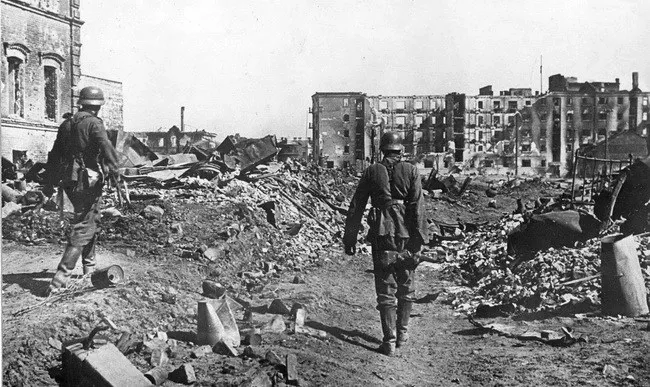
And this is what Dresden looked like after the bombing by Anglo-American aircraft in February 1945. The number of bombs dropped on the city in 2 days came to about 650 thousand! Then 1,478 tons of high-explosive and 1,182 tons of incendiary bombs were dropped on a peaceful city crowded with refugees.
How was the Kirov Plant supplied?
“The Kirov Plant turned out various products: KV-1 tanks, SU-152 self-propelled guns, and by 1943 it had mastered production of IS-1 and IS-2 tanks and the SU-152. From the photographs posted on the Internet we can imagine the scale of tank production (this is large-scale, serial production). Besides the Kirov Plant, the other plants of Leningrad were working too, turning out shells and other military products. From the spring of 1942 trams began running again in Leningrad… This is only a small particle of a reality that is very different from the historical myths written by professional historians…”
For a large machine-building enterprise like the Kirov Plant to work and turn out products, very serious, constant supply is required. And this means not only electricity in the necessary and very large volumes, but also raw materials (metal of the required grades by the thousands of tons), components of thousands of types, tools of thousands of types, food and water for the workers, and a great deal else.
Besides, the finished products had to be taken somewhere! These are not ballpoint pens! These are large items that could be transported only under their own power, or by sea or rail. And that the products were being made is confirmed by written testimony:
“Because practically all the power stations had stopped, some machine tools had to be driven by hand, which lengthened the working day. Quite often some of the workers stayed overnight in the shop to save time on fulfilling urgent orders for the front.
As a result of such selfless labour, in the second half of 1941 the active army received from Leningrad 3 million shells and mines, more than 3 thousand regimental and anti-tank guns, 713 tanks, 480 armoured cars, 58 armoured trains and armoured platforms.
2. The working people of Leningrad also helped other sectors of the Soviet-German front. In the autumn of 1941, during the fierce battles for Moscow, the city on the Neva sent the troops of the Western Front over a thousand artillery guns and mortars, as well as a considerable quantity of other kinds of weapons. In the difficult situation of the autumn of 1941, the main task of the working people of the besieged city was to supply the front with weapons, ammunition, equipment and uniforms.
Despite the evacuation of a number of enterprises, the capacity of Leningrad's industry remained considerable. In September 1941 the city's enterprises produced more than a thousand 76-millimetre guns, over two thousand mortars, and hundreds of anti-tank guns and machine guns…”
A strange blockade this turns out to be: on 30 August 1941 the railway connection with the “mainland” was cut, and in the autumn of 1941 “over a thousand artillery guns and mortars, as well as a considerable quantity of other kinds of weapons” were sent to the Western Front…
How could such a colossal quantity of weapons be taken out of “blockaded” Leningrad to the Western Front if there was no longer any railway connection? On rafts and boats across Lake Ladoga, under continuous fire from German artillery and aircraft, which dominated the air at that time?
Theoretically that is possible, but in practice very unlikely…
Where did the Kirov Plant's output go?
“A fact remains a fact: the quantity of products made has been counted and announced, and you cannot argue with the fact. Now let us think a little about what the historians actually wrote.
The first question is about the means of delivery from the besieged city to the active army, mostly near Moscow, of 713 tanks, 3,000 guns, a million shells and, above all, 58 armoured trains: all this could be taken out only by rail, and no fewer than 100 trains are needed. For tanks, and armoured trains even more so, are not carried on boats (such boats (ferries) did not yet exist).
The second question: mass production has been announced (and this under siege conditions). Fairy tales that something can be produced without raw materials, supplies and, still more, tools can be told only to illiterate people!
All this points to a constant delivery of the necessary materials and raw materials. After all, in the blockaded city of Leningrad there were no coal mines, iron-ore or other deposits to supply industry with coal, steel, coke, fluxes and other materials!
The “historians” claim that the machine tools were turned by hand. This is simply a conjecture by people who are illiterate in engineering: try turning by hand a machine tool with a 3–10 kW drive (and that is exactly the kind of drive industrial drilling and turning lathes have) and cutting a metal blank on it. You will realise at once that this is an ordinary invention; by hand it is impossible not just to provide the required rotation speed but even to turn such a machine over at all!..”
Did they themselves lack shells?
“Historians” also claim that the main reason for the longer working hours was not a heroic impulse to give everything for the common victory but the lack of electricity. From the works of the “historians”:
“In the autumn and winter of 1941/42 Soviet artillery waged this struggle in extremely difficult conditions: there was a shortage of ammunition and of artillery instrument reconnaissance equipment, there was no spotter aircraft, and the firing range of Soviet guns was at first inferior to the German ones, so until the spring of 1942 the counteraction against enemy artillery was defensive in nature, although the return strikes of Soviet artillery did weaken the enemy's combat power...”
Still, it is interesting: did they themselves lack shells, or did they ship 3 million shells to the army?! Why? Did they have no problems under the blockade? And how did they increase the firing range of the guns? Presumably they rolled the guns up closer?! This is yet another example not merely of illiterate exposition and misunderstanding of information, but of outright falsification!
A gun's firing range does not increase or decrease by itself; it is set from the start by design parameters! The historians should have stated that new guns with a longer firing range were designed, manufactured, tested and adopted. It seems the historians wrote this in the hope that nobody would read or analyse it…
Where did the electricity come from?
"There were five thermal power plants on the territory of Leningrad, part of the Leningrad Region power system. This is what power engineers write about that period:
The energy blockade
After the blockade ring closed around Leningrad on 8 September 1941, the city found itself cut off from all the out-of-town power plants that supplied it with energy. Many substations and power lines were destroyed. Only five thermal power plants were working in Leningrad itself.
But even they, because of a shortage of fuel, sharply cut their output, which was enough only for hospitals, bakeries and government buildings connected with the front. The transmission of electricity from the Volkhov hydroelectric plant was interrupted, and its main equipment was dismantled in October 1941 and shipped to the Urals and Central Asia.
Two auxiliary hydro units of 1,000 kW each remained in operation at the plant, working for the Volkhovstroy railway junction and military units. The work of the defence factories was paralysed, trams and trolleybuses stopped, and the water supply stopped working.
Many power engineers went to the front, while those who remained kept working in the harsh conditions of hunger and cold, generating whatever electricity they could. The energy blockade of Leningrad began. The hardest day for Leningrad's power industry was 25 January 1942. In the entire power system only one plant was working, carrying a load of just 3,000 kW…
A brief comment on the article: from September 1941 electricity production fell because of the regime of extreme economy. By January 1942 the city had run out of coal, the thermal power plants practically stopped, and only 3,000 kW was being produced. Meanwhile the Volkhov hydroelectric plant generated 2,000 kW (2 MW), and that was enough only for the railway junction and military units (note the figure: 2 megawatts is very little on the scale of a city).
During the Great Patriotic War, when most of the power plants of blockaded Leningrad could not work for lack of fuel, boiler No. 3 of the Krasny Oktyabr power plant was converted in the winter of 1941-1942 to burn milled peat, which was available at the peat enterprises of the Vsevolozhsk district. The start-up of this unit made it possible to raise the plant's load to 21-22 thousand kW out of the 23-24 thousand kW generated by the system. (Wikipedia)
That is, the final figure is given: the whole system (more precisely, one peat-fired thermal power plant plus the Volga hydroelectric plant) produced 24 thousand kilowatts until the end of the war. The figure only seems large, but, to give an example, this energy would not be enough for one city (say, Grodno, 338 thousand people) to boil its electric kettles at the same time.
From spring 1942, 6 tram routes operated in Leningrad. Powering them requires 3.6 thousand kW of electricity (3.6 MW). That is for 20 trams on each route, 120 in total, with an assumed motor power of 30 (!) kW (modern trams, for example, have up to 200 kW)…
It remains to draw up the electricity balance.
The electricity left over from running the trams (20 MW) has to power the production of the factories, and that means:
- tens of thousands of machine tools of 3-10 kW each (millions of shells, bolts, bushings, keys, shafts and so on were produced), - 30-100 MW (and that is if there were 10 thousand machine tools across all the factories);
- dozens of machines for making gun barrels (large screw-cutting lathes),
- rolling mills (without them there are no armour plates),
- many industrial welding units (after all, they turned out 713 tanks in half a year, 5 tanks a day); a tank takes more than one day to weld. If we assume a tank is welded by one welding unit over three days, then 15 welding units with a total power of 600 kW are required…
And as a result of this elementary arithmetic we find that the remaining energy (20 MW) is badly insufficient, and light still has to be provided for the regional and city Party committees, the regional and city soviets, the NKVD administration, hospitals and so on."
Where did the food come from?
"The city's food requirement (2 million 544 thousand residents, not counting the troop groupings, the fleet and the residents of the region inside the siege) was 1.5 kg of food per day (500 grams of rusks and 1 kg of vegetables and grain, the standard combined-arms ration), or 3,800 tonnes of food daily (63 modern railway wagons). I remind you, this is without the numbers of the troops and the fleet, and the residents of the region.
A second food inventory carried out on 10 and 11 September showed that, to supply the troops and the population, Leningrad had stocks of grain, flour and rusks for 35 days, groats and pasta for 30 days, meat and meat products for 33 days, fats for 45 days, and sugar and confectionery for 60 days (everything was due to run out by November, and that is with consumption cut by half).
To ease Leningrad's food situation, transport aircraft were assigned to ferry cargo. Food delivery was handled, together with the Special Air Group created at the end of June 1941 to serve the Northern Front, by the Moscow Special Purpose Aviation Group, formed from 30 Moscow civil aviation crews.
From September to December 1941, through the heroic efforts of Soviet pilots, more than 6 thousand tonnes of cargo were delivered to the blockaded city, including 4,325 tonnes of high-calorie foodstuffs and 1,660 tonnes of ammunition and weapons.
(In 3 months they delivered food for 2 days. It is unclear why ammunition was brought in, if Leningrad produced it itself and even shipped it out to the mainland.)
In total, before the end of the 1941 navigation season, 60 thousand tonnes of various cargo were delivered to the besieged city by water, including 45 thousand tonnes of food (Wikipedia) (food for another 20 days).
In total, in the first blockade winter the ice road operated until 24 April (152 days). In that time 361,109 tonnes of various cargo were transported, including 262,419 tonnes of food (Wikipedia) (that is, less than 2,000 tonnes of food were carried per day, which is less than the city's daily requirement)…"
Let us also do a little arithmetic ourselves. To haul 360,000 tonnes of cargo in one-and-a-half-ton trucks, one has to make 360,000 / 1.5 = 240,000 trips, which were completed in 152 days (let us round to 150 days; we do not need high precision here). That comes to 240,000 / 150 = 1,600 trips per day. A day has 60 x 24 = 1,440 minutes.
It follows that, to provide 1,600 trips a day along the "Road of Life", the vehicles had to move day and night at an interval of a little under 1 minute!
But the "Road of Life" was the ice of Lake Ladoga, cleared of snow (ordinary vehicles cannot drive through deep snow). On ice such an interval is quite acceptable, for ice is not asphalt, and excess load immediately leads to disaster and a long stoppage of the whole column.
If everything was as the historians and propagandists of those times tell us, then the enemy had a very simple task: to shell the lake from time to time and wreck the road.
After all, an ice road is very easy to wreck, but it is impossible to "repair" it quickly! A detour has to be cleared, and that takes several hours, since a tractor cannot be sent out there: it is too heavy.
Therefore the claim that 360 thousand tonnes of cargo were carried along the "Road of Life" in 152 days does not look plausible, if only because of the calculations above! And on top of that, round-the-clock, rhythmic unloading, loading and refuelling of the vehicles had to be ensured, and this conveyor could not stop for a minute!
There also had to be enough transport and fuel to bring up what needed to be sent to the "mainland" and to carry away what was delivered to the encircled area.
And how many vehicles were involved in this operation? This can be roughly calculated.
From the map it is easy to determine that the distance to be covered across Lake Ladoga is about 30 km. If we assume that the vehicles travelled at about 30 km per hour, and add 1 hour for loading and 1 hour for unloading, then each vehicle made 8 trips a day.
Consequently, to make 1,600 trips a day, 200 vehicles were needed.
Of course, this is the ideal scenario. In reality the travel time could be more than 1 hour, and vehicles broke down for various reasons. So, to provide the stated volume of transport, the number of vehicles can safely be doubled.
And all these 400 one-and-a-half-ton trucks had to be constantly refuelled with petrol. Their fuel consumption was about 20 litres per 100 km. In a day each vehicle, covering 480 km, used at least 100 litres of petrol. For the whole fleet, no less than 40 tonnes of petrol had to be delivered every day...
This work, entirely feasible in peacetime with constant and sufficient funding, becomes in wartime, under constant, deliberate opposition from the enemy, an overwhelming, almost impossible task.
No, I do not doubt that an attempt to organise the supply of the city and region in this way may have taken place. But I am absolutely certain that the results of this work were quite different.
Does all this look like the truth?
"By November not only the coal but also all stocks of raw materials, supplies and food were due to run out (and that is what happened). Through strict economy these stocks were stretched until January. Deliveries along the Road of Life in trucks with a carrying capacity of 1.5 tonnes covered only food needs (and even those not fully).
The "historians" do not reveal what the 100,000 tonnes of other cargo brought in during the first winter consisted of, but it did not cover the needs of industry (those are thousands and thousands of tonnes). Industry should have stopped. But the factories kept working and working (this is a fact).
Where the additional energy came from is unknown (probably the Germans supplied it). Where the resources came from, and how the finished products were sent out, is also unclear.
Meanwhile, to completely paralyse all the activity of the city, it was enough for the German command to destroy just 5 power plants (at the initial stage of the war, and one after January 1942), which were clearly visible by the smoke from their chimneys to the artillery fire spotters. Is this one more accidental oversight?
It is completely incomprehensible why 713 KV tanks did not solve the question of lifting the blockade of Leningrad, since at the start of the war we had only 636 KV tanks, and these tanks could not be penetrated by German guns.
The simultaneous, massed use of these tanks, supported by 3,000 newly produced guns (while at the start of the war we had only 1,928 guns) and with no need to ration ammunition, should have broken through any defence. This number of tanks and artillery should have been enough to throw the Germans back even to the border…"
The available maps do indeed show clearly that the troops of the Leningrad and Volkhov Fronts were separated in the Shlisselburg area by a narrow strip only 12 km wide!
And it is simply impossible to believe that the troops of these fronts, with the enormous quantity of powerful military equipment and ammunition being produced in Leningrad, had no way of pushing the Germans back from Lake Ladoga even 20-30 km!
What is more, it turns out that the following epoch-making event took place in March 1942:
"On 29 March 1942, a partisan convoy with food for the city's residents arrived in Leningrad from the Pskov and Novgorod regions. The event had enormous propaganda significance and demonstrated both the enemy's inability to control the rear of his forces and the possibility of lifting the siege of the city with the regular Red Army, since the partisans had managed to do it..."
Nevertheless, the encirclement was not broken, and we do not yet know the reasons for this...
CONCLUSIONS
1. The city of Leningrad was not blockaded during the war; there was never a blockade of the city as such.
2. It is claimed that by October 1942, 1.5 million people had been evacuated from Leningrad. It is claimed that about 1.5 million people died in Leningrad during the blockade. But before the war Leningrad had only 2.5 million residents. Where could an additional 0.5 million have come from in order to die, and who, then, worked for 3 years at the military plants that turned out hundreds of tanks, thousands of guns and millions of shells every month? The generally accepted statistics on these questions do not withstand even elementary analysis.
3. If, as is claimed, 1.5 million people were evacuated from Leningrad in 1.5 years, then supplying food to the 1 million who remained was no longer a very difficult task. If the supply situation had been as we are told, there would not have been 1.5 million dead from hunger!!!
4. Elementary calculations convincingly show that it was impossible to supply the military industry with raw materials, materials, tools and components by motor transport, boats or aircraft.
5. There is no information on the city and its industry being provided with sufficient electric power. The military plants that really did operate needed several times more energy than was available according to the official information.
6. It is completely unclear where most of the military equipment produced went, especially the heavy equipment. If more than 700 heavy tanks were produced in Leningrad in 3 months, then over 30 months of the blockade enough of them could have been made to grind all of Europe into dust!
7. So far there are no guesses as to why the Germans did not destroy the Kirov Plant, which operated right under their noses (3 kilometres away) and produced military equipment the entire time of the "blockade".
8. The reasons why the Germans did not destroy Leningrad with artillery and aircraft are likewise unclear, although at first they had a great advantage in these types of weapons.
9. There is no coherent explanation for the fact that the encirclement of the area was not broken by Soviet troops. The Leningrad and Volkhov Fronts were separated near Shlisselburg by a strip only 12 km wide! The partisans brought food in carts, while the regular troops could do nothing. Absurd!
10. It looks very much as if the variations on the theme of the "blockade" of Leningrad are meant to mask something far more serious than what we know from publicly available information. It is quite possible that completely different events were taking place at that time, and that millions of victims were not too high a price for concealing them, and that they are still being carefully concealed to this day...
POSTSCRIPT
We still have a great deal of sorting out to do with the history of the Great Patriotic War.
It contains many incomprehensible points. It is incomprehensible what kind of weapon the German troops used to destroy about 20,000 (twenty thousand) of our tanks by the winter of 1941, when they themselves had only 4,171 tanks and self-propelled guns.
It is incomprehensible how we lost the greater part of the 104,840 tanks and self-propelled guns produced during the war years, given that most of the tanks were repaired and returned to battle repeatedly.
Along with this, elementary calculations show that much information has simply been hidden from us, and because of this the rest cannot be explained. One gets the impression of a global betrayal, that this whole blockade was deliberately organised so as to kill as many people as possible.
References:akirama.com