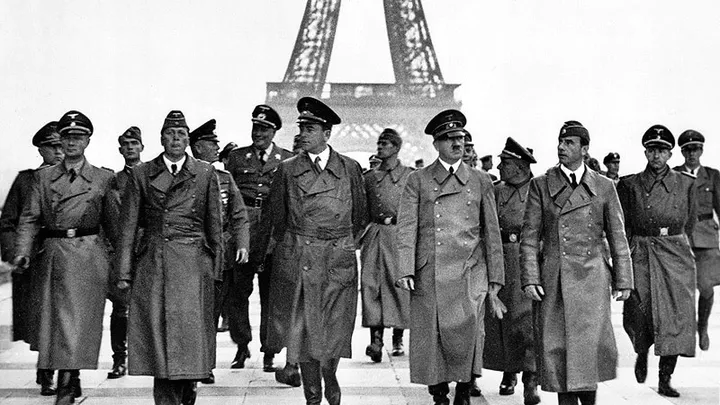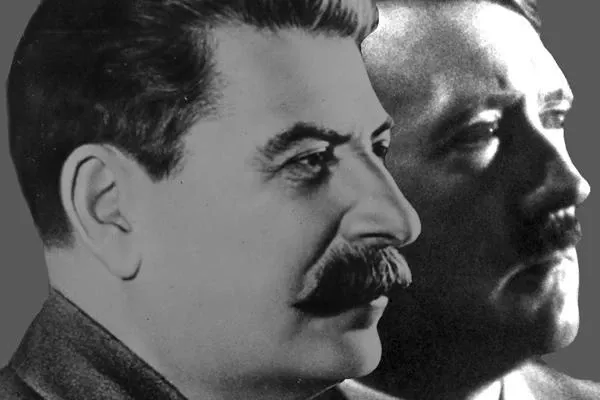
Who actually started the Second World War, and who plunged humanity into the most terrible slaughter in its history?
It seems that only the lazy today do not know that the Second World War, or, as it is affectionately called in the territories formerly known as the USSR, the Great Patriotic War, might never have happened but for the active participation of the Bolshevik Party, which, under the leadership of the builder of the Third Rome, Joseph Stalin, was determined to seize the whole world and rule it.
Of course, there is a mass of hypotheses and theories, as well as scholarly and popular-science books, about the foreign and domestic policy of the USSR, which, according to some authors, contributed to inciting the war in 1939, and according to others did everything to avoid the conflict. Each of these hypotheses and claims has its admirers, ready to insist that it was one way or the other.
Is it worth disputing anyone's hypothesis or claim when there are facts, and facts are stubborn things? So let us simply get acquainted with them, and as for the conclusions? You will draw them yourselves.
So what was happening in the Soviet Union in the pre-war period?
I do not want to argue or claim that my theory is the only correct one, but it may be correct, and that is what I will try to prove.
Any conspiracy theory is a secret, because that is the whole point of any such theory: not to become public knowledge.
The secret of Russian politics is blind adherence to the religious doctrine of Moscow as the Third Rome, the Great Kingdom of Orthodoxy headed by an autocrat czar.
Background, or why the Bolsheviks?
Czar Nicholas II put an end to the whole theory of the Third Rome, because by abdicating the throne he renounced God, and this in effect cast doubt on the validity of the entire theory, according to which the czar is a man placed by God on Earth, His right hand, His avenging sword, and so on and so forth.
Under this concept a czar simply cannot renounce his destiny, but Nicholas did renounce it, for which he was subsequently punished without mercy.
The situation that had developed in Russia was, to put it mildly, catastrophic.
The marginal masses, brought to boiling point by anti-German propaganda, were ready for anything, and they could not simply be stopped, any more than a horse at full gallop can be stopped, or a train.
So it was decided to use the mass hysteria that had gathered strength for the benefit of society and, under the guise of a coup, to proceed at once to seizing the territories of interest to Russia, first of all the Ottoman Empire and Germany, and then, who knows, perhaps all of Europe.
It sounds slightly unusual, because it does not fit the much-loved image of the Union of Soviet Socialist Republics born in the agony of revolution and civil war, but nevertheless, see for yourselves.
Communism, unlike Orthodoxy, which was Russia's main ideology, is absolutely no different from the theory of the Third Rome. Only the names of the roles have been swapped, while the religious devotion and the messianic essence of the Russian people are fully preserved.
Russia, as in the case of the Orthodox Jihad, is once again fated to baptize all humanity into proletarians (Orthodox believers in the MTR theory), to destroy all who do not wish to become proletarians (Orthodox believers in the MTR theory) and to restore the dictatorship of the proletariat all over the Earth under the watchful leadership of a leader (a czar).
Do you see the difference? I don't.
Even the name was picked so cleverly: a Union of Republics. What for? Right! So that republics could be annexed endlessly.
Do you think I am joking?
We are the party of a class that is marching to conquer the world , wrote M. Frunze.
And what does the Declaration on the Formation of the USSR (1922) say:
The USSR is the first decisive step toward the creation of a World Soviet Socialist Republic.
And if a Soviet Socialist Republic can be created as a result of a local revolution, then a World Soviet Socialist Republic can only be created as a result of a world revolution or a world war. So the goal of communism is world revolution or war, and where is the difference from the Third Rome's theory of Eternal War?
The idea is in different packaging, so to speak, but the meaning is the same: World Domination!
You may say: but when was the revolution? In 1917! And how can you link the passing of the Third Rome idea to the Bolsheviks, who started singing about world domination in 1920?
Easily!
Nicholas started talking about abdication as early as 1915, and while he was agonizing over the decision, the army of the Third Rome already had a new plan prepared, headed by V.I. Lenin, who in 1916 declared that:
World rule will pass into the hands of the proletariat as a result of the second imperialist war!
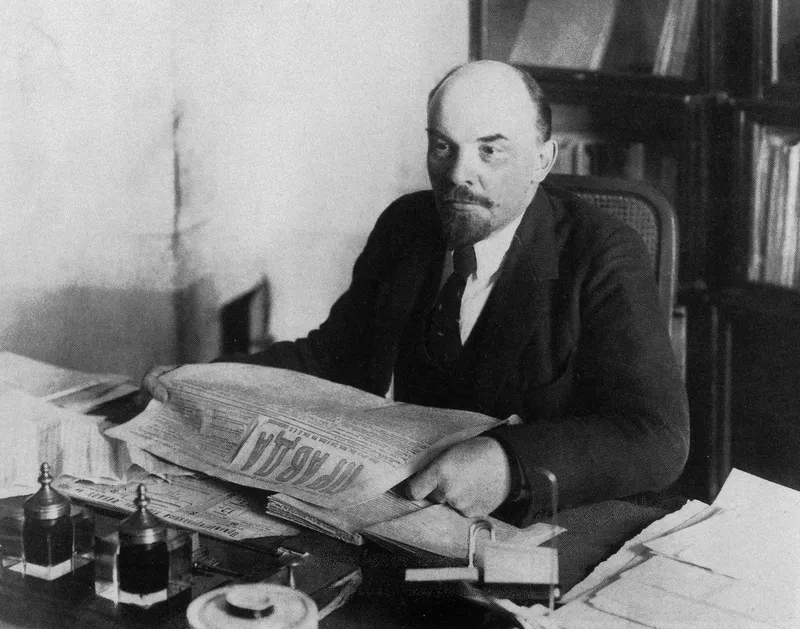
In 1916, while the First World War was under way, Lenin already knew about the Second World War and was preparing for it!
It was Lenin, and not the great theorists of communism such as Marx and Engels, who thought about war with the whole world, and he did not care in the slightest how many terrible sacrifices would have to be made to achieve the goals he had set!
He knew, and he was ready to put every last person to the knife for the sake of World Domination!
No romance, no flings, only the whole world or nothing!
Thus we can confidently state that it was Russia that, already in 1916, without even leaving the First World War, firmly intended to start a new war, and in fact spent all the time until it began preparing for it!
If you think I am mistaken, let us follow the course of events in the USSR in the 1920s and 1930s, and you will see that everything happened exactly this way!
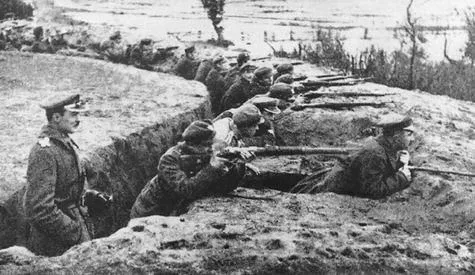
The Start of the Hybrid War for Europe
Note the wild discrepancy. We know that in 1918-1919 Russia was suffering famine and ruin, and yet Lenin, despite the state of the country, invested enormous sums in fomenting revolutions on the ruins of the defeated German Empire, on whose territory, thanks to him, many communist states arose: in Bavaria, Bremen, Slovakia, Hungary.
Soviet Russia could not help them with military intervention, since the Bolsheviks' own situation at the fronts was not great, but it found the means to support the revolutions with money, with weapons and with propaganda literature! In particular, at the very height of the civil war, the communist newspapers Die Weltrevolution and Die Rote Fahne came out in Petrograd, and were immediately sent to Germany in enormous quantities!
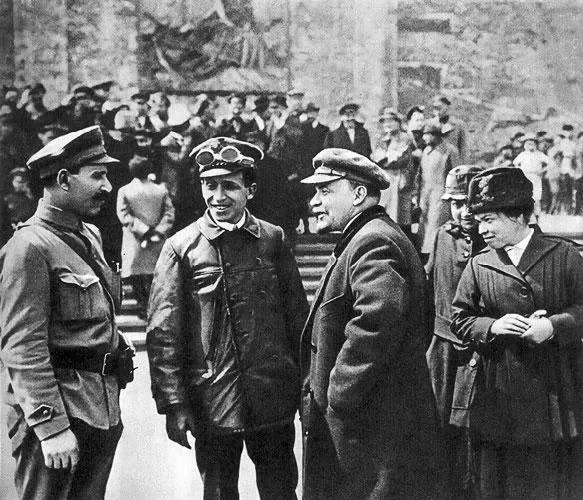
Lenin said at the time:
Now only months separate us from victory over capitalism in the whole world!
Lenin miscalculated: his plan was figured out by the forces of the Entente, and once the financing of the foreign proletariat from Soviet Russia was cut off, every one of the communist regimes collapsed without lasting even a year!
But this did not stop Lenin!
Again, look at what a wild inconsistency this is: the poor, unfortunate Bolsheviks, who had beaten back all the attempts by Denikin and Kolchak to take Moscow, instead of digging in and developing the proletarian state, without any delay unleashed a new, even bloodier war, launching an offensive on Warsaw in the early 1920s!
And after that on Berlin, and as the divisional commanders said, we will see in the new year in Paris!
Agree that it was a very desperate step!
Well, tell me yourselves: what does Soviet Russia need impoverished Poland for?
All the more so since in the south there was a real threat from the White armies that had not been finished off, and the Bolsheviks, instead of gathering all their forces for a final blow against the counter-revolution, march on Warsaw!
Russian historical science calls Tukhachevsky's Warsaw campaign his own mistake and hangs all the blame for the rout of the Red Army on him.
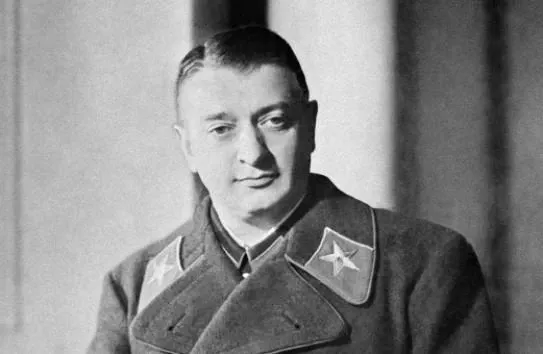
Although even a fool can see that Tukhachevsky was neither a blockhead nor a tyrant, and was carrying out an order from above, the adventurism of which he could not dispute, especially since Lenin himself demanded: a furious acceleration of the offensive against Poland !
So why did Lenin need Poland?
Lenin did not need Poland!
Lenin was heading for Germany! Precisely Germany, the country in whose revolution he had invested so much!
Yes, the favorable moment for coming to power in Germany had already been missed, but still, Germany in 1920 was extremely weak and more than suitable for a revolution. The country was in the grip of a severe economic crisis, and after the March general strike the government could barely hold back the unrest of the proletariat.
Germany was like a barrel of gasoline that lacked only a spark, and it was precisely that spark that Lenin tried to bring in 1920, but Poland stood in his way.
The Red Army... lacks the necessary new weapons, it lacks tanks, guns, aircraft to wage a modern war outside Russia. And even if we take into account that the Red Army manages to deliver a victorious blow through Poland, it will arrive weakened and, above all, too late to help the German revolution, wrote Edo Fimmen, one of the leaders of the left wing of Dutch and international social democracy.
So why does the Soviet government try, in spite of everything, to help bring about the German revolution? Lenin doesn't need Germany, and certainly not the support of the proletariat, does he?
The answer can be found in the same letter from Edo Fimmen to Zinoviev of 19 October 1923:
A proletarian revolution in Germany will threaten not only the Treaty of Versailles but all the capitalist states... That is, if the world fire can be fanned, it must be done precisely from Germany and not from some other European country.
It turns out that he saw his main ally precisely in Germany, and her geographical position made her a springboard for a further offensive on Europe!
That is exactly why Lenin spared no money to support the workers' movement in Germany, and the Red Army made a desperate attempt to break through Poland in order to help the German proletariat directly, creating yet another Soviet Republic on its territory.
But, I repeat, the Red Army was utterly defeated already on the approaches to Warsaw, and without help from outside the revolution in Germany did not take place.
The Battle for Germany
On 11 August 1922, only four months after the Soviet delegation at the Genoa conference had put forward a proposal for a general reduction of armaments, a temporary agreement was concluded on cooperation between the Reichswehr and the Red Army.
The cooperation between the two countries took various forms:
- mutual acquaintance with the state and methods of training of both armies by sending personnel to maneuvers, field exercises and academic courses
- joint chemical experiments
- organization of tank and aviation schools
- dispatching to Germany representatives of Soviet directorates, namely: the Air Force Directorate , the Scientific and Technical Committee , the Artillery Directorate , the Main Sanitary Directorate and others, to study individual questions and become familiar with the organization of a number of secret projects
And already in 1923, when Germany again found itself on the threshold of revolution:
... the German commission of the Comintern, consisting of Zinoviev, Bukharin, Stalin, Trotsky... and a number of German comrades, adopted a number of concrete decisions on direct assistance to the German comrades in the seizure of power.
Which meant only the following: that enormous sums were again being sent to Germany, and that all communists who spoke German were mobilized.
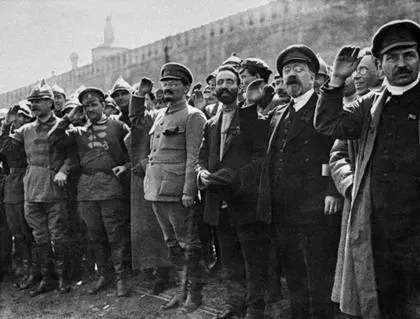
Moreover, it was not simply militants who were sent to Germany but top-ranking leaders, including People's Commissar Schmidt, Central Committee member Radek and many others.
But once again the Bolsheviks had no luck, and the 1923 revolution in Germany failed.
The German people did not believe the communists and sided with the Social Democrats.
Besides, the problems inside the USSR itself largely prevented the German revolution from happening, since Lenin was already not himself, and Stalin had not yet managed to usurp power in the country.
Nevertheless, cooperation between the two countries continued.
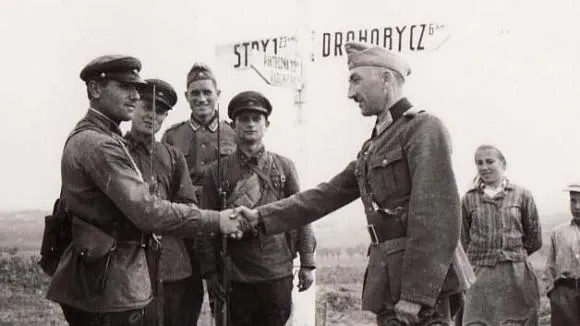
Thus in 1924 a Reichswehr aviation school was set up in Lipetsk. It existed for almost ten years and was disguised as the 4th squadron of an aviation unit of the Red Air Fleet.
From 1926 they began organising the Kama tank school in Kazan.
The most secret Reichswehr facility in the USSR was Tomka, in which the Germans invested about 1 million marks.
This was the so-called chemical warfare school, located in the Samara region, in immediate proximity to the territory of the autonomous republic of the Volga Germans.
The start of a new round of the struggle for Germany can be dated to 1927, when Stalin, who had by then taken complete possession of Russia, declared:
It is impossible to put an end to capitalism without putting an end to social democracy.
He was hinting that it was time to move on to an active struggle against the Social Democrats (pacifists) who governed Germany.
First, an unremitting struggle against social democracy along all lines... including the exposure of bourgeois pacifism, - he declared, though this was already in 1928.
In effect, Stalin declared that he had no need of pacifists. By rejecting pacifism he also rejected the communists, who did not want war in Germany, and thereby created the need for a party that openly demanded war.
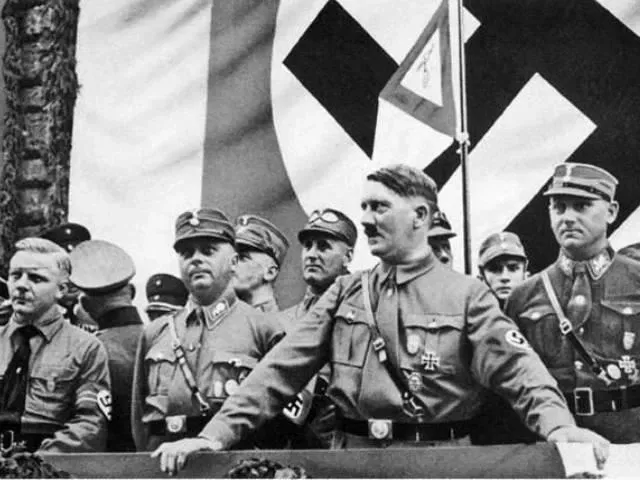
And only 5 years later a party came to power in Germany that openly proclaimed its plans of conquest, that is, its intention to start a big war soon: the National Socialist German Workers' Party under the leadership of Adolf Hitler. A party that had already been trying for 13 years to take the political summit of Germany, a party that was born practically at the same time as Lenin's desire to ignite revolution in Germany. A party that, more than likely, received funding from the USSR.
It cannot be a coincidence that Hitler's party programme corresponded to the main goal of communism: unleashing a big war, exhausting Europe, weakening its governments, creating a revolutionary situation and, as a consequence, carrying out revolution?
In confirmation of this thought one can cite Stalin's words spoken as early as 1927, when, echoing Lenin, he declared the inevitability of a Second Imperialist War, but showed the role assigned in it to Russia somewhat differently:
We will enter, but we will enter last, in order to throw onto the scales a weight that could tip the balance...
It turns out that Stalin all this time followed Lenin's programme and prepared for a new war, while already being quite certain that the war in Europe would be kindled for him by someone else!
It turns out that as early as 1927 Hitler was assigned the role of Europe's arsonist!
The Molotov-Ribbentrop Pact
On 23 August 1939 the Soviet Union and Germany signed a non-aggression treaty, better known as the Molotov-Ribbentrop Pact, and exactly one week later the Second World War began.
And it began with the attack of fascist Germany on Poland.
Yes, many try to say that the war in Europe began long before that, and name as the starting point the Anschluss (reunification) of Austria, which took place on 12-13 March 1938. Its prerequisite was the consent to Germany's acquisition of Austria given in November 1937 by the English minister Halifax.
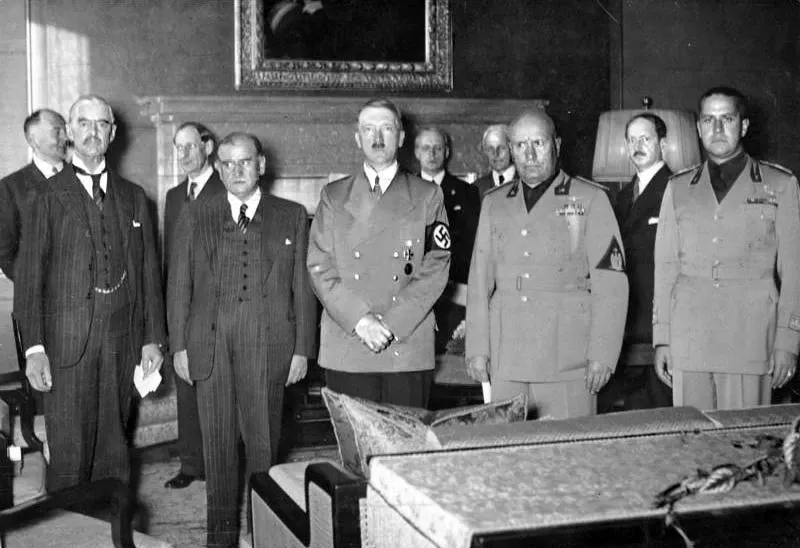
Many believe that the start of the war should be reckoned from the date the Munich Agreement was signed, 30 September 1938, or even from the date of the remilitarisation of the Rhineland carried out by Germany on 7 March 1936, but this is wrong.
Yes, in essence these were positional wars, and although one can say that they led to the Second World War, they cannot be counted as part of its events proper, because until 3 September 1939 Germany did in Europe whatever it wanted solely with the permission of Great Britain!
It is not entirely clear what specific aims Great Britain pursued by supporting all of Hitler's undertakings, but one can say unambiguously that everything Hitler did was done within the sphere of Great Britain's interests!
In any case this is a topic for a separate investigation, so let us return to Poland in 1939.
So, after Germany sent troops into Polish territory on 1 September 1939, England and France declared war on it on 3 September, while the USA unexpectedly declared its neutrality.
Did Hitler know what crime he was committing when German troops invaded Poland?
How did this war differ from the seizure of Czechoslovakia, which Hitler had been allowed to swallow?
In that Stalin outplayed Hitler and, forcing his hand, made him violate the secret form he had signed in Moscow shortly before the Ribbentrop-Molotov Pact.
Yes, Hitler knew that in August 1939 delegations of England and France had arrived in Moscow, but no one has ever disclosed the results of those negotiations!
And what they were about was that Stalin declared he no longer trusted Hitler and saw that, despite all the gestures of goodwill, Hitler could not get his fill and intended sooner or later to seize Poland, which the Soviet Union wanted to prevent by every means!
Therefore the result of these negotiations was an agreement to stop Hitler, and the foreign diplomats promised Stalin that their countries would immediately go to war with Germany if it attacked Poland.
Having secured the agreement with the Western countries, what does Stalin do?
Quite right: he begins negotiations with Hitler, to whom he explains that Hitler needs to attack Poland, all the more so since an agreement on this issue with England and France has been reached and they will not interfere!
After that, having signed in Moscow on 23 August 1939 the Additional Secret Protocol, which divided Poland into two parts, Germany moved on to active steps.
An important addition to the agreement signed in Moscow was the coordination of troop actions. The war with Poland was to be started simultaneously by both Germany and the USSR!
The entry of both fascist and Soviet troops into Polish territory was supposed to take place on the same day, simultaneously: 1 September 1939!
But Stalin deceived Hitler, and when on the morning of 1 September the punctual Germans were already fighting the stubbornly resisting Polish army, the Soviet army did not even budge!
Stalin never even thought of attacking Poland!
Stalin provoked Hitler into a step that completely discredited him in the eyes of world opinion, while Stalin's gift of foresight was highly appreciated by his Western colleagues, who now began to believe him.
A marvellous situation, mind you: by signing a non-aggression treaty with Hitler, Stalin ruled out the likelihood of his own participation in the war, while England and France he practically obliged to defend Poland!
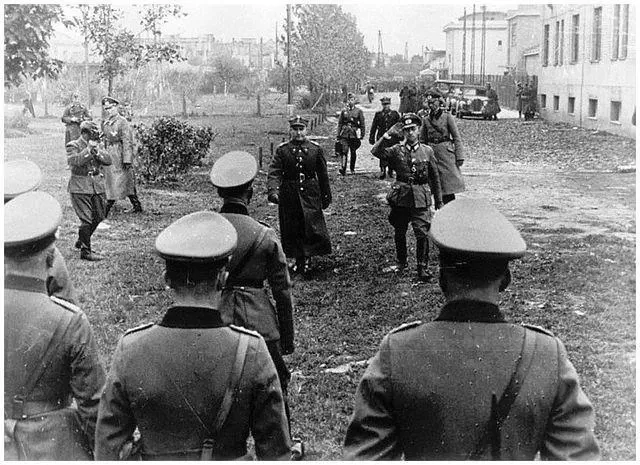
And when Hitler had practically brought his troops to the borders of the USSR, Stalin suddenly, unexpectedly for all the Western allies, crossed the border with Poland and returned to the USSR the lands that had been discussed in the agreement with Germany!
Remarkably, the Red Army entered Poland when the Polish army practically no longer existed, and there was no one left to resist the RKKA.
And what is still more important for the whole world, Stalin performed actions that seemingly went against Hitler; he seemed to be trying to stop him, to hold back his advance to the East, because thanks to the combination he had conceived and masterfully executed, the whole world already knew for certain: Hitler is the sole culprit of unleashing the Second World War!
That's Stalin for you!
He occupied the territories, set Hitler up, and for the whole world became lily-white and fluffy!
Not only did Stalin gain so many preferences from this war, he also pitted all the leading countries of Europe against each other, while he himself effectively declined to take part in the war, hiding behind the Pact!
One is simply reminded of Stalin's sacramental phrase, spoken as early as 1927:
We will enter, but we will enter last, in order to throw onto the scales a weight that could tip the balance...
Of course, since there is no way to shed light on the agreement Stalin concluded in Moscow in August 1939 with England and France, we can only guess what it really said. But in any case Stalin clearly positioned himself in it as staying out of the war with Germany, perhaps even by undertaking to take a neutral position regarding the war between Germany, France and Great Britain, which would, as it were, guarantee the latter a quick victory over his ally Germany.
Can the above statements be regarded as illogical and wrong?
Think for yourself: why would Germany, for the sake of a scrap of territory, get embroiled in a war with the strongest states in the world, especially as its relations with Great Britain had until that moment been excellent?
Why does Germany need Poland at all?
Whereas the USSR needs Poland, because it could have exerted a restraining effect should the RKKA begin its offensive against Europe earlier than planned!
So see for yourselves:
- a common border with Germany
- new territories seized absolutely painlessly: Western Ukraine, the Baltic states, Bukovina, half of Poland
- the discrediting of Hitler, who became a bloody aggressor in the eyes of Europe
- all the leading countries of Europe drawn into an armed conflict
And most important of all, no one accuses Stalin of unleashing the war: Hitler, who understands his own folly, keeps silent, no one knows about the secret protocol between the USSR and Germany, and there is no point for Stalin in boasting that he pitted everyone against each other.
A paradox: Germany, which seized only half of Poland, is the aggressor, while the USSR, which also received half of it, is a neutral country!
One can say that Germany's fate was sealed already at that moment, because only Germany knew about the USSR's plans of conquest, and from September 1939 on it was no longer regarded as a party to negotiations.
Preparing for the big war
Since there was no one left to liberate, Stalin began intensive preparations for the big war.
There was no particular need to hurry since, despite the capitulation of France, Great Britain had enormous potential, and the longer the war dragged on, the more exhausted became the countries that Stalin needed to reunite.
Beginning in October 1939, the General Staff of the Red Army began planning military operations against Germany , writes Valery Danilov, candidate of historical sciences and retired colonel.
Stalin simply was in no hurry; he really did schedule the war for Europe for 1941.
And for two years, from 1939 to 1941, while Western people killed each other and destroyed cities and factories, the USSR merely built up its military might.
So what did Stalin do during these two years?
Stalin strengthened the army
On 1 September 1939 a law on universal military duty was already issued, because even then Stalin understood that the war with Poland was not a local conflict but precisely the beginning of the Second World War, or, as he liked to call it, the Imperialist War.
Stalin began to concentrate his armies on the borders of the USSR.
So, if we are to believe the researcher Mikhail Meltyukhov:
... For the war with Germany the USSR set aside 247 (81.5%) of the 303 divisions in the Red Army, which after mobilization would have numbered over 6 million men, 62 thousand guns and mortars, 14.2 thousand tanks and 9.9 thousand aircraft.
In April 1940 work began on a mobilization plan, which was approved by the government on 12 February 1941 .. .
In all, it was planned to deploy 8 front and 29 army headquarters, which exceeded the number of military formations of all the armies of the world, 62 rifle, 29 mechanized, 4 cavalry, 5 airborne and 8 aviation corps directorates, 177 rifle, 19 mountain rifle, 2 motorized rifle, 61 tank, 31 motorized, 13 cavalry and 79 aviation divisions, 3 rifle and 10 antitank artillery brigades and 72 artillery regiments of the High Command Reserve (RGK), as well as rear units... After mobilization the strength of the armed forces of the USSR was to reach 9 million men, and the troops were to have more than 106 thousand guns and mortars, 37.8 thousand tanks, 22.2 thousand combat aircraft, 10.7 thousand armored cars, about 91 thousand tractors and 595 thousand motor vehicles...
According to plan MP-41, the mobilization deployment of the Red Army was to be carried out by echelons within a month.
It turns out that by the summer of 1941 about 4-5 million Soviet soldiers had already been concentrated in the border zone, a number that would grow to 6 million after mobilization, and under the mobilization plan the Red Army's strength would rise in total to 9 million men!
What could Germany set against Russia?
4 million soldiers and minimal opportunities to increase the size of its army.
beginning in February 1941 the Wehrmacht began to concentrate and deploy along the borders of the USSR... In all, 89 divisions were transferred to the East between February and 21 June. By 18 June the concentration of most of the air force, which was based in a 200-kilometer border strip, was complete. In all, for the war against the Soviet Union Germany set aside 155 (74.5%) of its 209 divisions, which numbered 4 million men, 43.8 thousand guns and mortars, 4.2 thousand tanks and assault guns and 3.9 thousand aircraft. In addition, Germany's allies deployed 37 divisions along the borders of the USSR, numbering 715 thousand men, 5.5 thousand guns and mortars, 262 tanks and 937 aircraft, writes Meltyukhov.
Any military strategist will tell you that, with such a balance of forces and military potential, which was clearly shaping up not in Germany's favor, talk of its treacherous attack was laughable.
Perhaps Stalin was preparing for defense?
Well, why not?
Why else would a defending Red Army need 5 airborne corps and 19 mountain rifle divisions?
Especially considering that in defense there is nowhere to parachute into, and no need to climb mountains either, all the more so since the overwhelming majority of the mountain rifle divisions were concentrated on the border with Romania, and there, on the territory of the USSR, there are no mountains at all!
What is more, as Valery Danilov, a candidate of historical sciences and retired colonel, writes:
Neither the Barbarossa plan was a secret to Stalin (already on 28 December 1940, ten days after it was approved, the main provisions of this document were in the hands of Soviet intelligence), nor were the measures systematically carried out by the Wehrmacht to build up forces and means along the Soviet western border. The last prewar intelligence summary on the West, dated 5 June, said: The total number of German troops on our western border with Germany and Romania as of 1 June reaches 120-122 divisions ...
And still, knowing Germany's plans, the Supreme Command does not order its troops concentrated at the border to dig in, build fortifications, dig antitank ditches, or in general prepare for defense in any way!
This means that the concentration of enormous numbers of men and equipment at the borders was the result of a different operational task, and not of defense at all.
To answer the question of what 80% of all the armed forces of the Red Army were doing on the border with Germany, one should become acquainted with a document: Considerations on the plan for the strategic deployment of the armed forces of the Soviet Union in the event of war with Germany and its allies.
The document was drawn up by Major General A. M. Vasilevsky, deputy chief of the Operations Directorate of the General Staff.
The manuscript was refined and corrected by Lieutenant General N. F. Vatutin, first deputy chief of the General Staff.
The document is addressed to J. V. Stalin, Chairman of the Council of People's Commissars of the USSR.
Work on it was completed between 7 and 15 May 1941.
The document is accompanied by:
- a plan for the strategic deployment of the armed forces of the USSR
- a plan of combat operations in the event of war with Germany
- deployment diagrams on the map
- covering deployment diagrams on three maps
- a diagram of the balance of forces
- three maps of air force basing in the West
Similar documents exist in many countries prepared to repel an aggressor's offensive.
Only the document submitted to Stalin is entirely and completely unique, because, unlike all other possible plans for a war against an aggressor, the USSR is not preparing for defense in it!
Instead of defending, the Soviet troops for some reason intend to attack at once!
What is more, the document even contains a ready-made moral justification for Soviet aggression:
Wars are sometimes interpreted as just or unjust in this way: if a country is the first to attack another and wages an offensive war, then that war is considered unjust. From this the conclusion is drawn that the Red Army supposedly will wage only a defensive war, forgetting the truth that ANY WAR WAGED BY THE SOVIET UNION WILL BE A JUST WAR.
Taking into account that Germany currently keeps its army mobilized with its rear areas deployed, it is able to forestall us in deployment and deliver a surprise blow. To prevent this and to defeat the German army, I consider that we must in no case give the German command the initiative, but must forestall the enemy in deployment and attack the German army at the moment when it is in the stage of deployment and has not yet had time to organize a front and coordination between the branches of the armed forces, says the Considerations.
After that the defensive operational tasks were distributed among the fronts in this way, while the main preemptive strike fell to the army of the Southwestern Front, which, cutting Germany off from its allies Italy, Romania and Hungary, cut it off from its oil artery: the oil from Romania on which all the Wehrmacht's equipment depended!
The plan was brilliant in its own way, and even Field Marshal W. Keitel, chief of staff of the Wehrmacht High Command, believed that a Soviet attack on Germany in 1941 could: put us in an exceptionally critical position strategically and economically... In the very first weeks, an attack from Russia would have put Germany in extremely unfavorable conditions.
But Germany did not hold out and, on the night of 22 June, the Soviet ambassador to Germany, Dekanozov, was summoned to German Foreign Minister Ribbentrop, whose interpreter, Erich Sommer, became the man through whose lips Germany declared war on the USSR in Russian.
A memorandum of the German government was read aloud, with a multitude of border incidents, violations of the border zones, in the air and on the ground, and so on.
It is still unclear why the Soviet authorities concealed this fact for so long and spread the myth that Germany attacked without declaring war. Probably this was done for propaganda purposes: to give Germany the image of a vile enemy and, conversely, to idealize the USSR.
Nevertheless, 22 June should be considered not the day the Second World War or the Great Patriotic War began, but merely the date of the USSR's entry into the Second World War.
Conclusions:
In essence, Germany played the role of a whipping boy in the Second World War, and if Hitler had not realized after the Polish campaign that he was being used and had not resolved to go to war with the USSR, Communism would probably reign today in Europe for certain, and perhaps in the whole world.
But in fact that is not what is interesting.
Much more interesting is the fact that Great Britain and the USA launched the Lend-Lease program for the USSR even before the USSR entered the Second World War!
It turns out that they were aware of Stalin's plans and were ready to support in every way both his huge army and his wish to enter the war.
Just imagine: Great Britain and the USA were preparing to sponsor an aggressor who, after occupying Germany and all of Europe, would not have stopped and would have gone after them!
But, as they say, by an absurd accident, the vengeful Hitler outplayed his progenitor and struck a preemptive blow.
It sounds funny: a Fascist saved Europe from the threat of Communism.
But a fact remains a fact.
Stalin did not regard the victory over Germany as a holiday, and for many years afterward was in deep depression, which is hardly surprising. Hitler thwarted the most brilliant plan for the enslavement of Europe, and later of the whole world!
To the sixteen coats of arms, other coats of arms will be added, so it remained just words from a song.
The world fire of revolution went out before it could even flare up. What is more, if not for the help of the enemies of the revolution, its fire would have died out much earlier than 1991.
Who is to blame for unleashing the Second World War?
Stalin alone.
Exclusively: Moscow, Russia, the Third Rome, its theory of eternal war and world fire.
Hitler, for all his desire, was merely a puppet in Stalin's hands.
This whole terrible war took place exclusively thanks to the policy of Stalin, who in 1939 set the world powers against each other and unleashed the most terrible war in the history of mankind.
References:ru.wikipedia.orgru.wikipedia.orgru.wikipedia.org