By the end of November 1941 the Germans had almost encircled Moscow, but could not take it, as if Stalin had raised some invisible wall around it...
By the end of November 1941 the Germans had almost encircled Moscow. In the west they had taken Mozhaysk, Naro-Fominsk and Maloyaroslavets. From the south Guderian's 2nd Panzer Army was advancing. The 53rd Army Corps was moving toward Serpukhov, encircling Tula from the north, where Stemmermann's division stood on the approaches. The 17th Panzer Division of the 24th Corps was moving out toward Kashira, while troops of the 47th Corps were fighting on the approaches to Ryazan.
A special train was already standing with steam up, ready to take Stalin to Kuibyshev, a safe distance from the front. Guderian received an order to move in the direction of Gorky, closing the ring around Moscow from the south in the area of Petushki. But when he reached Kolomna, the offensive ran out of steam.
And the strange thing is this: the Siberian divisions had not yet reached Moscow, and Stalin was already shifting troops from the north of the Moscow region to the south. Even though the commander of the Western Front, Georgy Zhukov, had only just asked the Supreme Commander for reinforcements in the north, on the Kryukovo-Rogachevo line.
Yet in the north of the Moscow region, despite the exposed front, nothing is happening. Army Group Center under Field Marshal von Bock had long since taken Kalinin, it is forty degrees below zero, the ice cover of the Moscow Sea (the Ivankovo Reservoir) is unbroken, and on the opposite bank of the Volga there are practically no troops of the Kalinin Front.
Von Bock's troops stand on the Klin-Rogachevo-Dmitrov line and move no further. They stand as if bewitched, even though clashes take place at only two points: near the village of Kryukovo (Zelenograd) and near Yakhroma, where the tank armies are opposed only by the lone armored train No. 73 of the NKVD troops and the soldiers of General Vlasov's 20th Army.
On the Volokolamsk axis the Germans have crossed the Dubosekovo line, but the panzer divisions of the 46th Corps do not go to Moscow along the Volokolamsk highway either! The heavy artillery of the 2nd Panzer Division of the Wehrmacht's 4th Army stands at Krasnaya Gorka (22 km from the Kremlin). The gunners study the center of the capital through binoculars but do not advance further, although there is no front left at all. Local residents calmly walk toward Moscow, board a bus at the Kropivnitsky barracks in Lianozovo (the Altufyevo metro station had not yet been built) and ride to the center to report the enemy's heavy guns trained on the Kremlin.
Stalin, by the way, by the end of November was no longer thinking of moving to Kuibyshev, beyond the Volga.
Stalin's Wall
There is something mystical about this whole situation. As if Stalin had built some impassable wall in the north-west of the Moscow region. But this wall was so secret that to this day official Soviet historiography has not a word about it. It appeared almost instantly. For there were, after all, chance appearances of enemy soldiers on the territory of Moscow.
"Our building stands on the highest point of the hill by Lock No. 8 of the canal, from where you can see far around," says Valentin Barkovsky, a veteran of the administration of the Moscow-Volga Canal (now the Moskva Canal federal state unitary enterprise). "I remember the employees who had worked there since the war and were on duty on the roof then telling how a German tank stopped on Skhodnenskaya Street, on the Western Bridge over the Derivation Canal (between the present metro stations Tushinskaya and Skhodnenskaya. I.K.). A hatch opened, a Wehrmacht officer looked out with a field notebook, glanced around, wrote something in the notebook and drove off toward the Aleshkinsky forest."
Another appearance of the Germans in Moscow: 30 motorcyclists a kilometer from the Sokol metro station. The motorcyclists were riding along the Leningradskoye highway. Two machine gunners on the bridge, later named the Victory Bridge, took up an unequal fight and stopped the attackers.
"The motorcyclists came from the direction of Khimki," Valentin Barkovsky recalls that episode. "They had passed the previous bridge (over the canal) without trouble (the weather was unfit for flying, and frozen soldiers were kicking a ball about on the bank of the canal)."
But how did that single platoon get there, if the front was holding at the village of Kryukovo? Did they break through by chance "through some wall" that had appeared in the path of the 5th SS Panzer Corps, which was approaching Moscow along the Volokolamsk highway after the fighting at the Dubosekovo siding?
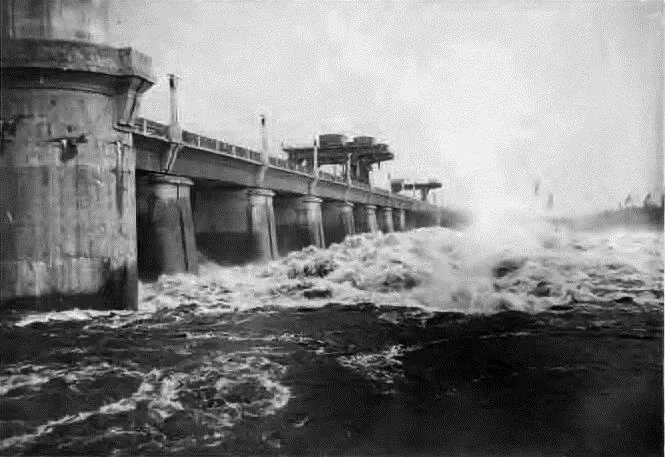
The wall really did appear instantly. It was a wall of water. Torrents of water from the Istra Reservoir swept away not only the advancing tanks and the infantry of the 52nd Army, but also numerous villages along the Istra River, the densely populated districts on the outskirts of the town of Istra, and the settlement of Pavlovskaya Sloboda. Fragile peasant huts flew apart into logs, carrying off old men, women and infants in the current. Workers' barracks in Pavlovskaya Sloboda flew into splinters. The little houses that miraculously survived were flooded with water thick with ice crumbs and fragments of large ice floes.
This terrible picture did not make it into the published memoirs of Soviet military commanders. The details remained only in a single secret publication, "The Rout of the German Forces near Moscow," under the general editorship of Marshal Shaposhnikov, prepared by the General Staff of the Red Army and issued by the Voenizdat of the USSR People's Commissariat of Defense in 1943. In the postwar years the "secret" classification was lifted and replaced with another, "for official use." The secret edition lay in the special depository until 2006.
Here are the meager descriptions of the building of the "wall." Marshal Shaposhnikov writes: "On 24 November the Germans came right up to the line of the Istra Reservoir and the Istra River. As the Germans approached this line, the spillways of the reservoir were blown up (after our troops had crossed), as a result of which a water flow up to 2.5 m high formed, extending up to 50 km south of the reservoir. The Germans' attempts to close the spillways did not succeed."
Probably the tanks on Skhodnenskaya and the platoon on Leningradka are precisely those who managed to slip through before the dam was blown.
Marshal Shaposhnikov was modest about the height of the water flow. The level of the Istra Reservoir is 168 m above sea level. The flow of the Istra River behind the dam lies at a water line of 143 meters, in Pavlovskaya Sloboda 134 meters. The pressure of this enormous volume of water went, as Shaposhnikov writes, for 50 kilometers, that is, as far as the Moskva River (whose level at the point where the Istra flows in, a little above the Rublevo dam, is 124 meters). Thus the height of the flow that swept away everything in its path was no less than 25 meters (the charge was placed at the base of the spillways, affecting also the so-called dead volume that remains in the reservoir during the planned spring releases of flood water). If one takes into account the drop of the flow down to the Moskva River, the total head reaches forty meters.
But the blowing up of the Kuibyshev dam (as the dam of the Istra hydroelectric complex is called) still does not explain the Germans standing still north of Moscow, when all the reserves of the Stavka had been thrown to the south, against Guderian's army. The scanty information about the events that followed the explosion of 24 November on the Istra, mentioned in the same book edited by Marshal Shaposhnikov, the research of a few enthusiasts (Valentin Barkovsky, Mikhail Arkhipov), and the testimony of surviving eyewitnesses make it possible to assemble from mosaic fragments a more or less coherent picture of what happened.
It looks roughly like this.
Flood them along with the population
"Comrade Stalin, von Bock is advancing along the whole front. Kalinin and Klin have been taken. Tanks are in Rogachevo, we have abandoned Yakhroma!" reports the commander of the Western Front, Georgy Zhukov, to the Supreme Commander. "The Siberian divisions will reach Zagorsk (Sergiev Posad. I.K.) only in a week. As much time again will go on deploying them along the front. The Western Front urgently needs reinforcements."
"Calm down, Comrade Zhukov!" the Supreme Commander-in-Chief says gently. "Here, for reinforcement, are two fighters for you! Meet them: Comrade Fedorov, Comrade Fradkin. Fine, and here is one more fighter for you, Comrade Zhukov, Comrade Zhdanov. Almost our Leningrad commander. Only this time Vladimir Sergeyevich."
Zhukov stood there, understanding nothing and not knowing how to react to the Supreme Commander's joke. But Stalin was not joking. He had summoned the head of the Ivankovo hydroelectric station Georgy Fedorov, the chief power engineer of the Moscow-Volga Canal Boris Fradkin, and the chief engineer Vladimir Zhdanov.
"If we quickly release the water of the Ivankovo Reservoir, the ice will break up and the icy surface will be impassable not only for tanks but also for enemy infantry!" Fedorov began his report. "The water will go quickly. The head is 12 meters. At Kalinin it is 124 meters, below the dam 112."
"By releasing water from the Moscow-region reservoirs, the Ikshinsky, Pestovsky, Pyalovsky, Pirogovsky, Klyazma, Khimki, we will break up the ice cover in the same way across the whole water surface and provide a belt impassable to the enemy from Dmitrov to the northern boundary of Moscow," Zhdanov backed his colleague.
"Where will you release the water? Into Moscow?" the Supreme Commander cut him off with a sinister squint.
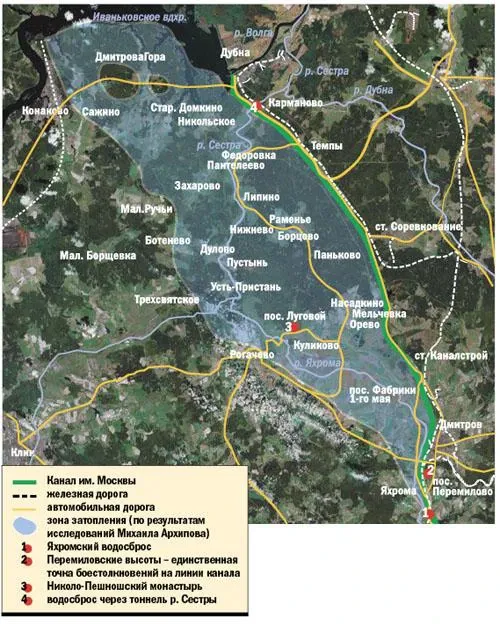
"We have the Yakhroma spillway. On the Volgusha River, a tributary of the Yakhroma," Zhdanov explains, stepping up to the map. "If we open the gates here, the water will go into the Yakhroma floodplain. The head is even greater than on the Volga. The level of the reservoirs is 162 meters, and in the Yakhroma valley 117. But here, true, there are two more dams: the Yakhroma hydroelectric complex and the Ikshinsky..."
"The dams work to lift Volga water. Unfortunately, the connection with the lower pool is only through the lifting pumps," Boris Fradkin joins the conversation. "But if we open the gates, the pumps will work in generator mode, passing water in the reverse direction. The water will go down from the reservoir, returning to the power system the electricity spent on lifting it. If we open both leaves of all four locks at once, the flow will intensify."
"So the water will go into the Yakhroma? Then the river will overflow and become a barrier for von Bock's tanks?" smiling into his mustache, Stalin goes up to the map. "And at the Ivankovo dam the canal crosses one more river, the Sestra, correct? Can we direct the water of the Ivankovo Reservoir there? So that the Germans do not get past Rogachevo?"
"The Sestra River passes in a pipe under the canal and flows into the Volga below the Ivankovo dam," Fradkin and Zhdanov take up the conversation again. "In the canal there are bottom openings provided for draining the canal between the guard gates, for repair purposes. If we shut the pipe and open the bottom openings, the water will rise, reach Rogachevo and flood the whole space from the Ivankovo Reservoir to Yakhroma. But there are gates only in the western part of the pipe."
"How much time is needed to install new gates?" Stalin asks.
"If we strain all available forces and are given help by the engineering directorate of the front, we will manage in a week, I think," Zhdanov estimates.
"In two days everything must be ready!" says Stalin. "I warn you: the whole operation must be carried out in conditions of strict secrecy. Only those directly concerned should know about it. The direct executors must not be informed of the aims of the operation."
"But, Comrade Stalin," the commander of the Western Front interrupts the Supreme Commander. "We have to evacuate the population from the flood zone!"
"So that the information leaks to the Germans? And so that they send their reconnaissance company to you? This is war, Comrade Zhukov! We are fighting for victory at any price! I have already given the order to blow up the Istra dam. I did not spare even my own dacha in Zubatovo. It could have been covered by the wave too."
The saved and the savior
The operation really did take place in conditions of strict secrecy. Here is what Alexei Kornilov, a lifelong resident of the settlement of the 1st of May Factories near Dmitrov, tells.
"Our settlement was built for the workers of the local peat enterprise. Flimsy prefabricated houses, whose residents at the moment of the German advance hid in the only brick structure, in the cellars of the potato store."
Alexei Kornilov tells a story that his grandmother Pelageya Ivanovna passed on to him in childhood.
Opening the door of the potato store a crack, a puny blue-eyed boy in German uniform with a flashlight in his hand looked in amazement at the women with children hiding in the cellar of the "high-rise" that had miraculously survived, which German artillery had until then been pounding mercilessly.
Hohe! Hohe! Feuer! the boy waved his arms toward the tall chimney of the potato storehouse and gesticulated relentlessly, explaining to the frightened women the danger of their position. A tall structure, he meant, dangerous, they are shooting at it. And he went on: Wasser! Wasser! Kaputt!
The women who looked out of the potato storehouse could not believe their eyes. In the depths of a forty-degree-below winter, a flood had broken out on the channels of the peat workings in the floodplain of the Yakhroma. Raging torrents with shattered ice floes were inundating everything around.
On every channel the water kept rising higher, recalled Alexey Kornilov's grandmother. One more moment and the icy water would have poured into the cellar of the potato storehouse.
The women, with their meagre bundles and children in their arms, climbed out of the storehouse cellars and up onto the embankment of the road leading toward Dmitrov. There could be no question of going back to their homes, which were gradually disappearing under water. Just then shelling began from the direction of the canal. One of the women made a white flag out of a piece of bedsheet (so that their own side would not shoot them). The Germans were hurrying to get back to the line of their fortifications on the opposite bank of the swelling Yakhroma.
It was hard going. Grandmother walked with two children, the third, still a baby (my mother), in her arms, Alexey Kornilov continues his story. Grandmother stopped and decided to unload some of her baggage. She remembered the summer shoes on the boy who had saved their lives, ran over and gave him a pair of felt boots.
Danke, Mutter! shouted a young, fair-haired soldier as he went off out of the line of fire.
The residents of many villages and settlements in the Yakhroma and Sestra valleys can no longer recall such stories. Because there is no one left to remember. Many villages were flooded completely. Especially those located in the Yakhroma floodplain between the numerous channels of the small canals of the local peat enterprises. Some, it is true, were lucky. The residents of the Lugovoy settlement were saved by the walls and towers of the ancient St. Nicholas Peshnosh Monastery (today it houses Moscow psychoneurological boarding home No. 3).
The name of the village of Ust-Pristan, standing right on the bank of the spit at the point where the Yakhroma flows into the Sestra, speaks of the navigable past of these rivers. Galina Sidneva recalls this.
In the old days the people of our village, and of many of the surrounding forest villages, made their living from shipping, Galina Mikhailovna begins unhurriedly. They worked at the mills, at the old wooden locks that reached as far as Lake Senezh and the Catherine Canal, which linked the Volga with the Moskva River basin. When the river was shut into a pipe under the new canal, it became hard to get through the pipe even in boats. So by the time of the war many people did not even have boats.
Galina Mikhailovna herself survived that Stalinist operation because she happened to be in another village, which did not fall within the flood zone.
Her cousin Vasily Sidnev also lived through the war. He served in an anti-aircraft unit in Lianozovo.
Many people told me about the terrible flooding, recalls Vasily Ivanovich. But they added that it was a military secret.
And what did you do in Lianozovo? I ask.
We caught paratroopers. There were a great many saboteurs, who made their way on foot.
On foot? Across the front line?
There was no front line here at all. The German is standing at Krasnaya Gorka with heavy artillery, and we are on the other bank with a single machine-gun crew.
However that may be, at the cost of numerous casualties among the civilian population in dozens of settlements and villages, Joseph Stalin achieved a great deal. Without any reserves, he managed to shrink the zone of combat on the Western Front to practically two small points, near the village of Kryukovo and on the Peremilovo Heights, where the Germans trying to break through across the canal were held back by the separate armoured train No. 73 of the NKVD troops, which happened to be there by chance. The armoured train was travelling from Zagorsk to Krasnaya Gorka (where long-range artillery aimed at Moscow was already being set up), but it got stuck at Yakhroma station after the bridge over the canal was blown up. Until Kuznetsov's 1st Shock Army was formed, the Germans on the Peremilovo Heights (between Yakhroma and Dmitrov) were held back by soldiers of the 20th Army under the command of General Andrei Vlasov. And the monument on the Peremilovo Heights is the only one in Russia where the name of this general is carved, the general who, after the encirclement of the 2nd Shock Army of the Volkhov Front, turned his weapons against Stalin.
According to the researcher Mikhail Arkhipov, as a result of the release of water from the Ivankovo Reservoir the level of the Yakhroma rose by four metres, and the level of the Sestra by as much as six metres. In that case more than thirty villages and many small settlements of the peat enterprises, whose houses stood right at the water's edge, ended up in the flood zone. If one remembers that the height of a peasant izba with its roof does not exceed four metres, and that everything around was covered with icy water full of splinters of small ice, it is easy to imagine the number of victims. There were no fewer (if not more) after the blowing up of the Kuibyshev dam on the Istra Reservoir. However, another researcher, Valentin Barkovsky, believes that the flood zone of the Sestra could have been much smaller. There was too little time to weld the gates at the eastern portal of the pipe under the canal. Possibly the hastily welded shields could not withstand the pressure of the Volga water, and the flows released from the canal through the gates went straight back into the Volga. That is why many village houses on the bank survived.
Execution reported
Unfortunately, the canal's technical archives have not survived. They were destroyed in evacuation, in Ulyanovsk, in mysterious circumstances. It is known only that the heads of the Bolshaya Volga section of the canal, Vasily Nekrasov, and of the Yakhroma section, Dmitry Agafonov, reported up the chain of command that the assignment had been carried out. If something did not work out, they could have kept silent about it (the result of failing to carry out the instructions of the Supreme Commander is predictable). One thing can be said for certain: the discharge of water through the Yakhroma made it possible to lower the level and break the ice on all six Moscow-region reservoirs (just as on the Ivankovo one).
Regardless of the point to which the pipe under the canal was raised, the consequences of the flooding were monstrous. Like the memorable spring flood on the Lena (when the town of Lensk was inundated), with the sole difference that all this happened in forty-degree frost.
People could die even if a house was only slightly flooded, says Farit Galeev, a professor of resuscitation medicine. If a person stands knee-deep in water for half an hour in forty-degree frost, he is already a corpse.
When I discuss this subject with professional military men, they often tell me that there is no point in dwelling on the deaths of the civilian population. The deaths of civilians, they say, are inevitable. Of the 27 million victims of the war, almost two thirds were outside the regular strength of the Red Army. The storming of any village is an artillery bombardment in which the villagers themselves die first of all.
Death without locks
When I tried to find out the flood zone (and the approximate number of victims) from the old residents of the village of Karmanovo, on the Sestra River, they drew my attention to quite different victims.
See that hill? Nothing but skeletons piled in heaps there! they point out to me a small mound on the bank of the Sestra. The canal-army men lie there.
Red Army men?
No, canal-army men!
The victims of the construction of this canal, built shortly before the Great Patriotic War, can quite well be counted among the victims of the defence of Moscow. All the more so as the number of dead here exceeds by an order of magnitude the number of victims of the Stalinist floods of autumn 1941. Historians estimate the number of dead canal-army men at no fewer than 700 thousand people (many hold to estimates of a million and a half).
The life of a prisoner on general labour rarely lasted more than six months. Every camp, every sub-division (as in that same Karmanovo on the bank of the Sestra) is surrounded by huge ditches with the graves of dead convicts. Only the kozly (goats, those who cooperated with the administration and wormed their way into administrative posts), the informers and the pridurki could survive. That was what they called those who got settled in the bread-slicing room, the kitchen, the post of film projectionist. Or as a musician in the orchestra. In the new documentary film Out of Water and by Water, or a Private Prison for Water (directed by Anton Vasiliev) there is a staggering shot: dying convicts run with wheelbarrows while a brass band plays on the parapet of a lock under construction so that dying would be more cheerful. And the names of the surviving settlements matched the pace of death from exhausting labour: Tempy (Paces), Sorevnovanie (Competition), Kanalstroy, Trudovaya-Severnaya (Labour-Northern)
In Moscow the mass graves are located where the most convicts died: around the locks of the Moscow–Volga Canal. Little-known burial sites lie in Nizhnie Mnevniki, by Lock No. 9 (behind the present-day restaurant Ermak), in the Pokrovskoye-Glebovo park, between Locks No. 7 and No. 8, on the bank of the Khimki river.
At the construction of Lock No. 10, in Pererva, there were two separate camps: one for priests, the other for spies, mostly Comintern employees. The camp for spies was located on what is now Guryanov Street (not far from the building blown up in the autumn of 1999). The second, for priests, was downstream, on the other bank of the Moskva River, at the eastern entrance to Kolomenskoye park. Convicts were buried on the present-day Kolomenskaya embankment, by the upper gates of Lock No. 10. However, there were so many dying that all the surrounding ditches in Kolomenskoye were filled with corpses. River workers say that after every spring discharge of water the skeletons of convicts can be seen on the exposed slopes of Kolomenskoye park.
Residents of the Moscow-region settlement of Letchik-Ispytatel (near Lock No. 6) tell how last summer the new Russians, having taken possession of a former collective-farm field with a burial mound, secretly buried at night the corpses found while laying foundations for cottages.
Two years after the start of construction of the canal, Order No. 359 of 03.07.1934 was issued for Dmitlag (the name of the GULAG division in charge of Volgostroy, later renamed Kanalstroy). Here is what it says on this matter: The question of allotting plots for burials is not given due attention on the part of the heads of construction districts and sections, plots for cemeteries are occupied arbitrarily, without regard for the protected zone of the canal and the location of water sources, the cemeteries are not dug round, not fenced, burials of corpses are carried out carelessly, especially in winter.
The order spoke, in particular, of burials in the Southern construction district at the Nikolsky and Shchukinsky sections. This refers to Locks No. 7 and No. 8. The Nikolsky section is the area of the present-day Nikolsky Tupik (the dam across the Khimka river at Lock No. 7), and the Shchukinsky section is at Lock No. 8 (the former village of Shchukino, which stood on the site of the present-day Scarlet Sails residential complex).
Order No. 359 prescribed that within a month the burials be properly registered, carried out, wherever possible, in civilian cemeteries, and that separate cemeteries be opened only in extreme cases, in agreement with the heads of the camps' sanitary departments and the civilian sanitary supervision authorities. However, there were so many dying convicts that there could be no question of any civilian cemeteries. Then another practice arose (later reproduced when Tajiks built fashionable elite new housing, as was mentioned in that same film Out of Water and by Water, or a Private Prison for Water): dead and dying convicts were walled up in the concrete foundations of the locks. Naturally, no one pulled out those who had simply fallen from the scaffolding. They died slowly, drawn down by the liquid concrete (the literature describes such a case at the construction of Lock No. 3 in Yakhroma).
That these are by no means idle tales is attested by builders who recently laid two new tunnel tracks of the Volokolamsk Highway under the canal between Locks No. 7 and No. 8 and built the interchange at the intersection of Svobody Street and the Volokolamsk Highway. They came across both huge ditches filled with heaps of skeletons (while building the overpass supports) and corpses walled up in the base of the canal (while building the new tunnels under the canal).
When you drive through a tunnel that goes deeper with every zigzag, knowing all this, it feels as though the tunnel is descending into hell.
The flood that never was
In fairness, it must be said that the flooding of settlements in the Moscow region was not the only such case in the history of the Second World War. Another is shown in Yuri Ozerov's film epic Liberation. However one may feel about this propaganda creation, one of the final scenes of the film is simply stunning. It is the scene in which, on the orders of the dying Führer, the sluice gates on the Spree were opened so that Russian reconnaissance companies could not reach the cellars of the Reich Chancellery.
Water rushed through the open gates into the tunnels of the metro and the city trains, flooding every station on its way that Berliners were using as bomb shelters. In the film we see the underground station of the city train (S-Bahn) Unter den Linden, in the immediate vicinity of the Reichstag. The water pouring through the tunnels rises rapidly, and Soviet and German soldiers, enemies only a short while before, rescue the wounded together and, forming a cordon, lead women and children out of the flooded station (it is in this very episode that one of the main characters of the film, played by Nikolai Olyalin, dies under the water).
An even worse fate awaited Moscow. Had the special train left the sidings of the Moskva-Ryazanskaya-Tovarnaya station for Kuibyshev (Samara) with its single passenger and his retinue, then once the enemy arrived the Khimki dam would have been blown up in Moscow. That dam separates the waters of the Khimki Reservoir from the little Khimka river that flows out of it through Pokrovskoye-Glebovo park. The level of the reservoir is 162 metres, the level of the Moskva River in the centre of Moscow is 120 metres. A forty-metre head of water, with the volume of six reservoirs from Moscow to Ikshа, would have swept away everything in its path, destroying all buildings and structures together with their inhabitants over tens of kilometres.
We are sitting on the third floor of a building at the highest point of a hill, says Ivan Rodionov, former head of the administration of the Moscow Canal. The calculations show that the flow of water would have reached the level of the third floor here, while the upper floors of many high-rise buildings in the centre of Moscow stand at a much lower elevation.
And the Kremlin?
Rodionov only spreads his hands.
After the war, the idea of flooding the Russian capital began to be attributed to Hitler. The Moscow playwright and director Andrei Vishnevsky even wrote a play, Moskauersee, about life in postwar Moscow (on the lake that formed after Hitler's victory). However, the flooding of the capital by NKVD troops would have been inevitable precisely after Joseph Stalin's departure. Such procedures were prepared very carefully.
When the old bridge on the Dmitrov highway was being dismantled in the 1980s, tens of tonnes of explosives were found in its foundation, lying in the embankment since the war, says Valentin Barkovsky.
How many tonnes of explosives lie in the embankment of the Khimki dam is unknown. The dam in Pokrovskoye-Glebovo park is still enclosed by fences with barbed wire and guarded around the clock by submachine gunners.