The history of Russia is a feuilleton on the theme of how to live out of spite for everyone, wage war on everyone constantly, spit on everyone and take offence, and then sit down at the table and, banging an empty bowl on it, shout: Give me something to eat!
Russia went hungry tirelessly. And it went hungry not because it grew too little grain, but because it waged war without pause. And war, as we know, is an expensive business that sucks money out of a country.
That is why all the grain sold abroad brought the Empire only enough money for war, while the peasants were left to starve.
The Empire starved many times, and in all of Russia's history there was not a single generation that did not know the horror of hunger.
But we will not look at all of them. We will turn our attention to the famine dubbed Czar in Russia, the famine that came after Russia's last adventurous Turkish campaign of 1877-1878.
Russia in effect lost the war with Turkey, because it was unable to occupy the allied Slavic countries for whose sake the war had been started in the first place.
I will not describe the events of that war. I will say only that its adventurous character, and the eternal wish of the Third Rome, Moscow, to command the Second Rome, Constantinople, forced the Empire to stake everything it had and to take on loans. When the time came to settle the bills, the czar, as always, acted with great wisdom: he simply sold the entire harvest to pay the promissory notes.
Russia did pay the notes, but the peasants felt no joy from it.
The illiterate conduct of the country's leadership, which sold the grain leaving practically no reserves for sowing, led to the terrible crop failure of 1891, which struck the SOUTH of the Empire and the Volga region.
What is astonishing is that even this terrible famine did not stop wheat exports abroad, which brought the situation to a critical point!
The Russian government, nevertheless, did not notice the famine, and even denied that there was one.
The West had to intervene itself. The American side officially offered humanitarian aid to Russia on its own initiative, which was announced by the US diplomatic mission in St. Petersburg in mid-November.
The czar resisted for some time, but on 4 December 1891 he finally allowed the people, stripped to the bone, to be fed.
A special committee was established to provide aid to the starving, headed by Nicholas II himself, the future Emperor of Russia.
In the United States, the Russian Famine Relief Committee of the United States was created at the same time, financed first of all by funds collected from American citizens and private organizations.
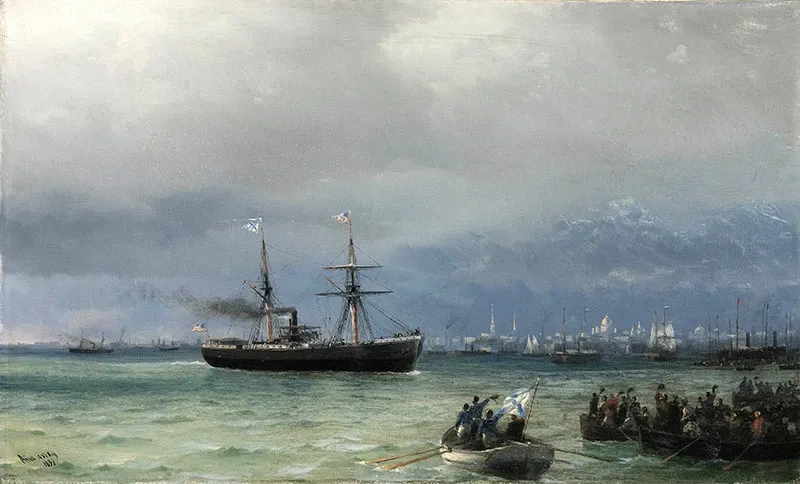
The first transport ship, Indiana, of the so-called Famine Fleet, carrying 1,900 tons of food in total, arrived at the Baltic port of Liepāja on 16 March 1892.
The second ship, Missouri, delivered a cargo of wheat and corn flour weighing 2,500 tons in total to Liepāja on 4 April 1892.
In 1892 the artist Aivazovsky captured this event in two paintings: The Ship of Aid and The Distribution of Food.
In May another ship with humanitarian cargo arrived in the port of Riga. Then there were more ships in June and July.
The total value of the aid provided to Russia in 1891-1892 was estimated at 1 million dollars.
According to American sources, the US government (the Department of the Interior) also provided financial assistance to individual Russian provinces in the form of loans totalling 75 million dollars.
The future Emperor of Russia, Nicholas II, wrote at the time: We are all deeply touched that ships full of food are coming to us from America.
A resolution prepared by prominent representatives of Russian society stated, among other things: By sending bread to Russian people in a year of privation and need, the United States of America shows the most moving example of fraternal feeling.
Nevertheless, over the years the aid was forgotten.
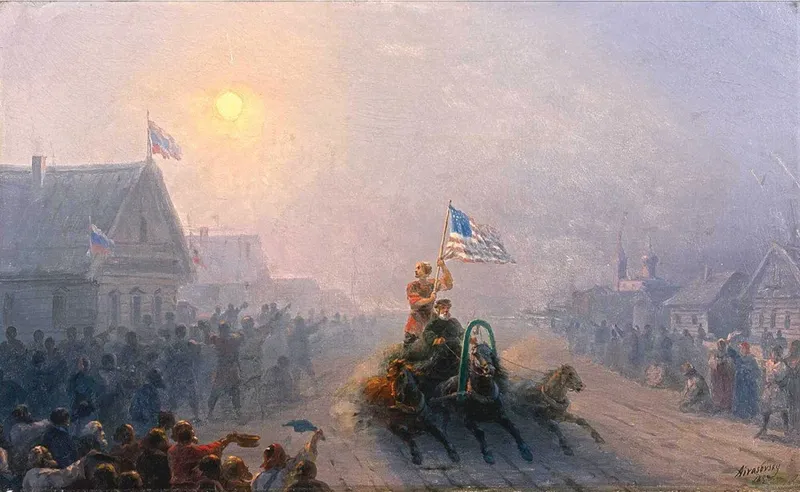
And Aivazovsky's paintings The Distribution of Food and The Ship of Aid, painted by the artist in 1892, were not especially revered in Russia, and at every opportunity people preferred to forget them rather than remember them.
Russia's talentless monarchs took no delight in the reminder of the aid given by the US during the years of terrible famine in Russia. They were irritated by the sight of the joy of simple villagers greeting the help from America with delight.