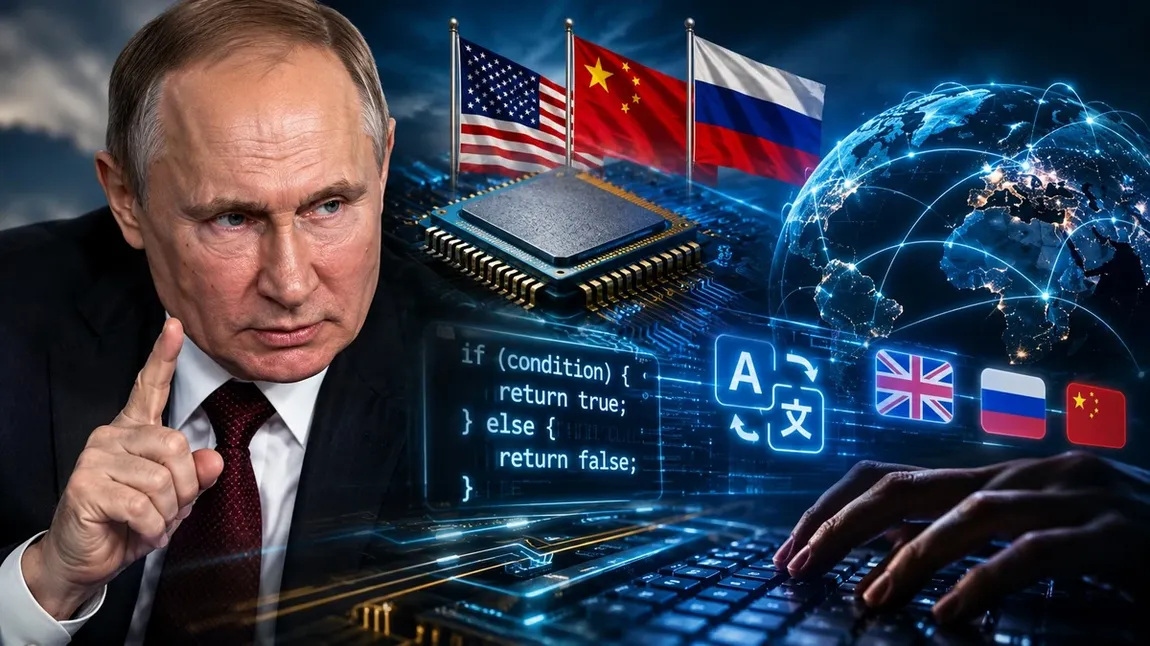
On the sidelines of the Russia–Africa summit, Vladimir Putin announced that only 3 countries in the world have a full set of sovereign digital technologies: the US, China and Russia. According to him, "no one else has it."
Fact-checkers immediately set about checking the hardware and found what they expected. Russia's largest chip maker, Mikron, takes pride in a 90-nanometer process, which is the level of 2004, while the "domestic" Elbrus and Baikal processors were printed in Taiwan until 2022, at the very TSMC that has now mastered 2 nanometers. All of this is true, and all of it matters. But the argument over nanometers distracts from a question that is far more uncomfortable for the Kremlin. Suppose for a minute that Russia learns tomorrow to print chips as well as the Taiwanese do. Would it become a digital sovereign? No. Because sovereignty in the digital world comes down not to silicon but to language. And the language of this world is one, and it is not Russian.
Let's begin with the simplest thing, the one any student sees in the first programming class. All the languages in which modern software is written, from operating systems to banking apps and neural networks, speak English. Not "mostly," not "predominantly," but entirely. If, else, while, return, import, class, print are not terms, they are ordinary English words, and without them you cannot write a single line in C, Python, Java or Rust. A Chinese programmer in Shenzhen and a programmer in Novosibirsk write the same thing: for i in range. They may hate America, may believe in a special path, may wear a pin with the portrait of a leader, but when their fingers touch the keyboard they are obliged to think in the language of Silicon Valley. They have no other tool.
Someone will say: well, that's only the top layer, words for people, while the machine understands zeros and ones. This is a misconception, and a very convenient one. Let's go down to the hardware itself. Every processor executes instructions that have mnemonics, short names used by compilers and programmers: MOV, ADD, JMP, CALL, RET. These are abbreviations of the English words move, add, jump, call, return. That is how Intel is built, that is how ARM is built, and that is how the "open" RISC-V is built, which both Moscow and Beijing now pray to as a salvation from Western dependence. RISC-V was invented at the University of California, Berkeley, and its entire standard is written in English. The Chinese Loongson, which Beijing presents as a fully homegrown architecture, is described in English-language documentation, and its instructions bear the same English names. The Russian Elbrus has documentation in Russian, but the compiler for it generates the same Latin mnemonics, and that compiler is assembled from Western components. Below this level there are only transistors, and transistors have no language. So there is no "crutch," no intermediate layer where Cyrillic or a Chinese character would mean anything to the machine; nothing of the kind exists in nature. Russian words in the accounting platform 1C live exactly until the moment of translation, and then turn into the same bytecode that is run by a virtual machine written in C++.
Let's now rise from the hardware to what Russia calls "domestic operating systems." Astra Linux, RED OS, Alt: all of them are builds of Linux, that is, of the kernel that the Finn Linus Torvalds began writing in C in 1991, and which thousands of programmers around the world have developed ever since, discussing every line in English. The Chinese Kylin and Deepin are built in exactly the same way. Even North Korea's Red Star OS is Linux. When Huawei, under sanctions, announced its own operating system HarmonyOS and its own programming language ArkTS, it turned out that ArkTS is built on TypeScript, a Microsoft development. The internet on which all of this runs stands on protocols whose standards have been published since 1969 in documents called RFC, Request for Comments, and to this day are published only in English. A website address, even if it is in Cyrillic, is converted by a machine into Latin letters before being sent to the network, otherwise the network will not understand it.
Science, on which all this rests, is a story of its own. A paper not published in English does not exist in modern computer science. It will not be cited, not be replicated, not be included in training data. This applies not only to mathematicians from California but also to the Chinese, who now publish more in this field than anyone. The technical reports of DeepSeek and Alibaba, of which Beijing is justly proud, are written in English and posted on arXiv, an American preprint server. The code of these models is posted on GitHub, which belongs to Microsoft. They were trained on Nvidia graphics cards using the PyTorch framework, created by Meta. The Russian GigaChat and YandexGPT are built on the very same Nvidia and the very same PyTorch from the company that a Russian court has declared an "extremist organization." Just imagine: a sovereign Russian artificial intelligence made with a tool of extremists.
And here we come to the most curious part. One could say: fine, the tools are Western, but the result is ours, the machine answers in Russian and Chinese, so it also thinks in Russian. Well, no. This is no longer a columnist's conjecture but an experimental fact. In 2024 a group from the École Polytechnique Fédérale de Lausanne published a paper with a title that speaks for itself: "Do Llamas Work in English?" It concerns Meta's Llama model. The scientists asked it questions in French, Chinese and Russian and, using a special method, looked into the intermediate layers of the neural network, the place where the answer is formed. It turned out that midway the model arrives at an English word and only in the last steps translates it into the language of the question. The model's internal "space of concepts" turned out to be skewed toward English. For this work the authors received an outstanding paper award at the main conference on computational linguistics. In 2025 researchers from Oxford and Google DeepMind went further and titled their paper even more directly: "Do Multilingual Models Think in English?" The answer: yes. The key semantic decisions, the choice of nouns and verbs, are made by the model in the representation closest to English, regardless of which language it was asked in and which it will answer in. For it, other languages are an input and output panel, an interface, not thinking.
The strongest admission was made by the Chinese themselves. In the technical report on the DeepSeek-R1 model, the very one that in January 2025 sent Nvidia's shares tumbling and was proclaimed a triumph of the Chinese engineering school, the authors honestly write that when the model was taught to reason, it constantly mixed languages in its internal reasoning, and to make it think in the user's language they had to introduce a special penalty for "language inconsistency" during training. And they add right away that this penalty slightly reduced the quality of reasoning. Think about it. The flagship Chinese artificial intelligence, left to itself, drifts into English. It has to be forced to think in Chinese, and it pays for this with intelligence. If this is digital sovereignty, it is a very expensive one.
Why it turned out this way is clear without any conspiracy theory. In the dataset on which GPT-3 was trained, English made up about 93 percent of the words, and Russian less than a third of a percent. In the Common Crawl corpus, on which almost all large models, including Chinese and Russian ones, are in one way or another trained, English is almost half, and Russian about 5 percent. But it is not even a matter of volume. It is a matter of the fact that everything that makes up a machine's understanding of the world is written precisely in English: all of science, all the code, all the documentation, all the patents, all the textbooks from which the people who wrote that code learned. English is inside the neural network not because there is a lot of it, but because everything that is in the neural network was created in it.
Now imagine that Russia seriously decided to become what Putin has declared it to be. Not in the sense of blocking YouTube and herding officials into the Max messenger, but for real: to build a digital universe that does not depend on decisions in Washington. What would that take? It would need its own programming language, and not a wrapper over C, but a language in which a compiler, an operating system, a browser and a database are written from scratch. It would need its own processor architecture with its own instruction set and its own compiler. It would need its own network protocols and its own internet on which these protocols work. It would need its own corpus of scientific texts on which to train an artificial intelligence that would think in Russian not at gunpoint. And it would need millions of people who would learn all this, because those who know how to program now know how to do it in English. In other words, it would need new Cyril and Methodius, who would devise a digital alphabet for the Russian world, and then centuries during which literature would appear in that alphabet. The brothers from Thessaloniki created the alphabet in the 9th century, and the first secular book in that alphabet appeared more than 700 years later.
History, incidentally, has already run such an experiment, and it ran it precisely in Moscow. In the 1960s the USSR had its own computers; Sergei Lebedev's BESM-6 was considered one of the best machines in the world. And in 1967 the Soviet government decided not to develop its own but to copy the American IBM System/360: that is how the ES EVM series appeared. They copied it together with the architecture, the instruction set and the English mnemonics. The home-grown school was wound down, and the country sat down for 20 years to reproduce someone else's work, and with a lag of several years behind the original. It ended, as is well known, with most Soviet people seeing their first personal computer when it was already imported. That is the answer to the question of what happens if Russia tries to "out-sovereign" itself for real: it will not create an alternative, it will simply drop out of the environment in which everything new is created, and will chase it with clones. Not by 20 years, as last time, because back then the gap was a few years, and now it is measured in decades and trillions of dollars. By about 100 years, if we count honestly.
But the main point is not even this. English became the language of the digital world not because it was imposed. Nobody imposed it: Linux is free, internet standards are open, anyone can read arXiv papers, and PyTorch can be downloaded from Shenzhen and from Skolkovo. English won because the environment in which it lives is built on one rule for everyone: anyone can come, take it and do it better. This is how nations in which one law applies to all win, and how those in which the law is one for insiders lose. Digital sovereignty in Putin's understanding means exactly the opposite: close the door and declare that behind the door there is everything necessary. Behind the door there is Mikron with its 90 nanometers and 4 blocked messengers in which the ministries continue to sit. And the whole world, including China, continues to think in English, and the smartest machines humanity has ever created think in it too. So who has out-sovereigned whom?
References:cheslavsky.substack.commedium.comx.com