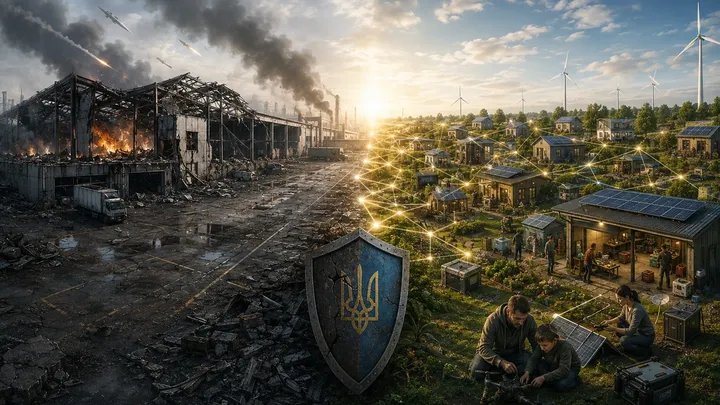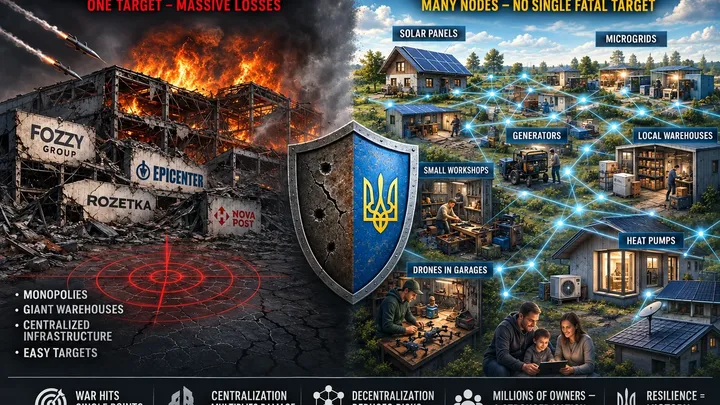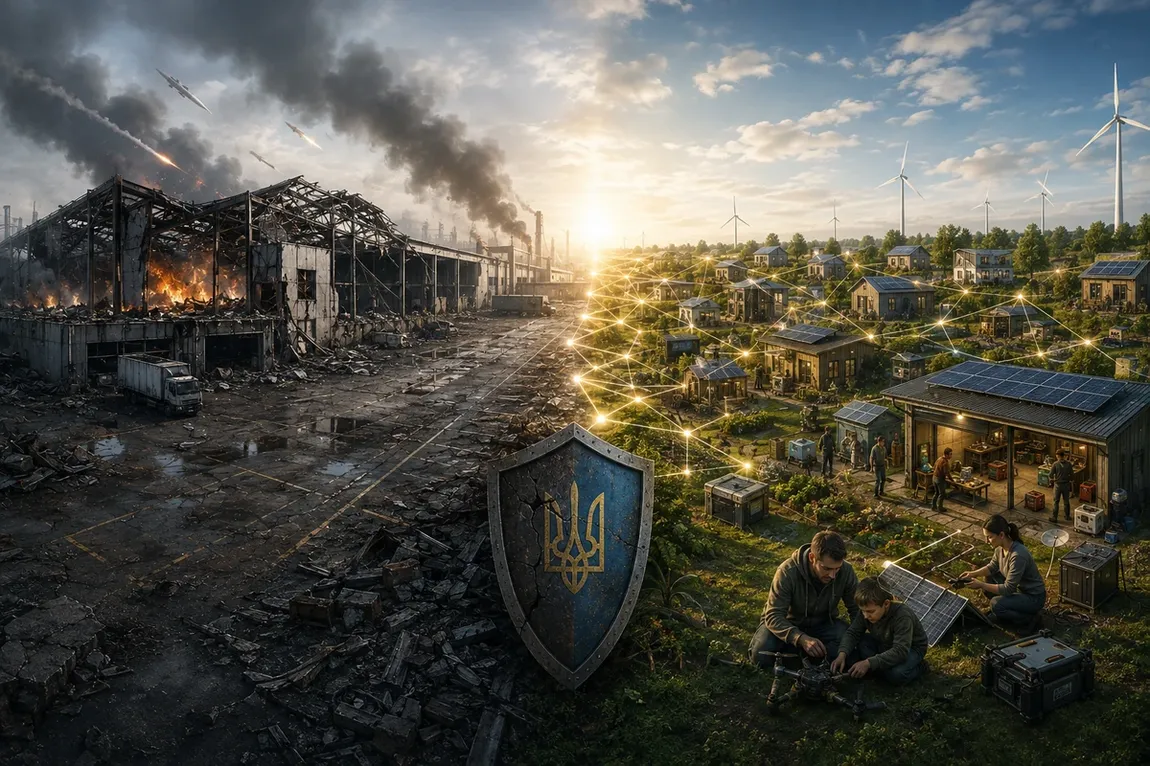
The war hits monopolies: the giants that carved up markets between themselves have become the most convenient targets for Russian missiles, while distributed systems, from garage drone workshops to rooftop solar panels, have proved invulnerable.
I wrote about this in the article "The War Hits Monopolies: Why Decentralization Has Become Ukraine's Only Survival Strategy". But physical vulnerability is only half the diagnosis. The other half is even worse: concentration produces not only targets for the occupiers, it produces corruption. Because you can only steal where money is gathered in one place and distributed from one office. Today the two brightest illustrations of this law are the defense industry and centralized heat supply.
Billions that stink
Let's look at what happened to the drone money as soon as it was concentrated. In 2023 the State Special Communications Service received 30 billion hryvnias to buy unmanned aircraft for the Defense Forces. The result is known: in autumn 2025 NABU and SAPO announced they had uncovered a large-scale scheme in which officials of the service, together with private companies, organized drone deliveries at inflated prices. The victories of the "right" firms in tenders were secured by affiliated companies that imitated competition, and the prices were justified with distorted market research. In parallel, detectives established the embezzlement of more than 90 million hryvnias on purchases of Mavic and Autel alone, that is, on the simplest mass-produced Chinese drones, whose price is known to every volunteer. Meanwhile the Economic Security Bureau uncovered a network supplying bomber drones, where components were run through shell firms with a markup of two to three times.
And now about the architecture inside which all this became possible. The "Army of Drones" program is the flagship project of Minister of Digital Transformation Mykhailo Fedorov. The United24 fundraising platform, from which the program was financed, operates under his supervision as well. Procurement went through the State Special Communications Service, an agency that institutionally sat in the orbit of the Ministry of Digital Transformation, and through the same procurement department the government later channeled another 48 billion hryvnias to continue the program. In other words, one person simultaneously shaped the state policy of the sector, managed a public fundraising platform, supervised the procurement agency and publicly promoted specific manufacturers as the face of the program. I am not a court and I accuse no one of anything: whether this construction contains the elements of a crime is for the HACC to decide. But as a journalist I am obliged to call this construction by its proper name: it is institutionalized lobbying of manufacturers' interests, built into the state vertical. And therefore from here on I operate exclusively with the dates of official procedural decisions. On November 20, 2023, NABU and SAPO announced a notice of suspicion to the then head of the State Special Communications Service, Yurii Shchyhol, and his deputy in a case involving 62 million hryvnias in software purchases; on November 23, 2023, the HACC remanded Shchyhol in custody with the alternative of 25 million hryvnias in bail, the bail was posted, and the case reached the stage of awaiting a verdict. In October 2024 Hromadske journalists calculated that on Autel drones, which the State Special Communications Service bought at almost 500 thousand hryvnias apiece while a charitable foundation bought equivalent ones at 212 thousand, the state overpaid about 600 million hryvnias; Fedorov himself stated that he learned of the inflated prices in September 2023, after which the Ministry of Digital Transformation appealed to NABU. The Bureau opened a criminal proceeding in January 2024, and suspicions in it appeared only on October 28, 2025. On May 29, 2026, NABU detectives carried out searches at the State Border Guard Service as well: again a purchase of unmanned aircraft, again "creating conditions for obtaining an unlawful benefit." In parallel the SBI is investigating a proceeding on the possible artificial inflation of the cost of drones supplied to a state customer in 2025. These are not accusations. This is a chronology, and it speaks for itself: wherever drone money was concentrated in one vertical, detectives followed.
Note the common denominator of all these cases. None of them would have been possible in the garage model of 2022-2023. You cannot cartelize ten thousand workshops. You cannot "distort market research" where the price is known to everyone who has soldered a board himself. You cannot mark up components threefold where hundreds of independent teams buy them and instantly compare receipts. Corruption is a tax on concentration. First the market is consolidated "in the name of scaling up," then the consolidated cash flow becomes the prey of those who consolidated it, and then the consolidated production becomes the prey of Russian ballistics. The missile and the prosecutor hunt at the same address, only the missile gets there first.
The monster in the pipes: utility slavery by law
The second monster is older and so familiar that we have stopped noticing it. Centralized heat supply is a Soviet system that was never offered to citizens as a choice. It was imposed along with the panel high-rise: a combined heat and power plant produces electricity, the "waste" heat has to go somewhere, so the city is tied to the pipe. That is how millions of people became lifelong subscribers of a system in which they choose neither the supplier, nor the temperature, nor the price, nor even the start date of the heating season. This is utility slavery in the most exact sense of the words: you are chained to the pipe by the fact of being born in that building.
And here is what is telling: escaping this slavery is legally forbidden. The Law "On Housing and Communal Services" permits disconnecting an individual apartment from centralized heating only in buildings where, on the day the law came into force, at least half of the apartments had already been disconnected. In all other buildings, only the whole building at once, by decision of the co-owners, through a commission at the local self-government body. The relevant order of the Ministry of Regional Development directly regulates the ban on disconnecting by apartment, by entrance or by riser. Unauthorized disconnection does not release you from payment: the courts do not accept even physically dismantled radiators as proof that the service was not provided. Think about it: a person cut out the radiators, heats his home at his own expense, yet by law continues to pay the monopolist for heat he does not receive. In what other industry is such a luxury possible: a customer who is forbidden to leave?
The answer to the question "who benefits" is obvious from the arithmetic. Centralized heat is a guaranteed cash flow that depends neither on quality nor on competition: tariffs, budget subsidies, compensation for the "difference in tariffs," debt restructurings. Ukrainians already owe 113 billion hryvnias for utilities, the debtors' register holds 830 thousand proceedings, and these debts are also an asset on the strength of which the monopolists extract new budget injections. For decades quite specific financial-industrial groups have sat on this flow: it is enough to recall that until 2018 the capital's heating networks were managed by the private Kyivenergo, and the city had to spend years getting its own heating infrastructure back. Meanwhile the pipes are worn out, a significant share of the heat warms the ground on its way to the apartments, and the subscriber pays for this heating of the soil too. In Denmark, to which the lobbyists of "centralized heat" like to point, district heating systems belong to consumer cooperatives and municipalities, operate on a non-profit principle and compete with individual solutions. In Ukraine the same technology has been turned into serfdom: not a service that is chosen, but a duty from which no one is allowed to run.
And now lay the war over this. Every combined heat and power plant, every district boiler house, every trunk collector is a point a strike on which takes hundreds of thousands of people hostage at once. Ukraine saw this scenario even before the full-scale war: in January 2006 a single accident on the heating network froze the entire city of Alchevsk, and for weeks the country watched neighborhoods being evacuated. Russia turns that accident into a military technology: it does not need to hit every home, it is enough to hit the pipe to which all the homes are chained by law. Centralized heating in conditions of a missile war is not a service. It is hostage-taking, formalized by a regulation.
One principle for two monsters
The defense monopoly and the heat monopoly are one and the same mechanism in two costumes. In both cases the concentration was justified by efficiency, "scale," "manageability." In both cases the concentrated flow of money immediately acquired schemes, shell firms and the right surnames among the beneficiaries. In both cases the concentrated infrastructure became an ideal target for Russia. And in both cases state policy consists not of dismantling the vulnerable model but of preserving it: the defense giants will be compensated and their state orders increased, the heat monopolies will have their debts written off and be allocated funds for new networks with new vulnerable nodes. And to people who simply want to get out of the line of fire, to assemble a drone in a workshop or install a heat pump instead of a radiator, the state responds with regulations, denial of access and a direct legislative ban on escape.
Because millions of free producers and millions of free consumers do not generate rents. Rent is generated only by the pipe and the register of large taxpayers. And that is where the strikes land.
References:x.commedium.comcheslavsky.substack.com