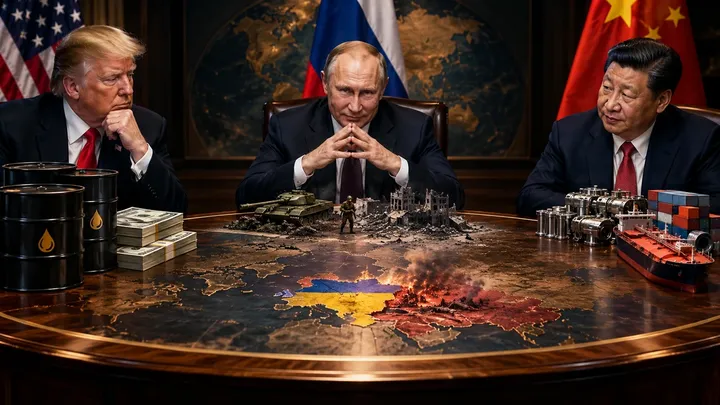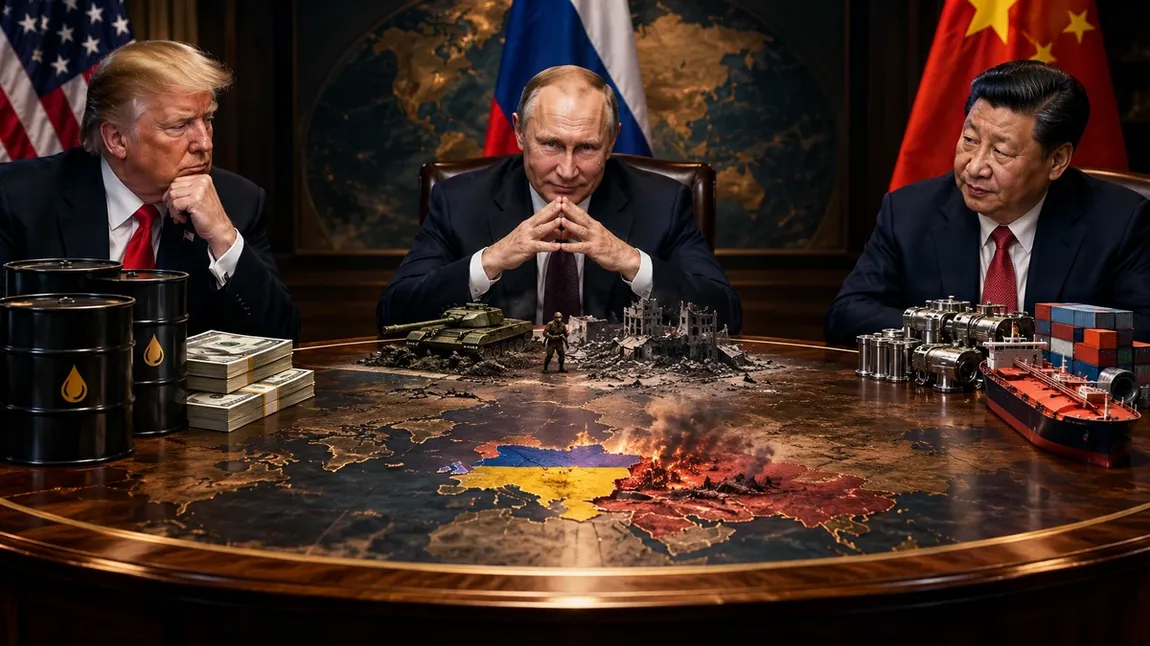
Some things are easier to see in a diagram than in text. Draw a table. Seat three people at it: the one who is waging a war, the one who is lending against that war, and the one who has just become its customer.
Now look at who is not at the table. The country on whose territory the war is being fought is not there. Those who pay for its defense are not there. That, in essence, is the whole of the news reported by The Wall Street Journal and then retold by everyone else. But to understand what exactly Putin has proposed, one should look not at the agenda. There is no agenda, and the Kremlin does not hide it. One should look at the lineup. Because in this story the lineup of the table is the deal.
The facts are these. Putin proposed holding a meeting in November with the participation of Trump and Xi Jinping, to agree on ending the war in Ukraine on terms favorable to Moscow. The proposal was made on October 9 during a phone call with Trump, in which an agreement was also reached on the US purchasing Russian diesel fuel, Reuters reports, citing The Wall Street Journal. The Kremlin suggested the sidelines of the APEC summit on November 18-19 in Shenzhen as the venue. The newspaper's source is a former Russian intelligence officer, and this is worth keeping in mind: the leak comes from the Russian side. The Kremlin is itself putting the idea before the public, because it is harder to publicly reject an invitation to a "peace meeting" than to stay silent on the phone.
What did Washington answer? So far, nothing definite. A senior administration official told the newspaper that Trump had not agreed to the summit but might in general be open to the idea. Peskov confirmed that discussions are under way, although "there is as yet no clear understanding about the meeting itself or its potential agenda." Whether Xi is ready for it is not known at all. So there is no meeting yet. There is a proposal. And a proposal, as often happens, says more about the design than the meeting itself would.
Let us begin with why this idea is not new and why it has surfaced again right now. Trump himself spoke about a trio back in February 2025, a day after his first call with Putin: he said he "would like" to see Russia back in the G7, called its exclusion a mistake, and added that one of the first meetings after "everything is settled" he would like to see is a meeting with Xi and Putin. Then too, in February 2025, Beijing, through intermediaries, offered Washington a summit of Trump and Putin without Zelensky, and the White House answered curtly: "completely unviable." Remember that formula. A year and a half has passed, and exactly the same proposal, only now from Moscow, gets the answer "may in general be open." Between "unviable" and "open" lies not a change on the front line. Between them lies a contract for diesel.
Now to the format itself. Putin is proposing Yalta. Not metaphorically: a "new Yalta" is his own long-held dream, which he has been voicing from podiums for years, and its meaning is always the same: three great powers divide the world among themselves, and all other peoples are the object of the division. But the real Yalta had one feature that Putin prefers not to recall. At Yalta the victors sat. After the victory. They divided what they had already taken. Putin, by contrast, is asking to be seated at the victors' table before the victory, because he has no victory: the front is standing still, Kyiv has not been taken, and the negotiations that Trump is trying to conduct through Witkoff and Kushner run up against the question of territory. And here is the key to everything. If he is seated third beside the US and China, he has already gained the main thing. He takes the status of a victor not at the front but at the table, by the very fact of the seating. That is his goal: not to agree on something at the meeting, but to get the meeting.
Note how this differs from Munich, to which comparisons are also made. In Munich in 1938 the fate of a country was also decided without the country itself, and the aggressor also sat at the table. But at least Britain and France were there, that is, a party formally bound by obligations to the victim. Putin proposes a cleaner construction. In Shenzhen there is no one from that side. Neither Ukraine, nor Europe, which today pays for its defense, nor even anyone who would be obliged to stand up for them. Munich was the betrayal of an ally. Here the ally is simply not invited.
So who is at the table? Let us call things by their names. Russia is waging war. China is its cash register and its arsenal: it is the main buyer of Russian oil and the supplier of dual-use components without which this war would have choked long ago. And the United States, after October 9, has become a buyer of Russian diesel, that is, one more payer into the Russian budget, and Trump is already explaining aloud that Zelensky "uses Russian diesel refineries as targets, because of which global fuel markets suffer, including American ones." Think about this phrase. The US president is defending Russian refineries from Ukrainian strikes, because it is now his fuel. This is the economics of sunk losses in its latest edition: the state does not merely shift the risks of war onto the taxpayer, it becomes a shareholder in the aggressor's infrastructure and begins to guard it against its own ally. Interest, not position, determines who stands with whom. So at the table in Shenzhen it is not three powers that sit. One side of the war sits there: the one who shoots, the one who pays for it, and the one who has just joined the queue for the goods.
Hence the question that matters more than all the others. Putin is inviting Trump and Xi not as arbiters. Arbiters are not summoned to a meeting where it has been announced in advance that the terms will be "favorable to Moscow." He is inviting them as allies. And if he is calling them as allies, he must have something to offer. What?
To Trump he offers what Trump has already begun paying for: cheap fuel, a "deal" that can be presented to voters as peace, and the role of the man who closed a war in Europe without spending a single American dollar on it. To Xi he offers something different, and it is more important. A concert of three powers in which Ukraine's fate is decided without Ukraine is a precedent. It is a model in which any territorial question is decided inside the trio, and not in the Security Council or on a platform where small countries have a voice. For Beijing, which has its own "Ukrainian question" under a different name, such a model is worth more than any oil. And to both at once Putin offers the main thing: Europe. Not as a partner, but as an object.
Here we must stop and ask a simple question: why, in fact, do all three need Europe in precisely this form, cut into pieces? Because whole, it is needed by none of them. For Moscow, a united Europe is an adversary that cannot be taken by gas, or tanks, or by bribing a single capital. For Beijing, a united Europe is the second-largest market, which can set uniform rules, uniform tariffs and uniform sanctions, while a fragmented Europe is twenty-seven doors, each of which can be entered with a separate offer. For Washington under Trump, a united Europe is a competitor that bargains as an equal, while a divided one is a set of clients, each of which separately buys American gas and American weapons on American terms. In other words, the three participants at the table have no common enemy, but they have a common interest: that Europe remain what it is today, that is, a problem that is solved for it. And the bitterest thing in this picture is that Europe itself does their work. A continent whose economy is ten times larger than Russia's and whose population is three times larger, which produces everything from shells to satellites, behaves as though its strength lay somewhere else. Its strength is in unity, and it is the only strength it does not use. Each capital bargains with Trump separately, each looks for its own channel to Beijing, each calculates its own price of peace with Moscow. There is no need to divide Europe: it already stands before the table one by one, while three sit at it.
I maintain: this is Putin's war against Europe, and it is already under way. Not the one in which tanks roll toward Warsaw, but the one in which Europe is struck off the list of those who decide. Shenzhen is its first protocol. And Putin is looking for those who will sign it together with him.
Look at where he proposes to sign. This is neither chance nor a matter of calendar convenience. Yalta took place on Stalin's territory, in Crimea, and Roosevelt and Churchill traveled to him, not he to them. Shenzhen is Xi's territory. The old hegemon, if he flies there, will fly to the land of the new one, to decide Europe's affairs on someone else's ground. Arrighi described the change of hegemonies in just this way: not as a war between the old center and the new, but as the moment when the old center begins to travel to the new one for decisions. The map of this meeting is a ready-made illustration for his book. Putin, incidentally, is not the host in this scheme. He is a petitioner who brings two hosts together and hopes to get his cut for the mediation. This is Moscow's eight-hundred-year role, and it has not changed: not to produce power, but to stand between those who have it and take a fee for doing so.
Now the most unpleasant part, and almost nobody speaks of it. Why does Putin need an "end to the war" on his terms at all, if the front is standing still and Ukraine is not surrendering? The answer lies in what he needed Ukraine for from the very beginning. Recall how it all started. He did not go for land and not for the "Russian world." He went for the Ukrainian army. That is exactly why he fought so hard against NATO for Ukraine: not because he feared NATO missiles near Kharkiv, but because a country that joins NATO drops out of his conscription list forever. Ukraine, with its mobilization reserve, its factories, its military school, which since Soviet times had supplied the empire with officers and designers, was for him not a goal but a means. He expected to take it in three days, and then to put it in the ranks and lead it further west. That is how the empire always fought: not with its own, but with the annexed. First conquer, then mobilize, then send them to conquer the next ones. So it was with the Cossacks, so it was with the Caucasians, so in 2022 it happened with the residents of Donetsk and Luhansk, who were driven into the trenches before Russian conscription reached Ryazan. Three days turned into years, and the army he meant to take became the army that stopped him. But the goal has not changed. "Terms favorable to Moscow" do not mean a line on a map. They mean the transfer of millions of people from the Ukrainian mobilization base to the Russian one. That is the resource Putin wants to carry out of Shenzhen: not the Donbas, but a conscript contingent for the next war. The very one with Europe. And then the picture is complete: he needs a table without Ukraine so that Ukraine can be handed over at that table, and he needs a table without Europe so that Europe does not learn against whom this Ukraine will later be set.
What follows from this today, while there is no meeting? It follows that Putin has submitted an application. Not for peace, but for status. The price of the first installment is already known: a contract for diesel and a pause in the "Graham law" with its sanctions. Now the decision is Trump's, and it is as simple as the seating at a table. If he flies to Shenzhen, he is not flying to end the war in Ukraine. He is flying to change its side: Ukraine turns from a country being defended into a resource being divided, and Europe from an ally into the next item on the agenda. Yalta cemented a victory. This Yalta is meant to replace it. And the only thing standing between Putin and this table is an answer that Washington has not yet given. And the second thing that is also still missing is a Europe that speaks with one voice.
References:medium.comcheslavsky.substack.comx.com