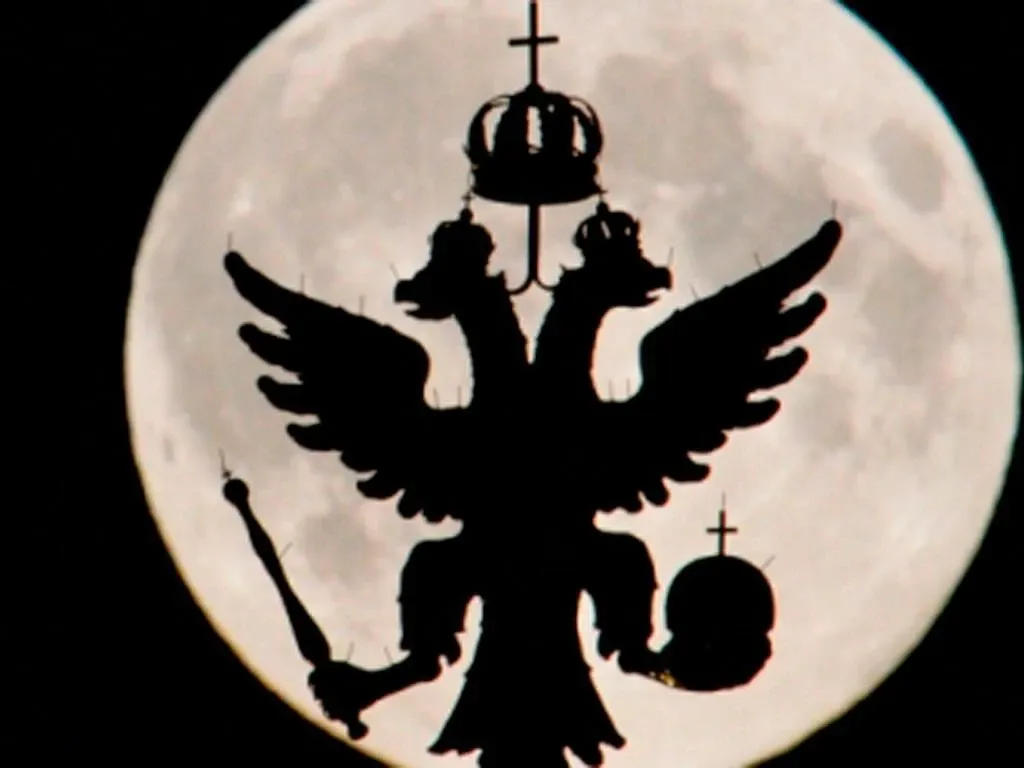
Nothing comes from nowhere, and the coat of arms of the Russian state did not come to it by chance. So where does the double-headed eagle on Russia's coat of arms come from, and why will the double-headed eagle become the symbol of Russia's fall?
In 330 the emperor Constantine moved the capital of the Roman Empire east, to the ancient Greek city of Byzantium on the shore of the Bosporus. He did not create a new state in doing so: the empire remained the same Roman one, and only its main city changed. The word "Byzantium" as the name of the state was coined by the German scholar Hieronymus Wolf in 1557, 104 years after the fall of Constantinople. The inhabitants of the empire themselves called themselves Romans (Romaioi) until its last day.
Nor was the empire Christian at that time. In 313 Constantine allowed Christians to profess their faith openly and patronized the church, but Christianity became the state religion only in 380, under the emperor Theodosius.
The city had been founded earlier, in 324, right after Constantine's victory over his co-ruler Licinius, and on 11 May 330 it was solemnly inaugurated as the new capital. From the very beginning it had 2 names. The church historian Socrates Scholasticus writes that the emperor named the city Constantinople, that is, after himself, and by a separate law ordered that it also be called the Second Rome, and this law was carved on a stone column. Well, Constantine had some trouble with imagination: he took one name from the old capital and the other from himself.
Constantine did not have to invent or select state symbols. He was the lawful emperor of Rome, so all the symbols of the empire, which traced their history back to Octavian Augustus, moved to the new capital together with him.
That means the coat of arms, and the colors, and much else.
A coat of arms, you ask?
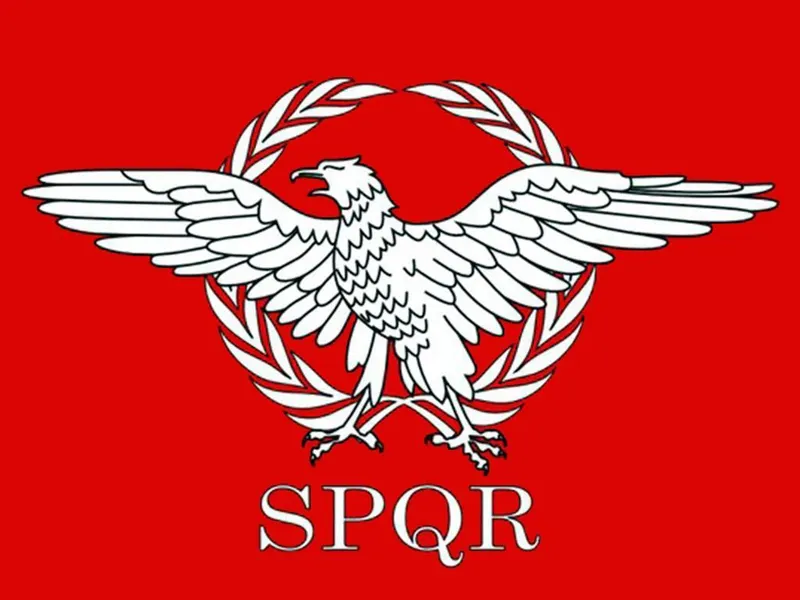
Rome had an eagle with one head, while Constantinople had a double-headed eagle. Where did the second head come from?
The prettiest explanation suggests itself. Constantine built a Second Rome and, like any educated soldier, marked it with banal arithmetic. He was a Roman emperor, a man for whom logic stood above everything, and logic told him: 1 + 1 = 2. The First Rome has one head, the Second Rome has two heads!
Too bad this arithmetic has nothing to do with Constantine. There were no coats of arms at all in his time; they appeared in Western Europe only in the 12th century. Rome had the eagle of the legions: in 104 BC the consul Gaius Marius removed the wolf, the bull, the horse and the boar from the military standards and left only the eagle. With this single-headed eagle Constantine moved to the Bosporus.
The double-headed eagle appeared in the empire of the Romans around the 10th century, 600 years after Constantine, and at first it was merely a pattern. It was made the emblem of the imperial house by the Palaiologoi, the last dynasty of the empire, and this happened in its last 100 years, that is, 1000 years after the founding of Constantinople. The two-headed bird itself, moreover, is much older than Rome: the Hittites in Anatolia carved it in stone, and it appears on a Babylonian seal as early as the 3rd millennium BC. So nobody added a second head. It was taken ready-made from the peoples who had lived on this land long before the Romans.
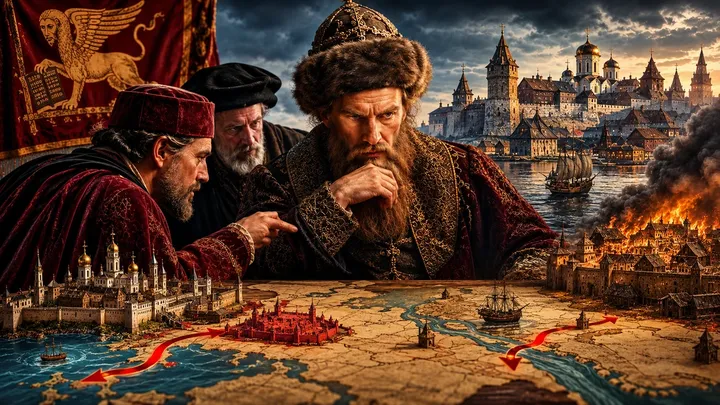
The first fall of the empire happened in 1204. Constantinople was taken and plundered by the crusaders whom the Venetian doge Enrico Dandolo had brought on his ships. In the division of the spoils Venice received 3/8 of the empire.
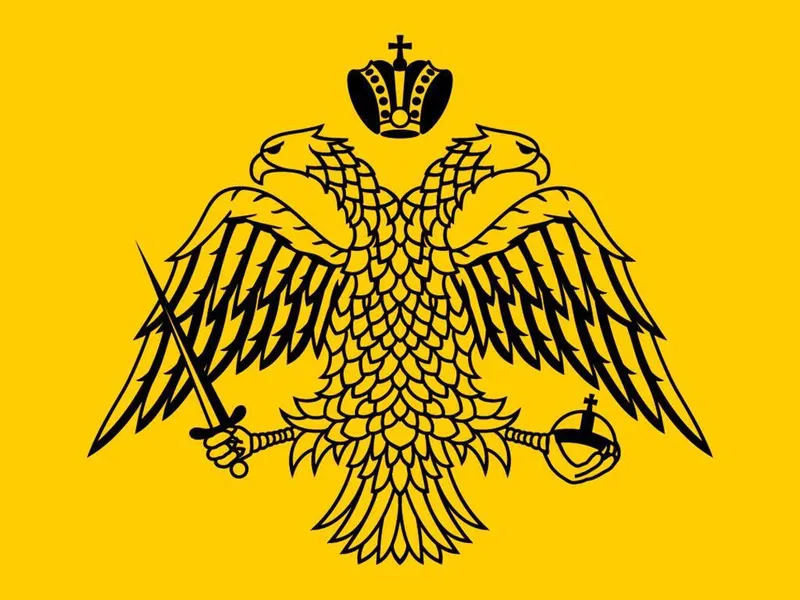
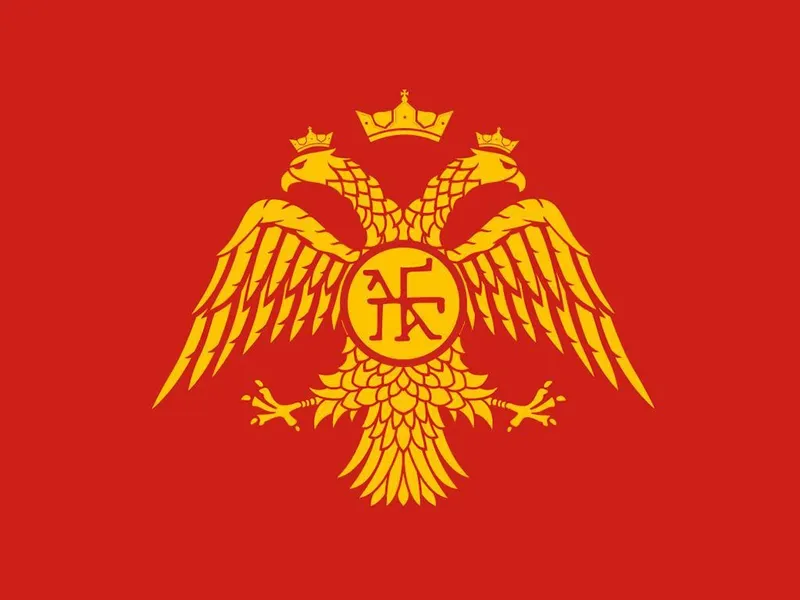
But already in 1261, thanks to the efforts of Michael VIII Palaiologos, the empire was restored and lasted under the rule of this dynasty until 1453, when the Ottomans took Constantinople. It was under the Palaiologoi that the Second Rome got its symbol, the double-headed eagle. So two heads turned out better than one.
But the empire did not fall in fact; it migrated to Venice! Its wealth and its trade had been flowing there since 1204. After 1453 the Greeks fled there. Cardinal Bessarion, a Greek from Trebizond, also gave his library there around 1468, and the library of St Mark grew out of those books.
The emperors in Constantinople had expanded their possessions long before the Palaiologoi, conquering territories not only by the sword but also by Christianization and through marriage.
In 988 the emperor Basil II gave his sister Anna in marriage to the Kyiv prince Volodymyr. Kyiv accepted baptism, and from then on the metropolitan in Kyiv was appointed by the patriarch of Constantinople. In 1046 Constantine IX Monomachos gave his relative, possibly his daughter, to Vsevolod, the son of Yaroslav the Wise. The sources have not preserved her name, but it is known that her son was Volodymyr Monomakh.
The Kyiv princes did not become subjects of the emperor because of this. The church was subordinate to Constantinople, but the princes were not: in 1043 Yaroslav was still fighting the empire, and the marriage of 1046 precisely sealed the peace after that war.
An alliance with the Mongols gave Constantinople a far better result. In 1237-1240 the army of Czar Batu swept with fire and sword through Zalesye and then Rus, and in December 1240 took Kyiv, the capital of Rus.
As soon as the Horde's rule was established over Rus, the church at once asked to be taken under the protection of the Horde's czar. In 1261 the Sarai, or Czar's, eparchy was opened in Sarai, the capital of the Horde. In 1267 Czar Mengu-Timur issued the Kyiv metropolitan a yarlyk that exempted the church from tribute. The princes paid, the townspeople paid, the church did not. The Horde very pragmatically accepted that Orthodox priests would become its best tax agents.
In that same year, 1261, Michael VIII Palaiologos recovered Constantinople, and the new dynasty began to seek an alliance with the Horde. It paid for this alliance with daughters. The tumen commander Nogai took Michael VIII's illegitimate daughter Euphrosyne as his wife. Andronikos II's illegitimate daughter Maria was taken as a wife by Czar Tokhta in 1297. The third son-in-law of the Palaiologoi was Czar Uzbek.
Uzbek did not become a Palaiologos for all that: he took the throne in January 1313 already as a Muslim. The Arab traveler Ibn Battuta, who was a guest at his court in 1332, calls one of his wives, Bayalun, the daughter of the emperor of Constantinople and tells how he traveled with her to her father. The emperor at that time was Andronikos III. There was also another Bayalun at Uzbek's court, the widow of his father, who helped him obtain the throne, so these two women are easy to confuse.
It was Czar Uzbek who became the main founder of the Muscovite state. In 1317 he gave his sister Konchaka in marriage to the Moscow prince Yuri Danilovich and granted him the yarlyk for the grand principality. In 1327 Tver rose against the Mongols, and Yuri's brother Ivan, better known as Ivan Kalita, marched on it together with the Horde's army. In 1328 Uzbek gave him Novgorod and Kostroma for this, and 4 years later the entire grand principality of Vladimir as well. So Czar Uzbek is the very daddy of the Muscovite state, a vassal of the Horde.
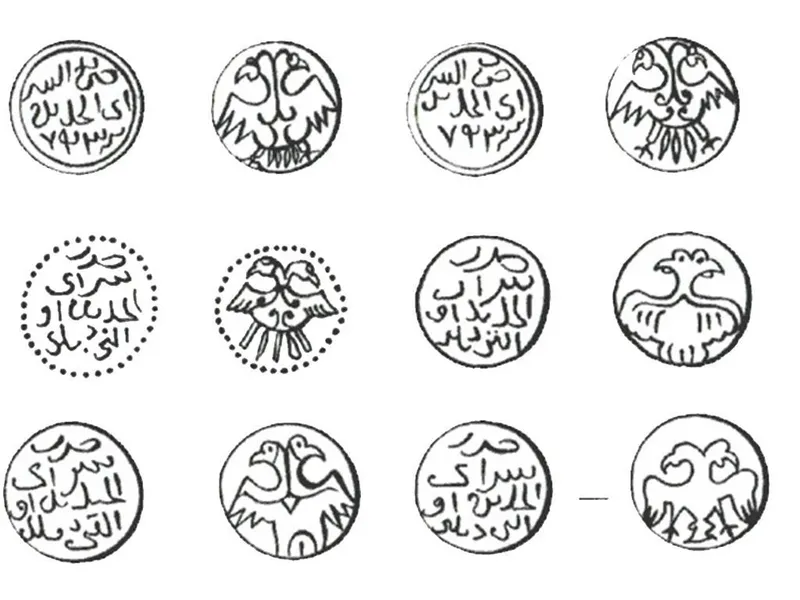
The Horde had a double-headed eagle too. It stands on the copper coins minted in New Sarai by Uzbek's son Czar Janibek, and the earliest of them are dated 743 AH, that is, 1342-1343. On Moscow seals this eagle would appear only in 1497, 150 years later. Where it came from on the Horde's copper is disputed. Some linked it with Uzbek's marriage to the emperor's daughter. Others derive it from the coins of Asia Minor and Iran, where the double-headed eagle had been minted even earlier.
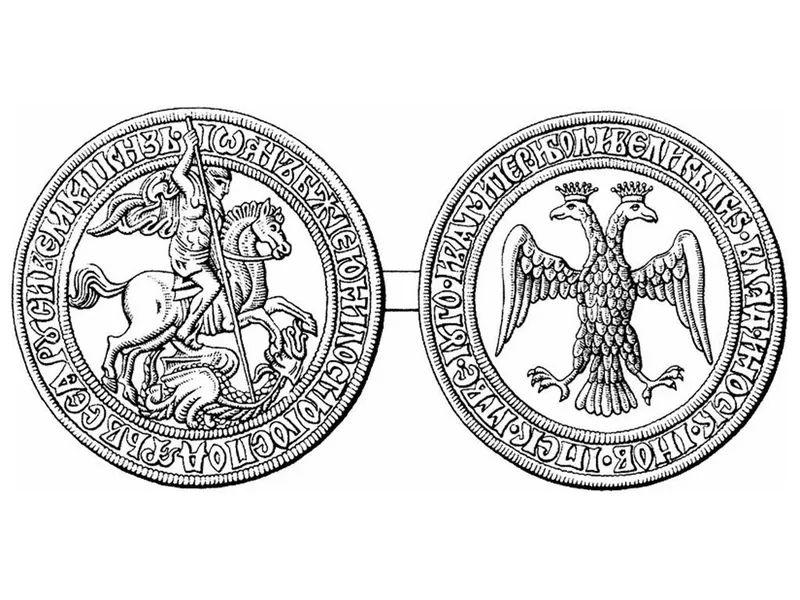
The double-headed eagle appeared in Moscow in 1497, on the seal of Grand Prince Ivan III. The red wax seal is attached to a charter that he issued in July 1497 to the princes of Volotsk. On one side of it a horseman stabs a dragon with a spear, and on the other sits a double-headed eagle. Historians called this seal a coat of arms 3 centuries later, beginning with Karamzin.
Legitimacy was supposedly given to the enterprise by Ivan's marriage to Zoe Palaiologina, supposedly the last heiress of the empire that fell in 1453. The wedding took place in 1472, and the eagle appeared on the seal only 25 years after it. The fact that Zoe was no heiress but merely a niece of the last emperor did not embarrass anyone in Moscow. Nor were they embarrassed that the lawful heir was considered to be her brother Andreas, who in 1494, 3 years before the Moscow seal, sold his rights to the crown to the French king Charles VIII.
The horseman with the spear, whom they now call St George, has no connection to Constantine and the Palaiologoi. He was minted on Moscow coins even under Basil II, before Zoe's arrival, and he was first called St George by an imperial decree of 1730. Yellow and black did not come from the Palaiologoi either: their eagle was golden on a red field. The black-yellow-white flag was approved in 1858 by Alexander II, based on the colors of the then coat of arms of the empire.
From 1497 to 1917 the double-headed eagle, in various variations, was the sole coat of arms of the Third Rome. After an interlude for communism it returned on 30 November 1993 by Yeltsin's decree, and onto the coat of arms, not the flag: since 1991 the flag of Russia has been the white-blue-red tricolor without an eagle.
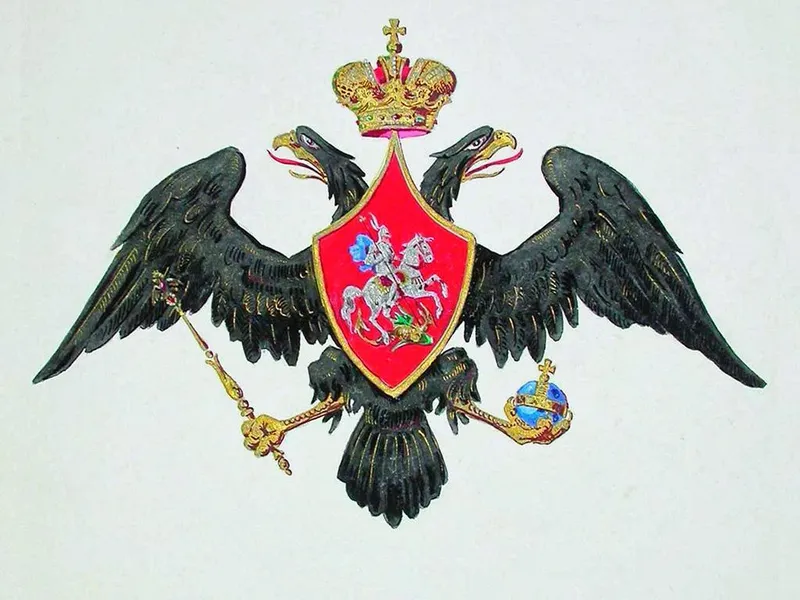
Russia, of course, has the right to use any symbols and any colors on its flags. But to say that yellow and black are the colors of the mother of the Slavic peoples is blasphemous. These colors are taken from the coat of arms of the empire, where from 1703 a black eagle sat on a golden field.
Moscow was never the heir of the empire of the Romans. In 1472 Venice needed a mercenary against the Turks, and Cardinal Bessarion matched Ivan III with Zoe Palaiologina as the heiress of the Second Rome, although Zoe had no rights to it whatsoever. Moscow believed it, and 51 years later the monk Filofei was already writing that Moscow is the Third Rome.
Moscow's real genealogy is that of the Horde. The Moscow prince received the grand principality in 1328 by the yarlyk of Czar Uzbek. The double-headed eagle stood on the coins of his son Janibek 150 years before the Moscow seal. Ivan IV took the title of czar in 1547 from the czars of the Horde.
Moscow's church is also self-proclaimed. In 1448 in Moscow they chose a metropolitan for themselves, without Constantinople, and until 1589 the Moscow church stood outside all jurisdictions. It received a patriarchate when Boris Godunov took the patriarch Jeremias II prisoner and did not release him until he signed his consent. The present-day ROC was assembled by Stalin in 1943, and since then it has been a project of the NKVD, the KGB and the FSB. It is no accident that the slogan "a Russian means an Orthodox, and an Orthodox means a Russian" and the dogmas of the "Russian World," the "Russian Idea" and the "Orthodox jihad" are inseparably linked with the ROC.
Moscow took the symbols from others, however, and did not understand what road it had prepared for itself with them.
First, if Moscow is the Third Rome, then by its own count the eagle should have not 2 heads but 3.
Second, of the two Georges Moscow chose the martyr. George the knight under a white banner with a red cross signifies honor and valor. George the martyr was ordered beheaded by the emperor Diocletian around 303 after 8 days of torture. A power that grew out of service to the Horde's czar has no need of knights. It needs servants ready to die for the faith and the czar.
Catherine II established the St. George ribbon in 1769. It has 3 black stripes and 2 yellow ones. Officially, these are the colors of the coat of arms. But if you read the ribbon through the martyr's life story, the 3 black stripes stand for 3 executions, and the 2 yellow ones stand for 2 resurrections. George was executed three times, but he rose again only twice. Diocletian put an end to the third attempt by cutting off his head.
The Muscovite empire has already used up its 2 resurrections. In 1917 it fell and was reborn as the USSR. In 1991 it fell again and was reborn as the Russian Federation, and in 1993 it took back the double-headed eagle. By its own ribbon, the third execution is the last: after the beheading, the saint did not rise again.