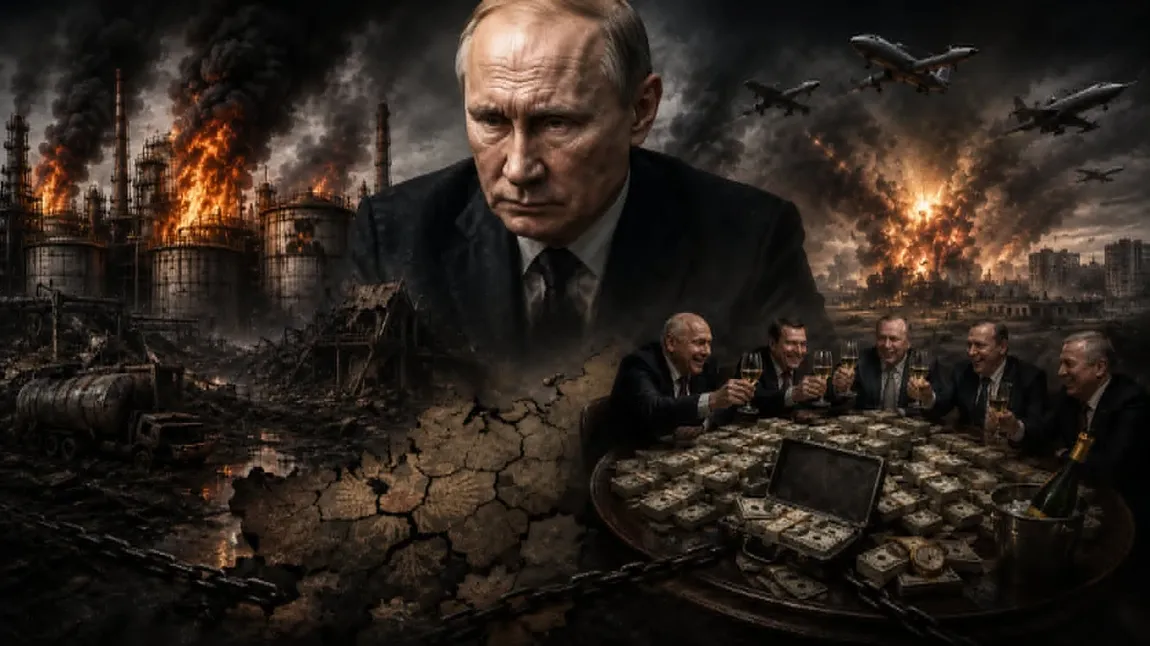
There is a project that in recent years has fed the Kremlin more reliably than oil and gas. War. Not as a tragedy but as an enterprise, a joint-stock company with a transparent business model. On the input side: cheap Soviet stockpiles, the cheap blood of contract soldiers and convicts, and high oil rent. On the output side: territory, fear, a society mobilized under a single bark of command, and a flow of money that spreads into the right pockets.
At first this JSC paid dividends faithfully. Today it has entered its terminal stage. And the most curious thing is not that it is loss-making, but that it keeps being pumped full of money precisely because it is loss-making.
Let us begin with a symptom that the Kremlin hides behind fairy tales about the "no-analogue" S-400s cracking drones like nuts. The Russian military analyst Alexei Chadaev, a thoroughly systemic man, is ringing the bells: the entire defense of the rear is a rusty colossus with feet of clay. The Kremlin believed that big Iranian mopeds would be enough for everything, and did not develop autonomous mid-range drones with a reach of 150-200 kilometers, playing with the illusion of remote control where Russia simply has no connectivity. The result is predictable. Ukraine has pulled ahead both in range and in autonomy, while Ukrainian air defense deals with Russian "Gerans" ever more confidently, steadily raising its kill rate.
Then comes pure kinetic idiocy. The cover systems were slapped together piecemeal, every oligarch built whatever he could at his own refinery, and interceptors are still forbidden to carry a warhead. The logic is lethal in the literal sense: a Russian drone or a gunner brings down a Ukrainian UAV by ramming it, and it flies on by inertia for another kilometer and a half and lands almost intact, fully armed, right on the territory of the oil depot, where it detonates with maximum effect. Mobile fire groups huddle right up against the facilities, because there is nothing to detect the target in advance. Radar does not see anything flying below fifty meters, and Ukrainian drones creep along the lowlands. Raise the radar's sensitivity and it goes mad from swarms of false targets, birds and debris. Lower it and you miss the real ones. In Ukraine this was closed long ago with a network of acoustic sensors; in Russia there is nothing even close. And for strikes from the water, on Novorossiysk and Petersburg, there are no solutions at all: drones arrive right at the pier. The interceptors themselves are raw, and to bring them to a decent state you need thousands of cheap mock-ups for test ranges, which do not exist either. Chadaev cheers himself up with his Z-patriotic "keep working, brothers" and calls to "repel the strikes on the rear", but it sounds like advice to a beggar to just go and buy a million dollars.
Let us remember this rear. Because it is precisely here that the main economic paradox of the whole construction is hidden. The war has begun to devour its own feed base. Burning refineries are not spectacular clips for a news feed, they are the degradation of the very oil rent that finances the war. The most profitable project of pre-war Russia, oil and gas, is now being burned to feed the unprofitable project of war. The snake is eating its own tail, and Chadaev's piece explains why this will last: the architecture of the cover is structurally incapable of protecting the rear, no matter how much is poured into it.
And they are pouring generously. Military spending in the first quarter reached 5.9 trillion rubles, 30% more than in the same quarter last year, when it was 4.5. The growth came primarily from the classified part, which jumped 43%, from 3.4 to 4.9 trillion. Of the 12.8 trillion in total federal spending for the quarter, an unprecedented 38.2% is classified, and under the budget law about 85% of this darkness goes to the military. The figures were compiled and published by Janis Kluge, and they diverge mockingly from the promises: the Kremlin planned to squeeze the war down to 6.2% of GDP against last year's 7.8%, and in a single quarter it has already burned through 2.5% of expected annual GDP. The military devoured 46% of all budget spending. Nearly every second ruble spent went to the war.
But the real horror is not in the spending but in its relation to revenue. New oil sanctions, a strong ruble and a slowing economy yielded only 8.3 trillion in taxes for the quarter. This means that in January-March the war swallowed two thirds of all budget revenue. Two thirds. The closure of the Strait of Hormuz and the Middle East war will toss Moscow something, but the effect will be modest and temporary and will come nowhere near the additional 3% of GDP that will be needed if spending really climbs to 9-10% of GDP. It is possible that the Finance Ministry simply shifted part of the spending from last year into this one, so as not to be embarrassed before its own deficit plans. And against this background Putin calmly approves an authorized army strength of 2,399,130 people, a million and a half of them servicemen, as if the problem were the staffing table and not who is going to pay for all of it.
And now it is being paid for with debt, and here the story becomes truly diagnostic. Yields on Russian bonds are creeping toward annual highs, around 14-15% for ten-year OFZs, because the market sets a price for risk, and the price is rising. The cost of servicing the debt has swollen to almost 9% of all federal spending, double the 2021 level. The deficit is now covered almost entirely by borrowing, because the cushion has run out: the liquid part of the National Wealth Fund has shrunk two and a half times, and currency reserves are at a multi-year low. Borrowing abroad is impossible because of sanctions, and even China has slammed the door on yuan bonds. A fresh law allows state debt to be increased without touching the budget law, that is, the formal lid has been taken off the boiler.
For the humanities people, I will translate this into the language of theory. Giovanni Arrighi described the autumn of any accumulation cycle by one feature: the system stops expanding materially and begins to sustain itself financially, borrowing from the future at an ever more predatory interest. That is exactly what we are observing. Russia no longer extracts profit from the war, it borrows so that the war can continue, and pays for it with rising yields, eaten-up reserves, and inflation. The bond market has simply put a price tag on the terminal risk. Autumn is not a hypothesis, autumn is in the quotations.
And here is the main question. It is commonly assumed that the Kremlin does not see its JSC collapsing and keeps shoving money into it out of inertia. The diagnosis is almost right, but one word should be replaced. They see everything, but they cannot get out. The Finance Ministry is not silent, the Finance Ministry is panicking, Siluanov is sending out alarming letters, every line of the reporting screams. Blindness has nothing to do with it. The trouble is that this enterprise has no "stop" button that would not mean immediate bankruptcy. The war is not a line item of the regime's expenses, it is both its legitimizing project and its distribution machine at once. To stop it means to crash the military boom, to send demobilized men back to impoverished regions without payouts, to shut off the coffin money that is now pumping live cash into the depressed periphery, and to tear open the very political contract that the war itself forged. So they keep topping up not out of stupidity. They top up by the logic of a debtor who adds more, because the alternative to adding more is to admit insolvency right now.
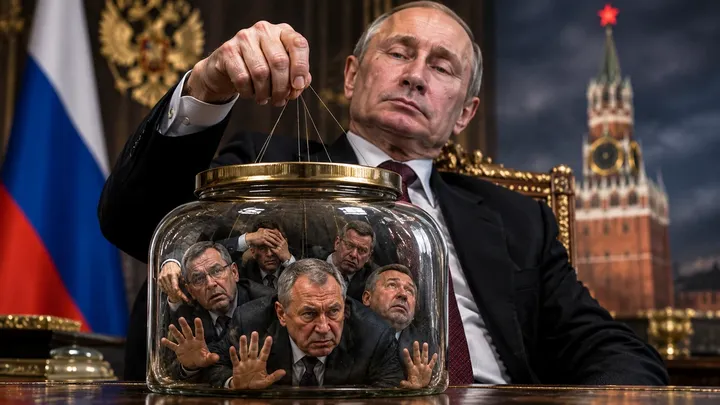
And here the very word "profitability" splits in two. As a national enterprise, as JSC "Russian Federation", the war has long been deep in the red: costs shooting up, returns going down, and it is eating up its own source of income. But as a private feeding trough for the siloviki-comprador bloc, for the Rotenbergs, for defense contractors, for the managers of the classified line, the war remains profitable to the point of indecency. That is why the investment does not stop. These people are investing not their own. They are investing the taxpayer's money, the money of future generations through debt, and the lives of the mobilized, and skimming for themselves off the flow. The budget's classified part, swollen to 38.2% and jumped by 43%, is a fingerprint at the crime scene: the more of the marginal ruble goes into the dark zone, the more of it settles with their own people. Losses are nationalized, profits are privatized. The country goes bankrupt, and at that very time the controlling shareholders collect dividends.
So the most honest formula is not "a company that does not notice its own bankruptcy". It is a company whose management is personally getting rich off the bankruptcy procedure and is therefore vitally interested in dragging out the doomed business for exactly as long as there is still something left to carry out of it. The terminal stage is not denial. It is the butchering of a carcass that still walks by inertia.
One caveat, so as not to pass off the desirable as the inevitable. The terminal stage in Arrighi's sense means that the model is exhausted and can continue only by eating up its own substance. That does not equal a collapse tomorrow. The system is capable of hobbling along for a long time, lowering everything else around the war: civilian industry, the ruble, roads, hospitals, demography. The Hormuz oil windows will keep tossing in some firewood. Exhausted does not mean it will fall next week. Exhausted means that every next day is bought at the price of the future, and the bill for it has already been issued, with payment simply deferred to descendants.
Meanwhile, as a regiment that believes in a nuclear Father Frost approves staffing tables and counts classified trillions, Ukrainian autonomous mid-range drones are methodically turning the Russian fuel system to ash. The very case where engineers defeat shamans. And a burning oil depot is not just a fire. It is a loss written off against the Kremlin's most profitable project by the hand of its own war.
References:medium.comopen.substack.comx.com