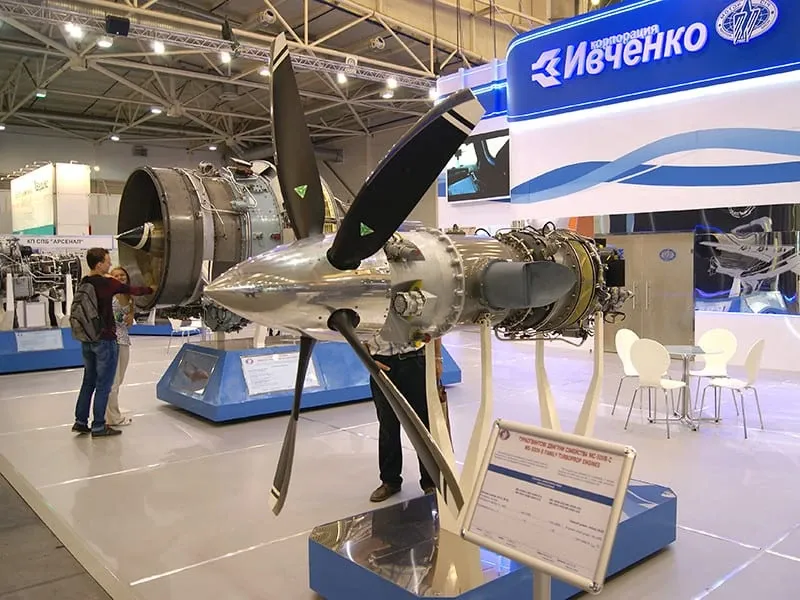
According to the SBU, in 2021-2023 the state-owned Ivchenko-Progress paid UAH 120 million, about $2.6 million, to two firms with no production, warehouse or staff. Goods were bought at inflated prices with forged certificates, and the money was cashed out through a chain of companies.
Officials of the Zaporizhzhia state enterprise "Ivchenko-Progress", in collusion with representatives of private firms, embezzled state money through fictitious purchases, writes Kostiantyn Parfenov. The journalist learned of this from the materials of an SBU criminal case, which in March 2025 was being conducted under Part 3 of Article 258-5 and Part 3 of Article 209 of the Criminal Code. The first concerns the financing of terrorism, the second the laundering of money obtained by criminal means, by an organized group or on an especially large scale. According to the journalist, the enterprise's director at the time was Ihor Kravchenko.
To grasp the scale, it helps to know what "Ivchenko-Progress" does. The enterprise designs, manufactures, certifies, repairs and tests gas turbine engines for aviation and industry, including for drones, and then puts them into serial production. It is part of the joint-stock company "Ukrainian Defense Industry", the successor of "Ukroboronprom". During the period covered by the case, the design bureau was still a state enterprise; it only became a joint-stock company on 31 January 2025. So the money was leaving the accounts of a strategic defense enterprise that belonged to the state.
From 2021 to 2023, "Ivchenko-Progress" transferred UAH 120 million to two firms, "PP Carbon" LLC and "UPK Carbon" LLC. At the current National Bank rate, that is about $2.6 million. Investigators found that 94% of all these companies' receipts came precisely from "Ivchenko-Progress". In other words, the firms had almost no other clients and in effect existed on the strength of a single state customer.
Neither company turned out to have production of its own. Nor did they have qualified staff or warehouse premises. According to the investigation, the firms worked as middlemen: they bought goods and resold them to the defense enterprise at prices far above market. The documents list, for example, heating elements, a 3D carbon composite plate, cast tubular cathodes and a shaft furnace table. A check showed that on the market all of this cost many times less than the state design bureau paid for it.
How did two middlemen with no warehouse and no people win a strategic enterprise's orders for years? The investigation believes that officials of "Ivchenko-Progress" deliberately created conditions in which only these two firms could supply the required goods. That is how the purchases escaped tender procedures. The quality and origin certificates for the products, according to investigators, turned out to be forged. They were issued in the name of foreign companies that in reality supplied nothing. When investigators checked the addresses where the firms were registered, the firms themselves were not there.
It turns out the companies existed only on paper, yet received millions of hryvnias of state money. Part of that money stayed in the accounts of the firms' managers. The rest was sent on, to other companies.
Significant sums, according to the investigation, went to the accounts of "Bridge Construction" LLC. Formally the firm was engaged in construction; in practice it was used for money laundering. The money was driven through a chain of shell companies, and the purpose of payments was changed along the way. Payment for the supply of components could turn into financial assistance, a purchase of materials or a payout of dividends. At the end of the chain, large sums were withdrawn in cash and divided among the organizers of the scheme.
"Bridge Construction" also had a second life. Through the Prozorro system the firm took part in tenders, mostly in Dnipro, Boiarka and Vyshneve, and won about 50 of them. As investigators established, it did not do the work itself. Other firms did the building, and at inflated prices. "Klion" LLC received UAH 66 million, about $1.5 million. "Molochnyi Krai 2019" LLC got UAH 51 million, roughly $1.1 million. "Akvaplast" LLC received UAH 36.2 million, about $800,000, and "Dniprostroi Invest" LLC UAH 20.4 million, roughly $450,000. Instead of real work being done, this money, according to the investigation, was cashed out through shell companies.
The figures are worth adding up. These 4 contractors alone received UAH 173.6 million, about $3.8 million. That is more than all the UAH 120 million that "Ivchenko-Progress" transferred to the two "Carbons". It means that "Bridge Construction" handled not only the defense bureau's money but also funds from local construction tenders.
Other agencies noticed the suspicious operations too. The State Financial Monitoring Service passed investigators summary materials on suspicious transactions between the companies. The tax service department found signs of the legalization of criminal proceeds. Investigators blocked the accounts of "Bridge Construction" in several banks, including JSC "EPB", JSC "KB Globus" and JSC "Sense Bank".
Curiously, by the time of the blocking the firm had changed owner. It used to be registered to Dnipro resident Dmytro Pasiura; now it has been re-registered to Kazakh citizen Aleksey Kamalov.
One question remains that the case materials do not yet clarify. The scheme is described as a procurement and construction one, but is classified, among other things, as financing of terrorism. Which actions of the suspects the investigation brings under that article, and which officials of "Ivchenko-Progress" it considers the organizers, the published data do not say. For now, something else is known: a strategic enterprise that makes engines for the army and for drones, according to the SBU, paid for years for parts resold at many times their price to firms that did not exist even at their own addresses.
References:368.media