The history of the Soviet Union, like that of all Russia for that matter, is one solid fake, as impassable as the taiga! One of our favorite fake stories is the fairy tale about the Young Guard.
To lead a crowd, you must constantly feed it ideas that blow its mind, ideas that compel it to follow an example, ideas whose imitation becomes the crowd's purpose in life.
Stalin understood this very well, and it was with this aim that he set a task for the country's creative prostitutes, oh sorry, the intelligentsia:
To create in the minds of the Soviet people, exhausted by the war, the image of a hero! The image of those who fought the enemies of the Soviet people without sparing their lives, and, just to make it perfectly smooth, naturally died in agony.
Well, dying is understandable, and it also means they could never later tell the truth about the real course of events.
So from under the pens of Stalin's talented scribblers came the fairy tales and bylinas about the feat of Zoya Kosmodemyanskaya, the Panfilov men, and of course the Young Guard.
The author of the bylina about the unbending Komsomol heroes spent a long time looking for fertile ground for his plot, understanding that it was impossible to find people in the country who remembered with what pleasure the Red Army and the NKVD had destroyed their fathers and sons.
But a writer is a writer for a reason!
Understanding that, ideally, the story of the feat should be hidden as far as possible from large settlements, Fadeyev went to the backwater mining town of Krasodon, where he began to scribble his immortal opus.
The real events invented by the author never actually happened and could not have happened, but to give the novel an appearance of documentary truth, the writer did indeed insert into it the surnames of real residents of Krasodon, whose fates, for various reasons, ended sadly.
All in all, the writer Fadeyev was superb and, thanks to his talent, truly did write a masterpiece canvas about the struggle of young Komsomol members for the Soviet motherland.
So masterful, in fact, that the father of nations was so inspired by it that he ordered the heroes to be found and awarded every possible honor, never suspecting that they were practically fictional characters!
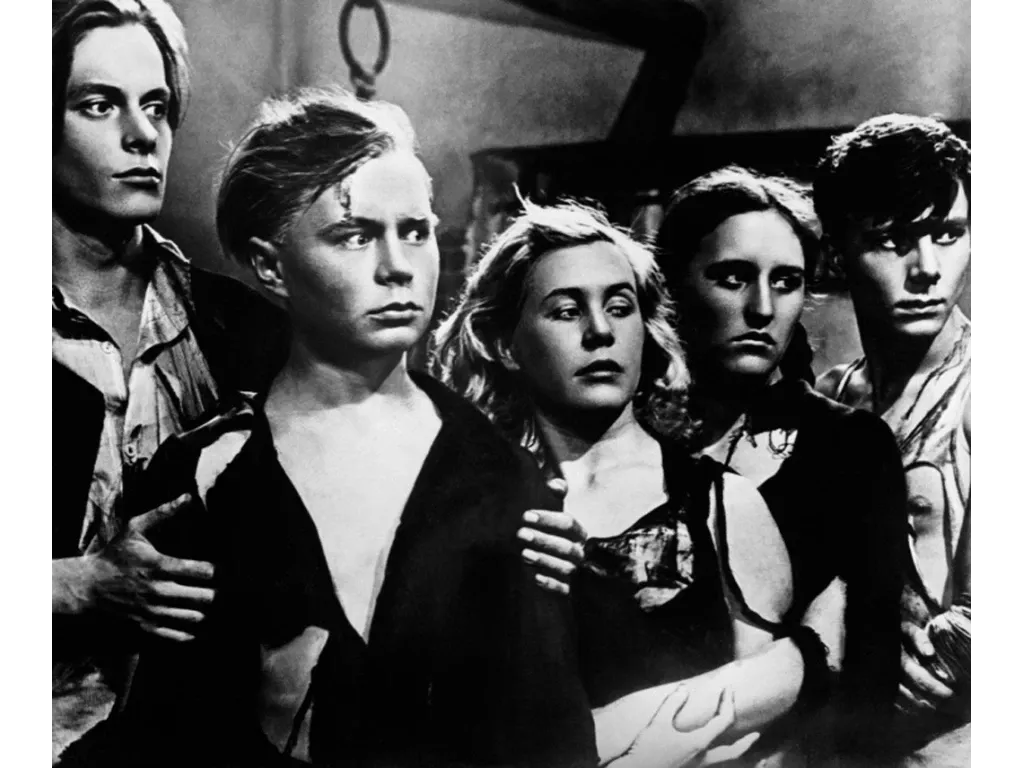
Fadeyev is given the Stalin Prize. The director Sergei Gerasimov starts shooting a film. Theaters in the capital stage plays based on the novel one after another.
Several films were made, each time inflating the party line. In its latest version it turned into an outright masterpiece of communist propaganda!
A super popular film that became a textbook classic, a Stalin Prize — what more, it would seem, could Stalin's favorite, and naturally the favorite of the whole Soviet people, wish for?
But Fadeyev was not happy.
To the end of his life he went about with a frozen mask of horror on his face, understanding what a terrible crime against the truth he had committed.
And although many said that the author of the immortal opus suffered greatly because he had made a hero out of the traitor Oleg Koshevoy and turned the hero scout Ivan Turevich into a traitor, in fact it was something else that killed him.
The absurd scale of the lie, the slander and the falsification of facts made him pick up a pistol and put an end to his life.
This proved once again that he was a good writer and a good man, and the realization of what kind of demon he had unleashed could not fail to distress him. Distress is hardly the word, he was in horror!
Being known as the nomenklatura mouthpiece of the government is not the best honor for a writer, an intellectual, or indeed any representative of the arts.
In his suicide note, Fadeyev described the reason for his premature departure like this:
My life as a writer is losing all meaning. And I leave this life with great joy, as a deliverance from this vile existence, where baseness, lies and slander rain down on you.