In the Middle Ages the Litvins-Belarusians, the Rusyns-Ukrainians and the other peoples of eastern Europe did not know obscene language (mat), just like all Slavs generally.
In the Middle Ages the Litvins-Belarusians, the Rusyns-Ukrainians and the other peoples of eastern Europe did not know obscene language (mat), just like all Slavs generally.
Obscenities were used only by the Finno-Ugrians or, possibly, only by the Ugrians of the Volga-Kama region, and by the Hungarians who came from there.
Presumably also by the Bulgars, who once lived in the same region, south of Kazan: scholars are still arguing over whether the ancestors of the Bulgars were Turks or Ugrians.
According to researchers of the question, mat took shape in a Finno-Ugric (or purely Ugric) environment as far back as the primitive-communal period.
It was not an insult at all, but an expression of dominance.
In exactly the same way, among monkeys and savages the display of the genitals or the imitation of copulation signifies a demonstration of one's superiority in the social hierarchy.
It should be added that mat has also been found on the birch-bark documents of Novgorod of the 11th and 12th centuries, written by the local Chud, that is, Finns.
So the enemies of the Russian people are not to blame: mat is a local invention.
It should also be added that the so-called Russian mat is precisely Finno-Ugric mat.
An amusing fact: the modern Commandments of the Russian Cossacks say: "Know this: mat was invented back in the 13th century by the enemies of the Russian people to insult our Mothers and our Faith."
This is untrue, since mat was invented by the Slavicized Finns of Muscovy, and long before the 13th century at that.
In Europe the only people who used MAT in their speech were the Hungarians.
They left the Volga for Central Europe long before the Tatar invasion and before the baptism of the local peoples.
Why do the Russians not understand the Slavic languages?
Why do all Slavs, including Czechs, Slovaks, Poles, Belarusians and Ukrainians, understand the various dialects of the Slavic languages without interpreters, while only the so-called Russians do not understand them, and even the so-called East Slavic languages of Belarus and Ukraine seem incomprehensible to them?
In medieval Muscovy several languages existed at the same time.
A near-Slavic koine as the language of the princely nobility.
The vernacular languages of the natives, which were Finnic.
The Turkic languages as religious languages during the period in the Horde and after Ivan the Terrible seized power in the Horde, until 1589.
And, finally, the Bulgarian language as the language of Orthodox texts and religious cults.
All this mixture ultimately became the basis of the present-day Russian language, whose vocabulary coincides with the other Slavic languages by only 30-40%, whereas for those languages, Belarusian and Ukrainian included, the coincidence is incomparably higher, at 70-80%.
Today Russian linguists mostly reduce the origins of the modern Russian language to only two components: the vernacular language of Russia, not Slavic at all but a Slavic-Finnic koine with a strong Turkic and Mongol influence, and Bulgarian, Old Bulgarian, also known as Church Slavonic.
As a third language of Russia one can name the modern literary Russian language, which is a completely artificial, armchair invention, a sort of Esperanto based on the two source languages named above, and it is in this Esperanto that I am writing this article.
Why do all Slavs understand the other Slavic languages without interpreters, Belarusians and Ukrainians included, while only the Russians do not understand the Slavic languages, and even the so-called East Slavic languages of Belarus and Ukraine seem incomprehensible to them?
Why in Russia is there contempt for the supposedly fraternal Slavic Ukrainian language, why was it never taught, and is it not taught today, in Russian schools, why do the Russians in eastern Ukraine not want to learn it and actively protest against the very status of Ukrainian as the state language in Ukraine?
Even though it is the language of Kyiv, the Mother of Rus cities and the Baptizer of Rus, it is the very ESSENCE OF RUS.
Where does this separatism of the Russians, so strange for Slavs, come from, this unwillingness to regard Ukraine and Belarus-GDL as common sources?
The answer to these and other questions will perhaps be given by the very history of the formation of Russia's language, which can be called Russian, let alone Slavic, only with an enormous stretch.
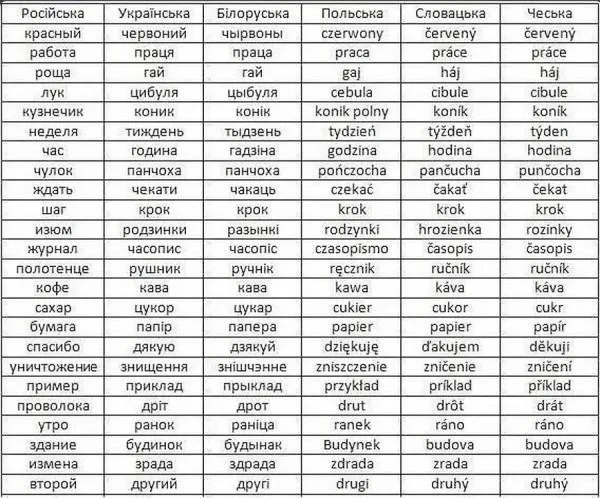
Non-Slavic Russia
Beginning a discussion of the Russian, or more precisely the Rossiyan, language, one should first of all recall that Russia is a non-Slavic country.
Only Smolensk, Kursk and Bryansk, the territories of the ancient Krivichi, Balts Slavicized by the western Slavs, can be counted among the lands populated by ancient near-Slavic peoples.
The remaining lands are Finnic, where no Slavs ever lived: the Chud, Muroma, Mordvins, Perm, the Vyatichi and others.
The principal place names of historical Muscovy are all Finnic: Moscow, Murom, Ryazan (Erzya), Vologda, Kostroma, Suzdal, Tula and so on.
These territories were conquered over several centuries by Rurik's Obodrite colonists, who sailed in from the Labe, or Elbe. However, the number of colonists who built Novgorod near Ladoga as a continuation of the Polabian Starogorod of the time, now Oldenburg, was extremely small in these parts.
In the rare little towns and fortresses founded by the Obodrite-Rusyns and the Normans, the Danes and Swedes, there lived a handful of colonial rulers with their retinues; this network of fortress-colonies was called Rus.
And 90-95% of the population of the region consisted of non-Slavic natives subject to these more civilized occupiers.
The language of the colonies was a Slavic koine, that is, a language serving for communication between peoples with different dialects and languages.
Gradually, over many centuries, the local native population adopted this koine. In the Novgorod land, as Academician Yanov writes, this process took at least 250 years, judging by the language of the birch-bark documents, which gradually turns from Sami into an Indo-European, Slavic analytic language, with inflections placed outside the word, and only then into normal Slavic synthetic speech.
Incidentally, this is exactly what Nestor writes about in the "Tale of Bygone Years": that the Sami of Ladoga gradually learned Rurik's Slavic language and after that began to be called Slovenes, that is, those who understand the word (slovo), as opposed to the "Germans" (nemtsy), the "mute" (nemye), that is, those who do not understand the language.
The term "Slavs" has nothing to do with the term "Slovenes," since it derives from the original "Sklavenes."
After the Ladoga Sami, the northern Finnic peoples, the Muroma, the Ves or Veps, and the Chud, began to adopt the Slavic koine, but for them the process took much longer. Among the more southern Finns of Mordvin Moscow itself and its surroundings, the adoption of the Slavic koine dragged on until Peter's time, and in some places native tongues have survived, such as the Erzya language of Ryazan or the Finnic dialect of the Vyatichi.
The characteristic "o"-pronunciation (okanye) of the population of Central Russia is mistakenly considered "Old Slavic" today, although it is a purely Finnic dialect, which precisely reflects the unfinished Slavicization of the region.
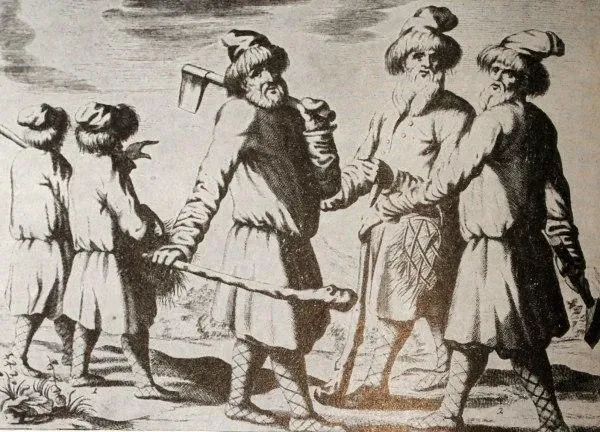
Incidentally, bast shoes (lapti) are also a purely Finnic attribute: Slavs never wore bast shoes, they wore only leather footwear, whereas all the Finnic peoples wear bast shoes.
During the Golden Horde, Muscovy for three centuries went over to the ethnically related Finno-Ugric peoples, whom the czars of the Horde gathered under their rule.
In this period the Turkic language exerted an enormous influence on the language of the region, as part of the generally enormous influence of Asia.
Indicative is the book by Afanasy Nikitin, from the end of the 15th century, "A Journey Beyond Three Seas."
There the author casually switches from the Slavic-Finnic koine of Muscovy to the language of the Horde, seeing no difference between them, and ends his book with a prayer of thanksgiving:
In the name of Allah the Merciful and the Compassionate, and of Jesus, the Spirit of God. Allah is great.
In the original:
Bismillah Rahman Rahim. Isa Ruh Uallo. Allah akbar. Allah kerim.
At that time Muscovy and the Horde shared a religion that was a hybrid of Islam and Arian-type Christianity, Jesus and Muhammad were equally revered, and the division of the faith occurred in 1589, when Moscow adopted the Greek canon and Kazan adopted pure Islam.
In medieval Muscovy several languages existed at the same time.
A near-Slavic koine as the language of the princely nobility.
The vernacular languages of the natives, which were Finnic.
The Turkic languages as religious languages during the period in the Horde and after Ivan the Terrible seized power in the Horde, until 1589.
And, finally, the Bulgarian language as the language of Orthodox texts and religious cults.
All this mixture ultimately became the basis of the present-day Russian language, whose vocabulary coincides with the other Slavic languages by only 30-40%, whereas for those languages (Belarusian and Ukrainian included) the coincidence is incomparably higher, at 70-80%.
Today Russian linguists mostly reduce the origins of the modern Russian language to only two components: the vernacular language of Russia, not Slavic at all but a Slavic-Finnic koine with a strong Turkic and Mongol influence, and Bulgarian, Old Bulgarian, also known as Church Slavonic.
As a third language of Russia one can name the modern literary Russian language, which is a completely artificial, armchair invention, a sort of Esperanto based on the two source languages named above; it is in this Esperanto that I am writing this article.
The Bulgarian component
Why is the present-day Russian language more similar to Bulgarian and Serbian than to Belarusian and Ukrainian?
Yet for some reason it is precisely these two languages, and not Bulgarian and Serbian, that are placed in one language group with Russian.
This seems strange, since territorially Russia does not border the Balkans but does border the Belarusians and Ukrainians, whose languages have almost no Bulgarian influence at all, and where it is found, it consists of Balkan linguistic elements brought in through Russia.
The point is that Russia had no native Slavs of its own, apart from rare settlements of Ukrainians in the Suzdal land in the 12th century and the mass enslavement of Belarusians and Ukrainians in the course of Muscovy's wars against the GDL and the Polish-Lithuanian Commonwealth: in the war of 1654-1667 alone the Muscovites took several tens of thousands of Belarusians into slavery.
And therefore the natives of Muscovy learned the Slavic language through religion, which relied on Bulgarian texts. That is why the Mordvins of Ryazan, Moscow, Tula, Kostroma, Vyatka, Murom and the other Finnic lands came to know the Slavic language from Bulgarian, having no local Slavic language of their own.
And for this reason even the small Slavic content of the present-day Russian language, about 30-40% Slavic vocabulary against 60-70% Finnic and Turkic vocabulary, is not shared with the Belarusians and Ukrainians but with the Bulgarians, from Bulgarian books.
In Belarus and Ukraine, by contrast, the situation was different: here the local population, half Baltic in Belarus and half Sarmatian in Ukraine, did have vernacular Slavic dialects, and these did not allow Bulgarian vocabulary from Orthodox books to be introduced, replacing their own native Slavic vocabulary.
Is Russia's language Slavic?
There are three points that all Russian linguists energetically hide, although, as the folk saying goes, you cannot hide an awl in a sack.
- Until the 18th century nobody in the world considered the language of Muscovy to be the Russian language; it was specifically called the language of the Muscovites, Muscovite.
- Until that time the Russian language meant precisely and only the Ukrainian language.
- Until that time the language of Muscovy, the Muscovite language, was not recognized by European linguists, including those of the Slavic countries, even as a Slavic language, and was classed among the Finnic dialects.
Of course, today everything is different: for the sake of the imperial interests of conquering Slavic countries, Russia has exerted enormous influence on its linguistic science, setting it the task of giving Russia's language Slavic status.
Moreover, if Germanic peoples lived west of Russia, it would argue in exactly the same way that the Russian language belongs to the Germanic family, because that would be the Empire's order.
And the reforms of the Russian language begun by Lomonosov were aimed precisely at accentuating its weak Slavic features.
However, as the Polish Slavist Jerzy Leszczyński wrote 150 years ago about the western Balts, who are related to the Slavs, the Prussian language has far more grounds to be considered Slavic than Great Russian, which has much less in common with Polish and the other Slavic languages than even the West Baltic Prussian language does.
Let me remind you that Russia was first officially called Russia only under Peter I, who considered the former name, Muscovy, dark and obscurantist.
Peter not only began forcibly shaving beards, forbade all the women of Muscovy to wear the chador in the Asian manner, and banned harems and terems, where women were kept under lock and key, but also, on his trips around Europe, pressed cartographers to call his country on their maps Russia from then on, instead of Muscovy or Muscovitia as before.
He also wanted the Muscovites themselves to be regarded as Slavs for the first time in history. This was part of the general strategy of cutting a window into Europe, together with Peter's request to move the eastern border of Europe from the border between Muscovy and the Grand Duchy of Lithuania (GDL) all the way to the Urals, thereby geographically including Muscovy in Europe for the first time in history.
Before that, Polish and Czech linguists and the compilers of Slavic grammars clearly distinguished the Russian language, meaning Ukrainian, from the Muscovite one, and did not count the Muscovite language itself as part of the Slavic family.
For the language of Muscovy was poor in Slavic vocabulary.
As the Russian linguist I.S. Ulukhanov writes in his work "Colloquial Speech of Ancient Rus'" (Russkaya rech, No. 5, 1972), the circle of Slavonicisms that regularly recurred in the living speech of the people of Muscovy widened very slowly.
The records of living spoken language made by foreigners in Muscovy in the 16th-17th centuries include only a few Slavonicisms against the background of the main mass of local Finnic and Turkic vocabulary.
In the Parisian Dictionary of the Muscovites (1586), out of the ENTIRE VOCABULARY of the Muscovite people we find, as I.S. Ulukhanov writes, only the words владыка and злат.
In the diary-dictionary of the Englishman Richard James of 1618-1619 there are already more, A WHOLE 16 WORDS: благо, блажить, бранить, воскресенье, воскреснуть, враг, время, ладья, немощь, пещера, помощь, праздникъ, прапоръ, разробление, сладкий, храмъ.
In the book "Grammar of the Muscovite Language" by the German scholar and traveller H. Ludolf, from 1696, there are 41 SLAVIC WORDS!
Moreover, some of them come with a huge Finnic "o-ing" in the prefixes, as in розсуждать.
The rest of the Muscovites' spoken vocabulary in these phrasebooks is Finnic and Turkic.
The linguists of that era had no grounds whatsoever to count the language of the Muscovites among the Slavic languages, since there were no Slavonicisms in spoken language, and it is precisely the spoken language of the people that is the criterion here.
Therefore the colloquial language of Muscovy was considered neither Slavic nor even close to Russian: the peasants of Muscovy spoke their own Finnic dialects.
A characteristic example: the Mordvin Ivan Susanin of the Kostroma district did not know Russian either, and his relatives, when submitting a petition to the czarina, paid an interpreter to translate from the Finnic of Kostroma into the czar's Russian state language.
It is amusing that today the thoroughly Mordvin Kostroma is considered in Russia the standard of "Russianness and Slavdom"; there is even a rock band that sings Kostroma's Mordvin songs in Russian, passing them off as supposedly "Slavic", although two centuries ago nobody in Kostroma spoke Slavic.
And the fact that the Muscovite church preached in Bulgarian, in which Muscovy's state papers were also written, meant nothing, since all of Europe then spoke Latin in its churches and kept its records in Latin, and this had no connection with which peoples lived there.
Let me remind you that after the Union of Lublin of 1569, when the Belarusians formed with the Poles a union state, the Republic (in Polish, Rzeczpospolita), the GDL kept Belarusian, that is Ruthenian, as its state language, while Poland made Latin its state language.
But that by no means shows that the Poles' vernacular is Latin.
In exactly the same way, the Russian language was not the vernacular in Muscovy-Russia until the Russian villages learned it.
Here is another example: today, as since time immemorial, the villages of the Smolensk, Kursk and Bryansk regions, which once belonged to the GDL, speak not Russian at all but Belarusian.
They do not speak literary Russian there, nor does anyone "o-ize", reflecting a Finnic accent, as in the Ryazan or Moscow regions; they speak exactly the language that the villagers of the Vitebsk or Minsk regions speak.
Any linguist should draw one conclusion: a Belarusian population lives in these Russian regions, because it speaks Belarusian.
But for some reason this population is classed ethnically with the "o-izing" eastern neighbors, who in Ludolf's time knew only 41 Slavic words there.
I.S. Ulukhanov writes that, speaking of the Muscovites having two languages, Slavic or Church Bulgarian and their own Muscovite one, H. Ludolf reported in the "Grammar of the Muscovite Language":
The more learned someone wishes to seem, the more Slavic expressions he mixes into his speech or writings, although some laugh at those who abuse the Slavic language in ordinary speech.
Amazing!
What kind of Slavic language of Moscow is this, whose speakers are laughed at for using Slavic words instead of their own Finnic and Turkic ones?
There was nothing like it in Belarus-GDL: nobody here laughs at people who use Slavic words in speech.
On the contrary, nobody would understand someone who builds phrases using Finnic or Turkic vocabulary instead of Slavic.
This bilingualism existed nowhere among the Slavs except in Muscovy alone.
By the way: the Statutes of the GDL were written in the purest Slavic language, the state language in the Grand Duchy of Lithuania and Rus', a purely Slavic state in which the Litvins were Slavs, today's Belarusians.
This problem of bilingualism, caused by the absence of a popular Slavic basis in Russia, has always pursued the creators of the literary Russian language too, as the main problem of the Russian language in general.
It went through stages of development of the term: at first it was called Muscovite, then Russian under Lomonosov until 1795; then, after Russia's occupation of Belarus and of Western and Central Ukraine in 1794 (formalized in 1795), it had to be renamed "the Great Russian dialect of the Russian language".
This is exactly how the Russian language appeared in the 1840s in the title of Dahl's dictionary, "Explanatory Dictionary of the Great Russian Dialect of the Russian Language", where the Russian language itself was understood generally as Belarusian, Ukrainian and Russian. Yet today all Russian linguists have unscientifically distorted the title of Dahl's dictionary to "Explanatory Dictionary of the Living Russian Language", although he never wrote a dictionary with that title.
In 1778 a pamphlet by the writer and linguist Fyodor Grigoryevich Karin, "Letter on the Reformers of the Russian Language", was published in Moscow.
He wrote: The terrible difference between our language (throughout the work he calls it "the Muscovite dialect") and the Slavic often cuts off our ways of expressing ourselves in it with that freedom which alone enlivens eloquence and which is acquired by nothing other than daily conversation. As a skilled gardener renews an old tree with a young graft, clearing away the dried-up vines on it and the thorns growing at its root, so the great writers acted in transforming our language, which by itself was poor, and which, when fashioned after the Slavic, became downright ugly.
Poor and ugly – this, of course, diverges from its later assessment as "great and mighty".
The excuse here is the fact that Pushkin had not yet been born for the young, green language just created by Lomonosov's experiments.
Once again I draw attention to this: the Belarusians, Poles, Czechs, Bulgarians, Ukrainians, Serbs and the other Slavs never had this problem, because among them the language of the villagers organically becomes the language of the country and the people.
It is a purely unique Russian problem: how to combine the Finnic language of the villagers with the Slavic language of the state. In Belarus, for example, it is absurd to argue about a possible "dominance of Slavonicisms in written speech", implying, as in Russia, a dominance of Bulgarian vocabulary, when Belarusian vocabulary itself is just as thoroughly Slavic vocabulary and consists of the very same Slavonicisms. That is, there is no subject for such a dispute, because the Slavonicisms of the Bulgarian language cannot possibly spoil a Belarusian language already built on nothing but Slavonicisms: you can't spoil butter with butter.
As a result, Russian linguists heroically cut the umbilical cord of Moscow culture's centuries-old connection with the Bulgarian language, which they unanimously find "alien", "ornate" in the conditions of Russia, and "hindering the formation of the literary Russian language".
And they reject the Bulgarian language, boldly falling into the bosom of the "popular language of the Muscovite dialect", which is 60-70 percent non-Slavic vocabulary.
As the great figures who carried out this linguistic revolution in Russia, F.G. Karin in his work names Feofan Prokopovich, M.V. Lomonosov and A.P. Sumarokov.
Thus at the very end of the 18th century Russia abandoned adherence to the Bulgarian language, which for centuries had held it like a rope in the Slavic field and turned it "toward Slavdom", and began to consider itself linguistically free and sovereign. It now recognized as its language not Bulgarian but the vernacular of the Slavicized Finns, which, unlike Bulgarian, had by no means any obvious Slavic features.
Patriotism defeated Slavic unity.
The real Russian language
Meletius Smotrytsky, a Belarusian educator who worked in Vilnius and Kyiv, author of the "Grammar of the Slavic Language, Correct Syntagma" published in 1619 in Yevye, laid down the scientific foundations of the language of the Ruthenians long before Lomonosov, the revolutionary of Russian linguistics and creator of the grammar of the Russian language.
As in L. Zizaniy's Grammar, he clearly distinguished the Bulgarian church language from ours:
Словенски переводимъ: Удержи языкъ свой от зла и устнъ своъ же не глати лсти. Руски истолковуемъ: Гамуй языкъ свой от злого и уста твои нехай не мовятъ здрады.
It is absolutely clear, as throughout the rest of his book, that the author considers the Russian language to be today's Ukrainian, or rather that Ruthenian language which in his time was common to Belarusians and Ukrainians.
And not at all the language of Muscovy-Russia.
Нехай, мовять, здрады are purely Belarusian-Ukrainian words, which Meletius Smotrytsky calls "a translation into the Russian language".
It is clear that this strikes everyone at once, which is why V.V. Anichenko, Doctor of Philology from Gomel State University, the author of an article in the journal Russkaya rech on the Moscow edition of M. Smotrytsky's Grammar, wraps the language into which Smotrytsky translates Church Bulgarian in this formula: "the so-called Russian".
So called by Meletius Smotrytsky?
And so called by the entire people of the GDL of that era?
Here the doctor of sciences clearly does not want to upset his Russian colleagues: all is well, what our people have called the Russian language since time immemorial is only "the so-called Russian language".
And the one that is not "so-called", the real one, existed only in Russia.
Bulgarian in content. And Meletius Smotrytsky was mistaken in his terms.
It is unscientific to distort medieval authors.
If they state plainly that the Russian language is, in its content, precisely the Ukrainian language and not the Muscovite one, then why equivocate?
Why rewrite history?
All the more so since in such an unscientific approach the present-day Ukrainian language itself becomes an anomaly fell from the Moon onto Kyiv, alien, because the so-called .
And yet the books of Meletius Smotrytsky are telling: the Ruthenian is our native, primordial tongue, which of course is still there today in the realities of the Ukrainian and Belarusian languages, while the Russian is not the Ruthenian but is based on Bulgarian.
And the translations that Meletius Smotrytsky makes in his book from Bulgarian into Ruthenian are in fact translations from Russian into Ruthenian, into Ukrainian and Belarusian.
There is nothing ethnically Russian here in what is now called Russian, there is only the Bulgarian, which needs to be translated into Ruthenian for the Belarusians and Ukrainians, who were then called Rusyns.
The alphabet
A universal misconception: everyone in Russia believes they write in Cyrillic, although no one in Russia writes in it.
There they write in a completely different alphabet, very little connected with Cyrillic, the civil alphabet introduced by Peter I.
It is not Cyrillic, since it was not created by Cyril and Methodius.
It is the imperial Russian alphabet, which Russia, in the czarist and Soviet periods, tried to spread among all its neighbors, even the Turkic peoples and the Finns.
It tries to do so today as well: not long ago the Duma forbade Karelia and Tatarstan to return to the Latin alphabet, calling it separatist machinations, although it is precisely the Latin alphabet that more successfully reflects the linguistic realities of the Finnic and Tatar languages.
In general it looks like complete absurdity: it turns out that Cyril and Methodius created a script not for the Bulgarians and Czechs, so that they could read the Byzantine Bibles, but for the Tatars, who profess Islam.
But why would Muslims need an Orthodox alphabet?
The second misconception is that Cyrillic is considered a Slavic alphabet.
In fact it is only a slightly modified Greek alphabet, and the Greeks are not Slavs.
Besides, more than half of the Slavic peoples write in the Latin alphabet, not in Cyrillic.
Finally, it is the alphabet of Church Slavonic, that is, Bulgarian, books, it is the Bulgarian alphabet, and not at all one's own Russian, Belarusian or Ukrainian one.
To refer here to religious Orthodox traditions is simply absurd, because in the Middle Ages the whole of Catholic Europe used Latin in religion. Is that a reason for all these countries to give up their national languages and return to Latin?
Of course not.
By the way, the Belarusian alphabet today should be the Latin one, not Cyrillic, or more precisely, not the alphabet of Peter I, since the Belarusian literary language was formed over the centuries as a language based on the Latin alphabet, and all the founders of Belarusian literature wrote in Latin script.
Let me remind you that after the Russian occupation of the Grand Duchy of Lithuania in 1795, the czar banned the Belarusian language by decree in 1839, in 1863 banned religious literature in Ukrainian, and in 1876 all kinds of literature in Ukrainian except belles-lettres.
In Ukraine the literary language was formed on the basis of Cyrillic, but in Belarus on the basis of the Latin alphabet, and in the 19th and early 20th centuries the Belarusian periodicals came out in Latin script: Bielarus, Bielaruskaja krynica, Nasza Niwa and so on.
Although under the chauvinist pressure of czarism, publications in Cyrillic began to appear too!
In the USSR the Belarusian Latin alphabet was banned altogether as Westernism and as a reminder of another choice of the Belarusian Litvins, of centuries of life in the Polish-Lithuanian Commonwealth together with the Poles, Czechs and Slovaks, and not as part of Russia.
After the collapse of the USSR in 1991, 4 republics returned to the Latin alphabet: Moldova, Azerbaijan, Uzbekistan and Turkmenistan.
The fifth among them must without fail be Belarus, since its literary language was formed precisely on the Latin alphabet, and today we have to translate the works of the founders of Belarusian literature into the present-day artificial and mangled Belarusian language created by Stalin's reforms.
This is, of course, absurd.
And it will, of course, cause a storm of outrage in the State Duma: the Belarusians, they will say, are returning to the Polish alphabet.
But what does the present-day Greek alphabet have to do with secular Belarus?
Nothing at all.
And yet the Poles are both Slavs and neighbors, while the Belarusians do not border non-Slavic Greece and have nothing in common with it whatsoever.
Moreover, both the Greeks and the Poles are equally members of NATO and the EU, so the choice between the Greek and Latin alphabets obviously cannot have any political subtext.
Except demagoguery.
But there is such a subtext in the position of Russian politicians, who see in it separatism and a departure from Russia, as if Russia alone were the monopolist in handing out alphabets to its neighbors and to its own Karelians and Tatars.
When the junta of Bolsheviks seized power in Russia, its commissars carried out a reform of the Great Russian language.
First, it was renamed simply Russian in order to cut out the great-power imperial GREAT, while at the same time changing the nationality of the Great Russians to Russians.
Which is illiterate, because in the Russian language the name of a nationality cannot suddenly be an adjective rather than a noun, but what do you expect from the authors of the innovation, Trotsky and Sverdlov, Jews who understood little of the nuances of the Russian language.
And this is wrong both scientifically and politically, since the Russian people of Belarus, Ukraine and Russia, previously united, if artificially, in czarist Russia, was now reduced to the people of the RSFSR alone, while Belarus and Ukraine were no longer considered Rus and Russians, because Russians now became only the Great Russians, a part of the Russian people that had existed under czarism.
Second, Trotsky and Sverdlov carried out a deep reform of the Great Russian language, creating a new civil alphabet.
And third, Trotsky insisted on the transition of the Great Russian language to the Latin alphabet for the sake of world revolution, and had his view prevailed, the alphabet of the RSFSR and then of the USSR would have become Latin.
And in 1991 Yeltsin would have solemnly returned Russia to its own Cyrillic.
Trotsky's idea was not accepted because Russian literature was created precisely in Cyrillic, and Pushkin did not write in the Latin alphabet.
By the way, on the same grounds Belarus should return to the Latin alphabet, because our poets too created Belarusian literature not in Cyrillic but in the Belarusian Latin alphabet
All of the above lets us understand why in Russia such importance is given to the cult of Cyril and Methodius, who, strictly speaking, never had anything to do with Russia, because they died long before Ukraine, namely Kyiv, adopted Christianity, and no Muscovy, let alone Russia, existed in their time on the expanses of Great Mordovia of Erzya-Ryazan, its capital, and Great Permia, the states that existed in the time of Cyril and Methodius on the site of present-day Russia.
For they created a quasi-Greek alphabet in Moravia for the Czechs earlier than pagan Rus appeared at all on the territory of the CIS countries, with the landing of the Slav colonists, Rurik's Obotrites, in the area of Sami Ladoga.
As Cyril himself wrote, there are NO Slavs on the territory of present-day Russia and Ukraine, and Slavs live only in Central and Southern Europe.
That is why Cyril did not go to the neighboring territory of present-day Russia and Ukraine to convert the Slavs to Orthodoxy, because there were no Slavs there then.
And there was no one to give a Slavic alphabet based on Greek.
Kyiv, too, was not Slavic then, it was closely allied with Khazaria, those who lived in it were not Slavs at all but Sarmatians and Jews, and the princes of Kyiv were then of Jewish roots, related by marriage to the Jewish princes of Khazaria, and professed the Judaism of Khazaria, and Kyiv was then a city of synagogues. This theme is actively developed by a popular-science series about Khazaria, shown on Israeli TV, as yet another ancestral homeland of the Israelites.
Why would Cyril go to the city of synagogues, Kyiv, where no one is waiting for him?
That is why I will express my own special opinion, which one may disagree with: Moscow's ROC and Russian historians and ideologists inflate the cult of Cyril and Methodius so actively in order to conceal the enormous contradictions in their idea of themselves as supposedly Slavs and to conceal the unwelcome facts that contradict this myth, that is, the entire historical, ethnographic and linguistic evidence.
By the way, Cyril and Methodius were no brothers, nor were they Greeks, but were Syrians, wealthy Orthodox Arabs from Damascus (Syria was then Orthodox), hired by Byzantium for the mission to Moravia.
The funniest thing is that the Czechs themselves, for whose alphabet the Arab Cyril came, do not venerate him at all, do not remember him at all, although he has been raised to a cult in Russia, where he never came.
As they say, you never know whom you will find and whom you will lose
References:secret-r.net