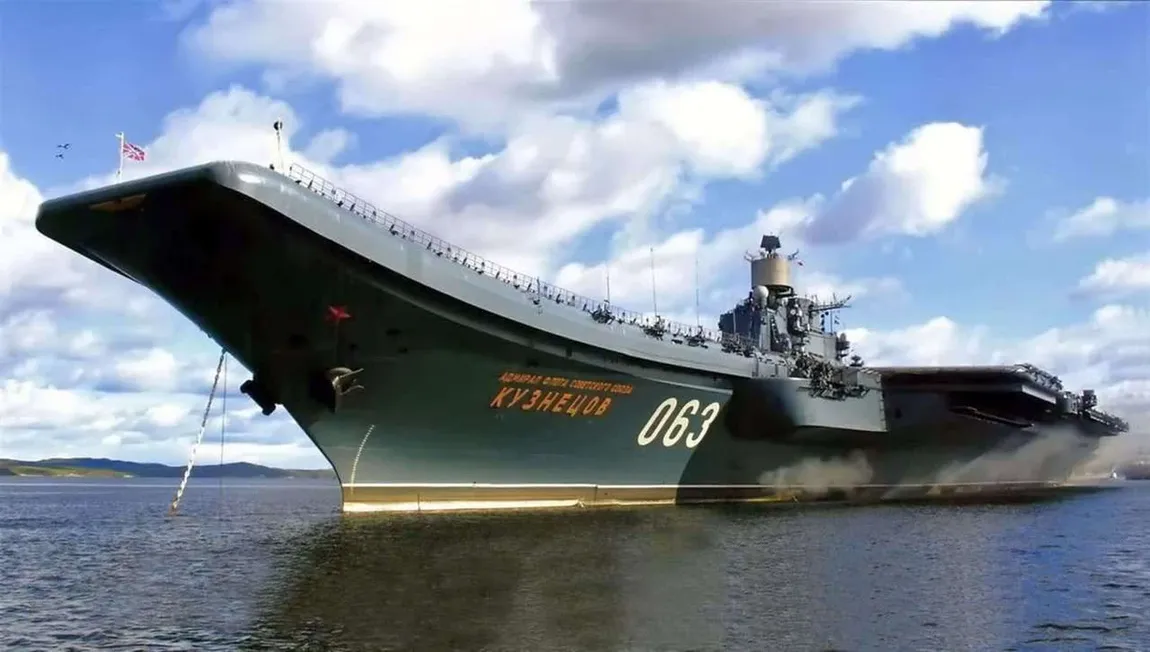
A letter from a serviceman who spent some time aboard the TAKR "Admiral of the Fleet of the Soviet Union Kuznetsov".
A letter from a serviceman who spent some time aboard the TAKR Admiral of the Fleet of the Soviet Union Kuznetsov .
We think this material will interest everyone, because on the eve of an impending war it is quite interesting to know what the enemy is armed with.
Full displacement: 70,500 tonnes
Standard displacement: 55,000 tonnes
Dimensions of the ship:
- length: 304.5 m
- beam at the waterline: 38.0 m
- draught: 10.5 m
- width of the flight deck: 75.0 m
Steam turbine plant power, hp: 4x50,000
Speed, knots:
- maximum: 32.0
- economical: 18.0
Range at economical speed, miles: 8,000
Number of aircraft: 26
Number of helicopters: 24
Aviation fuel reserve, t: 2,500
Crew: 1,980, including 520 officers
The ship's main power plant, which by the will of assorted leaders from our recent past was made a boiler-turbine one rather than nuclear (like the Americans'), is a four-shaft installation with a total output of 200,000 hp, and it used to give a speed of 29 knots (but that was back in the distant year 1990).
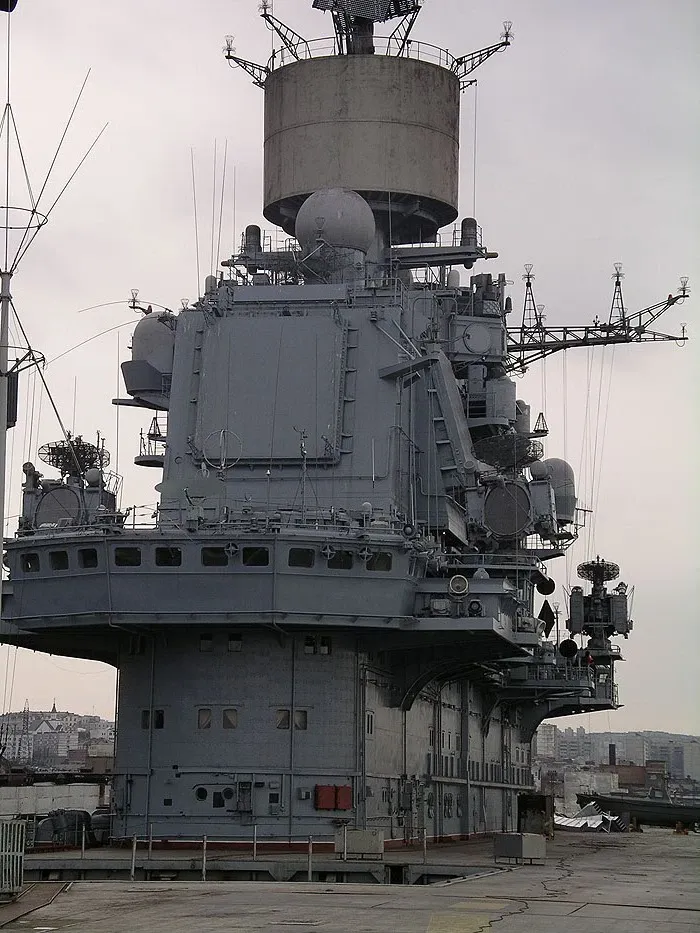
The ship has 8 tiers of superstructure, 7 decks and 2 platforms, bow and stern engine-boiler compartments (4 boilers and 2 main turbo-gear units in each), 5 power compartments (with diesel and steam-turbine generators); a hangar more than 150 m long and 26 m wide, spanning the height between the 2nd and 5th decks and linked to the flight deck by two aircraft lifts of roughly 14x16 m (if it were not for their side-mounted position, it would simply be impossible to raise our Su-33s, about 21 m long, from the hangar or lower them into it), as many as 6 galleys, a lock-up cell and its own guardhouse.
That is probably quite enough for a narrative whose aim is not a technical description of the ship but an essay on its social condition .
For convenience the whole ship is divided into skhods, numbered from the 1st to the 53rd. The same system was used on the ships of Project 1143. For those who have not been there, we explain: all the ladders (except those of the island ) are numbered; ladders located one beneath another carry the same number, even ones on the port side and odd ones on the starboard.
An example. Suppose we need to send a messenger with golden hooves (pardon me, a defender of the fatherland, that is, a sailor) to the communications command post (KPS). And he, the sailor, though he has served a year, still does not know where this KPS is (a common occurrence). Then he should be told: Go to the 17th skhod, 4th deck, to the KPS .
Now let us take a stroll around the ship. First we climb aboard the carrier by the gangway. It is amidships on the starboard side (if the Kuznetsov is standing at the yard). On the platform of the starboard gangway (4th deck) we are met by the gangway watch officer with a dirk and a marine with a bayonet-knife. If you put on a regulation face , you can quite easily pass for one of their own (documents at the gangway are rarely checked) and go aboard. Having climbed to the 3rd tier of the superstructure (the living quarters), let us begin the inspection from here.
Here, in single cabins, live the commander's assistants and the head of the electromechanical department ( the chief engineer ). Going down, we run into a block post on the ladder. This phenomenon deserves separate discussion, all the more so as no other ship has this kind of watch. A block post is a conscript sailor who plays the role of watchman over a certain area (a deck, a ladder, etc.) in his charge. What he guards are by no means secret objects but light bulbs, fire hoses, fire extinguishers, display stands, general-alarm bells and so on. And since the sailor may fall asleep or wander off, or, finally, someone may take this treasure from him at night, there is also a back-up measure. Thus fire extinguishers and fire hoses may simply not be put out at all, and indeed you will not find them anywhere on the ship. The exception is the time of the highest inspections, when H.I.M. with his retinue (the captain, the first officer, etc.) goes round the ship. Then everything there is gets put out, and the block posts are certain to be doubled. An inquisitive reader may ask: And what about the light bulbs? You can't take them away, otherwise how would one walk in total darkness? I hasten to reassure you: this problem was long ago solved at a high ideological and technical level. The bulbs are: a) glued on with epoxy resin; b) wrapped with wire, preferably barbed; c) wired so that current runs to the wire or the lamp shade. All this is as a rule used in combination. And still, the damned bulbs get stolen.
Back to our walk. One tier lower lives the captain and the flagship staff; there is a block post here, which means light and carpets. Let us go down to the second, gallery deck, situated between the hangar and the flight deck. There are block posts here, so there is light. But let us not be deceived, for BCh-5 is always ready to help , so the flashlight (you can't go anywhere here without it) must be kept at the ready . Going down a deck, we walk along the 3rd deck on the port side (it runs through from bow to stern). Here too there are block posts and light.
Now let us switch on the flashlight and go down still lower... Here we shall witness yet another carrier miracle that makes this ship unlike any other. You can walk along the clean, brightly lit 3rd deck, but as soon as you go lower, you find yourself in catacombs with wrecked posts and abandoned cabins, all of it without light and very often flooded (sometimes with sewage, so the smell is of the highest quality ). Below, it is the same. Of course, it is not like this everywhere (no more than 60% of the skhods below the 3rd deck). If you find yourself on a lit skhod, it means there are crew quarters or supply service stores there.
We go down still lower, into the holds. There everything is in fuel oil and water, and here and there are heaps of rubbish (carrying it to the pier is far, and they only let you out there at certain times, while cleaning aboard is always done, so the rubbish is thrown into the hold). And do you know how much fuel oil and water we have in the holds? How much, how much? 50 tonnes, you say? Forgive me, that is not respectable. After all, we are an aircraft carrier, not some gunboat. Then 500. Well, that is impressive, almost 10 railway tank cars. Still wrong; add another zero and that will be about right. There may be discontented exclamations from the side: they say, we've sailed, we know, we had that too, only people lived in the superstructure. May we know what ship that is? Ah, the large anti-submarine ship Udaloy ! The one that has been laid up for 10 years since the fire, with a crew of 30. Forgive us, the comparison is incorrect: we are not telling you about a laid-up ship but about a whole aircraft carrier that goes to sea!
We state with full responsibility that there is simply no second ship like it. Now all the ships of the Northern Fleet are divided into two groups: operational ones, that is, clean, tidy and ready to go to sea but standing idle for lack of fuel, and laid-up ships (now the majority). The Kuznetsov alone is a hybrid, an operational laid-up ship .
Amenities out in the yard
Note that when people talk about some miracle ship, they first give the number of guns, their calibre, the thickness of the armour and so on, and only then, in passing, and even then rarely, the living conditions of the crew. Yet this is not quite right, for it is precisely the crew that operates all this variety of weapons. Therefore, to avoid this mistake, let us pay particular attention to the crew's living conditions.
The first thing to note is the absence of heating on the ship, which, you will agree, is of no small importance in the North. There are many reasons for this, but probably the main one is the lack of a permanently operating auxiliary boiler. Therefore steam for domestic needs is taken from the main power plant, which is very costly, since it requires not ordinary but special boiler water, of which the fleet is always short. Steam can also be supplied from the ENS (an energy-carrying vessel of Project 305), but the pressure from there is next to nothing (and in the winter of 1998/1999 nothing was supplied at all). As a result, steam for heating is supplied intermittently, which the system is not designed for, since there is no condensate drain. The steam heating system runs through the BPTZ (side anti-torpedo protection) or, as it is called aboard, the pipe corridors, that is, along the side. So when the steam supply stops, the pipes freeze through very quickly. And then everything is as in a physics textbook: the condensate turns to ice, the ice expands, the pipe bursts. The result: no heating, no warmth, frost on the bulkheads in places and ice on the deck. The crew falls in wearing greatcoats even in the hangar. If it is +5 C in a berthing space or cabin, that is already good, and if it is +12-15, that is, forgive me, sheer luxury!
In such conditions only electric heaters save you. Since buying them is expensive and getting a ship's one is hard, people knock them together as best they can. The authorities confiscate non-regulation electrical equipment , and their owners are rewarded with punishments . But cold is no kin of ours, and the ranks of those dreaming of a personal electric sun do not thin.
What burns most often is not the electric heaters but the transformers of the lighting network. They are simply not designed for the loads that the heaters hung on them produce. As a result the voltage in the network is also always considerably below the nominal (100 V instead of 127 is far from the limit). Adding fuel to the fire is the absence of a 220 V network in the cabins (there is only the 127 V that nobody needs), so everyone tries to run 220 V for himself. They conjure in different ways: one throws a phase from 380 V, another adds up 127 V phases, a third drags kilometre-long wires from the rare 220 V panels. And this, in turn, contributes to numerous short circuits.
But the cold is terrible not only for this. It permeates the whole of shipboard life. For it is not only condensate that freezes; the same happens with the other pipes that contain water. For this reason water is supplied to none of the cabins of the 2nd deck (and that is almost 60% of all the ship's cabins), neither in winter nor in summer. Not a single officers' shower works. So the slogan of equality and brotherhood is especially applicable here: everyone, sailors and officers alike, washes in the bow (the stern one does not work) bathhouse of the personnel. Of course, this does not apply to the command: they have their own shower.
Water is not supplied to all the galleys. In winter the absence of drainage from the cabins has also become routine. Accordingly, things are hard on the ship with the heads too. There are more than fifty of them in all, but a good half do not work, and a considerable part of the rest are locked: if you are not the happy owner of a golden key , then you had better eat less, the more so as the Ministry of Defense of the Russian Federation is always ready to meet you halfway in this respect.
In the winter of 1998/1999 even the tubes in one of the main boilers froze.
Ventilation is bad with us too: 50% of the ventilator electric motors burned out long ago. And without ventilation it is hard going, since, unlike on other ships, there are few portholes here, and the overwhelming majority of living spaces have none at all. So only forced ventilation is possible, and if there is none, the cabin will smell of mould, condensate will drip from the deckhead, and the air will be so stuffy you could hang an axe in it .
Finally, it is worth telling about our wardroom. There is none as such; there is an officers' canteen, where the officers, more than 150 of them, only eat and do nothing else. As a space it looks more like a village canteen for machine operators at harvest time. There are no tablecloths to speak of, knives are also an excess, and the crockery is not exactly dirty, but it is still better to wipe the tableware before use . The food is cooked, in principle, well, and the products are good by today's navy standards. However, there may not be enough of all this, because they pilfer at the buffet. So it is better not to be late for the wardroom. It would probably be wiser to make several wardrooms (for example, one for each BCh).
...All the King's Men
What a nightmare, who would live in such conditions? I will tell you.
The plan was for fifteen hundred people to serve on the Kuznetsov (not counting the air group and the landing force), but the crew gradually grew to 2,000. The commander is a rear admiral (the only seagoing admiral!), with a number of deputies: the first officer (a captain 1st rank), an assistant, an assistant for political education, an assistant for combat control, an assistant for aviation, an assistant for damage control and an assistant for legal work. The ship has seven combat units, four services and three teams: navigation (BCh-1), missile and artillery (BCh-2), mine and torpedo (BCh-3), communications (BCh-4), electromechanical (BCh-5), aviation (BCh-6) and radio engineering (BCh-7); the medical, chemical and damage control services (the latter exists only on the Kuznetsov); the control team (KU), the boatswain's team (BK) and the commandant's team. There is also the RO, the guard company, which serves as the ship's riot police.
A bit more about our organization. We have an average of 10 formations a day, each lasting about 35 minutes (so over a year we stand idle at formations for almost 65 days). At formations they always say: The crew of the AIRCRAFT CARRIER... is formed up. And in general the command always stresses that we serve precisely on an AIRCRAFT CARRIER. Let me remind you that nobody has yet changed the classification of Russian Navy ships, and there is no aircraft carrier in it, only a heavy aircraft-carrying cruiser. And aircraft are a rarity on our ship, and they visit it in rather pitiful numbers. And at formations the commander likes to say (he generally likes to talk at formations for at least half an hour): We must work out the aircraft carrier organization. And this on the fifth TAKR!
Shore leave for officers, warrant officers and contract sailors is strict on the Kuznetsov. Here it is a two-shift system: one week they let you off on Monday and Wednesday, from 18.00 to 7.30, and also on Saturday, from 18.00 to 7.30 Monday; and the next week from 18.00 Tuesday to 7.30 and from 18.00 Thursday to 7.30 Saturday. It turns out that in one week you rest 64.5 hours, and in the second 51 out of 168. Forget the status of a serviceman with all its days off: Russian laws do not apply here (as, incidentally, on most other ships). True, some benefits are still honored: for example, you can get an apartment almost for free, but in the settlement of Vidyayevo, and that is in the middle of nowhere, and the bus ride there takes about four hours. And you will see your family once a week. As you can imagine, only special people can serve in such conditions.
Our superiors are amazing too. On 12 April the whole country celebrates Cosmonautics Day, and we celebrate the Day of Our Leadership, which soars in the clouds while we sinners walk on the ground. Such a style of command makes you feel like a pygmy.
After all that has been said, it is no surprise that the Kuznetsov has a bad reputation. Everywhere the authorities scare people with it: If you misbehave, we'll send you to the Kuznetsov (nicknamed Kuzya). And those who are lucky enough to end up serving on the Kuznetsov do not much want to serve there. Hence the high turnover. Every 4-5 years (when contracts expire) the junior officers, the main backbone of the ship, change by 80%. The experienced leave, and the green ones come in their place. The same goes for warrant officers. All this clearly does not help the upkeep of the equipment. Given such conditions, after conscript service on the carrier only those who are completely unfit for civilian life sign a contract, and that, you must agree, is far from the best human material. It is no accident that not all officers consider it desirable to have contract personnel on the ship.
As for the rank and file, that is, the sailors, looking at them you believe that the USSR is alive, lives and will live. What nationalities are not here! Russians are no more than 60%, although supposedly only residents of Russia are drafted. The reason, probably, is that among us Russians, dodging the sacred duty is considered a sign of social standing and prestige. So they round up all those who lacked the brains or the money to evade it. You read the conscripts' addresses and believe it: the Russian land has not run dry. A village, a settlement, a collective farm, but among the young sailors there are no Muscovites and no Petersburgers (Admiral N.O. Essen used to say: We have no use for plowmen in the navy). The North Caucasus is another matter. There it is held that a real man must go through the army school, and they consider getting into the navy a stroke of luck. So the ship receives not the worst representatives of the North Caucasus. Naturally, they quickly get used to the surroundings, organizing local gangs and seizing power among the sailors. The situation is different with the Tuvans and Bashkirs: apparently, for lack of close acquaintance with civilization, they simply do not know how to evade the honorable state duty. Now, probably, it is clear why every tenth conscript does not speak Russian.
Better safe than sorry, this whole contingent is not even let out on leave (so that they do not get up to anything in Murmansk). So they sit for 2 years on the iron. The main educational measure for sailors is now the whip (the carrot is absent), that is, the guardhouse, where even warrant officers sometimes end up. From such a life sailors like to get lost, fortunately the ship is big. This happens 3-4 times a month. Then all officers and warrant officers are assigned to search parties, and we look for the hidden sailor. The search usually lasts 1-2 days (if he is not found on the first day, and that is a 50% probability, the sailor as a rule comes out himself after 2-3 days), but there were record-holders too. One little sailor was searched for a week in the Mediterranean. And the most famous case was an aviation technician who, in a state of severe alcoholic intoxication, went missing. He (or rather his mummy) was found FOUR YEARS later in such a place that to this day nobody can understand how he got there...
Scoundreliad
If you want to live, know how to hustle. This good old truth characterizes the way of life on the Kuznetsov well. The commander likes to talk about foolish junior commanders who set impossible tasks of getting something, pushing sailors to steal, and in the same breath threatens to cancel shore leave for some BCh if it does not light up its corridors by morning. And where are you supposed to get those very light bulbs if they are not issued on the ship? Well, where else: from the neighbors, at night...
Everybody steals, and from everybody. Once 200 pairs (everything is big with us) of officers' shoes were stolen, and then they were sold almost openly on the ship for 50 rubles a pair. And the commander kept shouting that he would put everyone in prison.
The most fruitful field here, of course, is the galleys. Everyone who can be bothered pilfers from them, and everyone here can be bothered. What is not carried off is eaten, and at night all the galleys smell of fried potatoes. The galleys are issued specially punctured tins, but they are sold anyway at a reduced price to workers from the shipyard. And the service of supply, of course, plays first fiddle here.
It has already been said that we are short of showers. But not for everyone. The especially gifted make themselves home-made showers with electric heating, fortunately the ship has a huge number of abandoned showers and washrooms. The situation with cabins is no less interesting. The ship has many looted and abandoned cabins of landing force officers, pilots and aviation technicians. If you really want, you can find a suitable one and repair it. So often even warrant officers or contract sailors live in single cabins. If you want to live, know how to hustle.
The main weapon: the eaglets are learning to fly
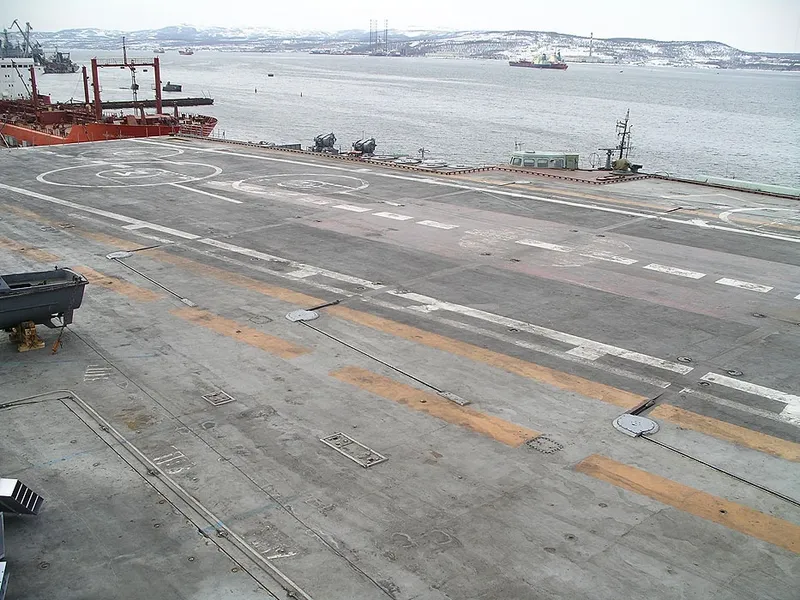
It is unclear what the main weapon on an aircraft-carrying cruiser is: aviation or strike missiles. The Kuznetsov is still more of a carrier than a missile ship, so aviation is considered the main weapon here. In theory, up to 40 Su-33s can be based on the ship. In fact the country coughed up for only 24, and for permanent basing it prepared, with enormous difficulty, only seven machines.
Our aircraft, unlike the more backward American ones, can only handle air defense tasks (although the Air Force has the universal Su-35), so the carrier performs the strike task with anti-ship missiles. Because of the ski-jump (instead of catapult) takeoff, restrictions are placed on the Su-33's takeoff weight. If you consider that (partly because of the main power plant) flights are conducted at a speed of 6-8 knots, it becomes clear why they happen only in windy weather and, as a rule, without external armament and with a reduced fuel load.
The ship has an automatic landing system installed, which in theory allows flights in any visibility, but in practice it has not been tested. So flights are carried out only in GOOD windy weather.
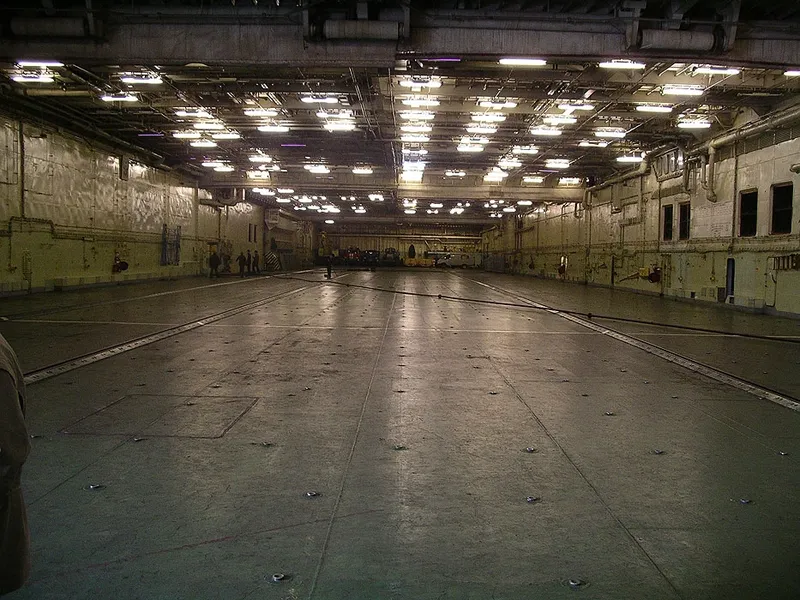
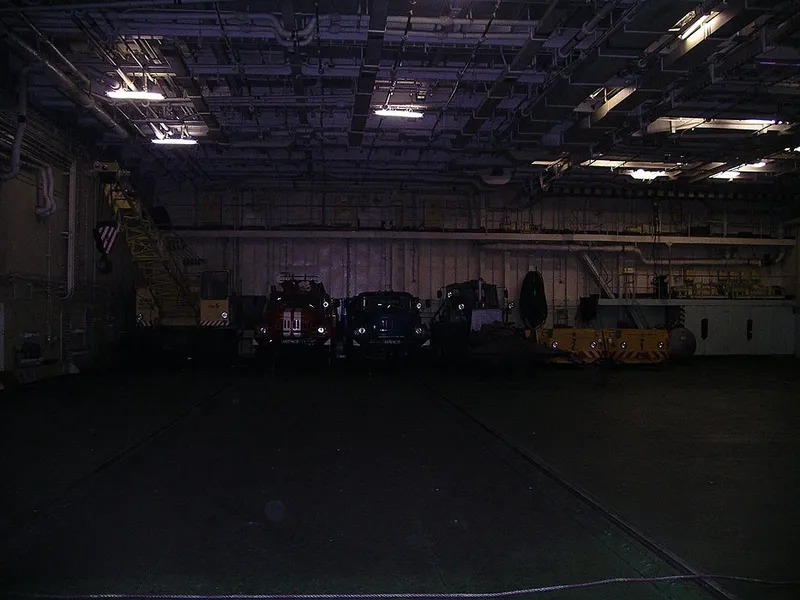
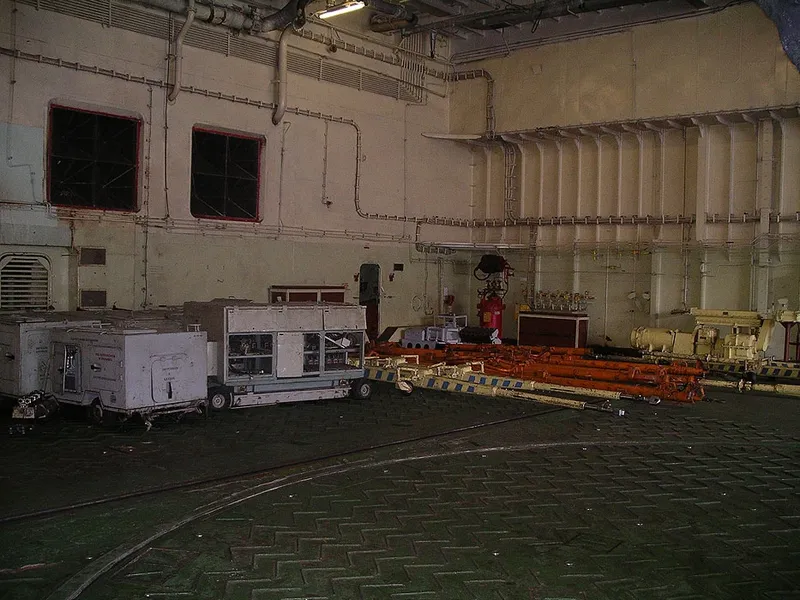
In general, the basing of aircraft on the Kuznetsov has a rather strange character. Aircraft do not even appear in the hangar, and instead of airplanes it peacefully holds: a 25-ton truck crane, four tow tractors, fire trucks (a GAZ-66 and a ZIL), a Gazelle, a UAZ-452, a jeep and a tractor with a jet engine mounted on it (for clearing snow and ice from the flight deck).
Our weapons
In the summer of 1998, on Navy Day, we were taking on fuel oil. You will ask: What does this have to do with weapons? Here is what: we took it not only into the tanks but also into one of the fire control posts. True, only 60 tons, and without malicious intent. The bilge crew apparently closed the wrong valve and went on taking fuel oil into an already full tank, whose loosely sealed neck was near the post in question. The post was flooded through that neck, and for some reason there was no BCh-2 watch in it. The sealed racks did not hold, and the post went out of action.
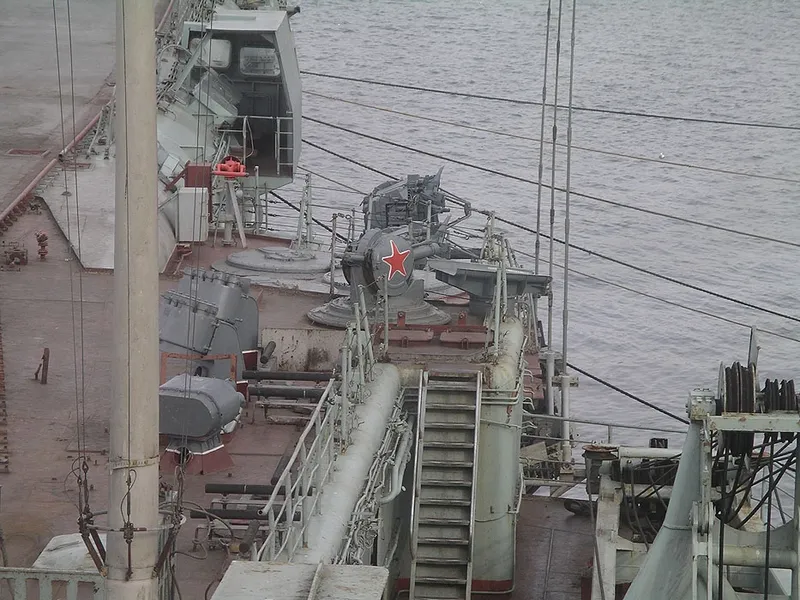
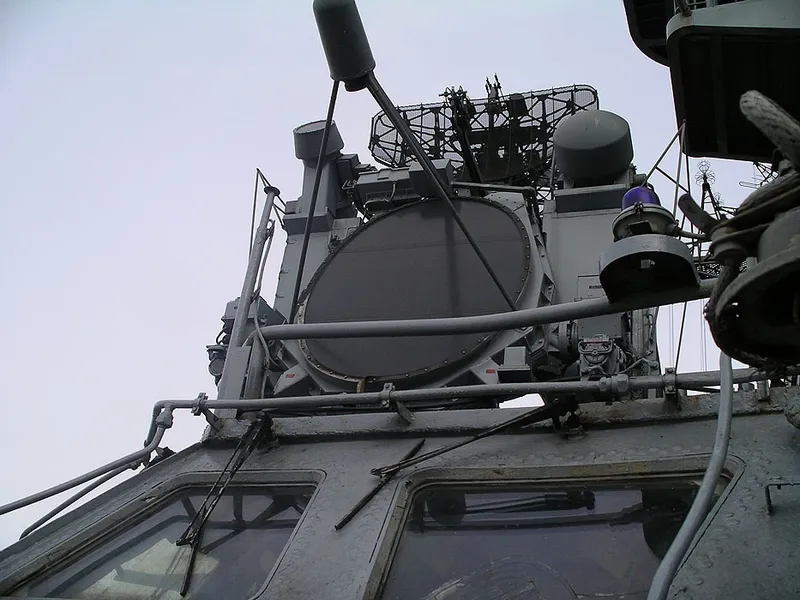
Two of the four SAM systems were also flooded in their time with seawater from the sprinkler system. It happened at night, a fistula appeared in a pipe, and all the compartments of both systems were flooded to the ceiling. All eight Kortiks need scheduled adjustment, for which there is no money. To crown all the troubles, the horizon-azimuth system is acting up. So we can shoot, but hitting...
And instead of a heart, a fiery engine
When people speak of BCh-5, they usually mean the main power plant. Let us talk about it.
First, one of the eight boilers and one main turbo-gear unit are temporarily out of order because of an explosion in the flue due to an operating error (before lighting the boiler they forgot to ventilate the flue). Thus, in theory, the power plant's output has dropped to 75%. But that is in theory, and in practice it is even less.
All four stern tubes leak, so the shaft-line bearings are periodically flooded, which limits the maximum revolutions. The power plant's automation exhausted its service life long ago, so the Kuznetsov smokes like an ironclad in a photograph from the beginning of the century. On top of that the pipelines are barely breathing, and the sailors who operate the power plant do not shine with professional skills and knowledge. As a result, instead of the almost 29 knots the Kuznetsov gave on trials, or at least 24, on three engines it barely holds 16-18, and usually no more than 10-12 knots.
The electrical side is in good shape too. Now a turbogenerator quits and the standby diesel generator cannot start, now something else happens. And the whole ship sinks into darkness. This looks especially piquant under way: the radars do not emit, there is no communication, the boilers die out: not an aircraft carrier but a Flying Dutchman. It was in just such circumstances that in the summer of 1998 the destroyer Bezstrashny nearly perished, and earlier the Kyiv. In both cases the ships were being carried toward the shore in a storm, and the power plant was brought back into service only by a miracle. On the Kyiv it happened 3-4 cables from the rocks...
Ship Repair Yard No. 35
The carrier's base should be mentioned too. Its official place is Ship Repair Yard No. 35 (SRZ-35). I do not know how things are in other fleets, but in the North no other ship has a permanent berth at a yard. For the Kuznetsov this is perhaps the ideal option, since otherwise it would have to be based in the settlement of Vidyayevo (where its regular berth used to be). There is nothing there except hills and a dozen shacks. Now the decommissioned Kyiv is living out its days in Vidyayevo.
Right next to us stands the Admiral of the Fleet of the Soviet Union Gorshkov. It once came to SRZ-35 for repairs, and its stern engine burned out. Now it is officially in mothballs, but in reality it is simply dying. Mothballing costs money too, so they just hung a padlock on the ship. The working day there ends strictly at 17.00, the crew is only 75 men, and the sailors go ashore on leave every day: not service but a fairy tale. So they stand half a cable apart, two antipodes, penal servitude and a resort of the Northern Fleet. Wondrous are thy works, O Lord!
SRZ-35 is not much suited to basing an aircraft carrier. Steam is supplied badly or not at all. The same goes for water, since the pressure is too low to deliver it to the tiers of the superstructure. Electricity is also barely sufficient: the shore supply is weak, and in winter, when the load on the grid rises because of the heaters, the shore power panel periodically trips.
But an account of SRZ-35 would not be complete without a word about the VOKhR, the plant guard. It is staffed by women of a certain age, the Balzac age, which, however, does not affect its combat readiness in the slightest: God forbid you fall into their female hands (it was no accident that the Winter Palace was defended precisely by a women's shock battalion). At the plant's checkpoint you will certainly be searched, sniffed (for the slightest whiff of alcohol) and, of course, checked for a pass. This is not the Kuznetsov. It is all taken to the point of absurdity. For example, large bags, backpacks and briefcases (even empty ones) may not be carried through the checkpoint without a special pass. But if you stuff them into a cellophane bag (even a two-metre one), you can carry them through without any pass at all.
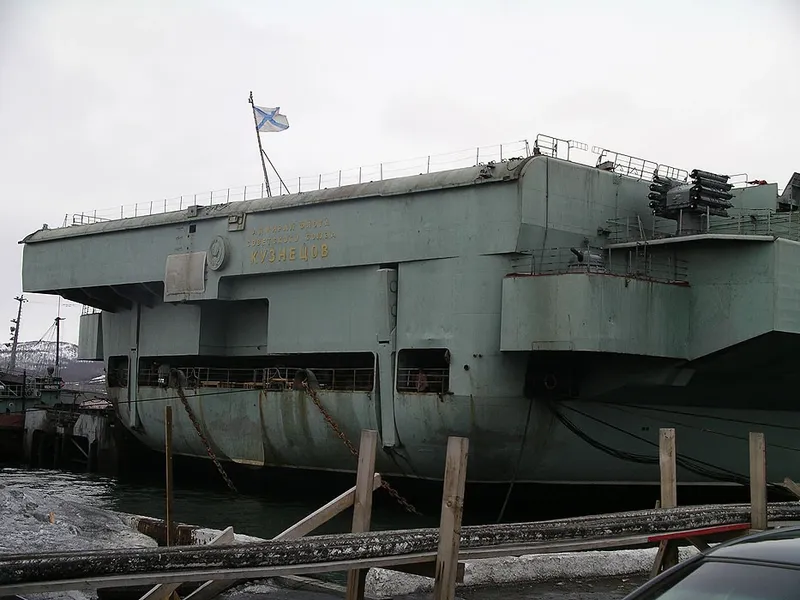
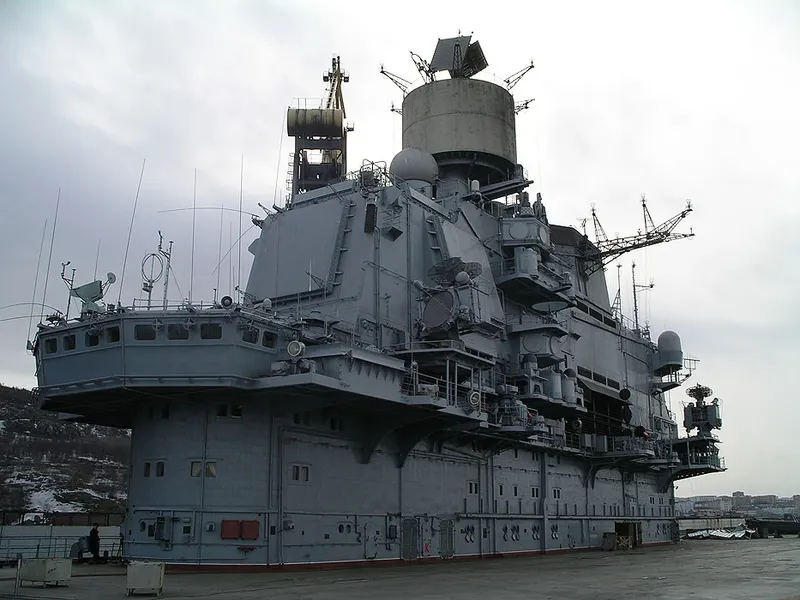
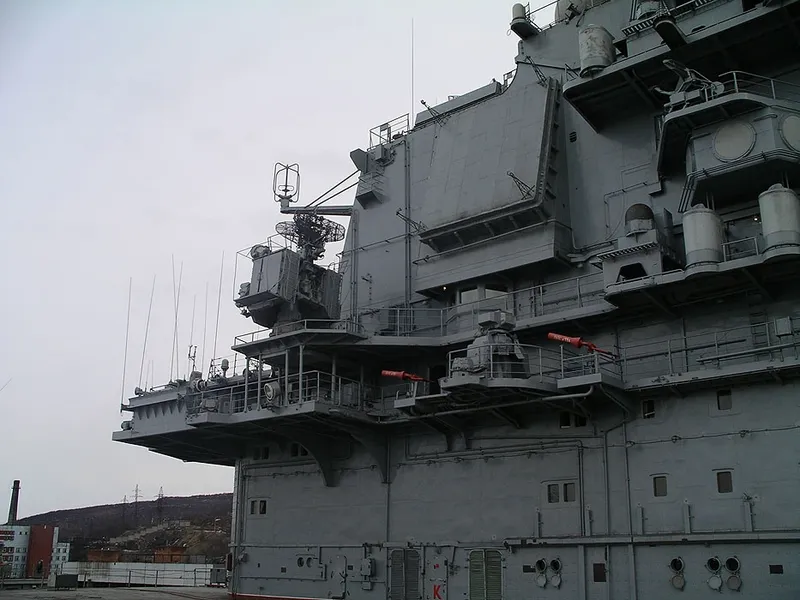
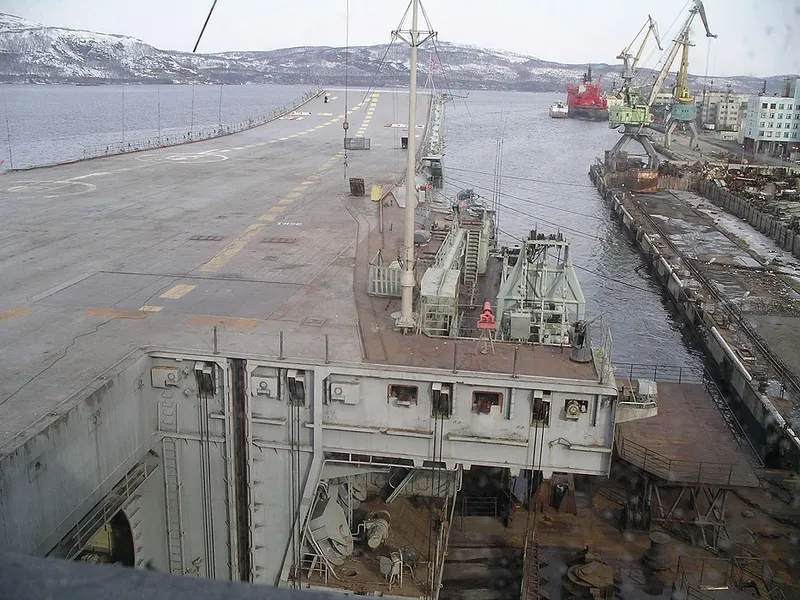
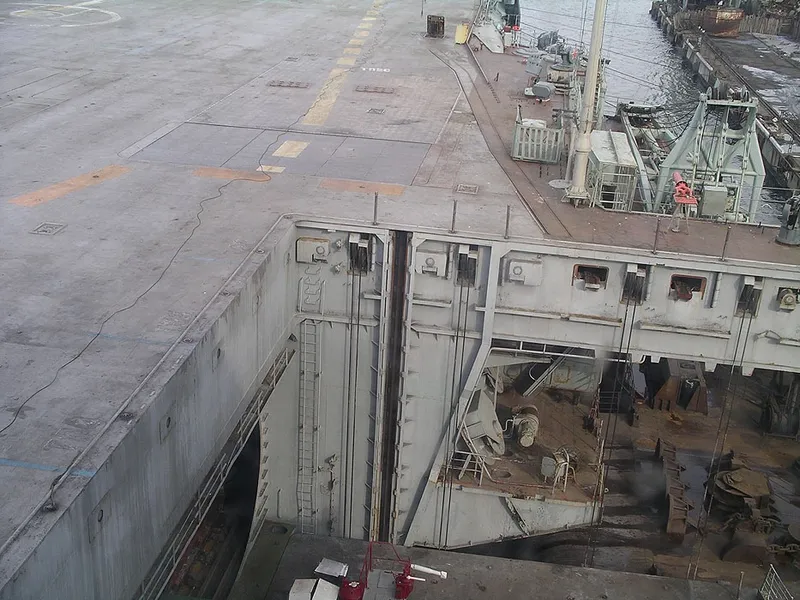
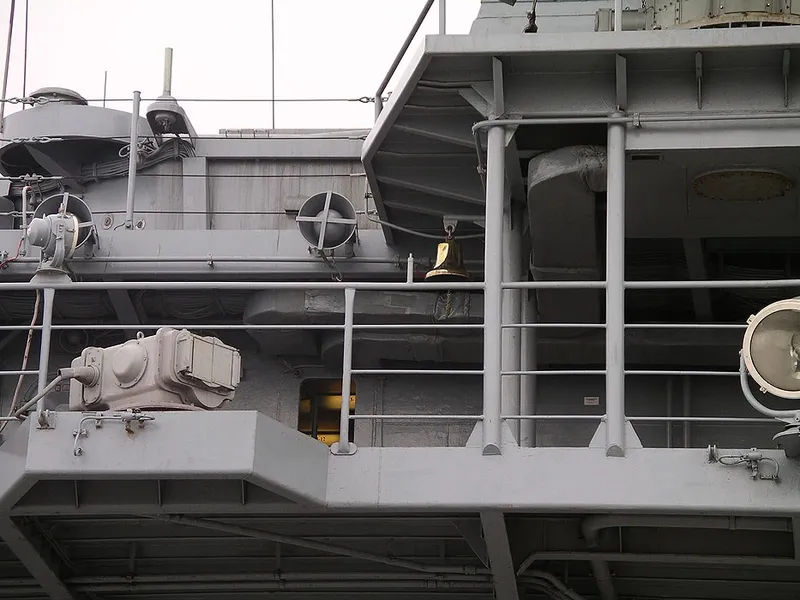
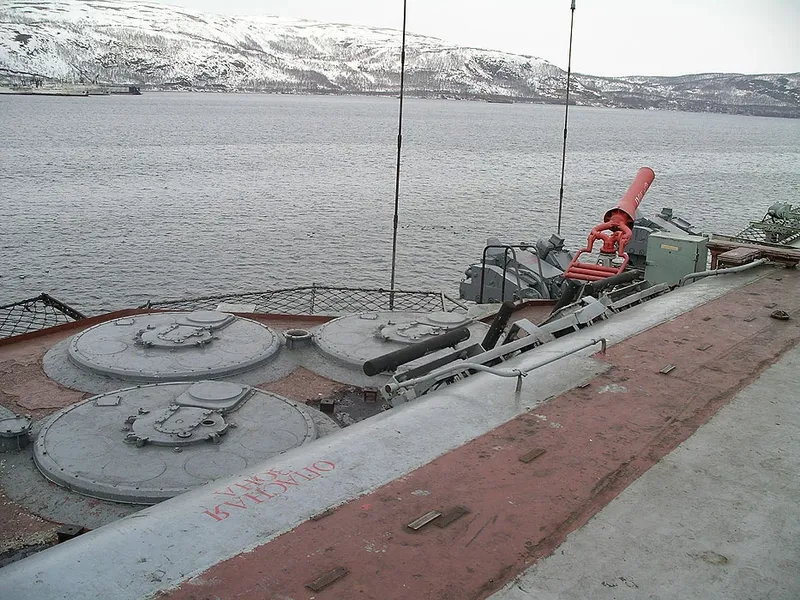
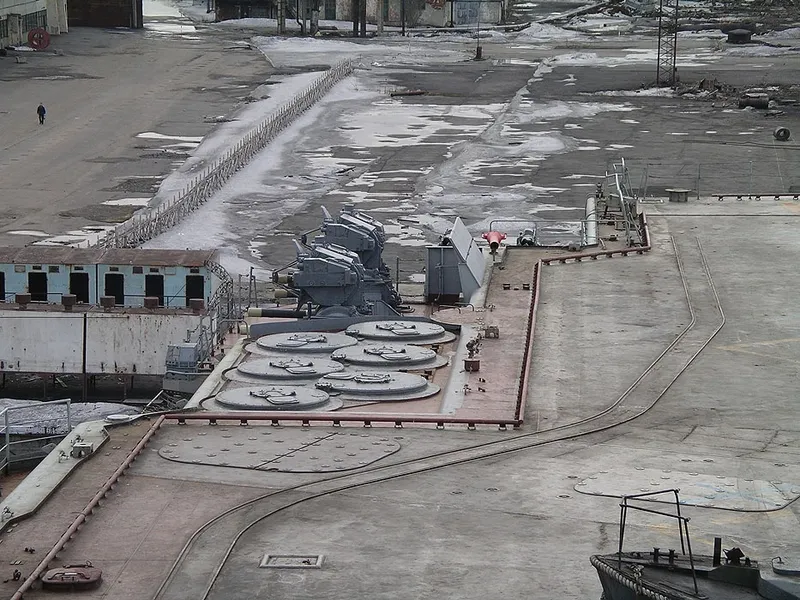
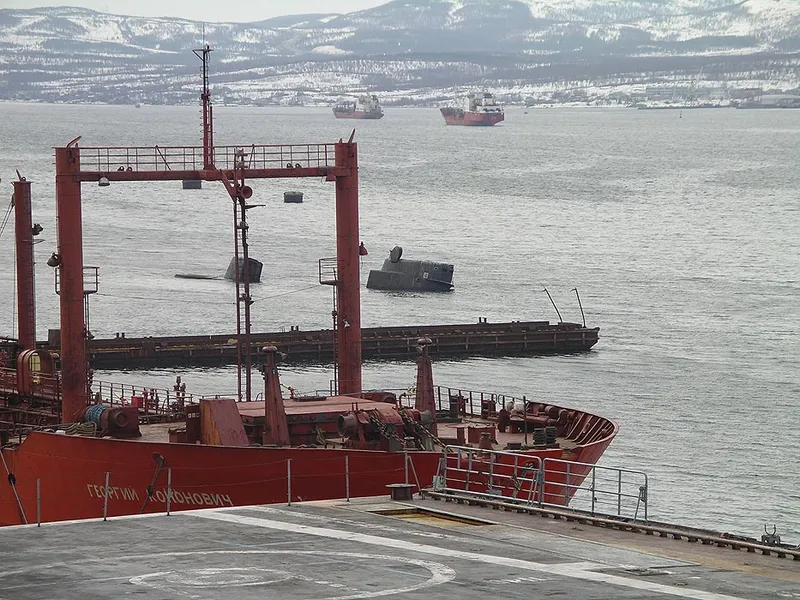
And next to it is a sunken submarine!!! I wonder, does anyone know what happened to it?
Now a little of the inside
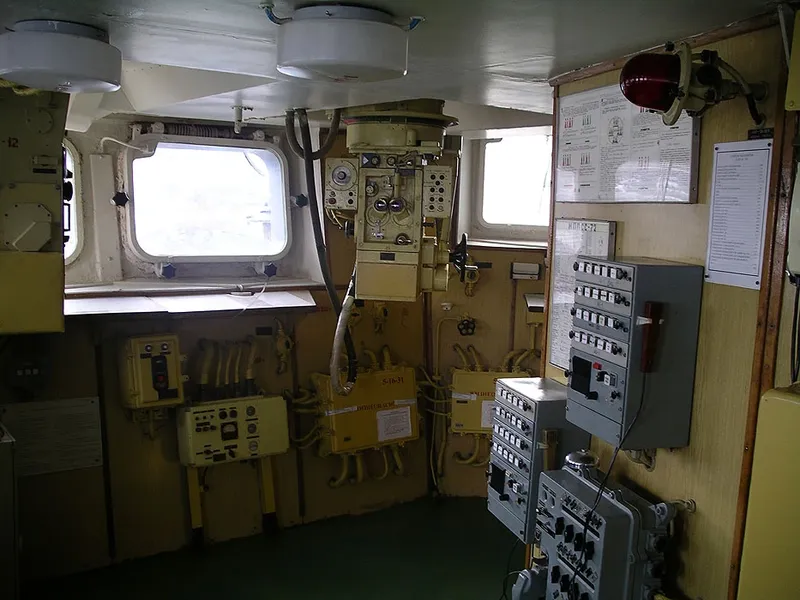
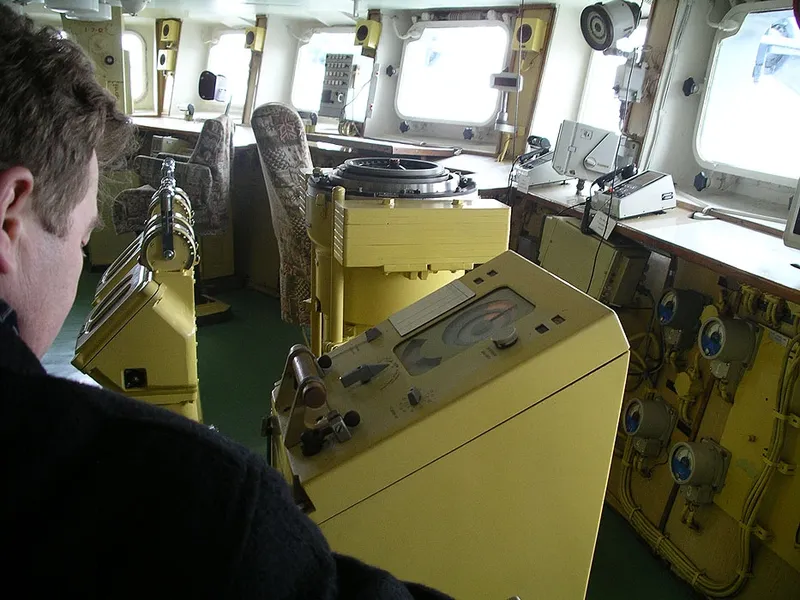
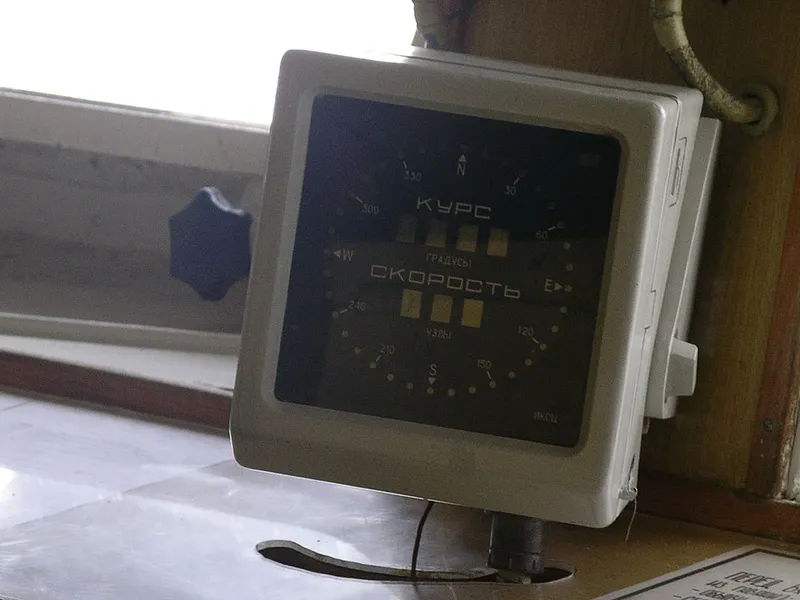
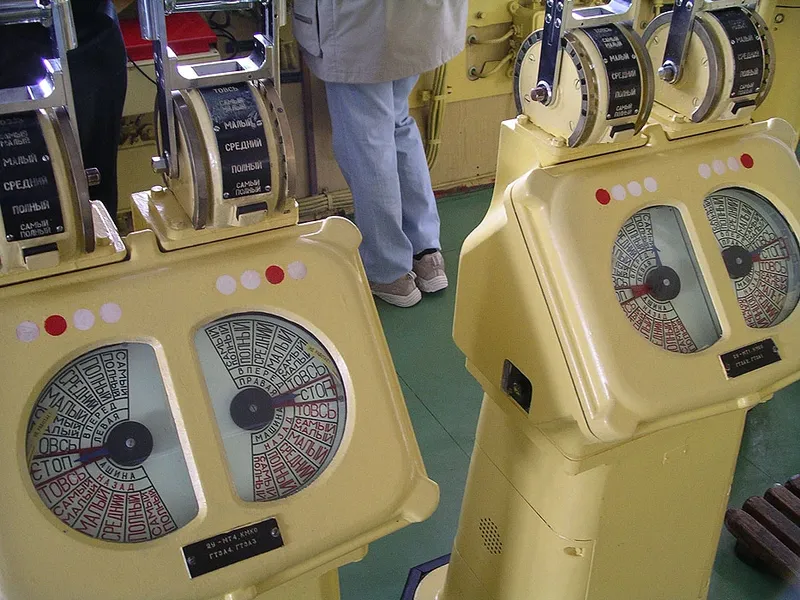
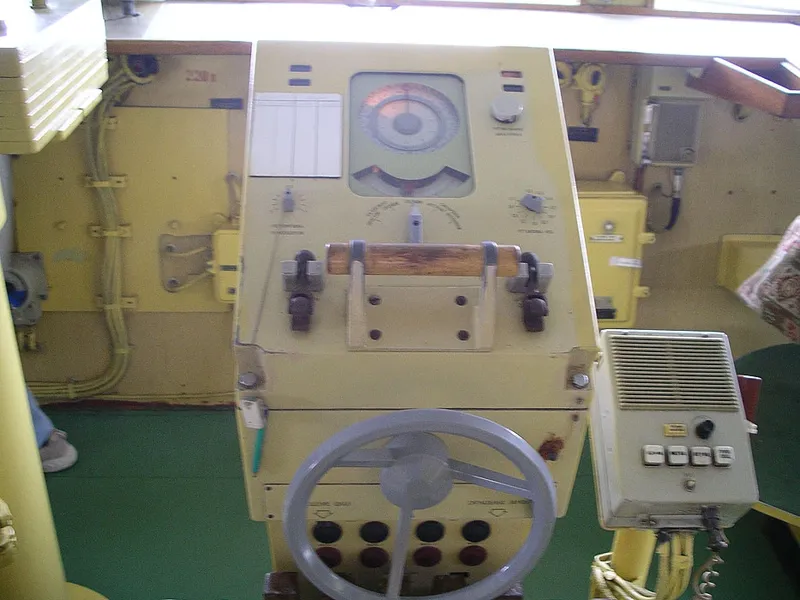
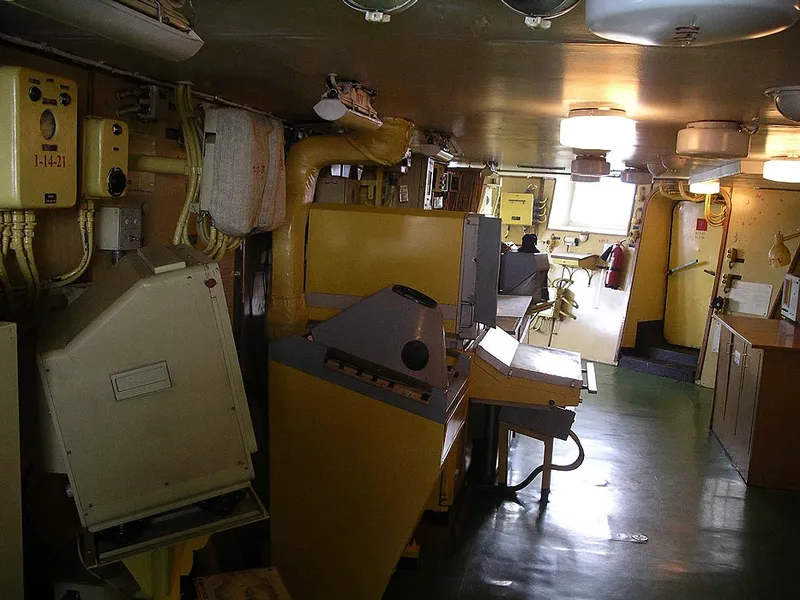
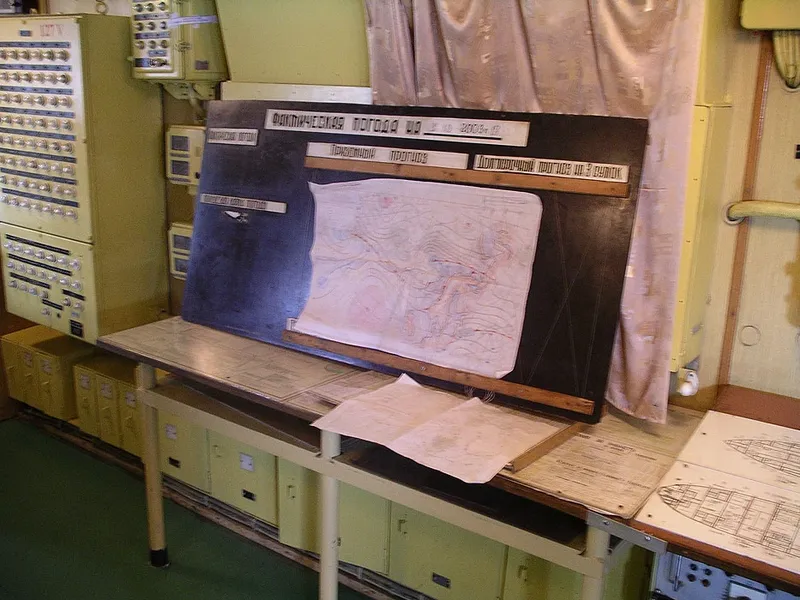
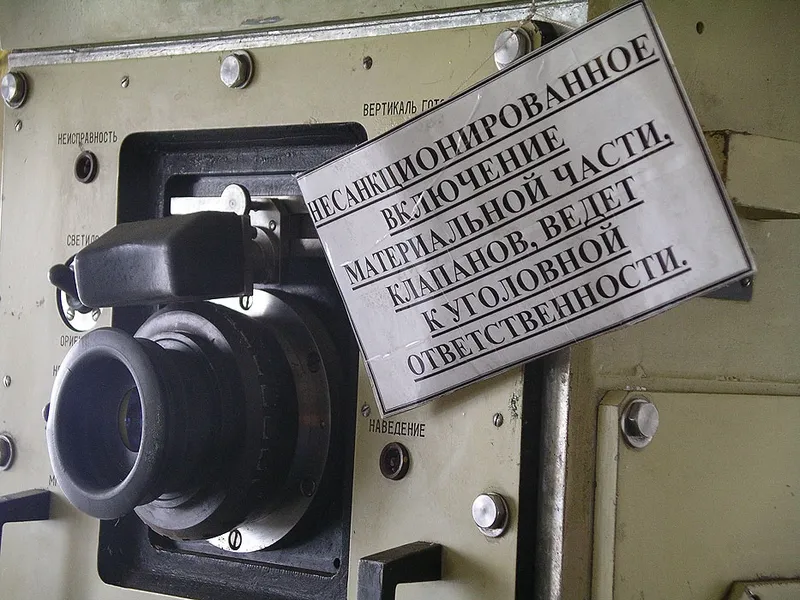
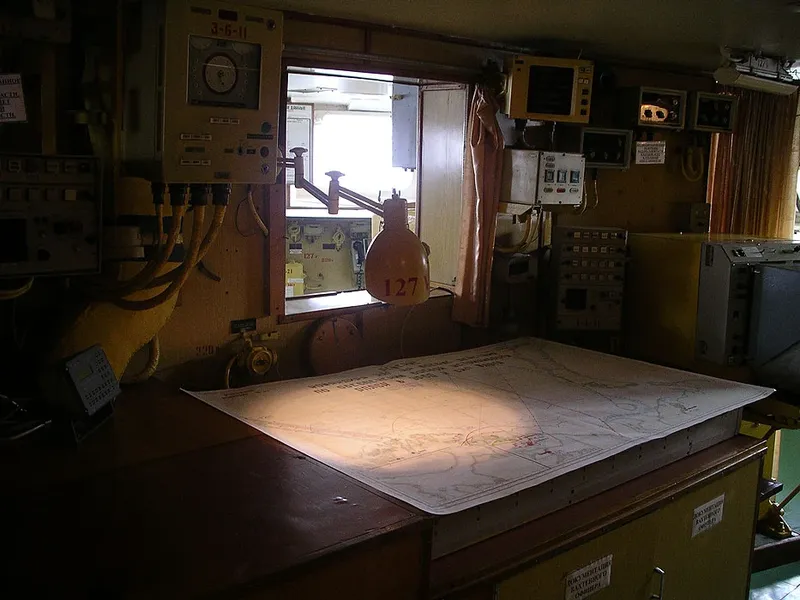
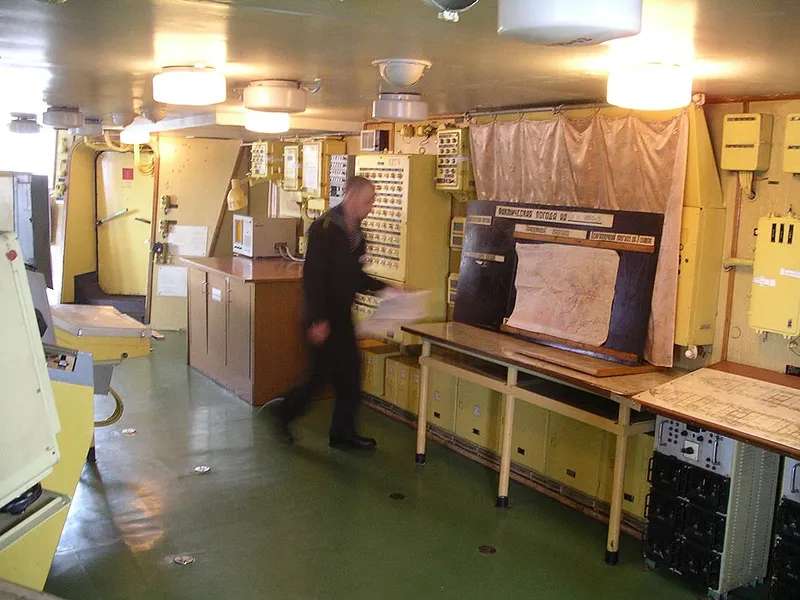
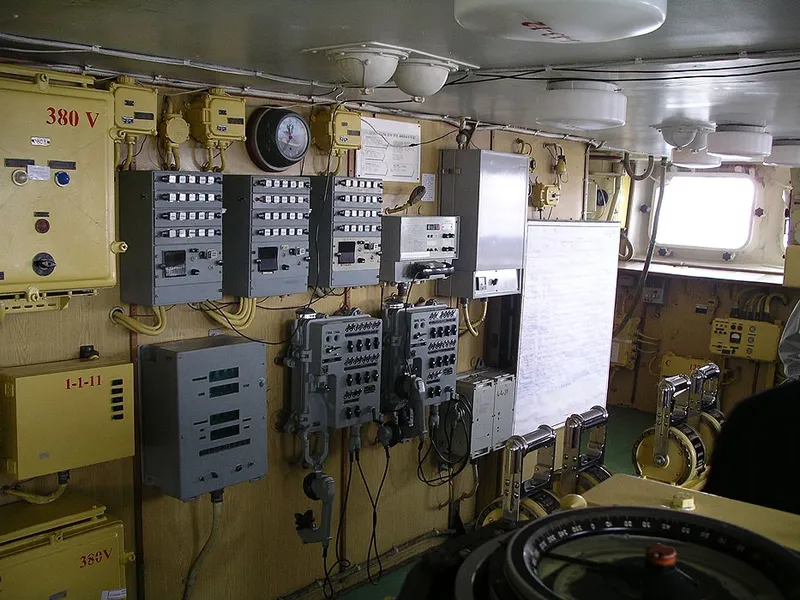
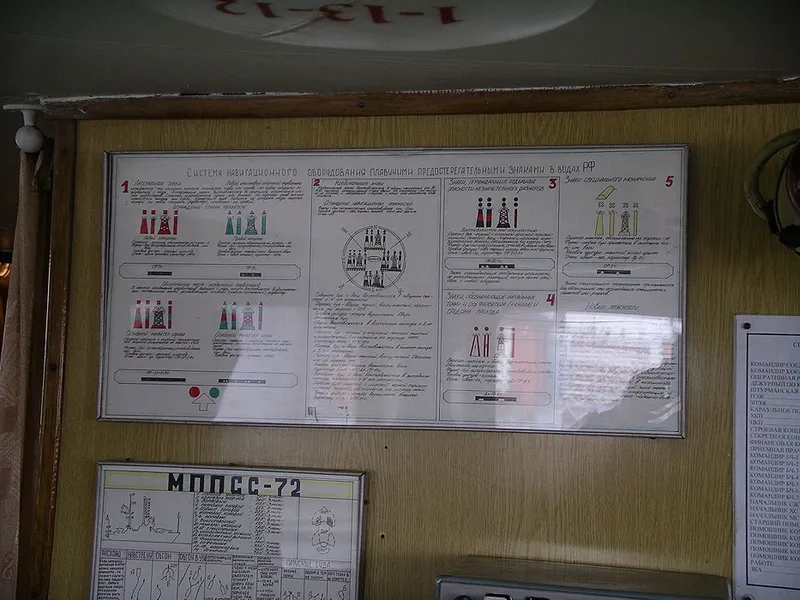
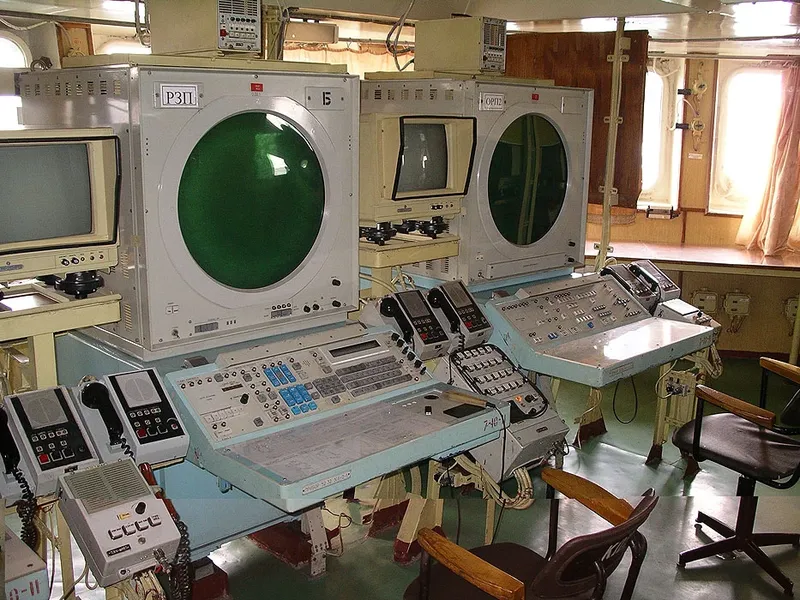
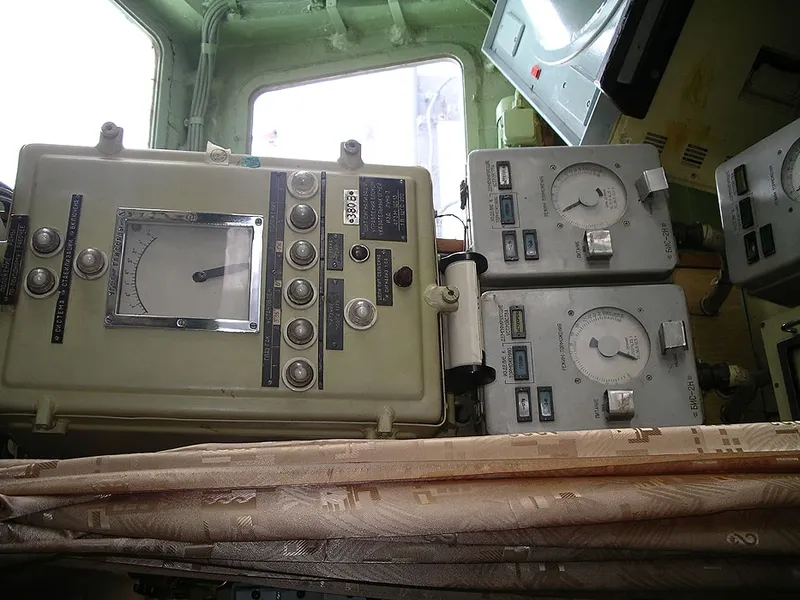
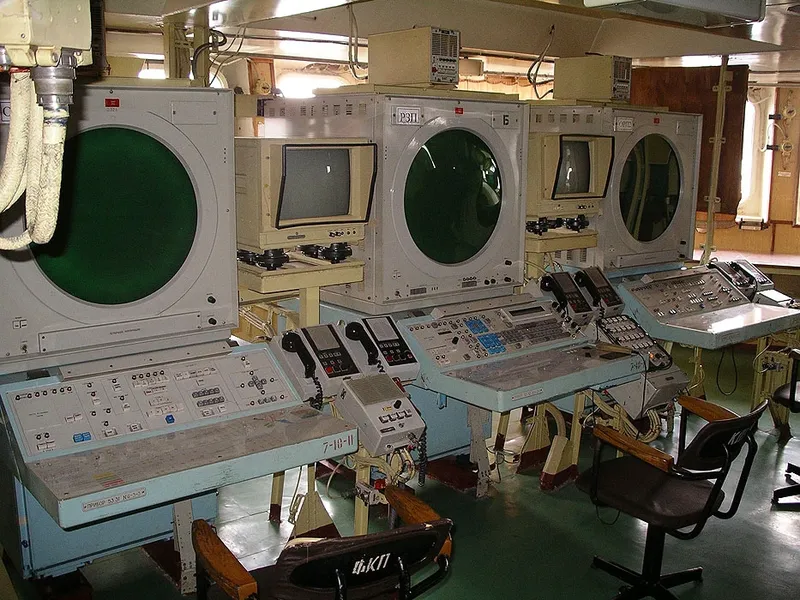
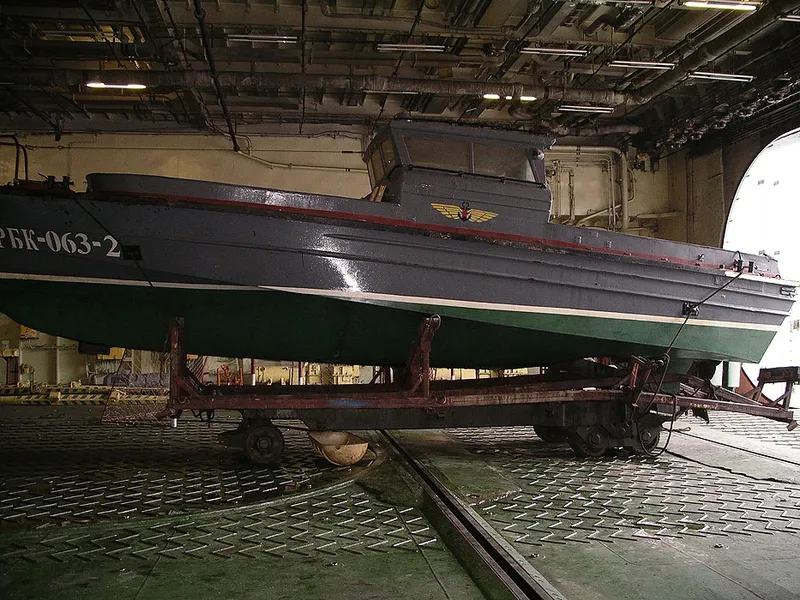
And a very little of the inner hangar. Empty. And fire engines :-)))
References:igor113.livejournal.com