War crimes of Soviet partisans in Belarus, the Baltics and Finland
War crimes of Soviet partisans in Belarus, the Baltics and Finland
On April 1, 2011, Vasily Kononov died. He was a former Soviet partisan who had been sentenced in Latvia to imprisonment for crimes he committed on the territory of the republic during the war of 1941-45.
The case of Kononov, who served two years and appealed to the European Court of Human Rights, caused an enormous outcry in the Russian Federation.
Official Russia backed Kononov in every way, both verbally, in speeches by the country's top officials, and in practice: it hired him a lawyer, organised demonstrations outside the Latvian embassy in Moscow and paid for the war criminal's funeral with the money of Russian taxpayers.
What was Vasily Kononov actually accused of?
The European Court obtained evidence that Kononov, while commanding a partisan detachment, gave the order to kill the civilian residents of the farmstead of Mazie Bati.
The heads of the families of Mazie Bati were suspected by the partisans of collaborating with the Germans and of handing over to them Chugunov's partisan detachment, which had earlier been shot by SS men in one of the farmstead's barns.
On the morning of May 27, 1944,
Kononov's detachment split into six groups, and each of them wiped out one of the six families living on the farmstead.
Among the residents who were shot and burned alive there were three women, one of whom, Fekla Krupnik, was in her ninth month of pregnancy.
She tried to escape into the forest, but was caught by the partisans and thrown through the window of her burning house, where she burned together with her husband, who had been shot.
The next morning residents of a neighbouring village found her charred skeleton among the ashes, next to the skeleton of her unborn child.
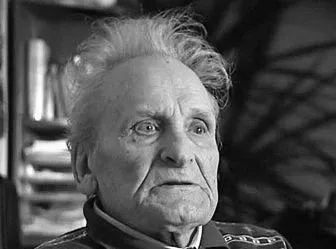
The war criminal Vasily Kononov before his death
Although Soviet and present-day Russian propaganda portray the partisans as kind, noble and selfless fighters against fascism, supposedly fleeing to the forests to avenge themselves on the occupiers for their atrocities, reality was far from this lurid picture.
And the war crime of Kononov and his detachment is not an exception, but only one of a huge number of similar atrocities committed by Soviet partisans during the war.
Many of these partisans, Kononov's detachment included, were saboteurs sent into the German rear on Moscow's directives to carry out scorched-earth tactics, under which depriving civilians of shelter and even killing them was considered necessary if it inflicted damage on the enemy.
For example, the first point of Stavka of the Supreme High Command order No. 0428 of 17.11.1941 reads:
- Destroy and burn to the ground all inhabited localities in the rear of the German troops to a depth of 40-60 km from the front line and 20-30 km to the right and left of the roads.
- To destroy the inhabited localities within the stated radius, immediately send in aviation, make wide use of artillery and mortar fire, teams of scouts, skiers and partisan sabotage groups equipped with bottles of incendiary mixture, grenades and demolition means.
Some of the partisans' atrocities were routinely recorded by the German occupation administration and by the competent Soviet bodies, and some of these records are still kept in archives today:
2nd Directorate of the SD. To the commander of the secret police and SD, Hauptsturmführer Gese, in Pinsk
On 5.4.43 bandits took the seamstress Kravchuk away from the village of Mukoshin.
The girl was later found dead in the forest, her head, chest and whole body slashed open several times.
Her eyes had been gouged out. Her genitals had been cut up.
What prompted the bandits to treat the girl in this way is unknown.
Two bandits shot the sister of one of the policemen in square 19, top left.
RGASPI. F. 69. D. 824. L. 20-23.
The 7th battalion of Saburov's detachments has arrived in the area of our operations.
The partisans of this battalion engage in unheard-of robbery, banditry and drunkenness, and drive around the villages in the uniform of German soldiers.
Residents who run away to the forests are shot.
Reports and correspondence of the NKGB and the Central Staff of the Partisan Movement, Jan. 43-Dec. 43. RTsKhIDNI.
It is no wonder that the Russian authorities do not want to open archives even from 70 years ago!
Here is what the Polish historian Bogdan Musial writes in the Frankfurter Allgemeine Zeitung of June 21, 2004:
In the course of the fight against the partisans in Belarus, up to 350 thousand people perished, not counting the Jews who were killed.
These crimes have been well studied.
However, the fact that the partisans, too, often treated their own population cruelly is almost unknown.
They, too, terrorised entire districts, burned villages and towns, killed civilians and carried out punitive expeditions.
Thus the population was caught between the hammer and the anvil.
Some inhabited localities were pacified in turn, now by the Germans, now by the partisans, as, for example, the little town of Naliboki, 120 km from Minsk.
But whereas the Germans arrested and shot only the instigators of disorder, the partisans killed everyone indiscriminately.
Thus on May 8, 1943, partisans attacked a strongpoint of the self-defence force organised by the Germans.
They killed 127 civilians, including children, burned buildings and drove off almost 100 cows and 70 horses.
Let us note in passing that the massacre at Naliboki was carried out by the partisan detachment of Tuvia Bielski because the local population cooperated with the Home Army, loyal to the Polish government in exile, and did not want to submit to the partisan centre in Moscow.
Hollywood made the film Defiance, which differs little from Soviet propaganda about the war and glorifies the Bielski brothers who commanded the detachment, thereby provoking protests from Poles, who consider the Bielskis thugs and murderers of the civilian population.
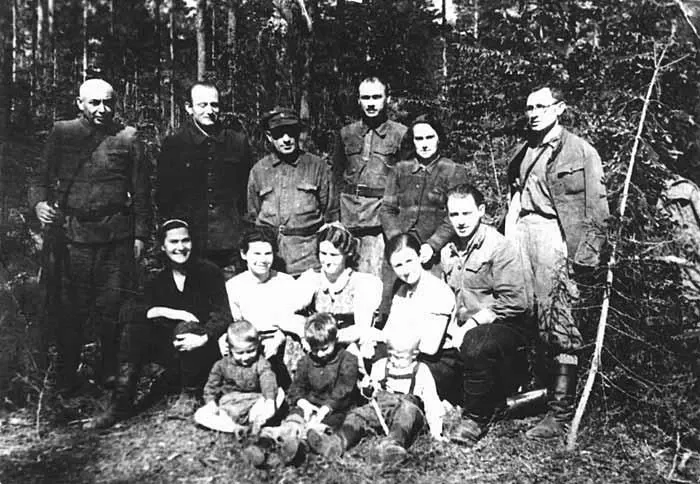
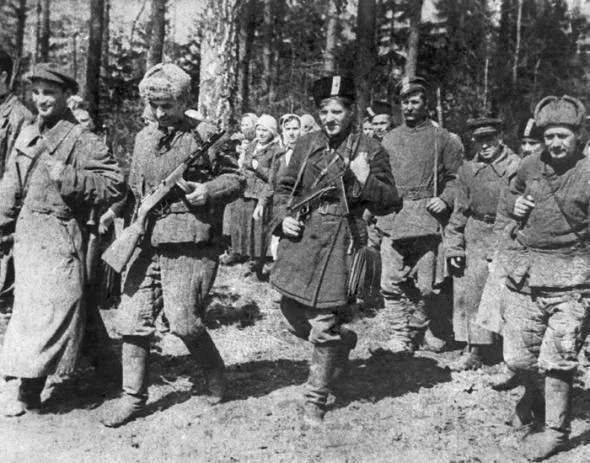
Tuvia Bielski, third from the left, at the head of his partisan detachment
A particular problem was created by the fact that the partisans had to feed themselves.
They obtained food and clothing from the local population.
During these supply operations the partisans often behaved like ordinary robbers, or at any rate that is how the population perceived them.
They requisitioned women's underwear, children's clothing, household goods, things of little use in the forest.
But these could be exchanged for alcohol or given as presents to the women partisans.
Most of the partisans' military operations were in any case directed not against the German occupiers, but against real or imagined collaborators and their families, and also against everyone who was well disposed to the Germans and was anti-Soviet.
And who was anti-Soviet, the partisans decided themselves.
On the agenda were shootings, rapes and robberies. On February 22, 1943, Mikhailov's detachment killed about 70 civilians in the village of Chigrinka in the Mogilev district, east of Minsk.
This detachment was also responsible for robberies, rapes and shootings.
According to a report by a senior Red Army officer made in June 1943, Batya's detachment, which operated about 200 km from Minsk, terrorised the civilian population.
In particular, on April 11, 1943, they:
Shot entirely innocent families of partisans in the village of Sokochi: a woman with a 12-year-old son, whose second son, a partisan, had died earlier, and also the wife of one partisan and her two children, aged two and five.
Another report says that in April 1943 the partisans of Frunze's detachment, operating north of Minsk, shot 57 people in the course of a punitive operation, including infants.
Some partisan detachments burned several inhabited localities at once, like, for example, Commissar Frolov together with his partisans, who operated in the Vitebsk region.
In April 1943 they turned many villages to ashes, and shot civilians and other partisans.
And this was far from an exception.
The burning of villages by partisans and the shooting of women with children were indeed a fairly frequent occurrence.
Here is a letter that readers sent to the Belarusian newspaper Nasha Niva in 2000:
We lived in a small town in western Belarus.
Sometime in the fifties, when I was going to school, I said at home that the village of Borki had been burned by the Germans.
Then my mother told me that the village of Starozhevshchina and the village of Borki in the Ivatsevichi district had been burned by partisans.
We had no relatives in Starozhevshchina, so we did not know the details.
But in Borki lived the large family of my mother's own brother.
And on a small farmstead near Slonim lived their sister.
These partisans often came to the farmstead and even left their wounded there.
That is why they warned her that if she had relatives in Borki, Let them run away!, but there was the war, six small children...
And the family stayed in Borki.
The self-defence men did not let the partisans into the village from the forest side, so they entered from the side of the small town.
When my uncle's wife saw two partisans coming to burn the house, she went out to meet them:
Boys, don't burn the house, look, there are six children sitting by the trench!
One partisan fired into the air and shoved the mother of six children aside with the words: Get out of the way, you bitch!
And the other corrected him, declaring: Is that how you hit? This is how you hit! He struck the woman with a rifle butt, then shot the Belarusian mother of six and burned down their house.
Perhaps that killer is alive to this day and has received privileges as a veteran.
But such war crimes have no statute of limitations.
It is interesting that the very fact of deliberately killing women and children solely because they were members of the families of policemen is to this day regarded by former partisans as something normal and not subject to condemnation.
Here is how the former partisan Yakov Isaakovich Shepetinsky assesses his own participation in the shooting of women and children:
Were the families of policemen also destroyed?
Not always and not everywhere.
But it happened often enough, why hide it now... I personally felt no pity for them.
They burned our small Jewish children alive and tore them to pieces, so why should I have worried about the policemen's spawn?
We exterminated all the police seed, their whole breed.
An eye for an eye...
Killing civilians, the relatives of traitors, in a brutal partisan war is almost an ordinary thing...
And you know that without me. It's just that many people don't want to talk about it.
But it is well known that the partisans destroyed not only the families of policemen.
Thus, according to Finnish documents cited by Veikko Erkkilä (Veikko Erkkilä, (1999) in Vaiettu sota, Arator Oy, ISBN 952-9619-18-9), Soviet partisans in Finland killed about two hundred civilians, mostly women, children and old people.
The attack by Soviet partisans on the farmstead of Lyamsyankyulya became well known: the partisans herded the farmstead's residents into a wooden house and burned it.
As a result of the raid seven civilians died, including two children aged six and three.
In the village of Laanila in northern Finland on July 4, 1943, Soviet partisans fired on a hotel and a truck carrying civilians, as a result of which more than 10 people died.
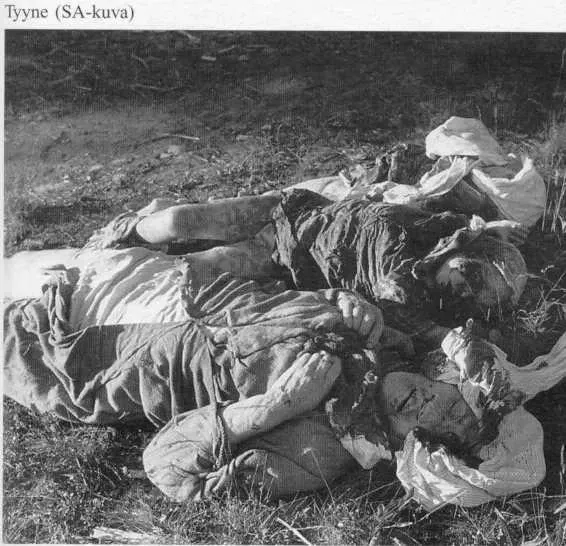
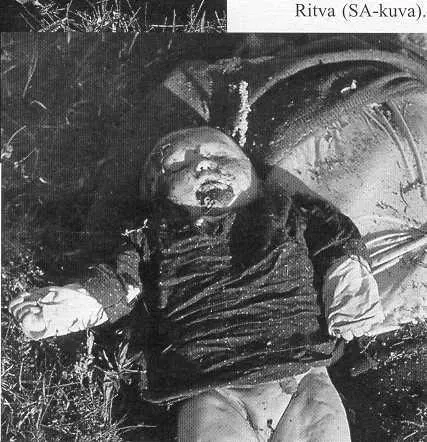
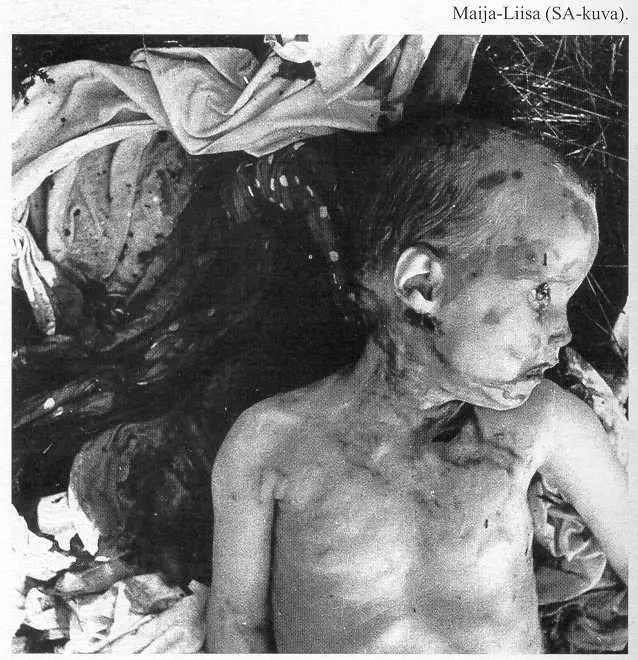
Civilians in Finland killed by Soviet partisans
Instead of hunting down and punishing war criminals among the partisans, the authorities of the former USSR openly repress those who publish the truth about the partisans' atrocities. One example is the journalist and local historian Viktor Khursik, who in his book Blood and Ashes of Drazhno described the destruction in 1943 of a Belarusian village by the partisan detachment of Israel Lapidus, part of the brigade of Brigade Commander Ivanov.
The partisans attacked the village and shot, stabbed and burned alive civilians indiscriminately.
The author backs up the testimony of the surviving Drazhno villagers with documents from the National Archive of the Republic of Belarus.
The story of the partisans' outrages in Drazhno became widely known when, in mid-April 2008, activists of the Belarusian Voluntary Society for the Protection of Historical and Cultural Monuments erected a memorial cross to the civilians of this village who were brutally killed.
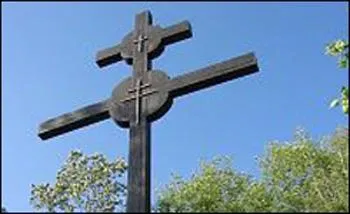
The cross stood by the fence of the Catholic cemetery in the village of Drazhno for only a few days.
The politician Vyacheslav Sivchik, the priest Leonid Akalovich and the journalist Viktor Khursik, who took part in putting up the memorial, were sentenced to 15 days of arrest.
The cross was dug up and taken by tractor to the neighbouring village of Zaluzhye.
The cross put up in Drazhno in memory of the partisans' victims
Here is what one of the witnesses of that massacre tells:
The shots woke us at about four in the morning on 14 April 1943.
Mama was shouting: Children, we're on fire!
We ran out into the yard naked and looked around: all the houses were burning, shooting, screaming
We ran to hide in the vegetable garden, and Mama went back into the house, she wanted to bring something out.
By then the straw roof of the house was already ablaze.
I lay there without moving, Mama was a long time coming back.
I turned around, and some ten people, even women, were stabbing her with bayonets and shouting: Take that, you fascist scum!
I saw them cut her throat.
Katya, my sister, jumped up and begged: Don't shoot! and took out her Komsomol card.
Before the war she had been a Young Pioneer leader, a convinced communist.
During the occupation she had sewn the card and Father's party membership card into her coat and carried them with her.
But a tall partisan in leather boots and a uniform began to aim at Katya.
I cried out: Uncle, don't kill my sister!
But a shot rang out.
My sister's coat instantly soaked through with blood.
She died in my arms.
I remembered the killer's face forever.
I remember crawling away.
I look, and three partisans have thrown our neighbour Fekla Subtselnaya, together with her little daughter, alive into the fire.
Aunt Fekla held her baby in her arms.
Further on, at the door of a blazing house, lay old Grinevichikha, burned and bloodied
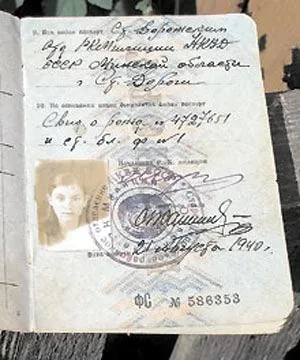
The passport of Valentina Shmatko, killed by partisans from Lapidus's detachment
Viktor Khursik does not consider this unflattering story, in which the partisans appear as criminals, a journalistic sensation.
Do you think I am the only one who knows these facts?
In any village they will tell you in a whisper how the partisans robbed, shot people for their clothes, for food or just like that, how they carried on drinking and raped.
Many facts were recorded by the staff of the special departments of partisan detachments and brigades, and are kept in the archives.
My role in this story is that of a transmitter.
I simply gave voice to facts that are quite well known.
The only thing that looks sensational in present-day Belarus is that, contrary to the official view of the partisan movement, a different view suddenly appeared...
But we are still very far from putting up a monument to the nameless peasant woman whose husband was fighting at the front while the partisans plundered her farmstead.
It was in the village of Khozyaninki in the Pukhovichi district that the detachment commander Pisarchik shot a mother and her small children because the woman, tormented by levies, could not bear it...
Russia, Belarus and even Ukraine are further still from calling criminal partisans criminals and trying them for their crimes.
Of all the republics of the former USSR, justice is timidly trying to prevail so far only in the Baltics.
References:nationalliberal.livejournal.com