However funny it may sound, the Chekists have a rule: never trust traitors.
It was 23 February 1944 when SMERSH senior investigator Captain Vasilchenko came to search the home of 26-year-old Vladimir Medvedchuk, a resident of the Zhytomyr village of Kornyn.
He had personally petitioned his superior, Captain Pugachev, for this detention the day before, noting that "Medvedchuk's criminal activity requires comprehensive verification and investigation" and that this man should therefore be taken into custody "to establish his identity."
Vladimir Medvedchuk was charged under three articles: armed uprising, anti-Soviet propaganda and agitation, and participation in a counter-revolutionary organization. Who was he, then, and what had he been doing to arouse suspicion? The answer can be found in the records of his interrogation.
The detainee told the investigator that he had started work at the age of 15: he was a clerk at the local administration, but not for long, because after a year he was forced to leave the post because of illness.
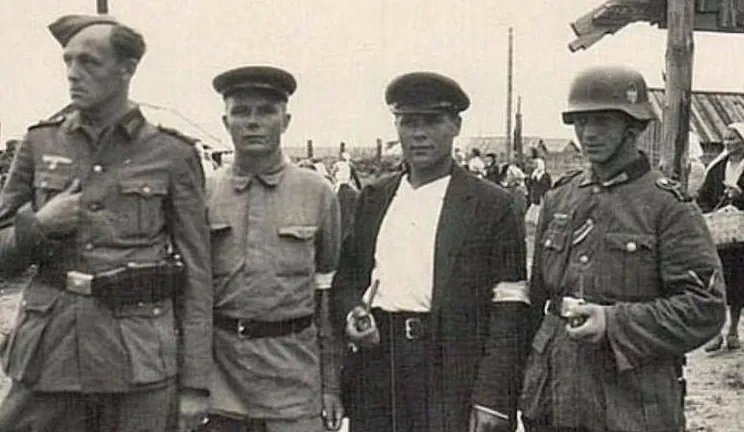
On 14 July 1941 the Germans occupied Kornyn. Already in December Vladimir Medvedchuk voluntarily came to Dyatel, then head of the Kornyn district administration, asking to be given a job. He was refused.
He tried to get a job there a second time in March 1942. This time the head of the district administration, Dmitry Grabar, took Medvedchuk on as a statistician in the land department. Vladimir stayed in that role until autumn, after which he transferred to the finance department as a bookkeeper and worked there, by his own account, until the German troops left Kornyn, that is, until 5 November 1943.
But was Medvedchuk, during his work in the occupation district administration, involved in the deportation of local residents to forced labor in Germany? He himself insisted that he had not cooperated with the labor department, which compiled the lists of Ostarbeiters; from April 1942 to May 1943 almost 1,700 people in total were sent away from Kornyn.
At the same time, another suspect in the case, Valentin Prevar, who headed that labor department, stated that Medvedchuk had been one of his scribes.
This information was also confirmed by local residents, who said that during the German occupation only five peasants decided to serve the fascists and became policemen. One of those policemen was Vladimir Nesterovich Medvedchuk. In the service of the fascists he was responsible for two areas:
- collection of the food tax, that is, when grain, cattle, poultry and pigs were taken away from the peasants;
- forced deportation of able-bodied Ukrainian youth to work in Germany. In two years of "fruitful" work the executioner sent about two thousand of his fellow citizens to Germany.
After the liberation of the village, all the traitors but one were shot by decision of a military tribunal. As you have already guessed, the one who was unfortunately left alive was none other than Medvedchuk, who in April 1944 was sentenced first to 8 years in prison and then to another four years of exile in Siberia.
Because he had betrayed the Chekists and served the fascist occupiers, he was offered, in order to rehabilitate himself, work while in exile, where he became an informer and exposed the activity of Ukrainian nationalists who were also exiled there.
Medvedchuk Jr. did not stray far from his father: from the age of 18 he cooperated with the KGB, helping to identify and subsequently convict Ukrainian patriots.
However diligent and useful to the KGB the Medvedchuks may have been, they were always traitors. And the agency has never been able to stand such people.
That, in fact, is why Medvedchuk has no permission to run for president, but there is no ban on the premiership.
That is why the roles in the Boiko-Medvedchuk tandem were distributed as they were: Boiko is president (a ceremonial figurehead), Medvedchuk is prime minister (the Kremlin's viceroy in Ukraine).