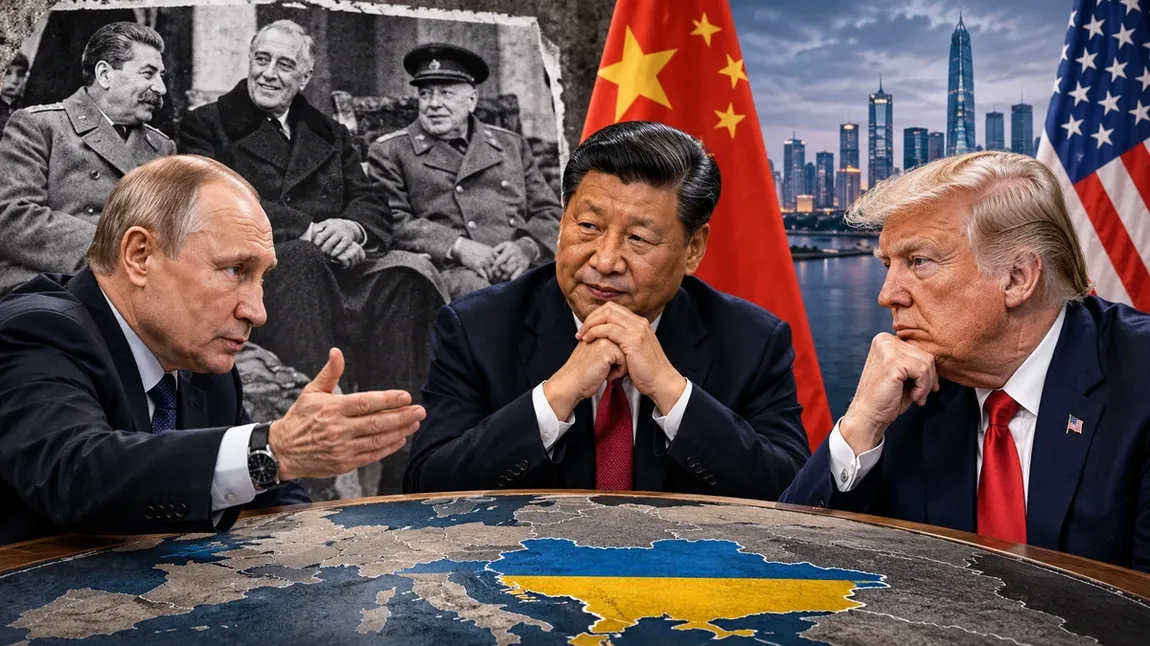
On November 18 the APEC summit opens in Shenzhen, China. Putin and Trump both plan to attend, and Xi Jinping is the host. The three have never sat down together, yet the meeting that has not happened already has a nickname: "the new Yalta."
https://youtu.be/IUzcJB7QlxI
The idea came from the Kremlin. On September 1 Putin's foreign policy aide Yuri Ushakov told Russian state TV reporter Pavel Zarubin that Putin and Xi had discussed it the day before. Ushakov retold the conversation as if the offer had come from the Chinese leader. In his version, Xi remarked that both Trump and Putin would be coming, "and if it works out, as was said, a meeting of the three could be arranged." Who exactly said it, Ushakov did not specify.
On October 9 Putin proposed the meeting to Trump by phone. The account comes from a former Russian intelligence officer briefed on the call. He also explained the design: Putin sees Shenzhen as a new Yalta, where the great powers divide the world into spheres of influence.
10 days later Trump replied that he would come but wanted to talk about nuclear weapons. Ushakov promised that "our Chinese friends" would put the meeting on the program. Beijing kept silent for 2 months and only on November 4 admitted that it was "maintaining communication with the relevant parties."
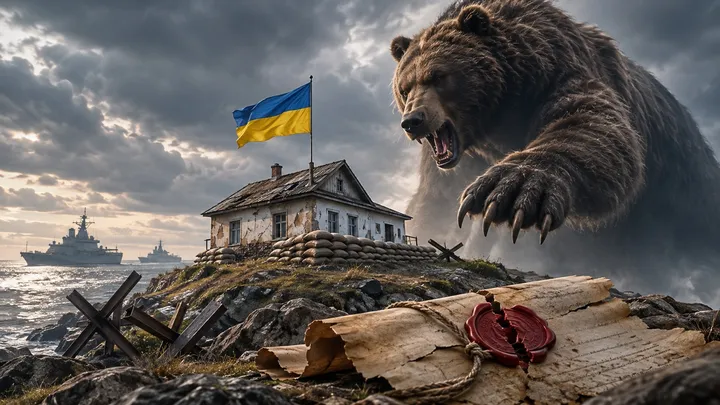
Why does Putin need a third man? Moscow and Washington have been bargaining over Ukraine since January, and their negotiators meet in Abu Dhabi with the Ukrainians in the room. If this were only about Ukrainian land, China would not be required.
But Putin wants more. He wants to repeat the deal Moscow struck at Yalta in February 1945. Back then it was paid in someone else's land for going to war against a third country, and nobody asked the owner of the land. Today the land is Ukrainian, the job Moscow offers is against Europe, and America is supposed to pay. China is needed as the witness: without its signature, what was seized stays merely seized. The trouble is that in 1945 the land was taken from China, and Beijing remembers.
To see how closely Moscow is copying that deal, look at Yalta the way a Chinese reader does.
A European hears "Yalta" and thinks of the partition of Europe and the fate of Poland. A Chinese reader thinks of another document from the same conference. On February 11, 1945, Stalin, Roosevelt and Churchill signed a secret agreement on the Far East.
Stalin promised to enter the war against Japan 2 to 3 months after Germany's surrender. He was paid for it, and almost all of the payment was Chinese.
Outer Mongolia, which China regarded as its own, was to stay detached from it. Port Arthur went to Moscow on lease as a naval base. In the neighboring port of Dairen Moscow's "preeminent interests" were to be safeguarded. Two railways across Manchuria, the Chinese Eastern and the South Manchurian, were placed under joint Soviet-Chinese operation. On top of that Moscow received Japan's southern Sakhalin and the Kuril Islands.
China had been fighting Japan since 1937 and was an ally of all three signatories. It was not invited to Yalta. The agreement itself states that the transfer of the ports, the railways and Mongolia requires the consent of China's leader Chiang Kai-shek, and that the U.S. president will take measures to obtain it.
Chiang was officially told about the deal only in June, 4 months after the conference. On August 14, the sixth day after Soviet troops entered Manchuria, he signed a treaty with Moscow on the Yalta terms. In January 1946 China recognized Mongolia's independence. It got Port Arthur back only in 1955.
Shanghai scholar Xin Qiang calls the deal a lesson China will never forget. America hired Moscow to fight America's enemy, paid with the land of America's own ally, and promised to collect the ally's consent later.
Moscow's demands today are built the same way. Even the wording matches.
Stalin framed his price as the return of what had been lost. The Yalta agreement speaks of restoring Russia's rights violated by Japan's attack in 1904: the Russian Empire had leased Port Arthur from China in 1898 and lost it in 1905. Putin talks about returning things too. In June 2022 he compared himself to Peter the Great and said that it had fallen to him as well "to return and to strengthen."
Putin also has a Port Arthur of his own, a naval base on someone else's soil. Russia leased Sevastopol from Ukraine under a 1997 treaty, extended the lease in 2010 until 2042, and in 2014 took the city along with all of Crimea.
Now Moscow demands more Ukrainian land. At the Abu Dhabi talks it insists on getting all of Donbas, including the part the Russian army failed to capture. In February it added another demand: every country in the world must recognize Donbas as Russian.
Crimea and the Donetsk and Luhansk regions were already written down as "de facto" Russian in the 28-point plan drafted in the fall of 2025 by Trump's envoy Steve Witkoff and Putin's representative Kirill Dmitriev. They drafted it without Ukraine, and then Kyiv was told to accept it. Roosevelt did the same: he signed first and undertook to get the landowner's consent afterward.
And the demands keep growing. Before the latest round in Abu Dhabi it emerged that Putin will discuss security guarantees for Ukraine only in exchange for more land.
Ukraine is only the first line on Moscow's list. The second line Moscow published itself, before the invasion. On December 17, 2021, 2 months before the full-scale war began, the Russian Foreign Ministry posted a draft treaty with NATO. Under it, the countries that were members of the alliance as of May 27, 1997, undertake not to deploy their troops and weapons in any other European state.
14 countries joined NATO after May 1997. They include every former Moscow ally in the Warsaw Pact except East Germany, which merged into Germany: Poland, Czechia, Slovakia, Hungary, Romania, Bulgaria and Albania. They include Estonia, Latvia and Lithuania, which Moscow held inside the USSR until 1991. And 4 Balkan countries.
Moscow did not demand their expulsion from NATO. It demanded that allied troops and missiles leave. So for Ukraine Putin counts his losses from 1991, and for Europe from 1989, the year Moscow lost Warsaw, Prague and Budapest.
Every deal has two sides: what is demanded and what is given in return. Stalin, for his payment, undertook to fight Japan. What does Putin give?
On paper, nothing. He promises not to attack Europe. On November 27, 2025, Putin said he was ready to put that in a future treaty, and called talk of an attack laughable.
But if Moscow has no intention of attacking, why does it need allied troops out of 14 countries? A shield bothers only the one who means to strike.
That is exactly how those countries read it. Latvia is digging anti-tank ditches more than 2 meters deep along its borders with Russia and Belarus, laying 3 rows of concrete "dragon's teeth" weighing 1.5 tons each, and has allocated 303 million euros for border fortification through 2029.
On November 10 in Oslo, aboard the British aircraft carrier HMS Prince of Wales, the navy chiefs of the United Kingdom and 9 countries of Northern Europe and the Baltic signed the Northern Navies Initiative. The 10 navies will operate by common rules, train crews to one standard, buy compatible equipment and plan operations together before a crisis begins. If NATO mobilizes, they pass at once under alliance command.
Britain's First Sea Lord, Gen. Sir Gwyn Jenkins, said at the same conference that the risk of an armed clash is rising. The day before, the Chief of the Defence Staff, Air Chief Marshal Sir Richard Knighton, named deterring Russian submarines as the main task and called the present moment the most dangerous of his adult life.
The military also names a date. In June the head of the German army, Lt. Gen. Christian Freuding, said the intelligence services of all 32 NATO countries had reached the same assessment: by 2029 Russia will be able to invade a member of the alliance.
So what Moscow offers in return is one thing: keeping Europe afraid. In 1945 the place Europe occupies now belonged to Japan.
There is a buyer for that service, and it is Washington. It was Washington that put Moscow's 2021 demands back on the table. Moscow became more accommodating in Abu Dhabi after the Americans proposed discussing the future of European security alongside Ukraine. Ukraine and the Europeans insist on a ceasefire first and talks about Europe's architecture after. The American negotiators reject that order. European governments fear that new arrangements with Moscow will weaken NATO.
Why would America want a frightened Europe? The first gain shows up in the invoices. America no longer gives Ukraine weapons. It sells them, and the Europeans pay: by May 2026, 25 NATO countries had put up almost $5.5 billion for such purchases. In June 2025 the European members of the alliance agreed, at Trump's demand, to spend 5% of their economies on defense, and a large share of that money will also go to American factories.
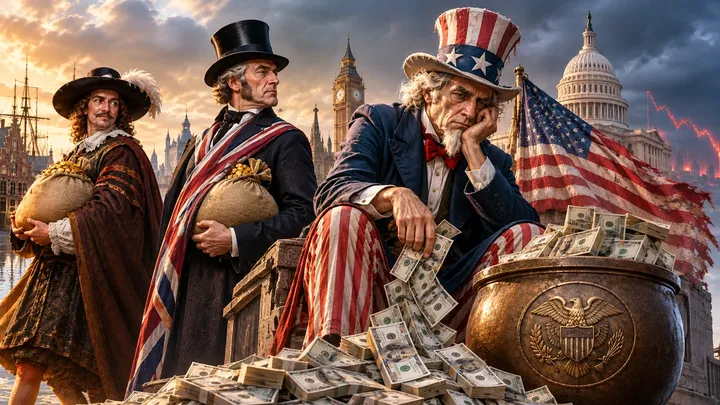
The second gain is bigger, but to see it you have to recall how the money of an aging power behaves. It has always looked for a new safe home. In the 18th century Dutch money moved to England; in the 20th, English money moved to America. Today America is the one aging, and its money, too, is due to look for somewhere to go. It will not go to China, where capital answers to the state. That leaves Europe, with its own currency and courts that do not take orders from governments.
Now look at Europe through the eyes of someone deciding where to keep his money. NATO generals give him the year of a possible invasion. Latvia is digging ditches, navies are preparing for mobilization. Nobody carries money into a place like that. So the Russian threat keeps American capital at home, and Moscow does not have to fire a single shot at Europe to do it. Being feared is enough.
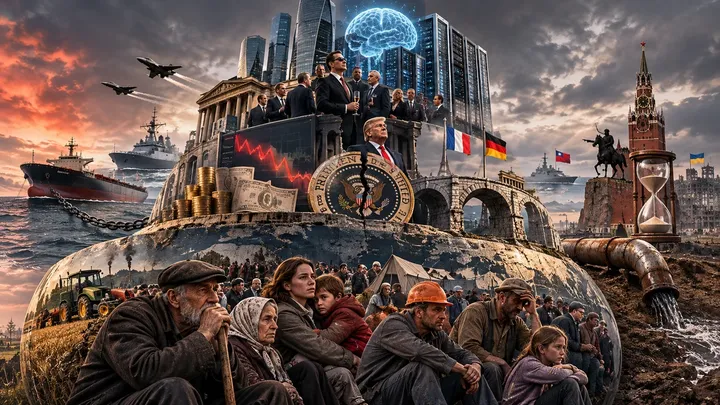
This is where today's deal turns out more cynical than Yalta. Japan was America's enemy and China's occupier. Europe is America's ally and Ukraine's main support. Roosevelt paid Stalin to fight America's enemy. Trump is ready to pay Putin to keep America's ally in fear.
Why does Washington bargain over this with Moscow instead of standing with its allies? Because the relationship is an old one, and it is the relationship of a master and a servant.
I call Moscow a viceroy. It is a power that, ever since the Mongol Horde first issued it a yarlyk, a charter to rule, has governed neighboring peoples on behalf of an outside master, and has changed masters whenever the world's leading power changed: the Horde, Venice, England, Holland, Britain, the United States.
The viceroy has two habits, and both have recurred under every master. The first: he imitates the master in everything while declaring himself the master's equal. From the Horde Moscow took the title of czar. After the Venetian-brokered marriage of 1472 it declared itself the heir of Byzantium. Under Peter it became an empire; under the Americans, the second superpower. Now it wants to be the "third pole" alongside America and China.
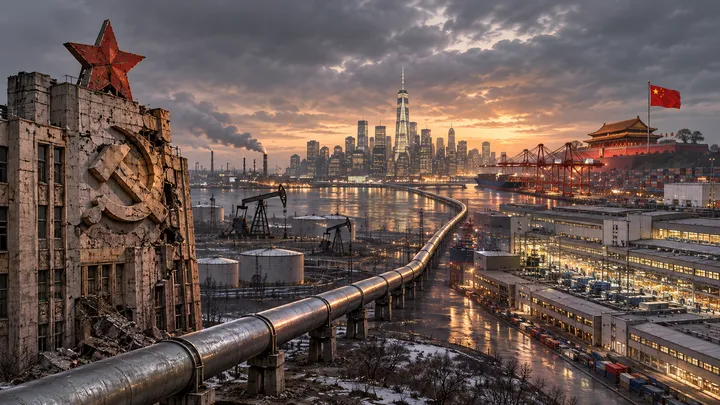
The second habit: Moscow has always betrayed an aging master. America became its master in the 1920s; since then Moscow has sold raw materials on a market where prices are set in dollars. In February 2007 in Munich Putin announced that the American-led world was over and began offering his services to Beijing. BRICS, settlements in yuan and the Power of Siberia pipeline were such offers.
Beijing made use of them but declined to take America's seat. On the contrary, China is pulling its money out of America. In November 2013 it held $1.316 trillion in U.S. government bonds. By June 2026 only $633.4 billion remained, less than half.
The viceroy found no new master in Beijing. So he went back to the old one and is asking him for payment.
A deal like that has a weak spot. A servant and a master are dividing someone else's land, and nobody is obliged to honor their paper. Trump's signature alone is not enough for Moscow: it demands that every country in the world recognize the seized land as Russian. China, in 12 years, has not recognized even Crimea as Russian. That is why Putin needs a third man at the table, and why it has to be China.
So the country that was partitioned in 1945 without being asked is now invited to countersign someone else's partition. China understood that at once.
Back in September, a few days after Ushakov's story, a column appeared on the Chinese internet under the headline "The U.S. and Russia want to pull China into a new Three Kingdoms, but we will not sit at this table where the spoils are divided." Every Chinese schoolchild knows the Three Kingdoms. It is both a historical era and a famous novel about the three states, Wei, Wu and Shu, into which the Han empire broke apart in the 3rd century.
Who wrote the column is not certain. A digest of Chinese social media attributes it to Hu Xijin, former editor-in-chief of the party tabloid Huanqiu Shibao, known in the West as Global Times. The only surviving reprint is signed by Jin Canrong, a professor at Renmin University in Beijing. Both write for a mass audience, and both are close to power.
The author writes that talk of a "new Yalta" began after Trump returned to the White House in January 2025, and that Russia needs it most. Of the three powers Russia is the weakest, and a seat at one table with the two strong ones flatters it.
Then comes a comparison any Chinese reader gets. The balance of three kingdoms was devised by the strategist Zhuge Liang for his lord Liu Bei, who had the fewest troops and the least land. Wei was the strongest, Wu second, Shu the weakest, and the balance worked in favor of the weakest. Russia, the author thinks, likes that scheme very much. China will not take part in any division: its leaders repeat at every negotiation that the fate of the world must not be decided by a few big countries.
The Chinese author spotted in Moscow's scheme the viceroy's first habit: the weak one claiming a seat that is not his. It matters that this was said in a country Moscow counts as an ally. The second habit he missed. In his headline the U.S. and Russia stand side by side, like two equals jointly dragging China to the table. I disagree: one of them is the master, the other the viceroy.
The column was later removed from Chinese sites. There is no sensation in that. In September Beijing had decided nothing yet, and the author was refusing on its behalf in advance. He had also called the weakest of the three a country with which China had signed 2 joint statements in May.
The refusal itself stands. On October 30 Xi Jinping, according to German President Frank-Walter Steinmeier, assured him that no summit on Ukraine involving the U.S., Russia and China was being prepared. Xi added that the war is being fought in Europe and cannot be settled without the Europeans.
Beijing is not refusing the meeting as such. Hosting two presidents at once is an honor for the summit's host. Shanghai-based U.S.-China specialist Song Guoyou explained how China sees its role: if Washington and Moscow want to talk, China cannot forbid it, but it would be only the organizer and a "neutral witness." Beijing will provide the room. It will not provide the signature.
In Shenzhen each of the three wants his own thing. Putin brings the bill for Ukraine and half of Europe. Trump wants a nuclear arms deal, which Beijing has no use for: China has about 620 warheads against more than 5,000 each for Russia and the U.S., and it will not lock that gap in on paper. Xi needs the meeting itself, in China and on his script.
So the most Moscow is likely to carry home from Shenzhen is a photograph. For a Yalta deal it is short two signatures. Kyiv has refused, and Beijing agrees to be nothing more than a witness.
In 1945 Chiang Kai-shek signed on the sixth day after Soviet troops entered Manchuria. His signature merely formalized what the army had already taken. Today it is the other way around. The part of Donbas Moscow demands is the part its army could not take. The shield in 14 European countries is standing, and after Oslo it is stronger. Moscow needs a new Yalta to get by treaty what it failed to take by force. And it is asking the country whose land paid for the last one to certify it.
P.S. The parable the Chinese author chose has an ending he left out.
He named only the weakest kingdom, Shu: that is Russia. The other roles are easy to work out. Wei, the strongest, is the United States. Wu, the second strongest, is China itself.
Shu and Wu were allies against Wei, just as Moscow and Beijing now call themselves partners against America. The balance of three kingdoms gave Shu a place in the triangle but did not save it. Shu was the first of the three to fall: Wei conquered it in 263.
The ally did not make it in time: Wu recalled its troops once Shu had already surrendered. But in March 264 Wu came to take the border fortress of Yong'an from its defeated partner and besieged it for half a year.
Today's "border fortress" is the Russian Far East. Moscow took the Amur region from China under the 1858 Treaty of Aigun and the Maritime region under the 1860 Convention of Peking. In China these are called unequal treaties. Officially Beijing recognizes the border, but it does not forget what was lost. In February 2023 China's Ministry of Natural Resources ordered that 8 Russian cities and territories be labeled on maps with their old Chinese names. On those maps Vladivostok is Haishenwai, Khabarovsk is Boli, Blagoveshchensk is Hailanpao.
Carry that ending into the present and it reads like this. The United States subordinates Russia, the weakest corner of the triangle. China has no intention of rescuing it and will try to take what is left.
If you enjoyed this piece, you might also be interested in my books: The Economics of Losses, available in English and in Ukrainian, and The Russian Myth, available in English and in Ukrainian
References:x.commedium.comcheslavsky.substack.com