The analytical unit of The Economist magazine compiles a democracy ranking every year. It covers 167 countries, scored on 5 criteria: electoral process, functioning of government, political participation, political culture and civil liberties. The ranking shows which countries have the best-organized democracy, but does not explain why democracy took shape there in particular.
An answer can be found by looking at what the countries at the top of the list have in common. An image circulating online shows the 35 most democratic countries in the world according to this ranking. Those at the very top turn out to share 3 features: constitutional monarchy, membership in Northern Europe and a maritime economy. Taken separately, none of them explains a high place. Together they point to a cause, and that cause lies in where the state gets its revenue.
The top ten contains 6 monarchies: Norway, New Zealand, Denmark, Sweden, Canada and Luxembourg. Roughly 20% of the world's states are monarchies. So among the 10 most democratic countries their share is three times higher than the world average. It is tempting to assume that monarchs somehow promote the development of democracy.
But that would be too simple an explanation. We are talking exclusively about constitutional monarchies, in which the monarch remains head of state but real political power belongs to parliament and the government. Where the monarch rules personally, as in Saudi Arabia, there is no democracy, and such countries sit at the very bottom of the ranking. What is more, alongside the monarchies the top ten includes 4 republics: Iceland, Finland, Ireland and Switzerland. Consequently, monarchy by itself does not explain the high quality of democracy.
The second shared feature is geography. Look at the top six. Norway is 1st, Denmark 3rd, Iceland 4th, Finland 5th, Sweden 6th. These are all 5 countries of the European North. Only New Zealand, in 2nd place, stands among them. Notably, the northernmost of them, Norway, has held 1st place for 16 years in a row.
Yet geography does not explain everything. New Zealand lies in the Southern Hemisphere. Canada, Uruguay, Australia and Japan are also far from northern Europe, and all of them are among the first 14 lines of the ranking.
The third feature emerges when the ranking is compared with a map. Of the first 14 countries, 12 have access to the sea. There are only 2 exceptions: Switzerland and Luxembourg. Of these 14 countries, 5 are surrounded by sea on all sides: New Zealand, Iceland, Ireland, Australia and Japan.
For these countries the sea is the foundation of the economy. In Norway only about 3% of the territory is suitable for farming, so the country has historically earned its living from fishing and shipping, and today has one of the largest merchant fleets in the world. The Danish company Maersk is the world's second-largest container carrier. Rotterdam in the Netherlands remains Europe's largest port. In Iceland fish and seafood are among the main export items.
The link between the sea and democracy is provided by trade. A state that earns its living from maritime trade depends on the people who conduct that trade. Trade needs rules that are the same for everyone, an independent court able to protect a contract, and guarantees that the authorities will not take away from the owner his profit, his ship and his cargo.
But rules alone are not enough. An authority that has given guarantees can also revoke them. That is why those who trade and pay taxes need control over that very authority. The monarch, for his part, needs taxes to maintain a fleet, ports and the protection of trade routes. All this money cannot be obtained by coercion alone, because trading capital easily moves to another jurisdiction. So the monarch is forced to negotiate with those who dispose of capital and pay taxes. A representative assembly gradually gains the right to control state revenues and expenditures. This is how the financial dependence of power turns into a political constraint.
In England this order took shape over centuries and was fixed as early as 1689. The Bill of Rights declared the collection of money for the crown without the consent of parliament illegal. Norway adopted its Constitution in 1814, and it remains in force to this day. Denmark became a constitutional monarchy in 1849. The monarchy survived in these countries, but decisions about taxes and spending passed to parliament.
This is what explains the coincidence of the 3 features. Constitutional monarchy took shape where the monarch depended on revenues from maritime trade. Most such states are in Northern Europe and among former British possessions. The states that have all 3 features at once, that is Norway, Denmark and Sweden, occupy 1st, 3rd and 6th places in the ranking.
In this chain monarchy is a consequence, not a cause. The cause is the source of state revenue. Where the state's income is made up of taxes from many independent owners and merchants, the authorities depend on them. They demand representation and control over spending, and the monarchy survives only in a constitutional form. Republics of the same type confirm this. Iceland, Finland and Ireland rank as high as the neighboring monarchies.
At the same time, maritime trade by itself does not guarantee democracy. Where the state gets its main income itself, from exporting raw materials or appropriating other people's resources, the authorities do not depend on taxpayers. Britain, Spain, France and Belgium also grew rich thanks to the sea, but they built colonial empires. The colonies gave the state additional revenue that it obtained by force, not by agreement with its own taxpayers. The less the authorities depend on taxpayers, the less reason they have to take them into account.
This is reflected in the ranking too. Britain is 18th, considerably lower than New Zealand, Canada and Australia, which it once owned. Spain is 22nd. France is 26th, the last among the full democracies. Belgium, which owned the Congo, is 31st. The United States, whose military bases stand all over the world, dropped within a year from 28th place to 34th.
Japan shows the opposite trend. It was an empire and waged wars of conquest in Asia. After the Second World War, Japan wrote into its Constitution a renunciation of war as a right of the nation. Today it is in 13th place.
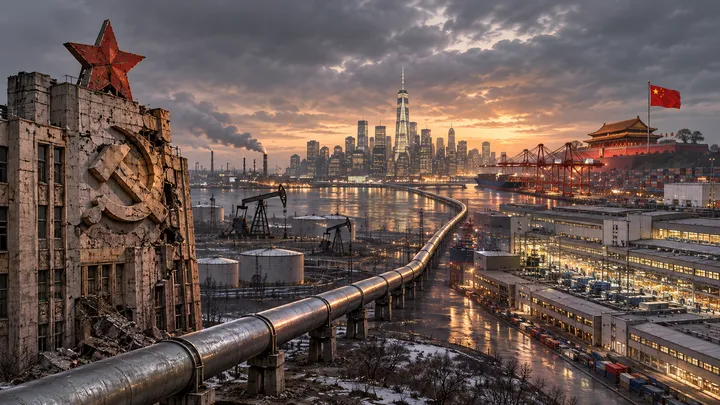
For understandable reasons, Russia is not among the leading democracies. In the ranking it takes 148th place out of 167 and has only 2 points out of 10. At the same time, Russia has still not become a maritime power, because by sea it mainly exports raw materials: oil, coal, grain. The income from this export goes not to the state but to companies connected with the government. Russia has not created a layer of independent merchants and shipowners whom the authorities would have to reckon with, because the foundation of Moscow's power was originally not production but the appropriation of other people's resources.
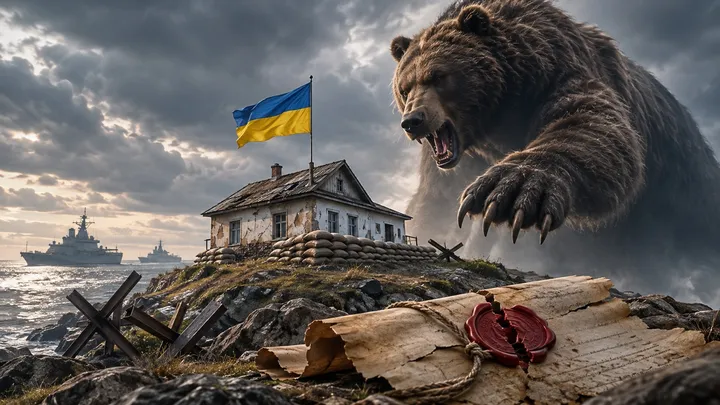
In 1328 the Moscow prince Ivan Kalita received from Czar Uzbek the yarlyk for the grand principality and the right to collect tribute from neighboring principalities for the Horde. A tribute collector has absolutely no need for rules that are the same for everyone, and no need at all for a parliament. All he needs is force, to subjugate his neighbors and take their resources. However terrible it may sound, this logic has not disappeared in all these centuries. Today its continuation is the war against Ukraine, which has put the security of all Europe at risk.
The first to understand this were precisely the countries at the top of the democracy ranking. In April 2023 Finland joined NATO. In March 2024 it was followed by Sweden, which for more than 200 years had not belonged to any military alliance. Denmark created a separate fund of 7 billion dollars for weapons procurement and publicly demanded of its military: "Buy, buy, buy."
In November 2026 the countries of Northern Europe created yet another military alliance. 10 countries led by Britain signed an agreement on joint action by their navies in the North Atlantic, the Arctic and the Baltic Sea. They are Britain, Norway, Sweden, Finland, Denmark, Iceland, the Netherlands, Latvia, Lithuania and Estonia. The agreement was signed on 10 November in Oslo aboard the British aircraft carrier Prince of Wales. It does not create a single fleet. For now it only provides for common planning, training to a single standard and joint equipping of the 10 navies, so that in the event of a threat they can act together.
Let us compare this list with the ranking. Of the 10 countries that signed the agreement, 9 are among the 35 most democratic countries in the world. 5 of them are in the top six. 5 are constitutional monarchies. Note that the agreement was signed even by Iceland, which has no army, only a coast guard.
Britain's Chief of the Defence Staff Richard Knighton explained to the Financial Times why this agreement is needed. The task of the navies is to contain Russian submarines, so that in wartime they cannot attack ships and threaten shipping. According to him, Russia is already carrying out deliberate actions in Europe aimed at destroying democratic states. These are contract killings, sabotage, cyberattacks. There is already evidence of this. The head of the British navy, Gwyn Jenkins, cited a figure: over 2 years, Russian ships and submarines have begun entering British waters almost a third more often.
Each of the 10 countries has its own reasons for signing the agreement. The Baltic states border Russia. Norway and the Netherlands depend on maritime shipping. What they have in common is that the states with the most stable democratic institutions turned out to be among the first to undertake the defense of freedom of navigation against Russia.
Thus the democracy ranking reflects a deeper difference between states than the quality of elections and the work of parliaments. Some states are built on trade and law, others on appropriation and force. Today the line of confrontation in Europe runs along this boundary too.