As the classics say, war is a continuation of politics, and politics is a continuation of economics.
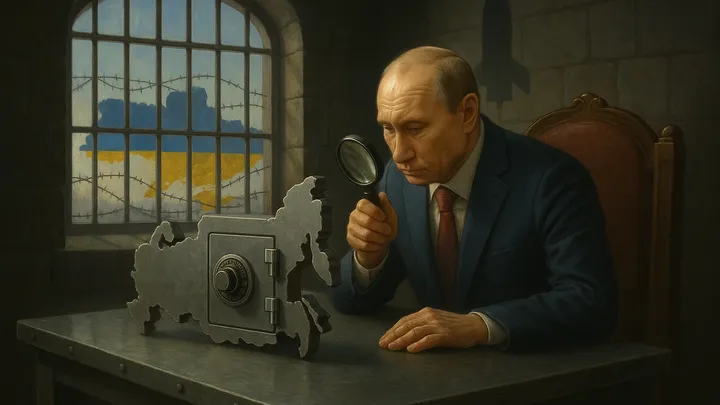
As the classics say, war is a continuation of politics, and politics is a continuation of economics. For the broad masses, Putin's regime builds delirious constructs to justify its aggressive policy, while in reality it is all about perfectly real money.
Moreover, after the recent leak of information that the US intends to block Putin's money to the sum of $40 billion in Switzerland alone, and only what was received from the profits of oil and gas enterprises, a question is in order: whose money was the war unleashed with?
A FEW WORDS ON PRICES
So, what became the basis of this war? As said above, the roots of any war lie in the economy. It is appropriate here to recall that the prices of gas and oil are linked through their energy value in terms of heat output. Roughly speaking, the price of gas is tied to the price of oil. Let us also recall what the oil price was in 1999, when Putin came to power. In February of that year Brent crude was about $10 a barrel.
After that, the oil price rose continuously, albeit with fluctuations. It reached its peak before the crisis of 2008, when it stood at $135 a barrel. The fastest and steadiest growth began in 2004.
The following 4 years were a benefit performance for the oil- and gas-exporting countries; gas rose in price at roughly the same pace.
Thus, from 2004 onward Russia obtained a source of financing for its own ambitions in the form of super-profits from selling its natural resources. It was the oil price that created Putin's macho image, and made his predecessor look like a drunk and a loser.
The dynamics of prices were such that at a certain point the country's leadership suffered intoxication from an overdose of revenue. An inner conviction arose that the prices of oil, gas, gold and so on would keep rising forever. And here one more important point must be understood.
While oil is mostly delivered by tankers, gas (because of its physical properties) is preferably delivered by pipeline. That is, it is not enough to have gas; you also have to control the pipe! Let us remember this. We remember the statements made at the peak of prices by the heads of the Russian state and of state corporations that gas reserves are finite and that, as it is extracted, its price will only rise. Prices of 600, 800 and even 1000 dollars per thousand cubic metres of gas were named as the near-term prospect.
IN SEARCH OF A SIGNATURE STYLE
The ambitions of a world empire awoke in clear connection with the growth of revenue. But in 2008 the first alarming catastrophe occurred. The crisis struck and prices went down. Prices collapsed in the wake of demand. At that moment the Russian leadership still hoped that this was a temporary phenomenon, but decided to take decisive measures to preserve the status quo as the supplier of raw materials to Europe.
First of all, Russia got rid of the gas contracted in Turkmenistan for Europe. A gas compressor station, together with a piece of the pipeline, exploded very opportunely. Back then one still wanted to believe the Russians' statements that the pressure had spiked or something of the sort. Now it is clear: it was sabotage. The Turkmens stopped playing durak with Gazprom and went to China. But they left Europe too! One competitor fewer.
GEORGIA
The aggression against Georgia was the first serious trial of the pen. At that time it was driven by the need to create a hotbed of tension along the route of the NABUCCO gas pipeline. Let me remind you: NABUCCO was an alternative project for supplying gas from Azerbaijan, Kazakhstan and Turkmenistan to Europe. Given that Iran was under sanctions, the only corridor ran precisely through the territory of Georgia. The goal was achieved. The NABUCCO project was stopped.
The brutality of the invasion demanded urgent informational and political cover for the operation. It was then that the mechanism of total brainwashing of those unlucky enough to watch or read Russian media was run in. The population was successfully infected with the virus of neo-imperialism. But no less effort was made at the other end of the pipe! In Europe, politicians and entire parties were bought up wholesale and retail. Petrodollars flowed into the pockets of lobbyists and European media. The result was an absurd situation: Europeans began to say out loud that Georgia had attacked the Russian Federation and that it had been forced to defend itself.
From that moment the leadership of the Russian Federation had a precedent for the spinelessness of European institutions. That is, the element of impunity was tested and recognised as reality. It was then that military invasion was entered into the toolkit of the Russian Federation's foreign policy.
In short, the Kremlin decided that the situation with the European sales market had to be controlled firmly. Mutual settlement schemes take gigantic sums into the shadows, and they flow smoothly into the pockets of the Russian Federation's leadership and their agents of influence in Europe. A reduction of this flow would directly hit both the Kremlin bigwigs and their authority in Europe. Besides, ambitious projects inside the Russian Federation provided the means to feed a multimillion-strong army of officials and security servicemen.
The regime rests precisely on their loyalty. To allow a drop in the inflow of funds would be suicidal. Everything was fine, but high energy prices set compensation mechanisms in motion. These include efficient energy-saving technologies at one end of the pipe, and new methods of extracting raw materials at the other.
USA — QATAR
Trouble came from where it was not expected. Shale gas in the US turned out to be a bolt from the blue. I think the reality and efficiency of this technology was assessed correctly and at once. True, the head of Gazprom, Miller, for a year and a half mocked the Americans' efforts and claimed that it was PR, that the soap bubble would burst if not tomorrow then the day after. Media reports that the price of gas in the US had fallen below $100 were explained by hidden state subsidies for the project. However, $100 for American gas against $450 for Russian can no longer be ignored. The dashing and jaunty humorous escapades of citizen Miller ended exactly at the moment when the US stopped importing liquefied gas.
And here one must recall economic geography. On the US west coast there exist, and were planned to be built, new terminals for receiving liquefied gas delivered by gas carriers. Right at that time, in South Korea, ships of a gas-carrier fleet began to be launched.
And the customer for this fleet was a small state with enormous gas reserves: Qatar. To get an idea of how rich this tiny state is, it is worth noting that besides the fleet of gas carriers, Qatar ordered a fleet of the newest and most luxurious airliners for its airline. 128 of the latest airliners are already in service, with another 50 in the manufacturers' workshops.
And not a single second-hand one, only new. Of course, it is not the Emirates with their 229 in service and 50 at the factory, but neither is it Transaero with its 103 antique jalopies. It is quite comparable with Aeroflot, which has 144 airliners. And this is Qatar, which you can't even see on the map! Why the example with aircraft? Because there the queue of arms manufacturers stands knee-deep in water, but the military contracts are closed and can only be guessed at. Note that all this is being ordered and built at the same time!
SYRIA
Such attention to Qatar is no accident. When the US refused Qatari liquefied gas, talks were reportedly held with Europeans about admitting Qatari gas to Europe. Such consent was obtained, and we all remember that Europe began to speak out loud about diversifying gas supplies.
But then two obstacles arose. Qatar can bring in as much of this gas as you like by gas carriers, but terminals are needed to receive it. Building them takes time and funds counted in billions of euros. Nevertheless, construction is under way in various parts of Europe, but as of today there are no mass deliveries yet. The second obstacle is the lack of a pipeline connection between Europe and the Gulf countries.
Qatar tried to solve this obstacle on its own. The task was simple: extend the pipe to Turkey, and then the NABUCCO project would be revived in its Turkish and European part. As we see, the pipe can reach Turkey either through Iraq or through Syria.
As we remember, Iraq is in a permanent civil war, while in Syria it was still quiet a few years ago. The choice was obvious. Qatar poured over $10 billion into Syria's infrastructure in return for Assad's consent to the pipe. And then Assad, after talking with his Russian brothers, backs out. What happened next everyone knows. The signature style of the Gazprom-KGB fraternity is visible at once. The war in Syria closed this corridor.
UKRAINE
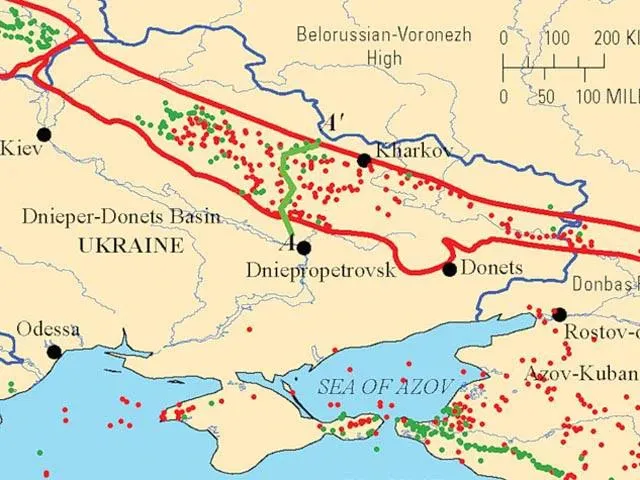
It seemed they had worked well: pipes cut off everywhere, war or tension everywhere, which, owing to the high risks, will not allow alternative pipelines to be financed. But then it turned out that Ukraine not only did not follow Belarus's example and hand over its pipe, but also proved to be the owner of the largest shale gas deposits in Europe! Moreover, the largest part of these deposits lies on the territory of the Donetsk and Kharkiv regions (that is where Novorossiya came from, and the slaughter for Sloviansk!).
That is, a real prospect arose that our gas would flow to Europe through the pipes of Ukraine's gas transportation system. From that moment the invasion option became the main and the only one. What was put at stake was the very possibility of the Russian Federation's survival as a single geographic space. Blocked oil and gas pipes to Europe mean the swift and guaranteed death of an energy superpower.
It was in this way that the elements of the invasion were set in motion. European lobbyists were given the command to drown the reaction of healthy forces in demagoguery; the media, you know yourselves what they did; the local FSB creatures, who consisted of a tight alliance of law enforcers and bandits, struck from within, and Crimea fell into their hands like a ripe apple. The same scenario was used in the Donbas. I think the Russian Federation's aggression against Ukraine was planned for an earlier date. Apparently, we must thank Qatar for the delay.
EPILOGUE
It seems to me that this war is being waged by Gazprom and that small group of persons who have attached themselves to the pipe for dear life and rightly believe that possessing or losing the pipe is a question of their personal life and death.
If one looks at the situation from this angle, almost all of Moscow's actions find their simple explanation. Another matter is that forcing Europe to buy gas and oil only from them, and making us love the elder brother, is no longer possible.
What lies at the foundation of this whole stream of blood and destruction? Greed! Bestial, all-consuming and boundless! Were Putin a wise politician, he would have curbed his own appetites (he has plundered well beyond $100 billion!), cut a number of absurd budget programmes and dropped the price by just enough to make shale gas unprofitable.
Nobody would have bothered with it. And now it is too late. Extraction technologies are improving rapidly. Shale oil has followed gas. The cost of production keeps falling, and the American economy consumes cheap energy.
We fell a little short of the collapse and breakup of the "energy superpower," but we are obliged to hold out, and we will hold out!