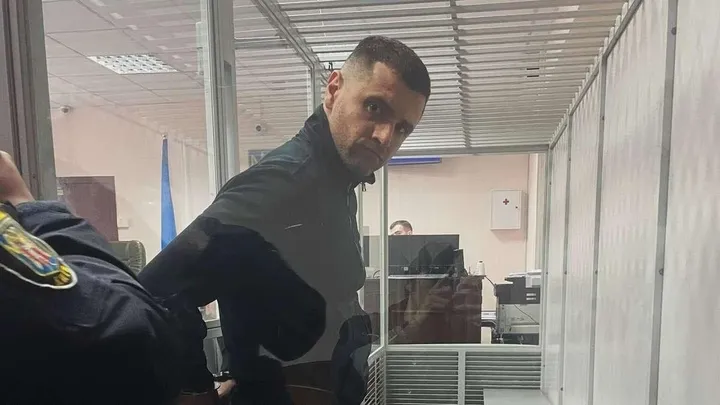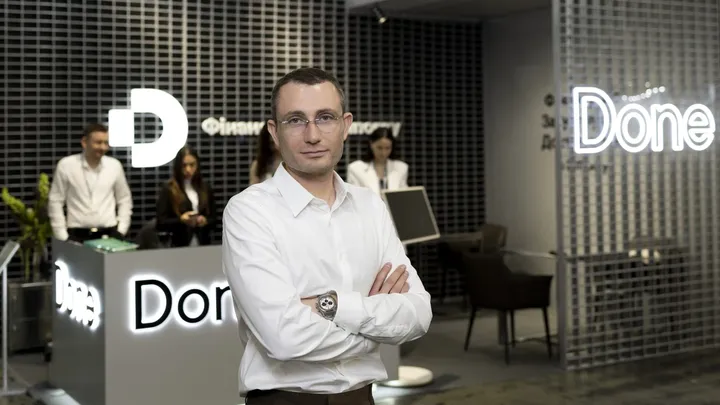
The KASL venture fund, whose assets are managed by Alexander Kirimov's asset management company Bonum Group, owned 70% of the financial company Supply Chain Finance in 2024-2025. This is the company behind the Done product, which issued bonds worth UAH 180 million, Absolution Leaks reports.
This is not rumor or anonymous sourcing but data from the National Bank. And it says that the controlling stake in the company, whose public face Dmitry Ryvkin has long been, did not belong to Ryvkin at all for a long time.
This story is easy to miss, because another plot has taken all the attention right now. As Antikor wrote, transfers by the group of Ryvkin and Anton Skorobogatov went through Kristalbank to the Swiss Done Switzerland AG. That company was formerly called Alltag und Gerätetechnik, and Ryvkin was listed among its managers with sole signing authority. Cryptocurrency was contributed to the Swiss firm's capital in three tranches: 504,376, 504,415 and 511,512 USDT, 1,520,303 USDT in total. Where this money came from and who owns the Swiss shares issued against it has still not been disclosed. There is also no public decision by the National Bank or a court that would recognize these operations as unlawful.
Kristalbank itself, meanwhile, is hardly a giant. At the start of 2026 its net assets were about UAH 2.9 billion, the bank closed 2025 with a loss of UAH 43 million, and its cost-to-income ratio reached 109%. In other words, the bank spent more than it earned. On top of that, the National Bank already had complaints about it in the very area of financial monitoring, that is, where a bank is obliged to notice suspicious flows.
But while everyone is counting USDT, the registries hold a question on which everything else depends: whose money really stands behind a financial company that borrows from people?
It is worth starting with what Done is. The product finances imports from China, Hong Kong, Europe and Turkey for small and medium-sized businesses. The scheme is simple: Done itself buys the goods from the manufacturer on the client's behalf, pays the factory, and arranges delivery, customs clearance and storage. The client pays an advance of about 40%, Done covers the remaining 60%, and ownership of the goods passes to the client only after full settlement. The group operates through four legal entities: DANN LLC in Ukraine, Done Polska in Poland, Done Global Dış Ticaret in Turkey, and the already mentioned Done Switzerland AG.
The money for these deals is provided by Supply Chain Finance, which the market calls SCF for short. It received its lending license as a financial company from the National Bank on March 26, 2024. In an advertorial on Forbes it was said that Ryvkin acquired this company and began attracting outside funds to finance trade deals. Ryvkin was in charge of the financial architecture, Skorobogatov of trade and logistics. And in 2025 SCF came to the public market with bonds worth UAH 180 million. The public offering of series B bonds ran from September 1 to 21, 2025, with a par value of UAH 1,000 per security. And here is the key detail that the promotional texts do not stress: the bonds are unsecured. Any investor could buy them.
Now picture such an investor. He puts his own money into the unsecured securities of a company because he trusts a man who says in interviews that there were zero defaults even in 2022 and talks about transparent logistics. Yet according to the regulator, over the same period 70% of this company was held not by that man but by a venture fund managed by someone else's AMC.
Interestingly, at the start of 2026 the picture in the company's own documents changed. On February 9, 2026, SCF reduced its charter capital to UAH 20 million, and this had to be reflected in a supplement to the bond prospectus. After that Ryvkin directly owns 90% of the company, and the KASL fund only 10%. But the most telling thing is something else: in the same document Ryvkin is named the ultimate beneficiary of all 100%, with the 10% held indirectly, precisely through KASL. That is, the fund managed by Kirimov's AMC officially turned out to be a wrapper for Ryvkin's own stake.
There is a mundane explanation for such a structure. Collective investment institutions in Ukraine do not pay corporate income tax, so business owners have for years used venture funds as a tax umbrella. But then the next question arises. If the fund was merely an umbrella, why did exactly 70% stand under it, and not a modest share? And why does this umbrella each time come from the same shop?
Because the KASL fund does not appear in Ryvkin's biography for the first time. In Ryvkin's former company, Sich Transport Company LLC, the founders replaced one another like duty officers at a post: first the Skyfall fund, then KASL, then AKS Capital and Bloom Invest. At least three of them, namely KASL, AKS Capital and Bloom Invest, are managed by the same Bonum Group of Alexander Kirimov. Consequently, this is no longer about one chance stake in one company, but about a repeating route along which Ryvkin's business passes through the funds of a single AMC.
And Sich itself deserves separate attention. For 2022 the company reported UAH 144 million in revenue and UAH 91 million in net profit. It had five employees. Imagine five people who earn UAH 91 million net for a company in a year, and try to work out what exactly they were hauling. Sich's charter capital was inflated from UAH 5 thousand to UAH 144 million, exactly the amount shown as revenue. The main line of activity was also rewritten: instead of "real estate rental" the company began engaging in "freight transport." And in the Shevchenkivskyi District Court of Kyiv a criminal proceeding concerning it appears under case No. 761/7023/22.
So the question to Done is not rhetorical at all. Why would a company that positions itself as a Swiss fintech with access to the Polish and Turkish markets need a Ukrainian AMC as the principal co-owner of its financial partner? Why do the Bonum Group funds of Alexander Kirimov take turns entering Ryvkin's companies, from the transport firm Sich with five employees and multimillion profits to a financial company that borrowed UAH 180 million from the public through unsecured bonds? And which of those who bought these bonds in the autumn of 2025 knew that most of the company then formally belonged to a fund, and not to the man who talked about it in promotional interviews?
Until there is an answer, Done's Swiss signboard covers a very Kyiv construction: the loan is taken by Ryvkin's company, the stake is held by Kirimov's fund, and the risk of the unsecured bonds is borne by those who were simply not told about this construction.