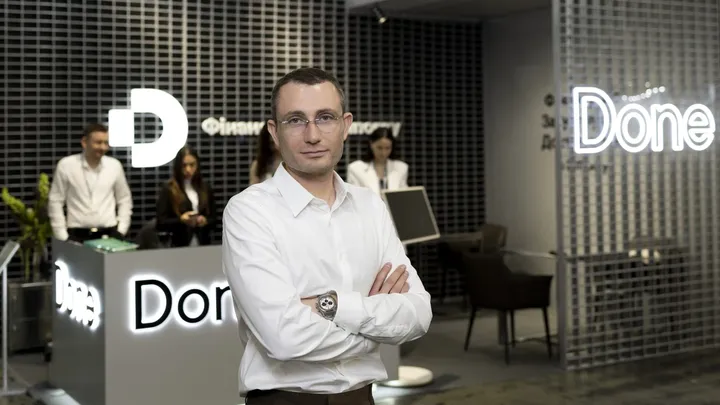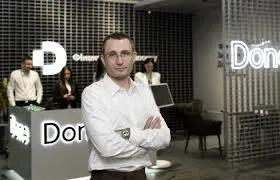
The Done platform, developed by Dmitry Ryvkin and Anton Skorobogatov, collects hryvnia in Ukraine, turns it into foreign currency and sends payments to the Swiss Done Switzerland AG, writes Neveroyatno, no fakt.
From the outside, everything looks perfectly respectable. Done presents itself as a modern alternative to traditional bank lending, that is, a service that gives businesses money while bypassing banks. But follow the chain to the end and it turns out that lending is only the first station on a long international route. The hryvnia comes in through the company Supply Chain Finance (SCF) and the investment structures linked to it. That money then finances an importer. The importer buys currency. And the payment goes to Switzerland.
Let us start with where the hryvnia comes from. In 2025, SCF issued bonds worth UAH 180 million. Who owns the issuer? At the start of 2026, 70% of the company belonged to Dmitry Ryvkin himself, and the remaining 30% to the fund KASL. The fund's name, however, sounds independent only until you learn what it was called before: DANN GROUP. DANN UKRAINA LLC operates within the same circle. In other words, the money is being raised from the market by structures whose names and shares easily reveal one and the same brand and one and the same surname.
Now to where this hryvnia ultimately ends up. A Swiss company with registration number CHE-363.272.422 appeared in 2020 under the name Alltag und Gerätetechnik. Later it became Done Switzerland AG. Dmitry Ryvkin was first its member, and then became chairman of the board of directors with individual signing authority. When the company was converted into a joint-stock company, it reported CHF 30.33 million in assets and CHF 27.77 million in liabilities.
And then things get really interesting. Cryptocurrency went into the Swiss company's capital, in three neat tranches: 504,376 USDT, 504,415 USDT and 511,512 USDT. A total of 1,520,303 USDT. New shares were issued against these contributions, and Done Switzerland AG's capital grew from CHF 520,000 to CHF 1.75 million. A simple question, it would seem: who brought more than one and a half million in stablecoins to Switzerland, and who received the shares issued against them? But it is precisely this question that the available documents do not answer. There is no name of the person who contributed the crypto, and no name of the person who became the owner of the new shares.
The import mechanism, according to the materials provided, is extremely simple. A financial company collects hryvnia from the market and transfers it to an importer with the payment purpose "importer lending". The importer uses this money to buy currency and sends it to the Swiss Done Switzerland. Note one important detail: the Swiss company can do more than trade in equipment, cars, grain, metal and other goods. It can also finance deals, carry out settlements and issue guarantees to third parties. That is, the Swiss recipient of the payments is in itself not merely a supplier, but a full-fledged financial hub.
The scheme also has an export wing, and it leads to Poland. The company KOOPERANT EUROPEJSKI sp. z o.o., with a capital of just 10,000 zlotys, operates there. It is this firm with an almost symbolic capital that buys raw materials and construction equipment in Ukraine and exports them to Poland. The owners of KOOPERANT EUROPEJSKI have changed over time: at various points Valeriia Musaieva, Kateryna Kornieva and Ella Traiduk were listed as such.
Alongside the Polish company appears a whole set of Ukrainian firms: Globinex (code 45659982), Motoroz Parts Ukraina (44306976), Komoditi (43888250), Hamptons Trade (44536061) and TBS (44099159). In the materials provided, these companies are linked to high tax risk and court proceedings. And their cover is linked there to employees of the State Tax Service in Kyiv. However, the claims about unlawful benefits for tax service employees and for judges still need to be confirmed by specific case materials.
That leaves the main question: through which bank does all this currency leave the country? The materials name Crystalbank as the currency banking channel. The chairman of its management board, Leonid Grebinsky, owns almost 25% of the bank at the same time. Another 25% belongs to Oksana Grebinska, and the remaining 50% to Maryna Lening.
Why Crystalbank specifically? According to the data provided, other banks refused to carry out these operations. The reason was questions about the connectedness of the residents and the non-resident, that is, about the possibility that the Ukrainian importers and the Swiss recipient of the money might be parts of one and the same circuit. Crystalbank, however, serviced such operations. It is also curious who at the bank is responsible for financial monitoring, that is, precisely for detecting such risks. This is Yevhen Sydoruk, who, as the materials claim, did not pass the regulator's approval. At the same time, the available data contain no public decision by the NBU or a court that would establish the illegality of Done's operations through Crystalbank.
A separate part of the story concerns VAT. According to the data provided, when goods are imported from the Swiss company, a tax credit is formed for the Ukrainian importer. After the goods are sold, this VAT is used in further operations, including the alleged sale of the tax credit on the shadow market. In parallel, questions arise about the approval of VAT tables at the State Tax Service: after such approval, companies gain the ability to run a different range of goods through themselves. This part of the story, however, requires tax invoices and the full chain of counterparties.
Putting it all together, the picture is as follows. SCF and the KASL fund provide hryvnia financing. DANN UKRAINA sits in the same business circle. Importers buy currency and settle with Done Switzerland AG, whose board of directors is chaired by Dmitry Ryvkin. Through Poland operates KOOPERANT EUROPEJSKI with a capital of 10,000 zlotys, and alongside it Globinex, Motoroz Parts Ukraina, Komoditi, Hamptons Trade and TBS. Crystalbank is named as the banking channel, and a VAT tax credit arises on import.
But there are still more blank spots in this picture than one would like. It is unknown where the 1.52 million USDT came from. It is unknown who owns the Swiss shares issued against them. The volume of currency payments received by Done Switzerland is unknown. And it is unknown where the Ukrainian importers' VAT moved next. And until these questions are answered, the "modern alternative to bank lending" looks above all like a very convenient bridge from the Ukrainian hryvnia to Swiss accounts.