I'll start with a claim that will sound wild: the war ended a year ago. It did not stop, it was not frozen, it did not move into a positional phase. It ended in the sense in which a business ends when it has no achievable goal and no calculable price left. Everything we have seen for at least the last twelve months is no longer a continuation of the war. It is an attempt to revive a corpse, and a frankly unsuccessful one.
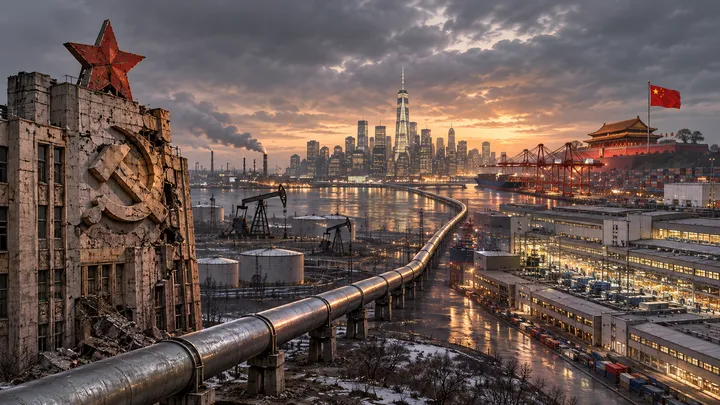
The proof lies not on the map of combat operations, where the arrows still show movement. It lies in the books. While the war remained a project, it was financed from revenue lines: oil, gas, export rent, accumulated reserves. The project made it possible to dispose of profit, and there was a cannibalistic logic in that. But at the very moment when the source stopped covering the expenses, the system switched to a different mode: it began to feed on itself. Not borrowing against the future, but finishing off that future with spending on the present. From that moment the war stopped being a war and became a way of disposing of Russia itself. The difference is fundamental and worth examining in detail, because the entire official statistical apparatus is built so that this difference stays invisible.
And the statistics, to give them their due, do their job brilliantly. It is the fifth year of the war, and the picture of reality for Russians comes out almost like a holiday resort. GDP grows modestly but confidently. Unemployment stays at a historic low. The banking system is resilient to every cataclysm at once. State debt is tiny by any world standard. Strikes on oil refineries do minimal damage to the economy, and the fuel shortage is strictly local and creates no critical problems. According to the official version there is no crisis in Russia at all, only small temporary difficulties of a seasonal nature that are about to dissolve on their own.
It is worth separately assessing the price at which this picture is maintained. In recent years the chekists have been waging a brilliant and highly successful battle against dissent: all hostile platforms are blocked, the institution of foreign agents has been created and is working, and methodical work is under way with those who contradict the party line. Nobody is spared, outsiders and insiders alike get their share. It is not only the liberal who relocated to Berlin who gets hit, but also the war correspondent who allowed himself to write about real losses or to ask where the promised drones went. This is an important detail, and we will return to it: the system is not purging a potential opposition, it is purging the books.
Because all the official figures require footnotes, and the footnotes turn out to be more interesting than the figures themselves. Enterprises are operating, but they move their employees to a shortened work week. Loans are being serviced, but already with several extensions and deferred interest, which means the borrower is formally no longer a debtor, he will simply pay everything back sometime later, in some new other life. State contracts are being fulfilled, but the contractors sit without money and in effect lend to the state out of their own working capital. Exports go on, but the revenue from abroad arrives far from always and far from immediately, and part of it settles in a labyrinth of intermediaries who heroically bypass sanctions for half the sum. The train runs on schedule, but the repair of that train, which was supposed to take place a year ago, has been postponed to next year. And next year it will most likely be postponed again.
Each of these footnotes looks like a technical trifle on its own. Add them together and you will see the mechanism. Money is drawn out of the sectors of the economy that Putin has not yet finished off in dozens of ingenious ways: through debts, through unpaid invoices, through cancelled repairs, through refusing to invest in the future. This is not robbery at gunpoint, it is competent financial engineering, and the people carrying it out really are good at their jobs. That is exactly why no loud collapse of Russia should be expected. The ATMs will not shut down, no default will be declared, there will be no panic in queues.
But this does nothing to diminish the scale of the problem. For Russia the problem is much worse than a one-off crash. A crash is an event after which recovery begins. Here there will be no such event at all. There will be a slow transformation of a working economy into a stage set of a working economy. A machine tool that was not repaired has not broken, it simply will never again deliver its former output. An engineer who left the industry has not died, he simply will not come back. A plant that has lived on deferred investment for the third year is formally alive, but it has already eaten its own tomorrow and is now finishing off the day after tomorrow. Russia is rapidly losing living business, skilled personnel, infrastructure and its future tax base, and what it gets in return is a formally functioning concentration-camp system, from which those living in Russia will have no benefit whatsoever.
Now, about why this is happening in exactly this way and not another. What is needed here is an optic without which the picture falls apart into separate unpleasant news items.
An economy of losses is neither a journalistic metaphor nor a curse. It is a description of a system in which the very process of spending a resource has become the main way of extracting profit. In a normal economy profit arises from the difference between costs and results, so a loss there is highly undesirable. But in a system where the budget has turned into an object of bargaining, and the state order has become the perfect commodity because it requires neither a buyer, nor quality, nor competition, loss has ceased to be an undesirable outcome. Loss becomes a product. It is produced deliberately, it is planned, and meteoric careers and insane fortunes are built on it.
And here the war turns out to be not a disaster but a market opportunity. In Russia there is a large group of people for whom the war is very profitable. Very, very profitable. Behind the charity advertising of first-aid kits, flashlights and socks hides budget theft on such a scale that the stolen money could have clothed, shod and fully equipped the personnel of two or three mid-sized states. Russians would do well to look more closely at how exactly this war is being waged. Not in the sense of little arrows on maps, but in the sense of elementary bookkeeping: how much was allocated and for what, how much did not arrive, where what did not arrive ended up. But this very inquiry is precisely the vicious dissent that the chekists fight so successfully. The circle has closed, and it was closed not by ideologues but by accountants.
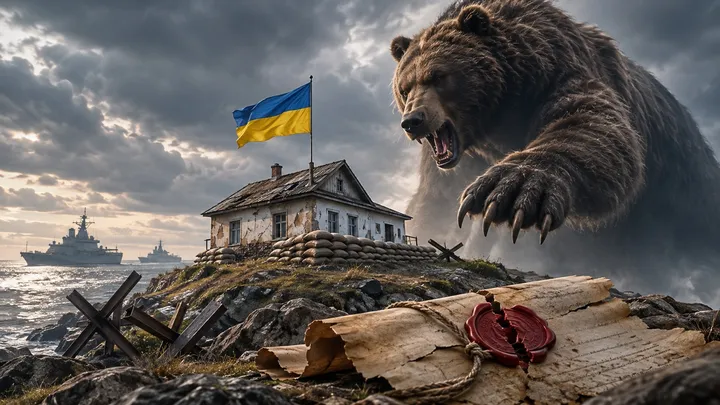
Back to the main thesis. Why do I say that the war is over and that what we are watching is the resuscitation of a mummy? Because the war has lost its function. Initially it was assumed that this was not merely the pacification of a runaway colony, Ukraine, but an acquisition: territory, resources, control over transit, status in the new world alignment. The acquisition did not happen on a single point, and Moscow knows this better than anyone else. What remains is the pure inertia of spending, which justifies itself: we fight simply because we fight, because that is how it must be. The system keeps moving not because there is a goal ahead, but because there is nothing behind.
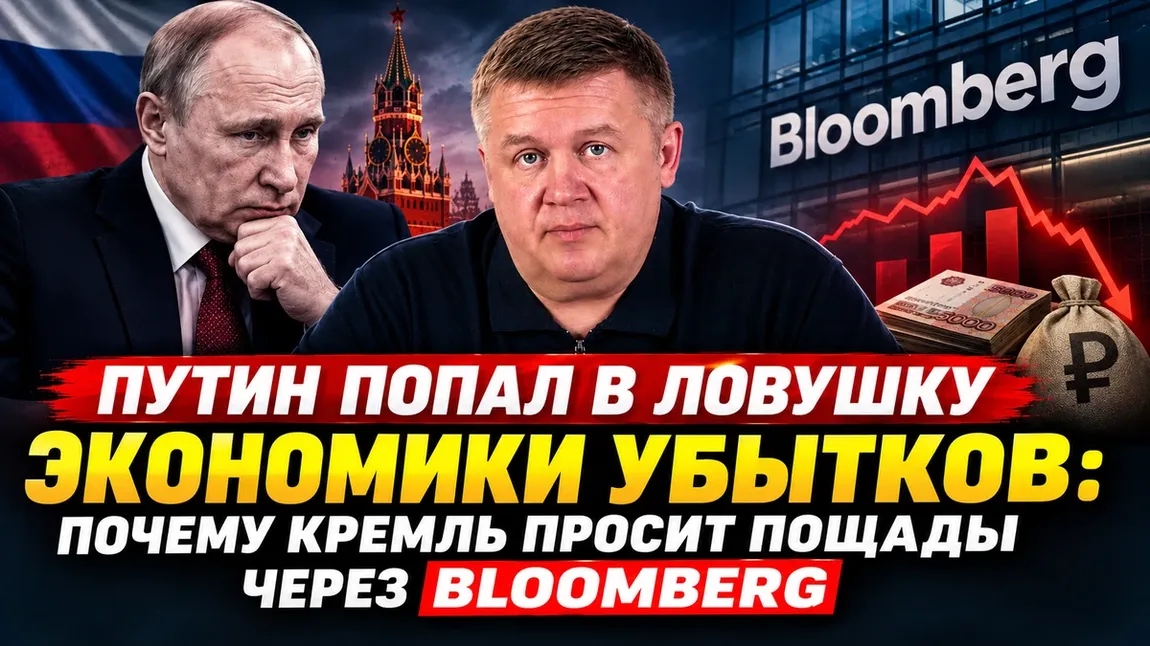
And here a symptom appears that everyone has been discussing in recent days: a managed leak in Bloomberg. Formally, three unnamed sources shared secret information about Putin's mood. In fact, what we have is a set of theses that coincides word for word with what is heard on Russian television, which means it is no leak at all but a message sent to the right address.
The message itself is remarkable for what is absent from it. There is not a single claim about future acquisitions or achievements of Russia. There are only threats and contrived explanations of Putin's position. Sanctions and strikes on refineries will not stop him. The current escalation is not yet the limit. The negotiating mechanisms have been destroyed. Russia has repeatedly made concessions, and each concession worsened its position. America is to blame for the failure at Anchorage. Ukraine's strikes are increasingly interpreted as NATO aggression, because the weapons come from there. There are practically no alternatives to further escalation, talk of tactical nuclear weapons is growing, and only Putin, who unleashed the war, restrains his subordinates from using them. Note the last point: the man whom the world unanimously regards as the source of the threat proposes, through the mouths of Western media, that he be considered the only restraining factor. This is not the position of a strong man, it is an attempt by a loser to sell himself at a higher price.
Some link the publication to the visit of the CIA director, which took place a couple of days before it: here, they say, is the Russian answer. But the chronology does not bear this out. Messages of this kind are not prepared and passed on in a single evening, the bargaining attempt went to the editorial office at least several days before publication. And then the order of events lines up exactly in reverse: first the White House read the article, then the CIA director flew to Moscow with the reply, and only after that did the piece come out. The publication became a formality, the ritual conclusion of an exchange that had already taken place. And if you like, here is the main conclusion from this chronology: the Americans treated Putin's attempt to establish communication in precisely that way, seriously.
Now the most interesting part. What is Putin actually bargaining over in this message? Moscow refuses the local ceasefires that Zelensky proposes: on grain, on energy, on a mutual halt to long-range strikes. The refusal is presented as a show of strength. Let us examine it through real damage, honestly and without pathos.
Ukrainian long-range strikes, for all their spectacle, do Russia not all that much damage. The campaign against refineries is noticeable, but not critical for Russia. The campaign against marketplace warehouses is noticeable for the people, but not particularly significant on the scale of the country. Incomparably greater damage to Russia's budget is done by the war itself: daily spending on it has been growing for the fifth year in a row. If combat operations last another year, it makes practically no difference whether they come with the fireworks of long-range strikes or not, because even a positional war with its incredibly bloated budgets will cost the Kremlin more than all the hits on oil depots put together.
Hence a simple conclusion. If Moscow is bargaining precisely over long-range strikes, then it is not bargaining over the economy. It is bargaining over the picture. A burning refinery can be seen from the window, it is filmed on phones and posted online. But working capital withdrawn from industry cannot be seen from anywhere, it does not burn and does not get into the frame. Putin is defending the image of stability instead of its substance, and that is perhaps the most honest description of his current strategy.
How long will this illusion last? The question is rhetorical. Missile escalation against Ukraine will yield no result. Strikes on food infrastructure are already under way, this is pure terrorism against the civilian population, and its use is close to zero: logistics will change, the range of goods will shrink, but with the European rear Ukraine will not go hungry. The effect of the new campaign against energy is also in serious doubt, because the infrastructure has been rebuilt over these years and the facilities hardened. And the prize itself is dubious: a country fully without power in winter, with a freezing population, is exactly the achievement for which Russia has already earned the reputation of a fascist state. Terror against civilians against the background of impotence against the military on the battlefield hurts Russia's reputation more than any defeat. A war against the civilian population is a demonstration of weakness to everyone at once, including those who are still counted as allies.
Threats to strike the center of Kyiv, Bankova Street, change nothing at the front and read exactly the same way. Tactical nuclear weapons are even more so, and indeed the effect is the opposite. A strike on a city with mass civilian casualties would raise the question of whether China wants to go on doing business with such a partner, and Beijing, as is well known, extremely dislikes it when a partner creates problems for it out of nowhere. Using nuclear weapons along the line of contact is pointless on purely technical grounds: the line would have to be showered with hundreds and thousands of warheads, and then one would have to advance across contaminated terrain, which is in itself a curious idea. Threats to hit Europe in order to force it to stop supporting Ukraine will provoke exactly the opposite reaction. And NATO entering the war is what the Russians would like least of all: if today oil is still somehow being shipped out by the shadow fleet, then in a direct conflict with Europe exports via the western routes can be forgotten for good.
In sum: the room for escalation is minimal, the gain from it is negligible, and the costs of the war, inflated by the chekists, are already far too enormous. Starting the war in February 2022 at enormous losses was a decision that can be explained within the framework of cynical capitalist rationality. Ramping up escalation at a moment when there is nothing left to carve up is a decision with worse consequences and not a single chance of a prize.
And here we come to the underwater part of the iceberg, without which the whole construction hangs in the air.
Recall when, and how many times, the heads of other countries' intelligence services have come to Russia. Britain's MI6? Israel's Mossad? German, French, Chinese intelligence? Can't remember? Right, because there were no such visits. It is always the Americans who come. They came under different presidents, in different circumstances, however loud the mutual accusations in the public space. And this is no mere matter of protocol. It points to the nature of the relationship, which deserves to be named directly: Russia is a crypto-colony of the US, however wild that may sound in the fifth year of Russia's war against Ukraine. And to describe the situation even more precisely, always, in all times, Russia has been the hegemon's servant.
And here we must be objective, otherwise what we get is not analysis but cheap conspiracy theory in a dress uniform. The mechanics of this alliance are extremely simple and maximally humiliating for Russia. Historically, Russia has never been an independent center of capital accumulation. Russia has always been run by compradors and has been a structure that lives off mediation between the world economic center and its own periphery: it sells raw materials upward, buys technology from above, and converts the difference into power at home. A comprador structure vitally needs a master, that is, a hegemon with a market it can attach itself to. Enmity with the hegemon is fatal for Russia, whereas subordination is a source of rent.
Hence the whole historical series of Russia's greatest allied victories. Russia, in a coalition with Britain in the war against Sweden, helped Britain become the Ruler of the Seas. Russia, in a coalition with Britain in the war against Napoleon, helped Britain become the world hegemon. And of course Russia in alliance with the US, with Stalin's industrialization, which directly or indirectly led to the subsequent Second World War, thanks to which hegemony moved across the ocean. And Lend-Lease was not an act of goodwill but the durable mortar of this alliance. Every time it found itself on the same side as the hegemon, Moscow received technology, credit, markets and status. Every time it found itself on the other side, it got the Crimean War, Port Arthur, the Cold War and what we are watching today.
Objectivity requires adding an important detail at once. The union of Russia and the US was never either friendship or a partnership of equals. The hegemon always used Russia as a colony, as a counterweight and as a supplier, and when the need passed, the tie was severed without any sentimentality: from the Congress of Vienna to the Crimean War was forty years, from Yalta to Fulton less than a year. And a working channel between Washington and Moscow today does not mean any collusion over the fate of Ukraine. It means exactly this: the hegemon and its crypto-colony maintain a line along which a message can be passed without intermediaries. That is a function, not affection. But this function exists exclusively with the US and does not exist with London, Berlin or Beijing. This asymmetry is the fact worth keeping in mind every time Moscow explains that the whole West, and the US in particular, has taken up arms against it.
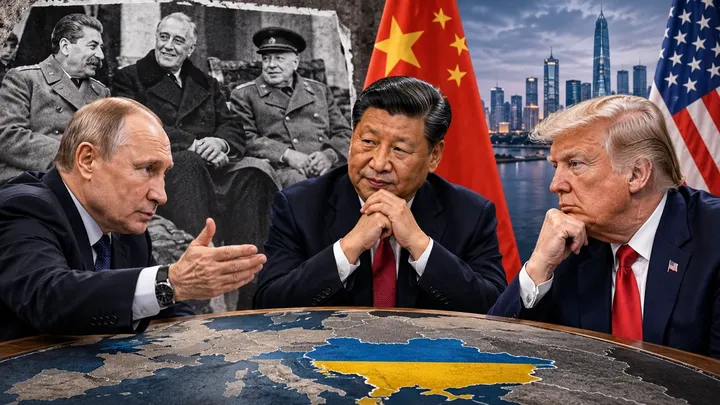
Now let us look at events through this lens. Russia's economy is being taken apart for spare parts to finance a war that ended as a profitable project a year ago. Escalation is unavailable, because any version of it costs more to the one who escalates. And the only working foreign-policy channel leads where it has always led, to the hegemon, to which Moscow desperately wants to attach itself again, but can no longer do so on the old terms and without losing face. This, and not a readiness to go to the end, is what can be read in the message Putin sent through Bloomberg. The question is long past stopping at the line of contact. The question is how to roll back in economic contracts to the state of affairs before February 2022 and never fight again.
Note, by the way, how Putin's rhetoric has changed lately. There is noticeably less of the openly delirious patriotic-historical pontificating, and in interviews uncertainty and irritation show through more and more. Why? Because the nonsense for the masses about a historical mission and great conquests inspires Putin only until his own safety and the safety of his family come under threat. The talk about turning the whole world to dust for the sake of greatness was part of the show from the start, and the message to Bloomberg confirmed this better than any analysts.
The same goes for Putin's entire present retinue, which, in the best traditions of yard hooligans, endlessly threatens nuclear strikes and all manner of reprisals from every iron and hairdryer. Putin's retinue, psychologically organized like a prison hierarchy, is cowardly by definition and was not ready to die in principle, especially after having come to success. A man who has made millions on the war will not go off to die for the Russian World. He is ready to sink to the very bottom and will obediently whine in order to survive.
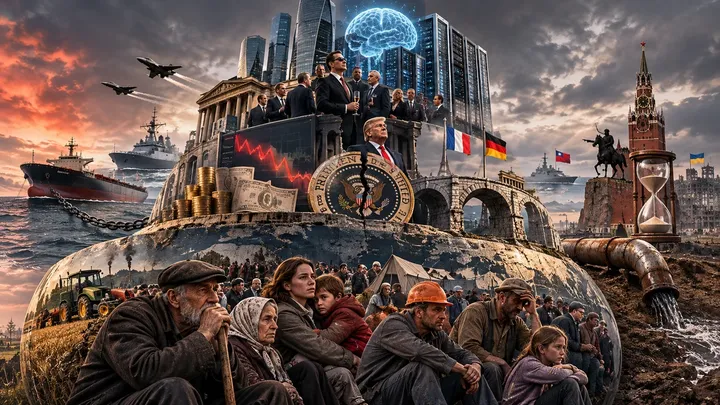
And the last thing, for the sake of which it was worth laying out all this bookkeeping. The dismantling of Putin's vertical has already begun, is being carried out by his own hands, and will continue for exactly as long as there is something left to take apart. That is why the ruins of Ukraine are today being paid for by the dismantling of Russia itself. And that is why this dismantling is profitable for those carrying it out, right up to their last day.
References:cheslavsky.substack.commedium.comx.com