Guest: Oleg Cheslavsky, publicist, historian, analyst, author of the book "Myths of the Third Rome." Host: Yuriy Romanenko.
Yuriy Romanenko: Friends, hello everyone. Surfers and slackers, our beloved deviants. Today we have Oleg Cheslavsky, who has been on the air many times before. He has come with his new book, "Myths of the Third Rome," which you can already buy. Today we will talk about a different topic, no less interesting, and maybe more so. Why is 2026 more frightening for Russia than 1917? Oleg wrote a good article about this. It caught me: I started reading and got to the end, to the dialogue between the French ambassador and someone from the Russian elite in 1916. The terrible forecast made there was confirmed. Oleg showed this through the lens of world-systems analysis: how the revolutionary events in Russia fitted into the logic of the restructuring of the world system, into the British cycle according to Arrighi and Wallerstein. Russia went through a series of revolutionary upheavals and ended up where it ended up. And now, at the tail end of the American cycle, Russia is stretched on the rack again. Oleg?
Oleg Cheslavsky: The situation now is actually worse. If we talk about 1916, Russia was not in the worst position then. The country is full of money, credit money. It is included in the world economic system. That is, it does not simply exist as a kind of territory, as Russia has in fact come to exist now; it fills and complements the world economic system. On one side, the British have come into Russia, extract minerals here, build railways, industrialize Russia. On the other side there are French loans, again so that the British can do all this. The country works and lives. And the czar lives on a rent that suits him perfectly well: he receives enormous income, can place it, re-place it, and it all moves in the direction of growth.
In any case, the situation that is taking shape in Russia now, in 2026, is exactly the opposite. Everything that was left after the Soviet Union has been eaten up. Everything that was accumulated after the Soviet Union has been eaten up. Complete deindustrialization. They do not produce nails today; everything is produced in China. A country without a credit system, in fact not included in the world market, under constant sanctions. That is, the fact that tomorrow Putin finds himself, roughly speaking, with a broken trough if the war ends is a fact.
Russia, coming out in 1917, even though it had lost, received (already as the Soviet Union) one of the options for transformation and preservation of Russia: the rejection of the previous system of accumulation. According to Arrighi, they rejected that system, made a Soviet one, and went on existing. What will Putin do in a situation when the war stops, ends, goes on pause? It is unclear, he has no way out. In fact he has driven himself into a corner by the fact that nothing that would have provided some kind of cushion after the end of the war remains.
Y.R.: Well, and China? Many people see China as a partner, senior, junior, it doesn't matter.
O.C.: The funniest thing about China is that everyone forgets about the traps, how they are built in Arrighi; he wrote a great deal about this. He asked: why did the British go into India, why did they go into China, but did not go into South America? It would seem that there could have been even more resources there, the profitability could have been higher. But they held quite firmly to one idea: infrastructure. In China and in India there was an underdeveloped, insufficiently developed, but still existing infrastructure. In South America there categorically was none. The situation in Russia now is the same. Putin has completely finished off Russia in terms of infrastructure. There are no roads, nothing. How would you go in there, and why? To go into Russia and make a profitable asset out of it, you have to invest in it.
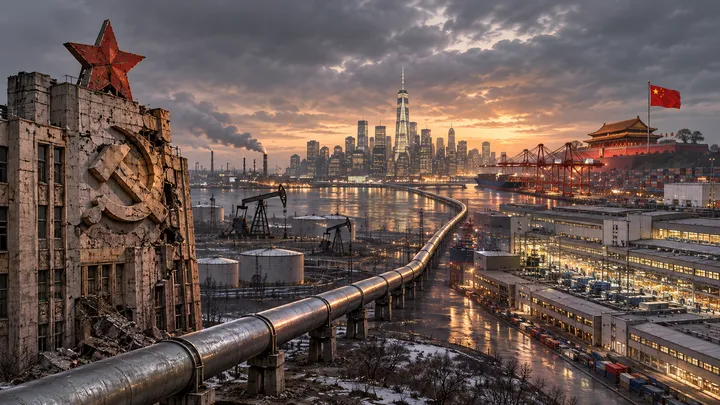
The Americans reckoned: "Let's let China go first. Let them invest in Russia, develop Russia, and then perhaps we will be interested in going in there, when there is somewhere to go in." Right now it is a wild field for China. And for the US it is also a wild field, and they are simply letting China go ahead so that it invests. But what did Xi answer on "Power of Siberia 2"? "Not the time. The first one is enough for us. We will buy the same gas in America at a higher price, because we have a national strategy which assumes that we will never depend on a single supplier, even the best one, even the most advantageous." How right that is, you can see from the experience of Germany, which sat completely on the gas needle and where it has ended up now.
Y.R.: So a situation in which Russia ends up under China is beneficial to the US?
O.C.: Definitely yes. Another matter is when someone starts telling you that China is the future hegemon; here you have to stop and say right away: how can a communist country be a hegemon? That contradicts the very logic of capital. For the world economy they will not be the hegemon to which capital will come, from Arrighi's point of view. There will be no relocation of capital there.
Y.R.: But it is itself already a holder of capital. It has a great deal of capital.
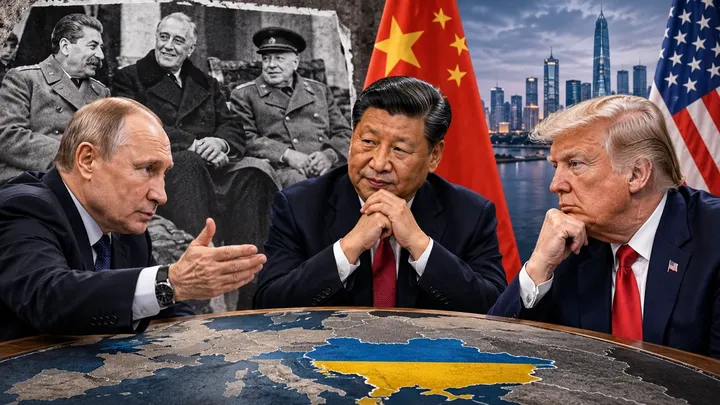
O.C.: I do not deny this fact of excess capital. They process it quite well, but for the world economy they will not be the hegemon to which capital will come, from Arrighi's point of view. That is, in fact, why the meeting of Trump and Xi ended with them saying: "Let's set up a G2, let's be hegemons together." They have come up with a system in which there is no need to engage in reindustrialization, they do not need to change the system of relations. Everyone is quite satisfied with the existence of the dollar as the common system of settlements. They are quite satisfied with China in this world-system, where China occupies its place as a manufacturing, industrial giant. The US remains the financial center. That is, they have as if agreed that they will coexist, and this will be a mutually beneficial coexistence.
Y.R.: But they did not agree. All serious analysts say that the visit ended in nothing. Certain positions were set out, contradictions were set out. On none of the key points of conflict was any consensus presented. The decision was postponed to September, when they are supposed to meet again.
O.C.: I am not saying that the full stop has been put. I am reasoning in terms of a change in the systemic environment. From my point of view, even if no treaty has been signed, there is a change in relations, the vector has changed. The vector of relations has changed completely. They are already ready to meet. They have four meetings planned for this year alone. The negotiation process that has been launched is, one way or another, moving toward some consensus. That it is difficult or impossible to reach agreement with the Chinese is the complete truth. There is a saying: if you have shaken hands with a Chinese, check how many fingers you have left on your hand. They will look for opportunities to get more or to cheat. That is normal. The Chinese approach.
Y.R.: Honestly, this position is incomprehensible to me. In the early seventies the Chinese agreed perfectly well with the Americans and fulfilled their agreements.
O.C.: Well, that was because it was beneficial to them. Now it must again be beneficial to both. Only now the position has changed: China feels much better. China is now at a peak position that it has not had for the last 200 years. It feels best of all right now. And so the Americans came to the conclusion that destabilizing the world further with some wars, some events, is rather difficult. It is easier to have a good consensus with China, which fits completely into their system and complements them. Engaging in reindustrialization of the US now is that kind of process.
Y.R.: Wait, they are doing that. On Mexico, Trump set the task that 80% of the car components now produced in Mexico should be produced in the US. That is concrete. Reindustrialization is under way, just not at the pace of the thirties of the last century.
O.C.: I do not deny that point. I simply mean that at a pace that would push China out or replace it completely, America will not do that. They go only in the area where they find autonomy in the cycles necessary for their own existence, autonomous from the world. The only place where they may plunge very strongly into development is the military sphere. I think they will bring the military sphere back and will develop it.
Y.R.: I will not agree with you, because look: they are competing with China very dangerously in the field of artificial intelligence. This is the nuclear technology of the 21st century. There is a crazy race, a life-and-death race, because everyone understands perfectly well that whoever gets the better AI, in the full sense of the word, will rule the world. I simply do not see them heading for some course of reconciliation. They are possibly playing to reduce the costs of a head-on collision for now. And China understands this. The States have understood their dependence on rare earth metals and its influence on the military-industrial complex cluster. And China understands its dependence on the world financial system, which the Americans still control, and its dependence on sea communications: the Americans will cut them off in the Strait of Malacca, and that's it. 80% of their trade will simply go down the drain.
O.C.: I completely agree with all of it. It fits entirely into what I am trying to say. The situation is that they have now found some single vector of development that allows them to develop without crossing each other's path. Even the race in the AI sphere helps them develop faster. The presence of a competitor capable of showing a better result lets you see where to develop. The absence of such a competitor would slow you down for hundreds of years.
Europe today has completely lost its weight and development, and everything, as it were, passes it by. But this does not change the fact that China will somehow be hindered in developing further industrially.
Y.R.: Well, they impose restrictions on supplies of certain chips, there was talk about Nvidia...
O.C.: That is already a strategy of national interests. But as for the development of the industrial sector, they do not particularly meddle there. Artificial intelligence is, well, not as developed as it is described in science-fiction novels. In reality they will restrict chip supplies, they will restrict the industrial base in terms of AI development. But AI today theoretically has enormous growth and weight for the development of a state, and no one yet imagines where all this will lead. We calculate it all, we believe in it, but in fact for now these are also forecasts.
Y.R.: Still, Russia is tied to the Chinese and clearly coordinates its positions with them. If the Chinese steer toward a consensus with the Americans, Russia will get something, so why would the Chinese drop it? It is a trump card for them, one that will be used the way North Korea has been for decades.
O.C.: Nobody will throw Russia out onto the street. I say once again: the situation is not that it will be thrown out. The situation is that the difference between the two wars, a hundred years apart, is that then Russia was part of a system as a debtor. Russia was wildly indebted so that the British could earn their money here. And now Russia has gone off into its own system. And although it has resources and everything else, it is not capable of returning to the world-system and becoming part of the economy tomorrow in a single day. It has to change.
It has to carry out some kind of, if not de-oligarchization, which is impossible in principle, then de-imperialization, which is quite possible as an option that would allow it to preserve its place in the world-system economy or return to it. But to return as a semi-periphery, and by now rather as a periphery of China, is the only path that is really possible now, given the steps Putin has taken. To become a periphery for China, nothing more.
Y.R.: So becoming part of the G7 is no longer about Russia?
O.Ch.: But again, you and I are forgetting that the Americans may well be staging a situation that simply devalues Russia's position, so that they can buy it out much more cheaply later.
Yu.R.: What has changed for Russia? Well, it was semi-peripheral. As Kagarlitsky wrote: "a semi-peripheral empire."
O.Ch.: It was a semi-peripheral empire and it remains one. Only now, instead of being the semi-periphery of the West, it may become the semi-periphery of Asia and China. There are only two options here: fragmented or whole. I see only two options. That is, it will remain a semi-periphery, but either fragmented or whole. The fragmented option is to develop this economy, become more powerful and reach some new level. Or to keep it as it is today. A loss-making, forgotten periphery. That's all.
Yu.R.: Periphery and semi-periphery are different things. The periphery is Zambia, Ghana.
O.Ch.: Agreed. A semi-periphery is when you still have your own science, your own production, your own military-industrial complex. But there is practically no science of its own, practically no production of its own, no base of its own. The best minds left long ago. Research is still being done, but it is not at that level. That is already more of a periphery.
Yu.R.: Well, then we remain a periphery. On the plus side, nothing has changed for us at all.
O.Ch.: I am not saying that we are better off because Russia ended up in a worse situation. No, we are much worse off. I don't know at all how we will get out of this situation today. Our only option is to join a dying Europe. However funny that may sound, it is the only option where we can find some place that would now allow us to preserve the country. I don't see any other option so far, because to get drawn into China's zone of influence — to be honest, I don't think that has any prospects. We are not a promising player in this game.
From Europe's point of view, becoming a chance to strengthen itself somehow is a plus. If Europe realizes that we are saving it, we have some possibility of development. Well, that's my opinion. I may be very wrong.
Yu.R.: It is obvious that our future lies within the European project. Not necessarily within the European Union, because it is unclear what will happen to the EU itself, but within a European project that will exist in the form of some coalitions and will coordinate its interests. As it was in the 15th–16th centuries, when European monarchs understood that the main problem was the Turks. Yesterday I was reading about Bohdan Khmelnytsky and the Cossack uprising, and how it was discussed in the European press. In our version it is presented like this: the Cossacks kicked the oppressors' asses at Zhovti Vody, Korsun, Batih. But you open the European press and it says that some traitors, bands of bandits who had allied with the Tatars, the Tatars being vassals of the Turks, and the Turks persecutors of Christianity. The most dangerous thing — look how far it went. And the legitimate Polish king is fighting back. A completely different focus.
O.Ch.: And with all that fragmentation — different states, hundreds of dwarf states on the site of present-day Germany, a dying feudalism — there was nevertheless an understanding of common interests. They tried somehow to defend those common interests, as in the Battle of Vienna. The Poles sent troops, and everyone else did too. But we had neither agency nor understanding. We were more like the Tatars for that world — we differed little from them in the eyes of a European. But one way or another this led to some manifestation of statehood, even if only for a second, which arose among us then and disappeared very quickly.
The situation we are in now: we are wildly in debt, we will be in even more debt, and we will need to find a way out of this situation so as not to turn into some kind of Greece or something even worse. I think we have better prospects. But as for Russia, its problem is that it has left the system, and it has to resort to some tricks and contrivances to get back. And again, this means superprofits for those players who will be able to play with it. In essence, it is being played with. After all, nobody today says that it is not a valuable asset. Nobody says that this asset is devalued. It's just that to restore its value, you need to invest in it.
It seemed to me that the US game of playing the one who is behind consists precisely in letting China through, so that the Chinese invest in projects in Russia and it becomes more attractive to investors. And there is one more very important nuance: all the enterprises in czarist Russia, which fell, were not simply protected by the state, they experienced no pressure from it at all. Today everyone has left Russia, and not a single investment that came in from the West was protected. They seized and tore apart all the enterprises. It is a long process of rehabilitation that they will have to go through to bring investors back. It certainly won't happen tomorrow.
On world-systems analysis as a tool
Yu.R.: Here is a question from viewers: world-systems analysis is not a scientific method, because it relies on the poorly verifiable concept of core and periphery, which greatly oversimplifies political processes.
O.Ch.: I would like to ask: how many works on world-systems analysis has this person read? If he had read at least the four volumes of Wallerstein, which are the foundation, or had started with Braudel, who was the forerunner and simply described the whole structure of everyday life very deeply, what would he counter with? These are very deep things. Everything is drawn together on the basis of sociology, economics, psychology.
Arrighi's The Long Twentieth Century took twenty years to write. Twenty years. And it is an outstanding work that gathered and rethought the approaches of Braudel and Wallerstein. He did not simply absorb them into one book; he rethought them and presented them in clear language. I consider it a brilliant book in every respect.
Yu.R.: I agree too.
O.Ch.: That is why it is easier to refer to him, why it is easier to explain things with him. Because the interpretive models he gave are better. It is the same as with the institutionalists or the Marxists, who devise some model, and through the prism of that model you understand the world better. Before that you could see only from one point of view. And here the word "optics" is simply perfect. In Arrighi's optics you begin to see in this world some outlines, contours. Show a primitive man the Mona Lisa, say. He would see some female in an unclear interior. A patch of color, in essence. But here you finally see the contours of certain movements, the vectors of direction, and you begin to understand that, using this optics, you can assume something and build hypotheses.
And nobody denies that a new concept will appear above Arrighi; of course, it is inevitable. Artificial intelligence will make it possible to calculate many models and overlay them on existing situations. We will see completely different dynamics and different processes. But for now this is not available to us for such things; judging by everything, those who can afford it are already calculating it.
On solar theory and cyclicality
Yu.R.: There is also this one of yours, the solar theory of the shifting of centers.
O.Ch.: Yes, all these centers kept shifting westward. First there was Italy, then Holland, then Britain, now the United States. And everyone says: "Where next? The ocean!" We must understand that the United States is in an astonishing position: it is the west for the West and the East for the East. The States are in a very astonishing position from the point of view of cycles: in theory, they hand over, return the cycle to the East, and from the East this cycle should go west again.
Yu.R.: Well, that's the same as tulip mania, a purely speculative logic. And it is generally characteristic of this second stage after the signal crisis. World-systems analysis teaches that the signal crisis is the moment when capital moves from production into the speculative sphere, into the sphere of financial speculation, and begins to look for areas where it can make superprofits. In the States this signal crisis began, according to Arrighi, in the 1970s.
O.Ch.: Yes, but it has been going on ever since. I have said several times that we don't understand something: perhaps each time they simply go onto a penalty lap. That is, the situation is not that they cannot move up to a higher level. We don't understand this. We see that they are failing. But perhaps the situation should be viewed differently; maybe there is some problem there. But in any case, what is happening now...
I laughed recently about the role of the United States: in essence, Trump is now looking for a way to resell, as a comprador, the opportunity to spend the American budget on projects that are not supposed to benefit America. They are supposed to ensure superprofits for investors.
Yu.R.: Then it will lead to the end of America, if that is how it goes.
O.Ch.: One way or another it turns out that this end has been going on for the last 50–60 years. And what we see today is in fact that end which never ends. When a moment comes that we regard as some kind of reference point, they either print more money or get drawn into another war. That, in fact, allows them to maneuver in this field. But the superprofits they provide keep them legitimate in this field.