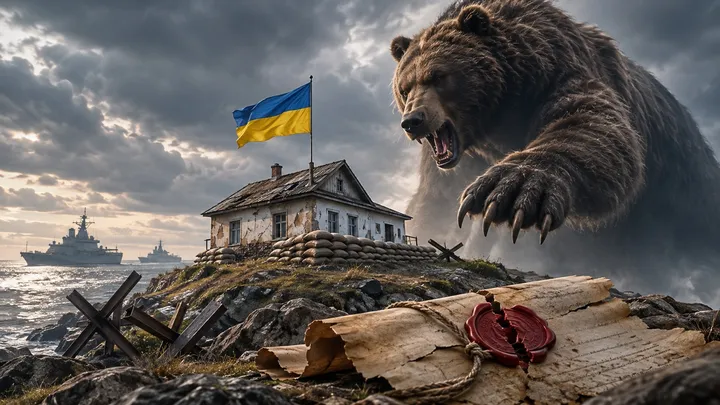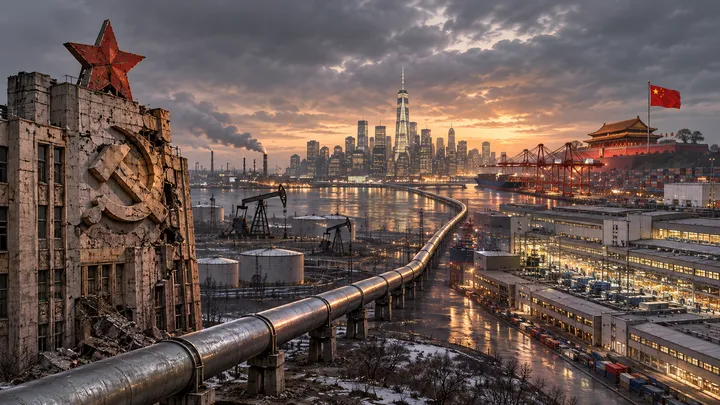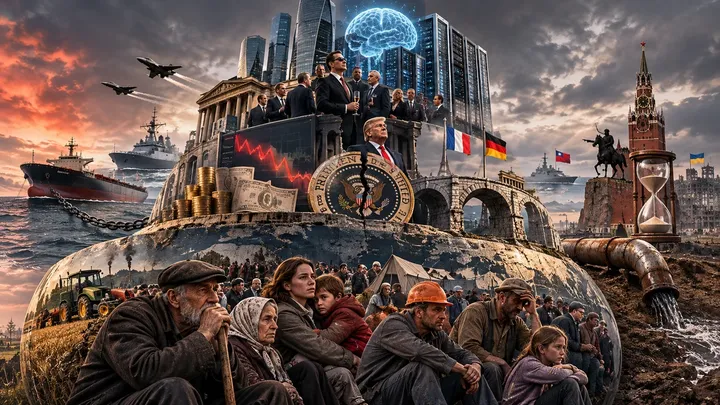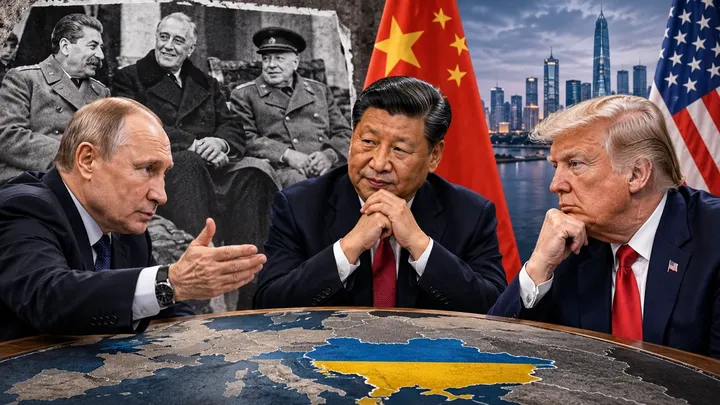
The news of recent days sounds as if Russia's war with Europe could begin tomorrow. The alarm was set off by Putin's speech at Valdai, where he threatened that if Russia is attacked, it will use every weapon it has. He did not say aloud which weapon he meant. But everyone understood. Nuclear.
Whether this was a declaration of war or just another act of blackmail, Europe did not bother to work out. Lithuania is already preparing a plan to evacuate its civilian population: residents of Vilnius are to be taken out to Poland. The Lithuanians and the Poles are plotting routes together and deciding which bridges will have to be reinforced so that they can bear the flow of people. The same is happening in Estonia and Latvia. All of this seems to suggest that the Third World War is already on the doorstep.
My answer is no. And why not, Putin himself explained in that same Valdai speech.
An admission spoken aloud
Putin pointed out that Europe is an adversary twice the size of Russia. Europe has twice as many people, a far stronger army and a far more powerful economy. What matters here is not the fact that he said it, but the tone in which he said it. Putin seemed to be justifying himself to someone, explaining that his opponent is twice as strong as he is. He spoke like a foreman explaining to his contractor that he won't manage the job. That he cannot handle one more military clash, however much he is asked.
He does not renounce his obligations, though, and declares his readiness to use nuclear weapons. But the main thing to grasp here is this: the threat of nuclear war is not quite a plan of attack. It is a frank admission of Russia's weakness, of its military impotence.
Does this mean that there will definitely be no war with Europe, ever? No. Dozens of analysts say that a war with Europe is planned, and has been planned for a long time. It is just that Moscow lacks one, shall we say, component for carrying it out successfully. To understand which one, we will have to recall history.
The battering ram that always fought on someone else's money
Has Russia attacked Europe before? Yes, and more than once. Russia has fought Europe many times. And, very importantly, never with its own money and never for its own interests.
It all began under Ivan the Terrible, who was not called the "English czar" by accident. In 1558 he started the Livonian War and seized Narva. It was through Narva that English ships carrying gunpowder, weapons and craftsmen went to Moscow. The Polish king Sigismund Augustus wrote to Queen Elizabeth at the time and begged her to stop these shipments, because the English were arming the enemy of all free peoples.
London did not listen to him. And it did not listen for a very objective reason. It is enough to ask who lost in that war. The Hanse. The Livonian cities of the Hanseatic League, Riga, Reval, Dorpat, found themselves in flames. And the Baltic trade, which the Hanse had held for centuries, was taken over by the English. In 1598 Elizabeth closed the Hanseatic Steelyard in London. Moscow fought, the Hanse fell, and England won.
A century and a half later history repeated itself. In the Great Northern War, Peter I fought Sweden, then the mistress of the Baltic, for 21 years. Sweden fell, but the main beneficiary was not Russia but Britain. While Peter fought, Britain secured its dominance of the seas in 1713 by the Peace of Utrecht. Russia broke Sweden, and Britain became the mistress of the seas.
Their relations did not end there. In 1755 Britain signed a subsidy convention with St. Petersburg, and its terms were as simple as in a lease agreement. Russia keeps 55,000 soldiers on the Livonian border, ready to march on London's first order. London pays 100,000 pounds a year for this while the troops stand ready, and 500,000 when they go into battle.
Under Napoleon this trade in cannon fodder became a system. Remember the pride of the Russian army, Suvorov's famous crossing of the Alps in 1799. Who paid for it? British money again. Russia is proud of that crossing to this day, but it was the British treasury that paid for it.
Did Russia try to break free of the grasping British hands? It did. Emperor Paul I quarrelled with the British and decided to change his buyer. He drew close to Napoleon and even sent the Don Cossacks on a march to India. But by a remarkable coincidence, in March 1801 Paul was struck on the head with a snuffbox. And his son Alexander I, having taken the throne, for some reason immediately brought the Cossacks home and at once made peace with London.
In 1805 London and St. Petersburg agreed on an exact tariff: 1,250,000 pounds a year for every 100,000 Russian soldiers. That is, Britain bought cannon fodder for the war with France by the piece, at a price per bayonet. Britain itself fought mostly at sea, where it simply had no equals. On land, bought armies fought for it. In 1814 the Russian army entered Paris, and thanks to this Britain became the master of the world, having lost in that war not a single village of any significance.
A new master from across the ocean
In time the era of British hegemony ended. The money crossed the ocean, and with it the Russian battering ram against Europe acquired a new master.
American money came to Russia, by then Soviet, before American diplomats did. In 1921, when the Volga region was dying of hunger, American aid fed more than 10 million people. Why America needed these people is clear. America was helping the Bolsheviks survive a famine that could have toppled their power.
And when the famine passed, American business came to Russia. Ford built the Soviets an automobile plant in Gorky. The Detroit architect Albert Kahn designed more than 500 factories for the Soviets. The famous Stalingrad Tractor Plant was assembled on the Volga under the direction of American engineers. And the legendary Magnitka was built by the very same Americans.
But what is truly important, curious and interesting is something else. The same American money was going to Germany at the very same time. American banks lent money to Germany so that Germany could use it to pay its debts to Britain and France. And Britain and France returned that money to America. The money went around in a circle, and on every lap American banks collected interest. The American company General Motors bought the German Opel. Ford built a plant in Cologne.
Moscow, meanwhile, was busy with its own business too: it was secretly raising the German army. Germany was forbidden to have tanks and military aviation, so German pilots trained near Lipetsk and German tank crews near Kazan. The future conquerors of Europe, Hitler's generals, learned to fight alongside the Russians in the Soviet Union.
In August 1939 Stalin and Hitler signed a pact and secretly divided Europe between them. Germany attacked Poland from the west, and the Red Army struck Poland from the east. Stalin and Hitler partitioned Poland, and so the Second World War began.
Britain and France declared war on Germany, and the British fleet cut off Germany's maritime trade. In effect, Germany found itself under sanctions: no oil, no rubber, no grain from overseas reached it any more. And here Moscow came to the rescue. It sold Germany not only its own raw materials. It bought rubber and other goods for Germany not only in Asia but all over the world. And it carried them across its territory by the Trans-Siberian Railway, bypassing the British blockade.
In 1940, at a moment when the whole world was fighting Germany, Moscow and Berlin signed a trade agreement. Soviet oil and Soviet grain poured into Germany in a stream. The trains ran until the last night before 22 June 1941. The German army crushed all of Europe only thanks to Russia.
Can we say that the Americans helped or hindered exclusively Europe, Germany or the USSR? No. Never. Big money has always gone where profits were bigger. But the war also had a political vision from across the ocean, and this logic was best formulated by Harry Truman, then still a senator. Two days after Germany's attack on the USSR he told the New York Times: if Germany is winning, we should help Russia, and if Russia is winning, we should help Germany, and let them kill as many as possible.
That is how it turned out. But however much profit the war brought American factories, the main earnings began only after it. The rebuilding of Europe became a truly fabulous market for American goods: machine tools, trucks, grain, power stations and credits years ahead. Europe lay in ruins and became a dream market for American money. All the more so since after the war America simply had no competitors left. All the competitors of the United States lay in ruins.
An algorithm with one part missing
If we put these two pages of history together, the British and the American history of mastery over Russia, we get one and the same algorithm. The master of the world always needs a weak Europe. And Moscow always acts as the battering ram for the hegemon.
Moscow sells the hegemon what it always has in abundance, and sells it as cheaply as possible. That is the readiness to throw into war as many people as the hegemon orders. This is exactly why Putin worries about Russia's worsening demography. The hegemon pays for cannon fodder. The war scorches Europe. The hegemon earns on selling arms, and then earns on the reconstruction. And after that Moscow is always put on a chain, so that it does not imagine itself master of the situation. After Napoleon that was the Crimean War. After 1945, the Cold War.
The algorithm is clear. But where is that very component that Moscow lacks? It exists, and it really is missing from Russia's formula for victory. Moscow has never had enough strength of its own for a big war with Europe. So before every big war Moscow first takes the resource of a neighbour. Recall that before the wars with Napoleon, Russia, together with Prussia and Austria, partitioned Poland. And it was precisely the partition of Poland under the pact with Hitler that became the beginning of the Second World War.
So is Poland the necessary component for Moscow's victory? No. Among all of Moscow's neighbours there is one without which it has never won a single big war. That is Ukraine.
The resource that the war is being fought over
In 1654 in Pereyaslav, Hetman Bohdan Khmelnytsky became an ally of the Muscovite czar. He sought an alliance and got a yoke. It was thanks to this union that Ukraine for centuries became the main donor of cannon fodder for Moscow's wars. Yes, Ukraine gave Russia not only bread. This is important to know and understand today as well.
Without Ukraine, Moscow is dangerous. But only with Ukraine does Moscow become a real threat to Europe. That is why Moscow is fighting for Ukraine today not so much for the sake of territory as for the sake of the resource. The very human resource that it so needs for war.
Now it is clear why the Kremlin has always been against Ukraine joining NATO. And why the US has always been in solidarity with it on this. If Ukraine becomes a NATO member, Moscow will lose its forward military resource forever. The same will happen if Ukraine unites with Poland in an alliance. Then an impassable redoubt will rise on Russia's western border, headed by the Ukrainian war machine, the most experienced army in Europe and the world.
Who this is least advantageous for is not hard to guess. And is it advantageous for the US? Categorically not. As long as Europe has no military force of its own, Europe buys American weapons and waits for decisions from Washington. That is why an alliance of Poland and Ukraine is completely unneeded by Washington. It wants it least of anything in the world.
The problem is that Berlin does not see any benefit for itself in this alliance either. After all, if Europe's main army ends up today between the Vistula and the Dnipro, Europe's political centre will shift there too. And so a paradox emerges: an alliance of Poland and Ukraine is needed by none of the big players.
2014: the Maidan as a thwarted pretext
Let us add a little realism and look at the events of 2014 in Ukraine from a different angle.
Today it is customary to claim that the Maidan wrecked Moscow's plans, and in response it took Crimea and Donbas. I suggest looking at these events differently. Could the Maidan have been for Moscow not an obstacle but a pretext? A pretext to send in troops?
In the summer of 2013, Russia imposed a trade blockade on Ukraine. In the autumn, Yanukovych was forced to refuse to sign the agreement with the European Union. And it was precisely in response to this that people took to the streets. I am absolutely sure that they were driven by pure patriotic motives. But was what Yanukovych did not a provocation? Did he not set in motion a scenario that Moscow had already played out in Hungary and Czechoslovakia?
After all, Moscow does not invent new schemes. The chekists constantly repeat what worked for them in the past. And in Ukraine the situation was very similar. A riot in the country. The legitimate president cannot cope and asks Russia for help. Russia sends in troops at his request and, while restoring order, seems almost reluctantly to seize the country, installing its puppet in power.
One can argue about this, but all the details of the scenario were in place. On 22 February, a congress of deputies from the South-East even gathered in Kharkiv to create another "legitimate" authority of Ukraine there. And Yanukovych was in Kharkiv that day. What went wrong afterwards, no one will ever know. Yanukovych did not come to the congress. He fled to Russia and wrecked all the Kremlin's plans. The president who was supposed to call on Moscow to send in troops turned into a fugitive.
He did sign the letter asking for troops to be sent in after all, and the Russian ambassador showed that letter at the UN. But behind the signature of a fugitive there was no longer a country, a capital or an army.
Moscow itself later provided further proof that this plan existed. In a documentary, Putin boasted that he gave the order to begin the invasion of Crimea on the night of 22 to 23 February, literally during Yanukovych's flight. And the Russian medal "For the Return of Crimea" has the start date of the operation stamped on it: 20 February 2014. Moscow began the military operation on a day when Yanukovych was still sitting in Kyiv as the legitimate president. That is, from him they were waiting only for the order. The operation had already begun, but he ran away.
As a result, Crimea and part of Donbas are what Moscow managed to seize from the thwarted plan. And for a battering ram against Europe, that is catastrophically little.
They wanted to get the army, not destroy it
Perhaps this is exactly why, 8 years later, Moscow launched a full-scale military campaign. Note that before the invasion Putin wrote an article claiming that Ukrainians and Russians are one people. And in December 2021, Moscow demanded that NATO withdraw from Poland, from the Baltic states and from all of Eastern Europe. And again, note: the demands were presented not to Ukraine but to Europe. What did Europe do? As always, it stayed silent. And on 24 February 2022, Russia began a full-scale invasion of Ukraine.
So it can be said with confidence that Putin's goal was not so much Ukraine itself as the army it could provide for a war with Europe. And one detail confirms this goal better than anything. On the second day of the war, Putin addressed the Ukrainian military and called on them to take power into their own hands.
Just think how incredible this sounds. Having started a war against Ukraine, Moscow did not intend to destroy the Ukrainian army. Moscow openly intended to privatise it, to subordinate it to itself. The Kremlin proposed making a deal with the generals and getting what has now turned out to be the most combat-capable army in the world. Putin probably saw it as a straight repetition of history, when the Cossack regiments after Pereiaslav went to fight under Muscovite banners.
Only the generals did not cross over to Moscow's side. The army did not surrender, Kyiv did not fall. The landing force at Hostomel was ground down, and the columns of tanks were burned. And already at the end of March, Russian troops were thrown back from the north of Ukraine.
Whatever the outcome of this war, much of it is already known. The cannibal has had his teeth knocked out. The army he was preparing for a march to the west was burned in Ukrainian fields. The stocks of military equipment and ammunition that Moscow had been hoarding for decades have run out. The situation is so dismal that Moscow went to North Korea for shells and soldiers, and to Iran for drones. Only with North Korea and Iran you can plug a hole at the front, but you cannot march on Europe with them.
This is exactly why Putin says at Valdai that he does not refuse to fight. He is ready. But only with nuclear weapons. For a ground military operation he has no military forces. Without Ukraine, he has no one to fight Europe with.
A scenario for 2030
But this by no means cancels the war. Yes, Moscow failed to seize Ukraine in a military confrontation. But does that change its plans in any way? No. What is the best thing for Moscow to do today? How can it turn the situation around so that it becomes convenient and advantageous for it?
The answer is again given by history. Ukraine must be pitted against Poland. The Kremlin's worst nightmare, a potential alliance of the two countries, must be destroyed not head-on. It must be blown up from within.
Work in this direction is going on slowly and very successfully, and it is visible every day. Remember how Polish farmers blocked the border and poured Ukrainian grain out of railcars straight onto the tracks. And Volyn? That is the Kremlin's most successful IPSO. Karol Nawrocki became president of Poland thanks to his hard line on Volyn. And what did he do first? He vetoed the law on aid to Ukrainians in Poland.
A rather interesting situation emerges. Poland today is preparing for a war with Russia, while in Moscow they are preparing Poland for a war with Ukraine. Moscow realised that there is no need to fight Poland at all. Only one thing is needed: for Poles to start hating Ukrainians, and Ukrainians to hate Poles. And the Poles today are doing everything to make this Kremlin plan come true.
Meanwhile, Trump is tearing down the foundations of NATO. He said that he would encourage Russia to do whatever it pleased with allies who do not pay enough. He says that Article 5 on the defence of allies depends on how it is interpreted. He lays claim to Greenland, which belongs to Denmark, a NATO ally. With his whole demeanour he shows Warsaw and Vilnius that there is no point in believing that America will come to help. And most likely, in 2030 that is exactly what will happen.
Someone will say today that this is science fiction. But what would you have said if in 2019 you had heard that Russia would attack Ukraine?
The ideal scenario for Moscow in 2030 looks like this. First, Poland and Ukraine must be set against each other. Then Moscow has two options. It can keep the conflict local, and then finish off the survivors. Or it can support Ukraine in that war and enter it as the defender of a brotherly people. This option is just as advantageous as the incitement, because then Europe would stand up for Poland and a big war would begin. And Ukraine would find itself next to Russia, which, in principle, has always guaranteed Moscow victory.
That is why I am sure that victory in the future war is being forged today not on the battlefield. It is being decided on the border between the national interests of Poland and Ukraine. If that border disappears, the interests will become common, and there will be no war. But if Warsaw and Kyiv follow the script written in Moscow, that notorious Third World War will begin.